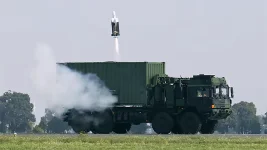
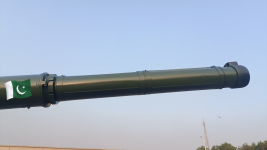
While the video is fake news, it is worthwhile for Pakistan to consider modifying their existing VT4 contract and upgrade them to VT4B standard.
The main reason is that VT4B is maximally designed to handle FPV threat, VT4 itself was designed before the Russo-Ukraine war and we all know how obsolete they are in the modern drone infested battlefield (as obsolete as T-90M, M1A2, Leopard 2A7...etc).
VT4B has AESA radar, APS and RWS. Note that both APS and RWS are designed to engage FPV, RWS deal with drones at a few hundred meters range and APS handles drones that got through the RWS. Such a setup is best equipped to handle saturated drone attack.
We can see the T-90M equipped with APS is already much more survivable in Ukraine, tanking many dozens of FPV attacks before their APS run out of ammo. Integrated RWS will massively improve their odds against sustained drone attack.
Anyhow, protecting the vehicles against drones is only one aspect of the solution, another aspect is to kill the enemy drone team before they kill your tanks, this is a much more complex matter. If people are interested in this matter they should pay attention to the Zhuhai airshow this December, there are a whole range of export ready solutions going to be displayed there.
This is a flawed perspective.
1. Product manufacturing is an immensely large and complex process; it is not something that can be altered or adjusted arbitrarily and with ease.
Following your line of reasoning:
If Pakistan were to suspend its current production contract for the VT-4 tank, who would bear the costs for the components already manufactured, as well as the losses incurred from reconfiguring the production lines?
Suppose Pakistan were to renegotiate a new production contract with China for the VT-4B variant. This would require a complete cycle of customization—design, evaluation, testing, verification, and final certification—followed by a comprehensive overhaul of the production lines. Furthermore, the Chinese manufacturers of the various sub-modules would also need to entirely readjust their production schedules...
By the time all these steps are completed and the first VT-4B tank finally rolls off the assembly line—ready for mass production—it is highly likely that an even newer version, such as the VT-4C or VT-4D, will have already emerged from China... Would you then suggest that Pakistan should suspend the VT-4B contract once again, in favor of switching to the newer VT-4C or VT-4D version???
2. There are two primary approaches to countering unmanned aerial vehicles (UAVs) in modern tank warfare. The first involves designing new tanks that integrate dedicated anti-UAV systems, while the second entails equipping existing tank formations with specialized low-altitude air defense platforms. The former is better suited for smaller armored groups, whereas the latter is more appropriate for large-scale armored formations.
The capabilities of any individual tank platform are inherently limited. Allocating more electrical power and internal space to anti-UAV systems—or other advanced electronic suites—inevitably comes at the expense of the space and capacity available for the tank’s original, core functions.
This is much like the case with fighter aircraft: major air powers tend to favor specialized, mission-specific platforms, while smaller nations often prefer multi-role variants.
—It is important to note the concept of a "platform" here. These represent different paths of choice based on the same platform, rather than a complete switch to a different platform.