Pakistan Constitutional Amendments:

27th Amendment: Chief Justice convenes SC Full Court meeting today

Terence J Sigamony Published November 14, 2025 Updated about an hour ago

Facebook


Twitter


Whatsapp


Comments


Follow us
ISLAMABAD: Chief Justice of Pakistan Yahya Afridi summoned a Full Court meeting today (Friday) over the 27th Amendment, the sources said.

Three judges, including Justice Syed Mansoor Ali Shah, Justice Athar Minallah, and Justice Salahuddin Panhwar, wrote letters to the Chief Justice Yahya Afridi, urging him to convene a Full Court meeting to discuss the 27th Amendment.

The meeting will be held before the Friday prayer, the sources further said, adding that all judges of the Supreme Court in this regard have been informed.


27th Amendment: Chief Justice urged to convene a ‘judicial conference’ for ‘open dialogue’

After the signature by President Asif Ali Zardari, the 27th Amendment has become part of the Constitution. Both Houses of Parliament have earlier passed the 27th Amendment.

Justice Panhwar, in his letter opposing the amendment, cited concerns over the curtailment of the court’s jurisdiction. “There comes a time when silence is not caution but abdication. I believe such a time may now be upon us,” he wrote.

Justice Panhwar noted that the 27thAmendment “appears to touch the very foundations upon which the edifice of our judiciary rests.” “It speaks of changes that may bring the executive and legislature into areas long reserved for judicial independence,” he cautioned.

Emphasizing the sanctity of an independent judiciary, Justice Panhwar stated that judicial independence “is not a matter of privilege; it is the very condition upon which liberty itself depends.” He warned that “If the judiciary is not free from fear, influence, or control, then the rule of law becomes but a phrase—hollow and without breath.” In his six-page letter, Justice Mansoor asked the incumbent CJP that you, as the “Head of the Judiciary”, are the trustee of this institution. Therefore, it is your constitutional and moral duty to ensure that no amendment affecting the judiciary proceeds without the judiciary’s considered, collegial, and recorded response.” “To permit otherwise would be to allow the judiciary to be restructured without its own participation, violating both constitutional propriety and the principle of separation of powers,” he added.

The SC senior puisne judge questioned, “Have the judges of the constitutional courts-the Supreme Court, the Federal Shariat Court, and the High Courts-been invited to deliberate on the proposed amendment and record their institutional response? If not, the process stands stripped of constitutional propriety and democratic legitimacy.”

Justice Mansoor wrote that until the questions [surrounding the 26th Amendment] are conclusively settled, any further attempt to alter the judicial architecture risks camouflaging unresolved constitutional infirmities and casting further doubt on the credibility of both the amendment process and the constitutional order.

Justice Athar Minallah also urged the CJP to convene a judicial conference to have an open institutional dialogue with all judges of the Supreme Court and the High Courts to consider threats to the independence of the judiciary.

In his seven-page letter, he recounted the role of the superior judiciary, particularly the Supreme Court, in the past supporting the dictators, who had trampled the constitutions, thus eroding people’s trust in the institution.

“The Supreme Court, by design or omission, has too often been employed as an instrument to suppress the will of the people, rather than to safeguard it. From the validation of the dissolution of the first expression of the will of the people, the Constituent Assembly, to the repeated endorsement of unconstitutional interventions by unelected power centres,” he wrote.

Former judges and the senior lawyers asked the CJP to call a Full Court meeting to deliberate on the implications of the proposed 27th Amendment and to articulate the judiciary’s collective stance.

Former judges, including ex-CJP Jawad S Khawaja, Justice Mushir Alam, ex-senior puisne judge of the Supreme Court, former Justice Nadeem Akhtar, ex- ex-senior puisne judge of the Sindh High Court, and former Attorney Generals of Pakistan Munir A. Malik, and Anwar Mansoor Khan, along with former Presidents of Supreme Court Bar Association Akram Sheikh, Ali Ahmed Kurd, Amanullah Kanrani and Abid Zuberi, and senior lawyers Khawaja Ahmed Hosain, Salahuddin Ahmed and Shabnam Nawaz Awan. They have expressed grave concern over the 27th Constitutional Amendment.

A group of lawyers – including Asad Rahim Khan and Zeeshaan Hashmi – have also filed a petition in the apex court against the amendment.

Copyright Business Recorder, 2025
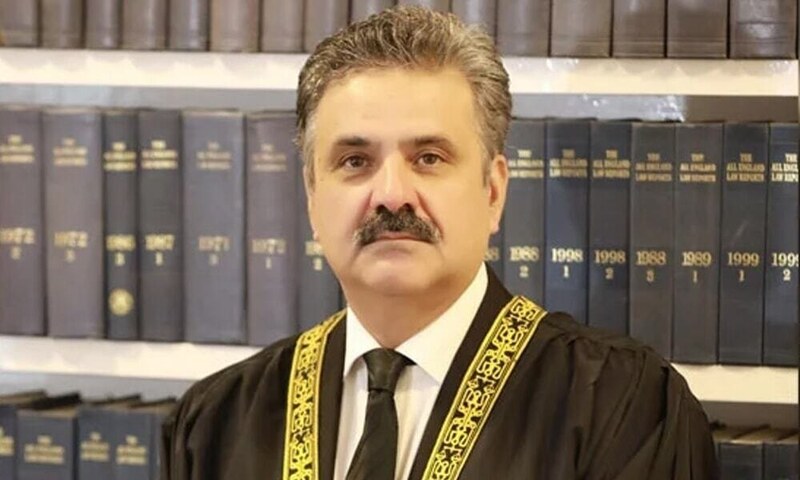
 

Justice Aminuddin takes oath as first chief justice of FCC under 27th Amendment​

President Zardari administers oath to Justice Aminuddin after his appointment under clause (3) of Article 175-A​


By Abdul Qayyum Siddiqui & Arfa Feroz Zake & Awais Yousafzai & Web Desk
November 14, 2025


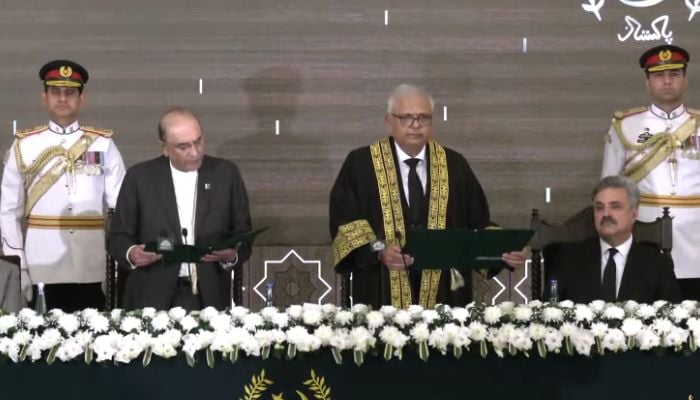
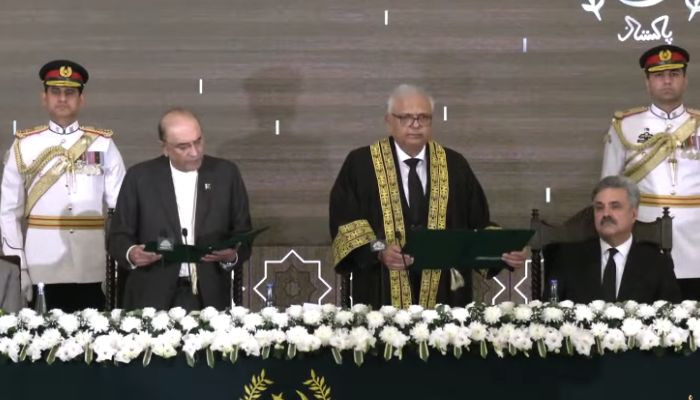
President Asif Ali Zardari administers oath to Justice Aminuddin Khan as first CJ of FCC on November 14, 2025. — Screegrab via Geo News
ISLAMABAD: Justice Aminuddin Khan on Friday was sworn in as the first Chief Justice of the newly formed Federal Constitutional Court (FCC) under the 27th Constitutional Amendment.

President Asif Ali Zardari administered the oath to Justice Aminuddin at the Aiwan-e-Sadar today, a day after he approved his appointment to the key post on the advice of Prime Minister Shehbaz Sharif.

Advertisement

The president made the appointment under clause (3) of Article 175-A, read with Article 175-C of the Constitution. It added that it would come into effect from the date that Justice Aminuddin took his oath.

Justice Aminuddin, whose legal practice started around four decades back, was previously serving as the head of the now-dissolved constitutional bench, which was formed as a result of the 26th Constitutional Amendment last year.


The oath-taking ceremony was attended by Field Marshal Asim Munir, Pakistan Navy and Pakistan Air Force chiefs, Pakistan Peoples Party Chairman Bilawal Bhutto-Zardari and federal ministers including DPM Ishaq Dar, Ahsan Iqbal, Finance Minister Muhammad Aurangzeb and other dignitaries and officials.

Meanwhile, the sources say that arrangements were being made in the open area between the judges' and administration block in the Islamabad High Court (IHC) for the oath-taking ceremony of six judges of the FCC.

Justice Aminuddin will administer the oath to other FCC judges after being sworn in as the chief justice.

The sources further added that Supreme Court's Justice Musarrat Hilali has recused herself from becoming part of the FCC citing health issues. Justice Hilali's name came under consideration for FCC but she expressed unwillingness to go to the newly formed court, the sources said. Her bench was also delisted recently due to ill health.

Also, FCC head Justice Aminuddin will sit in Room No 1 of the IHC, whereas the IHC CJ Sardar Muhammad Sarfraz Dogar will be shifted to Court Room No 2.

The number of FCC judges is likely to be 13, the sources added.

The new court, which has been established as a result of the 27th Amendment, is set to have equal provincial representation. The president and the prime minister will play key roles in judicial appointments, while powers to hear constitutional cases of the Supreme Court will be transferred to the new court.

A crucial power of the Supreme Court, taking suo motu notices, has also been transferred to the FCC, which has been empowered to take suo motu notice upon petitions.

Chief Justice Yahya Afridi, who was sworn to the coveted post on October 30, 2024, still remains the top judge; however, once his tenure ends after the stipulated three years, the senior-most judge from amongst the SC and FCC judges will become the top judge.

The judicial overhaul, part of the latest amendments, not only paved the way for dissolving the Constitutional Benches but also, through the Supreme Court Practice and Procedure (Amendment) Bill 2025, transferred the authority to constitute case-hearing benches to a three-member committee headed by the Chief Justice.

The committee will comprise the chief justice of the Supreme Court, the most senior judge, and a third judge nominated by the country's top jurist.

In the absence of any member, the chief justice may nominate another judge to serve on the committee. Decisions regarding the formation of benches by the committee will be made by a majority vote.

The retirement age of judges of the Constitutional Court will be 68 years, three years higher than that of the Supreme Court judges, who currently retire at 65.

 
@Forsvaret

Only 5 years? Why not lifetime?

Nothing objectionable about that. Field Marshall Helmuth von Moltke served the German Army as its COAS ( OHL as they called it) till the ripe old age of 90. His magnum opus- the Battle of Sedan- came at 70.

Regards
 
Muneer has usurped power like all other dictators that have ruled Pakistan in the past.

The difference is, doing it step by step and on the backs of politicians, pliant to his demands.

The the most important point is - Has any dictator ever done well for their nation? Anywhere in the world? This includes all the previous dictators of Pakistan. None of them are known for game changing aspects in a positive way.

The best part is when they are at peak of their rule. At that time they create a facade that makes their rule legit and indispensable. Munir is doing exactly that and there are scores of posters trying to justify each of his moves. This constitution amendment shows his true colours, which is to get as much painer as possible and that too for life.

Yaha, Zia, Musharraf all left a legacy that is known for more wrong reasons than otherwise.

From what Munir has done till now, his legacy is unlikely to be remembered for right things.
 
@Vkdindian1

Has any dictator ever done well for their nation? Anywhere in the world?

Deng. The South Korean Jarnail dude. Pinochet.

Regards
 
Deng. The South Korean Jarnail dude. Pinochet.
lee kuan yew
Considering the numbers that have ruled this appears to be an exception.

I would refine it further and specifically point out the failure of military generals in becoming successful dictators.

Probably, due to the baggage they carry from their military past, they get bogged down into military issues rather than pure governance. Or there could be more to it.

None from our immediate neighbourhood has been able to prove to be great rulers.
They seem to get surrounded by coteries of Yes Men, gobble up more and more power, start implementing agendas without vision and calibre and lead their nations into downward path.

Munir is just starting and initial few moves appear to be on a similar track.
 
The STRATCOM Bureau
@OSPSF

Yesterday, the 16th National Assembly of the Islamic Republic of Pakistan passed the Constitution (Twenty-Seventh Amendment) Act, 2025.

As such, the following changes will be made to the Constitution of Pakistan relating to military/defense:-

1. Five-star officers of the Pakistan Armed Forces, currently Field Marshal Asim Munir, will retain the rank of Field Marshal, all privileges thereof, and will remain in uniform, for life.

2. Five-star officers of the Pakistan Armed Forces, currently Field Marshal Asim Munir, cannot be removed from office/appointment except via a full parliamentary impeachment procedure requiring 2/3rds majority from both houses of parliament.

3. Five-star officers of the Pakistan Armed Forces, currently Field Marshal Asim Munir, will be granted Presidential Immunity and shall not be answerable to any court for the exercise of powers and performance of functions of their respective offices or for any act done or purported to be done in the exercise of those powers and performance of those functions. No criminal proceedings whatsoever shall be instituted or continued against them in any court during their term of office and no process for the arrest or imprisonment of them shall issue from any court during their term of office.

4. The Chief of Army Staff of the Pakistan Army will from now on concurrently hold the office and appointment of the Chief of Defense Forces, who will be the senior-most uniformed military officer of Pakistan and also the principal military advisor of the Government of Pakistan, the President and Prime Minister, and the National Command Authority.

5. The office and appointment of the Chairman Joint Chiefs of Staff Committee of the Pakistan Armed Forces, erstwhile the principal military advisor of the Government of Pakistan, will stand abolished, in immediate effect from the 27th of November 2025.

6. A new command shall be created in the Pakistan Armed Forces, the National Strategic Command, which will maintain joint operational command and control over all nuclear weapons held by the Army, Air Force and Navy's strategic forces/commands. The National Strategic Command will function parallel to the Strategic Plans Division, and will function under and in subordination of the National Command Authority (NCA). Thus, a new office and appointment, shall be created namely the Commander of the National Strategic Command of the Pakistan Armed Forces, who shall be appointed by the Prime Minister on the recommendation of the Chief of Defense Forces and Chief of Army Staff of the Pakistan Army, and that the Commander of the National Strategic Command will be from the Pakistan Army.

7. Upon completion of the term of their command, whenever that may be, five-star officers of the Pakistan Armed Forces, currently Field Marshal Asim Munir, shall be given additional responsibilities and duties determined by the Federal Government in the interest of the State.

8. The salaries, allowances and privileges of five-star officers of the Pakistan Armed Forces, currently Field Marshal Asim Munir, shall be determined by the President on the advice of the Prime Minister.

With this, it has been codified in Pakistan's constitution itself that it is indeed a banana republic, and that we should not have any pretence otherwise.
 

Justice Aminuddin Khan sworn in as first chief justice of Federal Constitutional Court


News Desk | Umer Mehtab | Malik Asad
November 14, 2025

1763121640138.png


President Asif Ali Zardari administers oath to Justice Aminuddin Khan. — DawnNewsTV

1763121660044.png


President Asif Ali Zardari administers oath to Justice Aminuddin Khan.

Justice Aminuddin Khan on Friday was sworn in as the first chief justice of the newly established Federal Constitutional Court (FCC) after the 27th Amendment was enacted into law a day earlier.

Chief of Army Staff (COAS) Field Marshal Asim Munir and Chairman Joint Chiefs of Staff Committee (CJCSC) General Sahir Shamshad Mirza were also present for the ceremony held at the Aiwan-i-Sadr in Islamabad. Meanwhile, Supreme Court Chief Justice Yahya Afridi, President Asif Ali Zardari and Prime Minister Shehbaz Sharif sat alongside Justice Aminuddin on the stage.
 
Munir is no Lee Kuan Yew.. Munir is a third rate drop out, lets not kid ourselves on this.
But these interns hired by boots to defend their Hazrat Asim Muneer don’t really care about that. 🤭
 

Users who are viewing this thread

Pakistan Defence Latest

Back
Top