Presidency’s decision to block legislation is evidence of where reform was pushed from, where it gets support.
Arifa Noor Published December 17, 2024
IN the wake of the
26th Amendment, it seems a weakened and tamed judiciary is now an accepted reality as the focus shifts to the
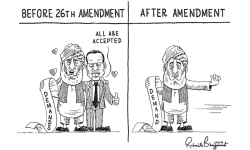
legislation for madressahs, which Maulana Fazlur Rehman had
negotiated in exchange for supporting the government-led amendment. However, since then, the decision by the presidency to block the law has led to renewed debate on seminaries, which had disappeared from the mainstream discourse.
Indeed, in the recent past, there has been little emphasis on madressahs and their role in extremism and providing education, which had been an important part of the debates even before 9/11. In the 1990s, considerable attention was paid, internationally and locally, to the role seminaries may have played in encouraging sectarianism and extremism in the country.
In fact, the Pakistani state’s interest in ‘regulating’ madressahs dates back further. Ayub Khan put together a committee in 1961 to mainstream madressahs and bring them under government supervision; Zulfikar Ali Bhutto made a similar attempt in 1975, and in 1978, Gen Ziaul Haq ordered the religious affairs’ ministry to prepare a report on how to reform and mainstream madressah education. None of these efforts bore much fruit and by the time of Gen Pervez Musharraf’s coup, the concerns had gone global while the government was still stuck in the same policy option — mainstreaming the network.
From the outside, it always appeared that the debate and policy prescription were not based on any solid efforts to diagnose the issues. Did the madressahs contribute to extremist thinking? Did they provide cannon fodder or foot soldiers to terrorist organisations or were they used by terrorist networks? If the answers were available to policymakers, the information stayed there. But it appeared there was only one prescription — bringing them into the ‘mainstream’, for which the first step was registration.
It has always seemed that the madresssah debate and prescriptions were not based on solid efforts.
This is the prescription that made it to NAP, put together after the APS tragedy a decade ago. Finally, in 2019, the madressahs signed an agreement with the education ministry, beginning a registration process, which remained voluntary but brought with it promises of government facilitation, funds and more. Earlier, the madressahs were registered under the Societies Act, with district-level authorities; the perception is that registration at the local level, in many cases, was never carried out.
The objective of the 2019 agreement was that with a centralised system, it would be possible to keep track of the number of madressahs in the country, which would allow for greater scrutiny of their curriculum, student numbers, funding, etc. In addition, the agreement allowed for new boards to be established, breaking the monopoly of the original five, which allowed the dominance enjoyed by the JUI-F.
It is worth asking, however, how more centralisation helps, because there are many other aspects of society where centralisation has not led to better or more efficient outcomes. The state of public sector education is a case in point. However, let’s leave that aside for now.
To return to the 2019 registration system, there is little clarity on what it achieved. There are official claims that around 18,000 madressahs have been registered and that many have shown an interest in availing government assistance for upgrading facilities and teachers. But those who monitor the sector are not so sure that government assistance has been this forthcoming or effective. At the same time, the agreement allowed new players to enter the market, so to speak, by breaking the monopoly of the five boards that dominated the madressah system. This, according to many critics, is one reason for the JUI-F’s discomfort.
However, before that, it is important to point out the agreement was signed during the PTI tenure, at a moment when the political government and the military were on ‘one page’. While the government was already working on reform in the education sector with the Single National Curriculum, it was the ‘added’ effort of the establishment which brought the religious elements to the negotiating table. Why the institution under Gen Bajwa was able to succeed where the other had failed is worth more scrutiny.