Pakistan Constitutional Amendments:

Bill to decide seminaries’ fate shrouded in mystery


Kalbe Ali
December 11, 2024

ISLAMABAD: As the fate of the Societies Registration (Amendment) Act 2024 remains shrouded in mystery, a meeting between JUI-F chief Maulana Fazlur Rehman and NA Speaker Ayaz Sadiq on Tuesday failed to break the deadlock, with the former once again accusing the government of ‘deception’.

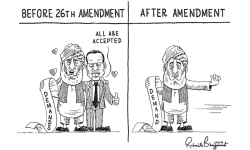
The proposed legislation, commonly known as the madressah registration bill, was sent back by President Asif Ali Zardari with objections, even though it was passed by parliament at the time of the passage of the 26th Amendment.

The bill had some ‘typos’ which was the reason it was returned by the president, but it was sent back to the presidency the next day after the errors were fixed, the JUI-F sources quoted the speaker as saying.

However, the NA officials feigned ignorance when Dawn approached them about the objections and even suggested that it might have been forwarded to the parliamentary affairs ministry by the presidency.

Fazl accuses govt of deception as deadlock persists
 
IMG-20241212-WA0010.jpg
It is surprising that a Seasoned politician was "Duped " so easily!!!
 

Maulana Fazlur Rehman claims madrassa bill approved despite President Zardari's objections​

JUI-F chief criticises objections, arguing that bill would have automatically become law if not opposed within 10 days

News Desk
December 12, 2024

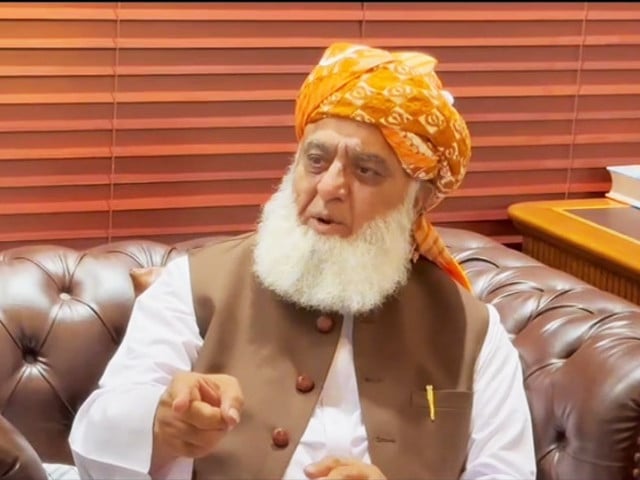
jui f chief maulana fazlur rehman appearing for an interview with a private digital media platform on friday screengrab


JUI-F chief Maulana Fazlur Rehman appearing for an interview with a private digital media platform on Friday.

Jamiat Ulema-e-Islam (JUI) chief Maulana Fazlur Rehman has claimed that the Madrassa Registration Bill has been legally approved, despite objections raised by President Asif Ali Zardari after a delay of over a month.

Speaking at a press conference in Dera Ismail Khan on Thursday, Rehman criticised the presidential objections, arguing that the bill would have automatically become law if not opposed within 10 days.

He said that the bill had already gone through all the necessary stages with the participation of state institutions, including drafting by the Ministry of Law and agreements made in meetings with PPP leaders President Zardari and Bilawal Bhutto.

He questioned the basis of objections raised by the president at this stage, especially since the process involved significant input from all parties, including the Pakistan Muslim League-Nawaz (PML-N) and the PPP.

"The draft was prepared by the government before the elections, and we accepted it despite our reservations. Why are you distancing yourselves now?" he said. "Why did you create new organisations for religious seminaries? Were state institutions involved in dividing these organisations?" he asserted.

The JUI-F chief further stated that while the government had created the draft for the bill, certain groups had deliberately created a divide among seminaries. He stressed that there was no issue between his party and religious scholars, nor was there any dispute with religious seminaries themselves.

“The people who incited and encouraged you to protest are responsible for this situation,” he said.

He also criticised the lack of implementation of provisions made in the agreement with the government, particularly the failure to open bank accounts for seminaries or grant visas for foreign students. "The government has violated the terms of the agreement," he added.

He claimed that the president’s objections were legally irrelevant after the 10-day period, citing the precedent set during the tenure of former President Arif Alvi, who had allowed a bill to pass once the deadline passed without objections.

"The president has delayed his objections for more than a month, and now the bill should be considered law," he said.

If the matter is not resolved, Rehman announced that his party would take legal action and approach the courts. He also confirmed that JUI would convene a meeting of religious seminaries on December 17 to discuss their next course of action.

Fazl concluded by warning against any attempt to place religious seminaries under direct government control, as he claimed previous government actions had led to a decline in religious education. "We do not want seminaries to be governed by any Directorate," he concluded.
 

President’s objections to seminaries’ bill legal, constitutional: Tarar

Minister for Information says the bill has nothing to do with FATF

BR Web Desk
December 14, 2024

Minister for Information, Broadcasting, National Heritage and Culture Attaullah Tarar said Saturday the objections raised by President Asif Ali Zardari on the seminaries’ registration bill are completely “constitutional and legal”.

“In these objections, there is no mention of Financial Action Task Force (FATF), nor they have any connection with it,” said the minister in a post on X, formerly Twitter.

He said it is not in the interest of anyone to politicize the constitutional and legal matters. “Linking the registration of seminaries with FATF is nothing but a creation of complete imagination and speculation”, he said.

The Constitution elaborated the complete procedure for legislation, he said, adding the President objected in accordance with the Constitution and the Parliament would also rectify it in the same spirit.

The purpose of these speculations is to target the powers of the President and Parliament, he said, while urging the people not to criticize the issue just for the sake of criticism.

President Asif Ali Zardari earlier raised objections on the Societies Registration (Amendment) Bill, 2024 (Madrassah’s registration) that laws already exist and there is no need for a new legislation and it would affect Pakistan’s ratings from organisations such as the Financial Action Task Force (FATF).

Referring to the existing laws related to madrassah registration, according to the sources, the president pointed out that the new legislation is unnecessary as two laws, Pakistan Madrasa Education Board Ordinance, 2001, and the Islamabad Capital Territory Trust Act, 2020, are already in place.

The president also warned that registering madrasahs under this law could foster sectarianism and disrupt peace and order due to the construction of multiple madrasahs within a single society.
 
Jamiat Ulema-e-Islam-Fazl (JUI-F) chief Maulana Fazlur Rehman has accused the President’s House and the president of creating confusion unnecessarily by raising objection to a bill already approved by the parliament.

Talking to the media in Dera Ismail Khan, Maulana Fazl said that the registration of madrasas is being debated in politics. He said that the draft of bill was finalised during the previous government of Prime Minister Shehbaz Sharif followed by its unanimous approval by both houses of the parliament.
 
ISLAMABAD: President Asif Ali Zardari raised objections on the Societies Registration (Amendment) Bill, 2024 (Madrassah’s registration) that laws already exist and there is no need for a new legislation and it would affect Pakistan’s ratings from organisations such as the Financial Action Task Force (FATF), it is learnt.

Referring to the existing laws related to madrassah registration, according to the sources, the president pointed out that the new legislation is unnecessary as two laws, Pakistan Madrasa Education Board Ordinance, 2001, and the Islamabad Capital Territory Trust Act, 2020, are already in place.

The president also warned that registering madrasahs under this law could foster sectarianism and disrupt peace and order due to the construction of multiple madrasahs within a single society.

Additionally, such a registration system could lead to conflicts of interest and attract global criticism, potentially affecting Pakistan’s ratings from organisations such as the FATF.

The president also remarked that international organisations such as the FATF might change their opinion if the bill becomes a law.

The president also noted that the Societies Registration Act of 1860 applies within Islamabad’s jurisdiction, but the bill does not include any clause regarding its applicability only in Islamabad. He expressed concerns that registering madrasahs as societies could lead to their use for purposes other than education.

The president pointed out contradictions in the definition of “madrasah” in various sections of the bill.

He also highlighted that the term “madrasah” is not mentioned in the preamble of the Societies Registration Act of 1860, which would create a contradiction with the new bill’s inclusion of madrasah education.

The sources said that President Zardari maintained that after the passage of 18th Constitutional Amendment, the Education Ministry has been dissolved to the provinces and the registration of religious seminaries is the domain of provincial governments and not of the federal government.

According to the sources, madrasahs are under the Ministry of Education of the provinces, their registration is a provincial matter, and Islamabad also already has two laws for registration of madrasahs. Therefore, the bill could not be signed as per law and the Constitution.

Copyright Business Recorder, 2024
 

Joint parliament session next week to resolve row on seminaries registration


The Newspaper's
December 15, 2024

ISLAMABAD: As the controversy regarding the madrassah registration bill refuses to die down, a joint session of parliament will be convened in the upcoming week to possibly take up the Societies Registration (Amendment) Bill 2024, which, after its passage by both houses of parliament, was returned by the president with ‘objections’.

Sources in the National Assembly Secretariat told Dawn that the summary had been prepared to call the joint session on Dec 17, and the date had been finalised after consultations with the JUI-F leadership, currently unhappy with how the abovementioned piece of legislation was being handled.

A day earlier, President Asif Ali Zardari cautioned parliamentarians to consider international obligations before altering the existing procedures for registering seminaries. This objection was met with severe criticism by JUI-F leader Hafiz Hamdullah, who took exception to the objections made by the president.

Mr Hamdullah, in a post on social media, challenged President Zardari’s competence and even stated that parliament was actually ‘operated’ by the Financial Action Task Force — a global anti-terror watchdog.

Information Minister Attaullah Tarar responded that the objections raised by the president on the seminaries bill were legal and constitutional. Though banned in the country by the government, the information minister took to ‘X’ to answer Hafiz Hamdullah’s post, saying there was no mention of FATF in the objections. “Linking the registration of madressahs to FATF is tantamount to idle imagination and speculation,” Mr Tarar wrote, adding that playing politics on legal and constitutional matters was not in anyone’s interest.

The procedure for making laws was clear in the Constitution and the president had raised constitutional objections, the minister said, adding that parliament was the only forum which could address these objections. “Unnecessary rhetoric and criticism for the sake of criticism on this issue should be avoided,” Mr Tarar asked Hafiz Hamdullah.

However, the JUI-F upped the ante against the president, alleging that he had insulted the Constitution, democracy, parliament, and the nation by not signing the seminaries bill under ‘external pressures’.

JUI-F spokesman Aslam Ghauri said the president had admitted that the country’s freedom had been mortgaged to foreign powers ‘for a few dollars’.

Mr Ghauri said if President Zardari cannot bear the pressure, then he should step down with dignity.
 
The JUI-F has said that the history of PPP’s sacrifices for democracy were being distorted, and threatened that if their just rights were not granted through constitutional and democratic means, the party would take other routes and launch protests to protect its rights.
 

Always seemed madresssah debate, policy prescriptions not based on solid efforts

Presidency’s decision to block legislation is evidence of where reform was pushed from, where it gets support.

Maulana on board

Arifa Noor Published December 17, 2024

IN the wake of the 26th Amendment, it seems a weakened and tamed judiciary is now an accepted reality as the focus shifts to the legislation for madressahs, which Maulana Fazlur Rehman had negotiated in exchange for supporting the government-led amendment. However, since then, the decision by the presidency to block the law has led to renewed debate on seminaries, which had disappeared from the mainstream discourse.

Indeed, in the recent past, there has been little emphasis on madressahs and their role in extremism and providing education, which had been an important part of the debates even before 9/11. In the 1990s, considerable attention was paid, internationally and locally, to the role seminaries may have played in encouraging sectarianism and extremism in the country.

In fact, the Pakistani state’s interest in ‘regulating’ madressahs dates back further. Ayub Khan put together a committee in 1961 to mainstream madressahs and bring them under government supervision; Zulfikar Ali Bhutto made a similar attempt in 1975, and in 1978, Gen Ziaul Haq ordered the religious affairs’ ministry to prepare a report on how to reform and mainstream madressah education. None of these efforts bore much fruit and by the time of Gen Pervez Musharraf’s coup, the concerns had gone global while the government was still stuck in the same policy option — mainstreaming the network.

From the outside, it always appeared that the debate and policy prescription were not based on any solid efforts to diagnose the issues. Did the madressahs contribute to extremist thinking? Did they provide cannon fodder or foot soldiers to terrorist organisations or were they used by terrorist networks? If the answers were available to policymakers, the information stayed there. But it appeared there was only one prescription — bringing them into the ‘mainstream’, for which the first step was registration.

It has always seemed that the madresssah debate and prescriptions were not based on solid efforts.

This is the prescription that made it to NAP, put together after the APS tragedy a decade ago. Finally, in 2019, the madressahs signed an agreement with the education ministry, beginning a registration process, which remained voluntary but brought with it promises of government facilitation, funds and more. Earlier, the madressahs were registered under the Societies Act, with district-level authorities; the perception is that registration at the local level, in many cases, was never carried out.

The objective of the 2019 agreement was that with a centralised system, it would be possible to keep track of the number of madressahs in the country, which would allow for greater scrutiny of their curriculum, student numbers, funding, etc. In addition, the agreement allowed for new boards to be established, breaking the monopoly of the original five, which allowed the dominance enjoyed by the JUI-F.

It is worth asking, however, how more centralisation helps, because there are many other aspects of society where centralisation has not led to better or more efficient outcomes. The state of public sector education is a case in point. However, let’s leave that aside for now.

To return to the 2019 registration system, there is little clarity on what it achieved. There are official claims that around 18,000 madressahs have been registered and that many have shown an interest in availing government assistance for upgrading facilities and teachers. But those who monitor the sector are not so sure that government assistance has been this forthcoming or effective. At the same time, the agreement allowed new players to enter the market, so to speak, by breaking the monopoly of the five boards that dominated the madressah system. This, according to many critics, is one reason for the JUI-F’s discomfort.

However, before that, it is important to point out the agreement was signed during the PTI tenure, at a moment when the political government and the military were on ‘one page’. While the government was already working on reform in the education sector with the Single National Curriculum, it was the ‘added’ effort of the establishment which brought the religious elements to the negotiating table. Why the institution under Gen Bajwa was able to succeed where the other had failed is worth more scrutiny.
 

Madressah bill issue: Fazl claims PM has ordered law ministry to take ‘immediate practical measures’

Dawn.com
December 20, 2024

Jamiat Ulema-i-Islam-Fazl chief Maulana Fazlur Rehman speaks to the media on Friday. — DawnNewsTV


Jamiat Ulema-i-Islam-Fazl chief Maulana Fazlur Rehman speaks to the media on Friday. — DawnNewsTV
https://whatsapp.com/channel/0029VaMc238IiRov8okfYy3n
Jamiat Ulema-i-Islam-Fazl chief Maulana Fazlur Rehman claimed on Friday that Prime Minister Shehbaz Sharif has ordered the law ministry to take immediate practical measures as per the law and the Constitution regarding the Societies Registration (Amendment) Act 2024.

Controversy persists in the country related to the new law passed by parliament which relates to the regulatory affairs of madressahs. President Asif Ali Zardari has yet to grant it presidential assent, prompting the JUI-F to criticise ruling coalition parties for using ‘delaying tactics’ regarding the bill.

The bill pertains to the registration of seminaries by the relevant deputy commissioner’s office, as it was before 2019.

The government and the JUI-F both seemed to favour talks in Tuesday’s National Assembly to sort out the controversy surrounding the proposed legislation.

Fazl held a meeting with Prime Minister Shehbaz Sharif in Islamabad today with other senior PML-N and PPP officials present as well.
 
President Zardari had returned the bill to the National Assembly with certain objections on October 29, before flying to the United Arab Emirates. The bill was approved by the Senate on Oct 20, along with the 26th amendment. It passed through the National Assembly on Oct 21 and was forwarded to the president on Oct 22.

When the JUI-F chief learnt of the development, he threatened to launch protests against the government to force it to accept the bill.

The bill in question was part of an agreement between JUI-F and the government in support of the 26th Amendment. The Societies Registration (Amendment) Act, 2024 extends the Societies Registration Act, 1860, and includes provisions for the registration of madressahs under the relevant deputy commissioner office.

The bill specifies that a madressah with more than one campus needs only one registration, and every madressah must submit an annual report of its educational activities to the registrar. Additionally, each madressah must have its accounts audited by an auditor and submit the audit report to the registrar. The bill also states that no madressah should teach or publish literature that promotes militancy, sectarianism, or religious hatred.
 
In October 2019, the PTI-led government transferred the registration of seminaries to the education departments.

After more than five years of deliberations involving the government, interior ministry, security agencies, provinces and NGOs, the federal government accepted the demand of religious groups that seminaries be regulated under the education departments, viewing them as educational institutes.

Authorities had initially proposed that seminaries fall under the regulation of the Interior Ministry and provincial home departments. The decision by the PTI-led government in 2019 was welcomed by the joint body of religious seminaries, representing all four mainstream Islamic sects in the country.

However, due to political differences with the PTI government, seminaries affiliated with the JUI-F rejected the idea of placing madressahs under the education department and opposed incorporating conventional education into religious seminaries.
 
Under the Societies Act of 1860, religious seminaries were supposed to be registered by the relevant deputy commissioner’s (DC) office. Traditionally, there were five seminary boards — four belonging to the respective mainstream sects: Barelvi, Shia, Deobandi, and Ahle Hadith schools of thought, while the fifth board administered the affairs of seminaries under the control of the Jamaat-i-Islami.

However, after three years of consultations following the 2014 Army Public School Peshawar attack, these five boards agreed with the government that seminaries should be placed under the administrative control of the Federal Education Department.

Subsequently, the Directorate General of Religious Education was established and the government also decided to make rules allowing the establishment of more madressah boards. Since 2019, ten new boards have been established, which seemingly pose a challenge to the monopoly enjoyed by the five traditional seminary boards.
 
Editorials Print 2024-12-19

The madressah bill controversy


Apparently, the ruling alliance did not realise the implications of what it bargained for when it sought and received the badly needed support of the JUI-F for the passage of the highly controversial 26th Amendment in rerun for sponsoring madressah’s registration bill, free from education authorities’ oversight.

Although the government by-passed the procedural requirement of sending it to the relevant parliamentary committees, and got the Societies Registration (Amendment) Bill, 2024, steamrolled through the Senate on October 20 and the National Assembly the next day, the President refused to sign it twice.

The government now finds itself in a quandary, wanting to backtrack on its obligation and yet appease the JUI-F chief, Maulana Fazlur Rehman.

PPP Chairman Bilawal Bhutto-Zardari called on him and reportedly promised to have the bill approved in its existing form, but to no avail. Meanwhile, the government said it would get it done in a joint session of parliament but seems to have changed its mind while its information minister talked of legal complications as a hindrance.

The Maulana is in no mood to let any of this pass. At first, he gave the government until December 8 to get the bill approved; otherwise, he would launch a massive agitation. He held back for a while after the pro-government madressah boards came out to express their reservations over the bill, but stayed stuck to his guns.

He has since reached out to the esteemed Sunni religious scholar, Mufti Taqi Usmani. That helped him rallying the support of Ittehad Tanzeemat-i-Madaris (TTM) — a federation of madressahs and their main regulatory body.

At its meeting in Islamabad this past Monday, the TTM iterated the Maulana’s stance. As things stand, in the first instance the President had objected to the proposed legislation saying that it was unnecessary as two laws, Pakistan Madressah Education Board Ordinance, 2001, and the Islamabad Capital Territory Trust Act, 2020, were already in the field; the second time the bill landed before him, he raised more objections.
 

Users who are viewing this thread

Pakistan Defence Latest

Back
Top