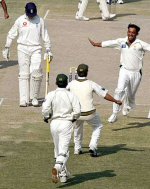
The Lahore Storm: Shoaib Akhtar Triggers a Collapse, England Lose
England’s bid for a draw in this Lahore Test was akin to a perilous tightrope walk above a fiery abyss. For hours, Ian Bell and Paul Collingwood held firm, absorbing pressure with the grim determination of men scaling a sheer cliff. The sanctuary of safety was within sight. Then, suddenly—disaster. A momentary slip, a violent plunge, and England collapsed spectacularly. There was no stunned silence among the spectators, no sympathetic groans. Instead, the crowd erupted in rapturous delight, hammering their plastic seats in celebration of Pakistan’s triumph.
What followed was one of the most staggering implosions in recent Test history. England, having meticulously built their defensive wall for more than four hours, crumbled in a mere 70 minutes, losing eight wickets for just 43 runs after lunch on the final day. Their 2005 had been hailed as a golden year, yet it ended in ignominy. The architects of their undoing? The mercurial Shoaib Akhtar and the wily Danish Kaneria, a duo who, for a brief but decisive period, transcended brilliance.
The Fragility of England’s Position
This match was where permanence at the crease was easy and elusive. The slow surface and rapid outfield suggested that once settled, a batsman could endure—but true security remained tantalizingly out of reach. England’s demise did not stem from sheer ineptitude but from an underlying fragility, exacerbated by a self-inflicted wound at the very outset. The decision to bat first had offered an opportunity to seize control, yet their initial innings of 288 was a squandered advantage, a foundation too weak to support their aspirations.
For a fleeting moment, the illusion of a competitive total persisted. But as Mohammad Yousuf and Kamran Akmal took command on the third afternoon, it became clear that England’s primary objective—a series-leveling victory—was a fantasy. As the game progressed, even the consolation of a draw slipped beyond reach, and by the time the collapse arrived, there was no disputing Pakistan’s deserved 2-0 series win.
A Shuffled Deck and Tactical Decisions
The teams had been reshuffled due to a curious mix of circumstances. Pakistan were without the banned Shahid Afridi and the bereaved Younis Khan, replaced by Asim Kamal and Hasan Raza. England, too, were forced into changes: Andrew Strauss had returned home for the birth of his child, while Ashley Giles’ hip injury ruled him out. Paul Collingwood was recalled, and 20-year-old Liam Plunkett, an untested prospect from Durham, was preferred over the perennially overlooked James Anderson. With Steve Harmison also in the side, Durham now boasted more representatives in the England XI than any other county—a testament to their rise from minor county status just 14 years earlier.
The opening session had been fraught with peril for England’s top order. On a lively pitch, Michael Vaughan and Marcus Trescothick navigated an arduous examination, emerging relatively unscathed to forge a century stand. But with the surface easing, England, rather than consolidate, turned reckless benefactors. The downfall was set in motion by Shoaib Malik, whose unremarkable off-spin was made lethal by English generosity. A succession of ill-judged sweeps proved their undoing—each stroke more poorly executed than the last. The dismissals of Kevin Pietersen and Andrew Flintoff, meanwhile, were courtesy of a stunning catch by Akmal and an errant hook, respectively. By stumps, England were already sinking.
Collingwood alone resisted, eschewing the sweep in favour of a more conventional approach. A maiden Test century loomed, but, in a rush of misplaced grandeur, he perished attempting the spectacular. His departure not only deepened England’s predicament but likely jeopardized his own fragile place in the side.
The Tenacity of Yousuf and Akmal
England’s bowling effort was spirited but ultimately futile. Matthew Hoggard struck early, reducing Pakistan to 12 for two, and on the second evening, the match still hung in the balance. The equation changed decisively the next day, when Yousuf, patient and unerring, methodically dismantled England’s resolve. The former Yousuf Youhana had transformed—not just in faith, but in temperament. His 223, spanning over ten hours, was a masterclass in endurance, punctuated by 26 boundaries and two towering sixes. With Akmal providing unyielding support, they compiled a sixth-wicket stand of 269, a record for Pakistan.
England’s bowlers were not culpable of gross incompetence, but they found themselves bereft of fortune. Harmison, fierce and relentless, toiled unrewarded. Plunkett, despite a nervy initiation—tumbling embarrassingly after his tenth delivery—settled into an impressive rhythm, claiming Salman Butt with his next. Flintoff, however, seemed burdened by exhaustion, his usual fire dimmed.
Yousuf’s eventual dismissal brought Inzamam-ul-Haq to the crease, and the Pakistan captain wasted little time asserting himself. Five half-centuries in as many innings underlined his dominance. He was cruising towards a third successive century when an ill-fated run-out left him incensed, his anger directed at the unfortunate Naved-ul-Hasan. Declaring immediately, Inzamam left England a mountain to climb—348 runs adrift, with five and a half sessions to endure.
The Collapse: From Resistance to Ruin
Their resistance was short-lived. Trescothick’s second-ball dismissal set an ominous tone. Vaughan followed soon after. Yet Bell and Collingwood, defiant and diligent, slowly extinguished Pakistan’s momentum. At lunch on the final day, the prospect of a draw appeared increasingly probable. In the dressing room, however, Bob Woolmer was at work, moving through the ranks, whispering quiet urgings.
The effect was immediate. Kaneria switched angles and, within four balls, removed Collingwood. Pietersen succumbed in his next over, and Flintoff, deceived by a googly, followed without scoring. Shoaib Akhtar then delivered the coup de grâce, alternating between searing pace and masterful deception. His slower ball, which had already undone Vaughan a day earlier, accounted for Bell on 92. England crumbled into disarray, and then submission.
The Unforgiving Nature of Subcontinental Cricket
This, by all accounts, should have been a straightforward draw. Lahore’s late starts and early twilights conspired to reduce playtime, with bad light routinely curtailing proceedings. In theory, survival was achievable. In practice, England never quite grasped it. As Pakistan celebrated, there was no disputing the justice of the result. A series England had entered with grand ambitions ended in unceremonious defeat, leaving them to reflect on the harsh realities of Test cricket in the subcontinent.
England’s shortcomings were not merely technical but psychological. Their inability to adjust to the rhythm of subcontinental cricket—a game of patience, attrition, and guile—proved their undoing. As the dust settled on Lahore, Pakistan could revel in a victory forged by discipline and brilliance, while England departed with a humbling lesson: on these pitches, resilience is not an option; it is a necessity.












 Federal cabinet gives nod to imposition of emergency in KP; summary sent to president (66 Viewers)
 Iran - Israel/US War: Israel-US declare war on Iran, Iran responds (1,251 Viewers)

 Saudi Cabinet reaffirms full support for Yemen amid Houthi escalation (2 Viewers)
 Makkah Defence Alliance: Turkey, Saudi Arabia, and Pakistan, news & updates (162 Viewers)