Edgbaston 1971 : A Triumph Denied, A Legacy Forged
The summer of 1971 brought with it more than just cricket to English shores—it carried echoes of change, signs of resurgence, and a tale of near-triumph that would become part of Pakistan's cricketing folklore. When Pakistan met England at Edgbaston for the first Test of their series, it was not just a contest between bat and ball, but a clash of contrasting fortunes and evolving cricketing identities.
England, freshly returned from a successful Ashes tour in Australia, entered the match with the aura of recent conquest. Their squad bore the hardened polish of experience, with only Dennis Amiss as the unfamiliar figure in a lineup seasoned by Australian battlefields. Yet, despite their composure and pedigree, England were to be humbled—technically, tactically, and emotionally—by a Pakistani side that played with poise, panache, and purpose.
A Monumental Statement with the Bat
Winning the toss under overcast skies, Pakistan chose to bat first—an audacious decision in English conditions. But what followed was not a cautious accumulation; it was a bold assertion of batting brilliance.
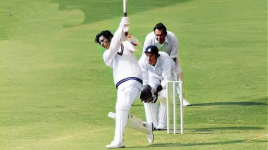
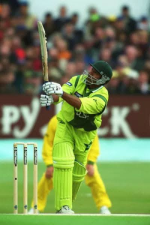
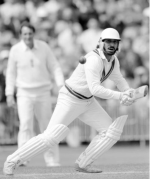
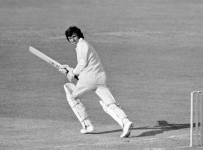
The innings began with a scare. Aftab Gul, struck on the head by a bouncer from Alan Ward in just the third delivery, was forced to retire hurt. But what could have been a psychological blow turned into an unexpected boon, as Zaheer Abbas walked in. What unfolded over the next nine hours was an innings of the highest pedigree. Zaheer was elegance incarnate, each stroke a testament to timing and temperament. His cover drives glided like whispers through the off-side, while on the leg-side, he played with almost mathematical precision.
Abbas’s 274 was more than just a score—it was a magnum opus, a coming-of-age story written in boundaries and milestones. Thirty-eight times he caressed the ball to the fence. His stand of 291 with Mushtaq Mohammed, who contributed a patient 100, became a monument to partnership building, balancing flair with concentration. When Zaheer fell—attempting a rare sweep shot after reaching 261 and, in doing so, becoming the first batsman to cross 1,000 runs in that English season—he was on the verge not only of D.C.S. Compton’s record but of a place among the immortals.
The tail did not merely wag; it roared.
Asif Iqbal’s unbeaten 104, marked by improvisation and aggression, further demonstrated Pakistan’s batting depth. Captain Intikhab Alam delayed the declaration just enough for Iqbal to reach his milestone on the third morning, setting a towering total of 608 for 7 declared—the highest total Pakistan had ever posted on English soil.
The Collapse and the Comeback
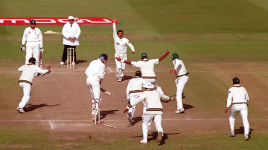
England’s reply began in disarray. Asif Masood, lean and eccentric with a deceptive shuffle-run-up, made an immediate impact. With a fiery spell of 8.1 overs, he accounted for Edrich, Cowdrey, and Amiss, sending shockwaves through the English dressing room. His mastery of late movement and that vicious break-back proved too much for even the most seasoned campaigners.
Only Alan Knott, known for his grit, resisted with a defiant 116—an innings full of counterattacking urgency and fearless strokeplay. Basil D’Oliveira, with a flourish of 73, provided brief support, his innings punctuated with twenty-one boundaries and a characteristic dose of flamboyance. But despite their resistance, England folded for 353, trailing by 255 runs—a deficit large enough to force the follow-on, a rare occurrence for the home side, and the first time ever against Pakistan.
Rain, Resistance, and Regret
The second innings saw signs of fight. Brian Luckhurst, a stoic left-hander with a textbook technique, stood tall amid the storm. Asif Masood, now physically weakened by stomach trouble but mentally relentless, struck again—removing Edrich and then returning from the dressing room to claim Cowdrey with his very first ball. Amiss fell to a well-directed bouncer, and England’s second innings hung by a thread at 184 for 3 by stumps on Day 4.
The stage was set for Pakistan’s final assault. The new ball was only nine overs away, and the English lineup brittle and exposed. Victory seemed not just likely—it felt imminent.
But the morning of the fifth day dawned under sullen skies. Rain, persistent and merciless, denied Pakistan the battlefield they had so thoroughly prepared. Play finally began in the evening, but after just 14.5 overs, bad light intervened. England, still 26 runs behind with five wickets remaining, were spared—not by grit or glory, but by nature’s indifference.
Beyond the Scorecard: A Test of Character
Numbers tell part of the story—Zaheer’s 274, Masood’s 9 for 160, Pakistan’s 608—but what remains with the connoisseur is the tone of the match: the elegance of Pakistani batsmanship, the venom of their bowling, and the poignancy of a victory that was never consummated.
For England, it was a sobering reminder of their vulnerabilities. For Pakistan, it was a loud proclamation of their arrival on the world stage as equals—no longer the underdogs or exotic tourists, but masters of skill and temperament.
It was also the quiet debut of a teenager—Imran Khan—who would go on to reshape the destiny of Pakistani cricket in the decades to come. Though he played only a minor role in this Test, his presence symbolized the generational continuity of ambition and talent.
Epilogue: A Forgotten Victory
Though officially recorded as a draw, Edgbaston 1971 was, in every essential way, a Pakistani triumph. It was a match of moral ascendancy, of narrative richness, and of missed history. Cricket, after all, is not merely a sport of stats and schedules—it is a game of moments, of character revealed under pressure, and of the quiet poetry written in sweat and silence.
Rain may have erased the result, but it could not wash away what Pakistan achieved. That summer, at Edgbaston, they turned possibility into poetry—and nearly, into victory.