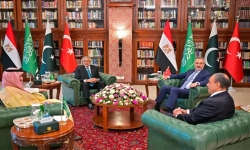
Pakistan Defence/Securities Agreement and Cooperation - Middle East.

Pak-Saudi-Turkiye defence pact ‘entirely for defensive purposes’, not aggression: PM Shehbaz

News Desk
August 10, 2026

1786370570865.png

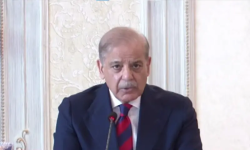
Prime Minister Shehbaz Sharif addresses the federal cabinet on Aug 10, 2026. — screengrab via DawnNewsTV

Prime Minister Shehbaz Sharif on Monday affirmed that the recently signed Makkah Joint Defence Agreement was “entirely for defensive purposes”, and not for any aggression.

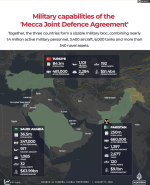
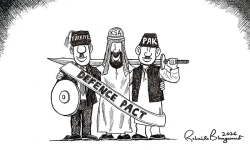
The joint defence agreement, signed on August 7 between Pakistan, Saudi Arabia and Turkiye, aims to strengthen collective deterrence and empowers its signatory states to treat an attack against one of them as an attack against all of them.

Addressing the federal cabinet on Monday, PM Shehbaz recalled that he, Saudi Crown Prince Mohammed bin Salman and Turkish President Recep Tayyip Erdogan signed the pact in Makkah on Friday.

The prime minister stressed that the objective of the pact is to “promote peace, progress, and prosperity in the region”.
“Its purpose is definitely not that any aggression occurs. It is entirely for defensive purposes, for peace, tranquillity and progress in the region,” he affirmed.

“I believe this agreement is a source of strength not just among these three countries, but for the entire Muslim ummah,” he noted.

PM Shehbaz particularly felicitated Deputy PM and Foreign Minister Ishaq Dar as well as Chief of Defence Forces (CDF) Field Marshal Asim Munir on the signing of the agreement.

Efforts for the joint defence pact had been underway for “many years and materialised this Friday”, the prime minister said.

He noted that while Pakistan and Saudi Arabia had already entered the “Strategic Mutual Defence Agreement” in September 2025, Islamabad and Ankara also had “arrangements for decades” between them.
 
To view this content we will need your consent to set third party cookies.
For more detailed information, see our cookies page.
 
Iran’s Foreign Minister Abbas Araghchi and Parliament Speaker Mohammad Bagher Ghalibaf were invited by Pakistan to visit Islamabad for talks, Foreign Ministry spokesman Esmaeil Baghaei said.

He said the "Makkah Joint Defence Agreement" reflected a shift in regional countries' approach to security, with a shift away from reliance on US power.

"Any plan that is based on the geopolitical and historical realities of the region, is comprehensive and inclusive, and correctly identifies the enemy and the threat, has a chance of helping to strengthen security and prevent instability and abuses by the Zionist enemy and its allies," he added, referring to Israel.

He added that Iran would not hold talks with the US as long as Washington continued to "violate the interim deal", according to Al Jazeera.
 
To view this content we will need your consent to set third party cookies.
For more detailed information, see our cookies page.
 
Chinese Foreign Minister "Wang Yi": China supports the "Mecca Agreement" between Saudi Arabia, Turkey, and Pakistan, and calls for the establishment of a security charter between China and the Islamic countries.


To view this content we will need your consent to set third party cookies.
For more detailed information, see our cookies page.
 
Regarding the Mecca Agreement:

There is no reason for us to be concerned that this agreement is directed against Iran in relation to Turkey, Pakistan, and Saudi Arabia. For we share deep religious, historical, and civilizational ties with these three countries.

The friendship between the peoples of Turkey and Pakistan, as two Muslim and neighboring countries of Iran, is rooted in a longstanding history. The intertwined cultural ties between the peoples of Iran, Pakistan, and Turkey are exceedingly clear.

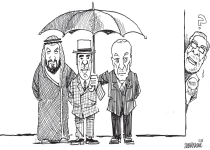
This development is an important indicator that the countries of the region have concluded they cannot rely on or endure the security provision claims of the United States and certain actors outside the region. These countries are turning to try another approach, based on their own capabilities and perspectives, independent of external interventions, the influence of outside parties, and their destructive interferences.

To view this content we will need your consent to set third party cookies.
For more detailed information, see our cookies page.
 

Tehran says Iran, Türkiye, Pakistan among major Muslim states responsible for advancing unity​


Top Iranian security official says Tehran and Islamabad have long regarded each other as strategic depth

Anadolu Agency
August 12, 2026

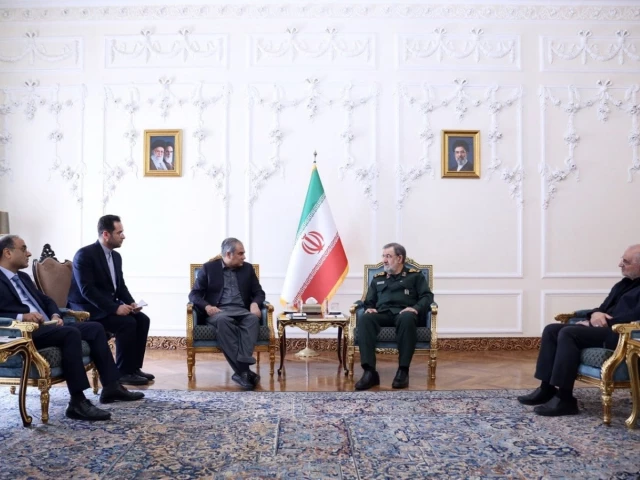
mohsen rezaei secretary of iran s supreme national security council meets interior minister mohsin naqvi press tv


Mohsen Rezaei, secretary of Iran's Supreme National Security Council, meets Interior Minister Mohsin Naqvi. — PRESS TV

Iran’s Supreme National Security Council Secretary Mohsen Rezaei said on Wednesday that Iran, Türkiye, Pakistan, Saudi Arabia, Egypt and Indonesia had a responsibility, as major Muslim countries, to advance unity across the Islamic world.

During a meeting in Tehran with Interior Minister Mohsin Naqvi, Rezaei described Pakistan’s government, armed forces and people as among the Islamic world’s greatest assets.

He also welcomed what he described as the growing role of Prime Minister Shehbaz Sharif and Chief of Defence Forces and Chief of the Army Staff Field Marshal Asim Munir in regional developments, according to Mehr News Agency.
 
Earlier this week on Monday, Iran Foreign Ministry spokesman Esmaeil Baghaei, at a weekly news conference, portrayed the Makkah Joint Defence Agreement signed by Pakistan, Turkiye and Saudi Arabia on August 7 "less as an anti-Iranian move" than as evidence of a broader reassessment by regional countries of their security relationships with Washington.

The minister said, "Countries have reached the conclusion that they cannot rely on America's claim of providing security," adding that Tehran interpreted the new arrangement within the wider transformation of the regional security order rather than treating it as a hostile military alignment.

On August 7, Pakistan, Saudi Arabia and Türkiye signed the Makkah Joint Defence Agreement, reaffirming their commitment to collective security, defence cooperation and regional stability, according to the Ministry of Foreign Affairs.

The ministry outlined that the agreement established a framework for collective deterrence against acts of aggression and stipulated that an attack against any one of the three signatory states will be regarded as an attack against all three.
 

Users who are viewing this thread

Back
Top