Pakistan Exports / Imports - Updates

Exports increase by 11.83% to $2.3 bln in July 2024​

By Staff Reporter | The APP
Aug 3, 2024

Exports from the country witnessed an increase of 11.83 percent during the first month of fiscal year 2024-25 as compared to the corresponding month of last year, the Pakistan Bureau of Statistics (PBS) reported Friday.

The exports during July 2024 were recorded at $2.308 billion against the exports of $2.064 billion in July 2023, according to latest PBS data.

On the other hand, imports into the country also increased by 15.30 percent to $4.256 billion during the month under review as against the imports of $3.691billion last July.

Based on the figures, the trade deficit during the month under review was recorded at $1.948 billion against the deficit of $1.627 billion last year, showing an increase of 19.71 percent.

Meanwhile, on a month-on-month basis, the exports from the country decreased by 9.77 percent when compared to the exports of $2.558 billion during June 2024.

The imports also witnessed decrease of 14.27 percent when compared to the imports of $4.964 billion in June 2024, PBS reported.

On the other hand, the export of services during the fiscal year 2023-24 increased by2.7 percent by going up to $7.806 billion form $7.595 billion last year.
The services imports also increased from $8.638 billion last year to $10.119 billion this year, showing growth of 17.14 percent.

Based on the figures, the services trade deficit was recorded at $2.313 billion in July-June (2023-24) against the deficit of $1.043 billion in July-June (2022-23), showing an increase of 121.76 percent.
 

Rice exports grow 98.5pc in 2 months​

The APP
Sep 29, 2024

Rice exports from the country during the first two months of the current financial year increased by 98.58 per cent as compared to the exports of the corresponding period of the last year. During the period from July-August, 2024, over 340,703 metric tons of rice valued at $464.667 million was exported as compared to the exports of 340,703 metric tons worth $233.992 million in the same period of last year.

The exports of basmati rice grew by 103.63 per cent as 187,016 metric tons of basmati rice worth $192.610 million was exported as against the exports of 79,180 metric tons valued at $94.590 million in the same period of the last year. During the period under review, the country earned $272.057 million by exporting about 430,045 metric tons of rice of other verities, which was recorded at $135.402 million in the first two months of the last year.

Meanwhile, the food group imports into the country experienced a significant decline of 18.15% during the first two months of the current financial year as compared to the imports of the corresponding period of the last year.

From July to August 2024, Pakistan imported various food commodities valued at $1.066 billion, down from $1.303 billion during the same of last year, whereas the food group exports from the country during the period under review grew by 42.39 per cent as compared to the exports of the corresponding period of the last year.

During the period from July-August, 2024, food commodities valued at $1.011 billion were exported as against the export of $710.651 million in the same period of the last year, according to the data of the Pakistan Bureau of Statistics.
 

Pakistan, Russia ink barter deal to boost agri trade

Reuters
October 2, 2024

MOSCOW: Two agriculture companies from Russia and Pakistan have signed barter deals to trade chickpeas and lentils from Russia in exchange for rice, mandarins and potatoes, Russia’s TASS news agency reported on Tuesday.

Grappling with payment issues due to Western sanctions over Russia’s invasion of Ukraine in February 2022, Moscow is pursuing barter deals that strip away the need for payment exchange, reduce the visibility Western countries have over its trade flows, and limit currency risk.

Russian firm Astarta-Agrotrading agreed to supply 20,000 tonnes of chickpeas in exchange for 20,000 tonnes of rice from Pakistan’s Meskay & Femtee Trading Company, TASS reported.

Under another contract, Astarta agreed to supply 15,000 tonnes of chickpeas and 10,000 tonnes of lentils for 15,000 tonnes of mandarins and 10,000 tonnes of potatoes.

The two companies did not immediately respond to requests for comment.

“Russia and Pakistan are experiencing specific difficulties in carrying out mutual payments,” TASS quoted a Pakistani official as saying on the sidelines of a Pakistan-Russia trade forum in Moscow. “Therefore, the two companies decided to launch a barter trade mechanism.”

Payment issues are a particular issue for Russia with China, as bilateral trade soars. Sources told Reuters in August that the first agriculture barter deals between Russia and China would come this autumn. Russia’s economy ministry published a document in February advising Russian companies on how to conduct barter transactions and pointing out pitfalls to avoid.

A source in payment markets told Reuters that barter deals with China were now taking place, but at the level of individual companies.

Published in Dawn, October 2nd, 2024
 

Pakistan mulls lifting ban on livestock export

Kalbe Ali
October 6, 2024

With livestock population steadily increasing, Pakistan has been receiving supply orders, especially for sheep and goats, from different countries.—Dawn/file


With livestock population steadily increasing, Pakistan has been receiving supply orders, especially for sheep and goats, from different countries.—Dawn/file

ISLAMABAD: Pakistan is likely to lift the ban on the commercial export of sheep and goats imposed more than a decade back, mainly responding to the demand from Gulf countries.

The Ministry of National Food Security and Research (MNFSR) has finalised the summary in this regard and sought permission from the federal cabinet to undo the decision taken in 2009.

The Executive Committee of the Special Investment Facilitation Council (SIFC) has considered the matter and agreed to lift the ban on live animal export. According to the summary, several domestic investors have already started small- to medium-scale feedlot fattening farms, which are expected to create a surplus of goats and sheep in the coming years.

“The MNFS&R has also approached various countries for investment in feedlot fattening farms of small and large ruminants, and serious interest has been shown by Saudi Arabia, Kuwait and the UAE,” it added.

SIFC has already given its consent amid high demand from Gulf countries

The summary highlighted that the agriculture sector contributes around 24 per cent to gross domestic product. The livestock sector accounts for 60.84pc of the agricultural value added and 14.5pc GDP during 2023-24.

The summary said that animal husbandry remains an important economic activity for rural dwellers, with over 8 million families engaged in livestock production and deriving around 35-40pc of their income from the sector.

In 2023-24, Pakistan’s diversified inventory of food-producing animals stood at 224.7 million heads, including 57.5m cattle, 46.3m buffaloes, 32.7m sheep, 87.00m goats and 1.2m camels and produced a total quantity of around 70m tonnes of milk and 3.447m tonnes of meat including 2.630m tonnes of beef and 0.917m tonnes of mutton besides 2.363m tonnes of poultry meat.

Previously, the export of live animals was permitted with the approval of the Economic Coordination Committee of the Cabinet (ECC) in 2009. However, smuggling through the porous border, mainly with Afghanistan, led to its local shortage, and the government observed that it was creating domestic price instability.

The summary added that to ensure price stability in the domestic market and considering the demand and supply chain, a ban was imposed on the commercial export of live animals with the approval of ECC in July 2013. The complete ban on commercial export of live animals remained enforced.

The summary also noted that with effective anti-smuggling measures and border fencing, the demand and supply situation has improved, resulting in the stability of the price of mutton.

Published in Dawn, October 6th, 2024
 
Last edited:

Pakistan earns $4bn in rice exports in 2024, sets target of $5bn for next year​

The Nation
Oct 14, 2024

The Special Investment Facilitation Council (SIFC) has played a pivotal role in helping Pakistan achieve a historic milestone, with rice exports generating $4 billion in revenue.

According to SIFC official Shahjehan Malik, the target for rice exports in the next fiscal year has been set at $5 billion. Malik emphasized that a comprehensive strategy will be developed, focusing on modern seed research and the promotion of standardized agricultural practices to boost exports further.

Pakistan’s Basmati rice, renowned for its high quality, has been instrumental in fostering global partnerships. During the 2024 fiscal year, the country exported over 6 million tons of various rice varieties.

In addition to rice, Pakistan's overall goods exports saw a significant boost, increasing by 10.54% to $30.64 billion compared to the previous year. While exports surged, imports slightly declined by 0.84%, dropping from $55.19 billion to $54.73 billion, signaling positive economic growth.

One of the standout achievements was the 20% rise in meat and meat product exports, reaching a record high of $512 million. The SIFC and the Ministry of Commerce were instrumental in opening new markets for meat exports in countries such as Jordan, Uzbekistan, Lebanon, and Egypt.
 

Banks directed to process export of 500,000 metric tons of Sugar​

By Staff Reporter | Profit
Oct 17, 2024

The State Bank of Pakistan (SBP) has directed all banks to process the requests of eligible Authorized Dealers (ADs) to export an additional 500,000 metric tons of Sugar.

On Tuesday, the Economic Coordination Committee (ECC) approved the export of an additional 500,000 metric tons of sugar, following a directive from the Ministry of Industries and Production. The federal cabinet later ratified the ECC’s decision.

“Attention of Authorized Dealers (ADs) is invited towards the enclosed Ministry of Industries and Production’s Office Memorandum (O.M) F. No.1(6)/2022-23-CAO dated October 12, 2024. As per the O.M., the Economic Coordination Committee (ECC) of the Cabinet has allowed the export of a further 500,000 MT of sugar with certain terms and conditions. The ECC’s decision has also been ratified by the Federal Cabinet,” the SBP said in a circular.

According to the SBP directive, authorized dealers will obtain an undertaking from the exporters that the consignment would be shipped within 90 days of the allocation of quota by the respective Cane Commissioner.

ADs will ensure 100% advance receipt of export proceeds through banking channels, in the case of Afghanistan. For other destinations, the export of sugar may be made against a Letter of Credit (LC).
 

Textile exports rise 18pc in September

The Newspaper
October 18, 2024

ISLAMABAD: The exports of textile and clothing recorded an increase of nearly 9.51 per cent in the first quarter of FY25 amid concerns that the industry was experiencing a slump, Pakistan Bureau of Statistics data showed on Thursday.

The exports from the sector had a negative growth of 3.09pc in July, which rebounded 13pc in August and 17.92pc in September.

Many experts believe that the textile sector may struggle to compete with regional rivals due to the implementation of harsh taxation measures in the current fiscal year. However, the disruption in supply from Bangladesh has also increased the demand for Pakistani garments.

Textile and clothing exports have stayed the same in the last two years despite having a $25 billion installed capacity. According to textile exporters, exports from the same sectors have been static for the past two years due to structural issues.

Raw cotton imports jump 21pc in 1QFY25

In absolute terms, the textile and clothing exports surged to $4.52bn in the first quarter (July-September) of FY25 from $4.13bn over the corresponding months last year.

The government has introduced various measures, including increasing the tax rate on exporters’ personal income in 2024-25.

The PBS data showed the exports of readymade garments rose 23.17pc by value in the first quarter and 16.16pc by quantity, while knitwear rose 14.13pc by value and 2.17pc by quantity. Bedwear posted a growth of 13.31pc in value and a growth of 14.55pc in quantity.

Towel exports surged 7.04pc in value and 5.32pc in quantity in the first quarter of FY25, whereas cotton cloth went up by 10.20pc in value and 3.43pc in quantity, respectively.

Yarn exports dipped by over 48.45pc in the first three months this year over the same period last year. The exports of made-up articles, excluding towels, increased by 12.10pc, and tents, canvas, and tarpaulin grew by 5.43pc in the three months from a year ago. No export of raw cotton during the period under review.

The import of synthetic fibre posted a negative growth of 19.65pc in three months this year and that of synthetic and artificial silk yarn by 5pc. However, other textile items increased by 66.51pc during the months under review.

The import of raw cotton increased by 21.17pc in the first quarter of the current fiscal year from a year ago. However, the import of second-hand clothes posted a growth of 23.35pc. In July-September FY25, total exports increased by 14.61pc to $7.90bn, up from $6.90bn in the same months last year.

Published in Dawn, October 18th, 2024
 
To view this content we will need your consent to set third party cookies.
For more detailed information, see our cookies page.
 
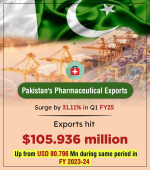
The exports of#pharmaceutical in Pakistan witnessed an increase of 31.11% during the first quarter of the current financial year 2024-25, as against the exports of the corresponding months of last year.

The pharmaceutical exports from the country were recorded at US $105.936 million during July-September (2024-25) against the exports of US $80.796 million during July-September (2023-24), according to the latest figures released by the Pakistan Bureau of Statistics (PBS).
 

Foods exports surge by 21.73pc to $2.36 billion in July-October​


By Staff Reporter | The Nation
Nov 23, 2024

The food exports from Pakistan increased by 21.73 percent during the first four months of the current fiscal year as compared to the corresponding period of last year, Pakistan Bureau of Statistics (PBS) reported.

Food exports during July-October (2024-25) were recorded at $2,365.114 million as compared to the exports of $1,942.915 million in July-October (2023-24), according to latest PBS data.

The food products that contributed in the positive growth of food trade included rice, the exports of which increased by 52.53 percent, from $710.789 million last year to $1,084.193 million during the ongoing fiscal year.

Likewise, the exports of fruits increased by 7.02 percent, from $108.995 million to $116.649 million, vegetables by 36.74 percent, from $66.640 million to $91.121 million and tobacco by 365 percent, from 14.061 million to $65.474 million. The exports of sugar also went up by 413 percent, from $21.070 million to $108.248 million whereas the exports of meat and meat preparations increased by 4.67 percent, from $152.997 million to $160.135 million.

The food products that witnessed negative growth in the trade included fish and fish preparations, the exports of which declined by 6.33 percent, from $123.965 million to $116.115 million, leguminous vegetable vegetables (pulses) by 100 percent, from $0.084 million to zero exports; spices by 11.80 percent from 35.157 million to 31.007 million.

Likewise, the exports of oil, seeds, nuts and kernals declined by 31.79 percent, from $307.024 million to $209.423 million whereas exports of all other food commodities decreased by 4.82 percent, from $402.133 million to $382.749 million.

Meanwhile, on year on year basis, the food exports during the month of October 2024 increased by 12.77 percent to $748.435 million compared to exports of $663.664 million in October 2023. On month-on-month basis, the food exports increased by 23.76 percent in October 2024 when compared to the exports of $604.752 million in September2024. It is pertinent to mention here that the merchandise exports from the country increased by 13.45 percent during the first four months of the current fiscal year as compared to the corresponding months of last year.

Exports during July-October (2024-25) were recorded at $10.880 billion against $9.590 billion during July-October (2023-24), according to PBS data.

On the other hand, imports into the country also went up by 5.17 percent, growing from $16.977 billion last year to $17.854 billion during the first four months of the current year.

Based on the figures, the trade deficit during the months under review was recorded at $6.974 billion against the deficit of $7.387 billion last year, showing a decrease of 5.59 percent.
 
To view this content we will need your consent to set third party cookies.
For more detailed information, see our cookies page.
 
To view this content we will need your consent to set third party cookies.
For more detailed information, see our cookies page.
 
To view this content we will need your consent to set third party cookies.
For more detailed information, see our cookies page.
 
Pakistan's exports have increased by 12.57% during the first five months of FY25 (July-November), marking a significant boost in trade performance.

This rise in exports has contributed to a 7.39% reduction in the country's trade deficit, as imports have decreased.

The growth in exports highlights the positive shift in Pakistan's trade balance and economic outlook.

The government’s efforts to promote local industries and improve export strategies seem to be paying off, helping the country navigate economic challenges.
 

Users who are viewing this thread

Country Watch Latest

Back
Top