Follow along with the video below to see how to install our site as a web app on your home screen.
Note: This feature may not be available in some browsers.
| Category | Amount (PKR) | % of Budget |
|---|---|---|
| Debt Servicing (Interest + Principal) | Rs 8.21 trillion | ~47% |
| Defence (official) | Rs 2.55 trillion | ~14.5% |
| Pensions (civilian + military) | Rs 1.06 trillion | ~6% |
| Development Programme (PSDP) | Rs 1.0 trillion | ~5.7% |
| Grants & Transfers | remainder | ~27% |
The domestic debt stuff likely ties into the stock market bros and uncles among us. So, every time these chumps shout aloud about the stock market booming, it's on the back of exploiting the nation and its fiscal exchequer.Pakistan's Debt Servicing: The Staggering Numbers (FY 2025–26)
The Headline Figure
Pakistan's debt servicing will account for 46.7% of the federal budget in fiscal year 2025–26, amounting to Rs 8.2066 trillion out of the total Rs 17.573 trillion budget. This is the largest single portion of current expenditures, highlighting the heavy burden of interest and loan repayments on government finances. Profit by Pakistan Today
To put this in dollar terms: due to Pakistan's sizable external debt of $87.4 billion, the largest share of the national budget is consumed by debt servicing, which stands at $29 billion — almost 47% of total expenditure. Al Jazeera
Domestic vs. Foreign Debt Servicing
Domestic debt servicing is set to cost Rs 7.197 trillion, while Rs 1.009 trillion has been earmarked for foreign loan repayments. Profit by Pakistan Today
This means the domestic debt burden — owed primarily to Pakistani banks and investors — is nearly 7 times larger than the foreign debt servicing bill, reflecting how aggressively the government has borrowed internally through T-bills, Pakistan Investment Bonds, and the National Savings Scheme.
How Pakistan Pays Its Foreign Creditors
Key foreign creditors receiving payments include: the IMF ($1.50 billion, of which $580 million was interest); the Asian Development Bank ($1.54 billion, including $615 million in interest); the World Bank ($1.25 billion, including $419 million in interest); and external commercial loans of nearly $3 billion, of which $327 million represented interest payments. Pid
The Debt Spiral — Why It Keeps Growing
Pakistan's public debt reached Rs 76.01 trillion (approximately US$269 billion) by March 2024, having more than quadrupled over the last decade. High repayments have displaced private investment, weakened the rupee, fuelled inflation, and increased dependence on further borrowing. Profit by Pakistan Today
During FY25, debt servicing constituted a whopping 70% of tax revenue and 41% of current expenditure, up from 34% and 27% in 2016 respectively. Comparative data shows interest payments in Pakistan are higher relative to peer economies with similar debt levels. SBP
The Budget in Context: Where Does the Money Actually Go?
Here is the complete picture of Pakistan's FY 2025–26 federal budget allocations:
Interest payments of PKR 8.207 trillion and pensions of PKR 1.055 trillion dominate current expenditure, resulting in limited fiscal space for productivity-led priorities, especially education and health. SSRN
Category Amount (PKR) % of Budget Debt Servicing (Interest + Principal) Rs 8.21 trillion ~47% Defence (official) Rs 2.55 trillion ~14.5% Pensions (civilian + military) Rs 1.06 trillion ~6% Development Programme (PSDP) Rs 1.0 trillion ~5.7% Grants & Transfers remainder ~27%
The Structural Trap
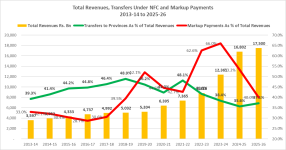
The government expects total revenues of Rs 11.1 trillion ($39 billion), leaving a Rs 6.5 trillion ($23 billion) financing gap to be filled through domestic and external borrowing, as well as privatization proceeds. Arab News
In other words, Pakistan does not earn enough revenue to even cover its debt repayments and defence spending together — let alone fund health, education, or development. It must borrow new money simply to pay old debts, deepening the spiral with each passing year.
Bottom Line
Nearly half of every rupee in Pakistan's federal budget goes straight back to creditors — domestic banks, foreign institutions, and bilateral lenders — before a single road is built, a single teacher is paid, or a single hospital is funded. Combined with the ~25–30% consumed by the military, Pakistan's government effectively has discretionary control over only about 20–25 cents of every budget rupee for everything else: development, health, education, social protection, and governance.
Pakistan's Debt Servicing: The Staggering Numbers (FY 2025–26)
The Headline Figure
Pakistan's debt servicing will account for 46.7% of the federal budget in fiscal year 2025–26, amounting to Rs 8.2066 trillion out of the total Rs 17.573 trillion budget. This is the largest single portion of current expenditures, highlighting the heavy burden of interest and loan repayments on government finances. Profit by Pakistan Today
To put this in dollar terms: due to Pakistan's sizable external debt of $87.4 billion, the largest share of the national budget is consumed by debt servicing, which stands at $29 billion — almost 47% of total expenditure. Al Jazeera
Domestic vs. Foreign Debt Servicing
Domestic debt servicing is set to cost Rs 7.197 trillion, while Rs 1.009 trillion has been earmarked for foreign loan repayments. Profit by Pakistan Today
This means the domestic debt burden — owed primarily to Pakistani banks and investors — is nearly 7 times larger than the foreign debt servicing bill, reflecting how aggressively the government has borrowed internally through T-bills, Pakistan Investment Bonds, and the National Savings Scheme.
How Pakistan Pays Its Foreign Creditors
Key foreign creditors receiving payments include: the IMF ($1.50 billion, of which $580 million was interest); the Asian Development Bank ($1.54 billion, including $615 million in interest); the World Bank ($1.25 billion, including $419 million in interest); and external commercial loans of nearly $3 billion, of which $327 million represented interest payments. Pid
The Debt Spiral — Why It Keeps Growing
Pakistan's public debt reached Rs 76.01 trillion (approximately US$269 billion) by March 2024, having more than quadrupled over the last decade. High repayments have displaced private investment, weakened the rupee, fuelled inflation, and increased dependence on further borrowing. Profit by Pakistan Today
During FY25, debt servicing constituted a whopping 70% of tax revenue and 41% of current expenditure, up from 34% and 27% in 2016 respectively. Comparative data shows interest payments in Pakistan are higher relative to peer economies with similar debt levels. SBP
The Budget in Context: Where Does the Money Actually Go?
Here is the complete picture of Pakistan's FY 2025–26 federal budget allocations:
Interest payments of PKR 8.207 trillion and pensions of PKR 1.055 trillion dominate current expenditure, resulting in limited fiscal space for productivity-led priorities, especially education and health. SSRN
Category Amount (PKR) % of Budget Debt Servicing (Interest + Principal) Rs 8.21 trillion ~47% Defence (official) Rs 2.55 trillion ~14.5% Pensions (civilian + military) Rs 1.06 trillion ~6% Development Programme (PSDP) Rs 1.0 trillion ~5.7% Grants & Transfers remainder ~27%
The Structural Trap
The government expects total revenues of Rs 11.1 trillion ($39 billion), leaving a Rs 6.5 trillion ($23 billion) financing gap to be filled through domestic and external borrowing, as well as privatization proceeds. Arab News
In other words, Pakistan does not earn enough revenue to even cover its debt repayments and defence spending together — let alone fund health, education, or development. It must borrow new money simply to pay old debts, deepening the spiral with each passing year.
Bottom Line
Nearly half of every rupee in Pakistan's federal budget goes straight back to creditors — domestic banks, foreign institutions, and bilateral lenders — before a single road is built, a single teacher is paid, or a single hospital is funded. Combined with the ~25–30% consumed by the military, Pakistan's government effectively has discretionary control over only about 20–25 cents of every budget rupee for everything else: development, health, education, social protection, and governance.

We use essential cookies to make this site work, and optional cookies to enhance your experience.