Pakistan External Debt

The general narrative in Pakistan is that "debt is bad, It is destroying Pakistan etc. etc."

The reality is that Pakistan's debt situation is not as precarious as our news media, opposition and their echo-chambers make it out. Yes, it makes the fiscal space tight, it brings various challenges, but a quick comparative look and you will find that Pakistan is #58 in the world in terms of "external debt". I will only focus on external debt since in Pakistan's case, it is the the largest debt owed (all based on OSI and 2024 numbers).

The government needs to do a better job of managing it and digging itself out to have a better balance but the crying wolf all the time also does not help. Inshallah we will manage this as we have all past challenges.


The general narrative in Pakistan is that "debt is bad, It is destroying Pakistan etc. etc."

The reality is that Pakistan's debt situation is not as precarious as our news media, opposition and their echo-chambers make it out. Yes, it makes the fiscal space tight, it brings various challenges, but a quick comparative look and you will find that Pakistan is #58 in the world in terms of "external debt". I will only focus on external debt since in Pakistan's case, it is the the largest debt owed (all based on OSI and 2024 numbers).

The government needs to do a better job of managing it and digging itself out to have a better balance but the crying wolf all the time also does not help. Inshallah we will manage this as we have all past challenges.


Amount of debt is not that big of an issue , it's lack of exports and shortage dollars to pay back in dollars....
 
Amount of debt is not that big of an issue , it's lack of exports and shortage dollars to pay back in dollars....
I get that, but there are plenty of first world countries in a far more precarious situation than Pakistan.

Our own narrative has painted Pakistan as if it is a chronically non-performing economy. Most people in Pakistan simply regurgitate what they hear others telling them without doing their own research. This is not to say that Pakistani economy is doing wonders by any means, but it is resilient and gets around tough spots.

Even the talk of "default" around the COVID timeframe was hyped up but even then Pakistan made sure that it did not follow the path of countries like Greece and Argentina.
 
NOT happening. Iran CANNOT be militarily neutralized by ANY country on earth as recent events have shown. There is a REASON why Iran has NEVER EVER been colonized by the white european races.
That will be decided by Iran and countries that oppose Iran - USA/Israel/GCC states
 
Instead of people, not you, gloating on the case, should we not wonder what has happened for UAE to call in it's placement of 3.5 Billion USD with Pakistan? Over the course of the US-Israel-Iran war, what has Pakistan done for the UAE to pull this stunt?

I am sorry that we are in a state where these GCC countries are able to pull stunts like this so very easily, but is it not strange that they can invest Trillions of USD in the US but will not invest anything in Pakistan? They are driving the US Military industry because of which the US is the super power that it is but they will not help out another Muslim country climb out of the debt trap while looking at us whenever they are threatened. Shameful at both ends I would say.
I did a quick google, saw this news piece

Pakistan anti-graft body says in talks with UAE to curb money laundering, illegal assets holding

According to the mentioned report back in 2018, Pakistani assets in UAE were worth $150bn, probably more now if that is accurate.

Pakistan needs to make a way for people to bring that money back to Pak, if this is just UAE, imagine other countries like Saudi, UK, US etc.
 
Amount of debt is not that big of an issue , it's lack of exports and shortage dollars to pay back in dollars....
Exactly.
Start with this data (just South Asia):

Rank Country Per Capita Exports (USD)
133 Bhutan 1,172
146 Sri Lanka 791
153 India 539
160 Bangladesh 359
164 Myanmar 286
185 Pakistan 150
194 Nepal 86
198 Afghanistan 45


Pakistan is so unproductive that Myanmar, nobody's idea of a well-run country, is twice more productive. India is thrice, tiny Sri Lanka and Bhutan are five times and seven times more productive.
 
I did a quick google, saw this news piece

Pakistan anti-graft body says in talks with UAE to curb money laundering, illegal assets holding

According to the mentioned report back in 2018, Pakistani assets in UAE were worth $150bn, probably more now if that is accurate.

Pakistan needs to make a way for people to bring that money back to Pak, if this is just UAE, imagine other countries like Saudi, UK, US etc.
UAE, UK and certain other countries are indeed safe havens for money laundering and parking of illegal assets. But some of these countries have reaped the benefits of criminal proceeds, why would they be willing to forego that advantage?

USD 150 Billion by 2018, as per your post, would probably mean USD 200 Billion by now. Let's assume for this discussion that UAE does indeed hold investment of USD 200 Billion (mostly in real estate) by Pakistanis; any idea what pulling out 200 Billion USD would mean to the Emirati economy and the Emirati real estate? Even with such a powerful economy, the pullout of such a massive amount would be devastating.

So, why would the UAE, UK, or even the US allow such action, rather force the action? Waise Saudi has historically not been a safe haven so I doubt there would be a lot of money invested in Saudi Arabia. Malaysia, Switzerland, Turkey, Spain, Virgin Islands, Panama etc., are some of the hotspots.
 
It is an open secret that the Saudis and the UAE have been moving towards a deal with Israel. The only real issue is the terms of the deal

There are 1+ million Pakistani workers in the Emirates.

Right now, both Saudis and the UAE want Iran militarily neutralized. Rightfully so, from their perspective.
That but also something else, Saudi and UAE have drifted apart quite considerably on certain matters, especially Yeman and Lebanon. The rift got so wide that the Saudis bombed UAE backed militants in Yeman a couple of months back; in a daring move, the UAE was able to evacuate the rebel leader from Yeman from right under the Saudi's. And these things coming to light out in the open could only mean that there has been bad blood for some time now.

Imagine the frustration of the Emiratis in which they made a defence pact with India......a country which is unable to defend even itself from a country 7x smaller in size, 6x small in population and 1/10 the GDP.
 
Competing on the global market requires single-minded focus on business and economics.
The idea of Business is to make money, right? How come the Businessmen in Bangladesh, Vietnam and India understand the importance of exports and the fact that there is generally more money to be made with exports, but the same fails on Pakistani Businessmen?

What has changed in the last 30 years, in the last 10 or even 5 years? Apart from some IT export growth, everything else has either stagnated or gotten worse. Why is that? I am amazed that a country like Netherlands, with cultivatable land only 1/30th of Pakistan is able to export almost USD 150 Billion worth of agriculture whereas Pakistan with 30x more cultivatable land exports only around 10 Billion USD worth of agriculture. What a damn shame.

And it makes me wonder, is it because we are too invested in useless crops like Sugar where extreme waster of water is also a regular practice. How frustrating these things are!!!
 
The idea of Business is to make money, right? How come the Businessmen in Bangladesh, Vietnam and India understand the importance of exports and the fact that there is generally more money to be made with exports, but the same fails on Pakistani Businessmen?

What has changed in the last 30 years, in the last 10 or even 5 years? Apart from some IT export growth, everything else has either stagnated or gotten worse. Why is that? I am amazed that a country like Netherlands, with cultivatable land only 1/30th of Pakistan is able to export almost USD 150 Billion worth of agriculture whereas Pakistan with 30x more cultivatable land exports only around 10 Billion USD worth of agriculture. What a damn shame.

And it makes me wonder, is it because we are too invested in useless crops like Sugar where extreme waster of water is also a regular practice. How frustrating these things are!!!
Agricultural exports are profitable, if one has price advantage and markets are nearby. Or the products are so high valued that they can be shipped afar, like coffee, tea, cocoa. I don't think Pakistan has either of these. No meaningful trade relations with neighbors and lack of high value products. Best course would be to start like Bangladesh with labor intensive manufacturing and then make higher value products.
 
Agricultural exports are profitable, if one has price advantage and markets are nearby. Or the products are so high valued that they can be shipped afar, like coffee, tea, cocoa. I don't think Pakistan has either of these. No meaningful trade relations with neighbors and lack of high value products. Best course would be to start like Bangladesh with labor intensive manufacturing and then make higher value products.

A simple way to understand Pakistan’s situation is this: imagine a safe that’s already empty, yet the people guarding it are the same ones who drained it. And instead of fixing the system, we keep returning to the IMF, the Asian Development Bank, and different Gulf states just to scrape together a few billion dollars to stay afloat. That cycle has become our economic routine.

But the real tragedy is who pays the price. It’s always the public. Ordinary people carry the weight of every bailout, every tax increase, every tariff, every fuel adjustment. It feels like a modern form of economic bondage, where the awam keeps working harder while the system keeps pulling them deeper into debt.

And then there’s the internal debt. A huge portion of it comes from long‑term power agreements….IPP contracts that locked Pakistan into paying high capacity charges whether electricity is used or not. Those payments drain billions every year, leaving even less room for development, education, healthcare, or future planning.

So when people say Pakistan lacks vision, it’s not an exaggeration. There’s no long‑term roadmap, no structural reform, no real investment in human capital. Meanwhile, the population is projected to approach 250 million in the next two decades. That means more young people entering a system that’s already struggling to support the people it has today.

In the end, the public is the one absorbing the shocks, higher prices, fewer opportunities, and a future that feels increasingly uncertain. That’s the part that hurts the most.
 

Pakistan repays $1.43bn in external debt​

Top Story
By News Desk
April 08, 2026


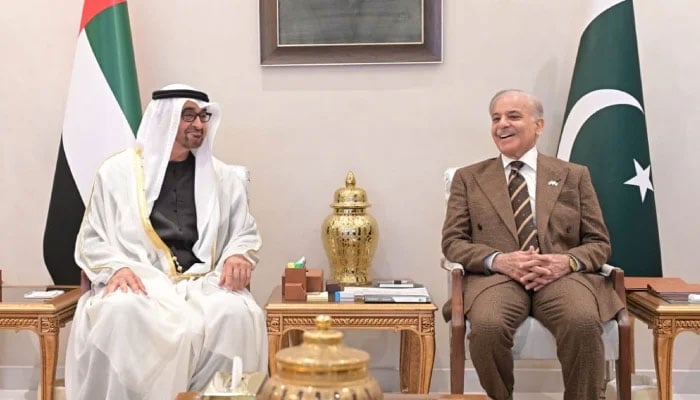
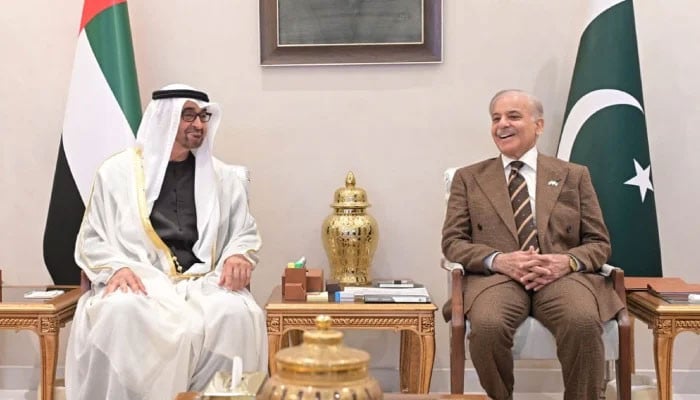
Prime Minister Muhammad Shehbaz Sharif meets UAE President Mohamed bin Zayed al-Nahyan in Islamabad, December 26, 2025. — X/PTV News
ISLAMABAD: Pakistan has repaid $1.43 billion in external debt, including the $1.3 billion Eurobond maturing on April 8, said Khurram Schehzad, adviser to the finance minister, on Tuesday.

Schehzad made the announcement in a post on X, saying debt servicing continued to be executed, “... reflecting consistency, discipline, and strengthened capacity.”

The $1.43 billion repayment also includes $126.125 million in coupon obligations on other Eurobond issuances, he added.

Schehzad attributed the timely repayment to stable external buffers, improved liquidity, and continued macroeconomic stabilisation. He said that the performance was underpinned by the government’s measures to strengthen investor confidence and a sustainable and disciplined debt trajectory.

“The seamless execution of large external repayments underscores both capacity and consistency — reinforcing Pakistan’s credibility across global investors and financial institutions,” he added.

The development comes as Islamabad prepares to repay over $3 billion debt to the United Arab Emirates (UAE).

The loan had been rolled over since 2018 before Islamabad decided to repay it in full, with clearance expected by April 23, Reuters quoted a Pakistani government official as saying.

Previously, the Foreign Office said that the State Bank of Pakistan would begin repayments, and rejected “misleading and unfounded” reports concerning the return of the debt.

In a statement on April 4, the FO spokesperson said that the debt repayment was “a routine financial transaction” and any attempt to portray it otherwise was “erroneous and misleading”.

Pakistan previously tried to convert some of the UAE debt into equity. Deputy Prime Minister and Foreign Minister Ishaq Dar said in November last year that the UAE was looking to convert investments into equity stakes in subsidiaries of the military-managed Fauji Foundation. UAE companies have made investments into Pakistan recently. The Abu Dhabi-based firm International Holding Co acquired a small Pakistani lender First Women Bank Ltd, while AD Ports Group signed a 25-year concession pact for bulk and general cargo operations with Karachi Port Trust in 2024. Pakistan has also offered its airports in government deals to Middle East countries.

Meanwhile, Pakistan’s central bank reserves stand at about $16.4 billion as of March 27, with the UAE loan — around 18% of holdings — adding pressure on an economy still recovering as fuel costs rise and shortages linked to the Iran war spur inflation and weigh on growth.

The country managed to stabilise its economy in recent years with the help of loans from the International Monetary Fund and friendly donors like the UAE, China and Saudi Arabia.


Pakistan’s external debt falls to 26pc of GDP in FY24
The external debt was at 32 percent of GDP in FY23
By Erum ZaidiAugust 16, 2024
facebooktwitter
A man counts US dollars in a money exchange shop. — AFP/File

KARACHI: Pakistan’s external debt to the gross domestic product (GDP) ratio decreased to a six-year low of 26 percent in the last fiscal year, largely due to a limited increase in foreign currency borrowings and a reduced current account deficit.

The external debt was at 32 percent of GDP in FY23.

Data from the State Bank of Pakistan on Thursday showed that the country’s total external debt and liabilities (EDL) increased by 3.4 percent or $4.6 billion to $130.502 billion at the end of June 30, 2024.

The public external debt grew to $98.256 billion at the end of FY24, compared with $94.881 billion in the previous year. The country’s public external debt, excluding foreign exchange liabilities, increased from $84.047 billion in FY23 to $86 billion at the end of FY24.

The public external debt, including public sector enterprises, rose to $106.262 billion in FY24 from $102.541 billion a year ago.

While the country’s foreign debt increased in absolute terms, it decreased in relation to GDP due to improvements in the balance of payments and exchange rate stability. This reduction in the debt burden was aided by a substantial drop in the current account deficit, which decreased from $17.48 billion in FY22 to $3.2 billion in FY23, and further to $0.68 billion in FY24. Additionally, foreign remittances increased to $30.25 billion in FY24 from $27.33 billion in FY23. Despite ongoing debt repayments, the SBP’s forex reserves stood at $9.27 billion as of August 9.

“External Debt to GDP has fallen to 6 year low in FY24 at 26 percent of GDP from 32 percent in FY23 due to relatively lower increase in foreign currency borrowings than local currency,” said Topline Securities in a note.

Pakistan’s debt-to-GDP ratio has reached a six-year low at 70 percent in FY24, as the nominal GDP has grown faster than debt, largely due to higher inflation. Additionally, Pakistan’s external debt servicing as a percentage of total exports has decreased to 35 percent in FY24 from 51 percent in FY23.

“This ratio indicates how much a country’s export revenue will be used up in servicing its debt, thus how vulnerable the payment of debt service obligations is to an unexpected fall in export proceeds,” it said.

The increase in the external debt-to-export ratio indicates that external debt is rising faster than exports. However, in FY24, this ratio has decreased to 253 percent compared to its peak of 314 percent in FY20.

Furthermore, the foreign debt servicing to foreign exchange reserves stands at 195 percent for FY24. This ratio shows the percentage of external debt repayments due within one year in comparison to the country’s reserves. It is anticipated that this ratio will decrease to 89 percent for FY25.

“We have taken external debt repayments at $10 billion (net of rollover) for FY25 in line with SBP guidance and reserves for all years we have taken as average of beginning and end of the year,” it said.

Mohammed Sohail the CEO of Topline Securities said contrary to popular belief, Pakistan’s debt ratios are steadily improving. “Timely reforms and strict adherence to the IMF conditions will accelerate this positive trend in the coming years,” Sohail added.

The end-FY24 debt-to-GDP ratio was expected to decrease due to fiscal consolidation. However, debt sustainability risks remain there given large gross financing needs and the persistent challenges in securing external financing.

In FY25, Pakistan needs to repay $26.2 billion in external repayments, including $22 billion in principal and $4 billion in interest. It’s anticipated that $16 billion will be rolled over. In July, $1.1 billion has already been repaid, and the remainder of the fiscal year will see $9 billion repaid.

Finance Minister Muhammad Aurangzeb said that Pakistan has secured assurances from China, Saudi Arabia, and the United Arab Emirates to roll over debt for a year. The country awaits final approval for its new $7 billion loan programme with the International Monetary Fund.
Thread already exists
 

Users who are viewing this thread

Back
Top