Ibbi32
Registered Member

The bigger question people should ask is what happened to Indian air defences?
Simply what happens when you have a passide air defence doctrine and try to intercept litteraly everything everything
Follow along with the video below to see how to install our site as a web app on your home screen.
Note: This feature may not be available in some browsers.
The bigger question people should ask is what happened to Indian air defences?
Well then it goes against the word "deter" but that is point isnt it? If I see the window to hit you - whether it is with all my might or sharpshooting - I am not deterred from aggression but I am deterred from being callous and foolhardy in how i execute it.
What is interesting is that post May 7th they have been furiously trying to plug gaps with new and existing equipment especially in the EW domain however I am not sure undertaking the one off academic and practical exercise on a large scale "validates" fighting concepts. These are verified over multiple large scale and smaller scale engagements, repeated drills and wargaming. Perhaps they are undertaking this and so the deterrence(for the lack of the better term) drops again for them.

Next round....Indian main asset would be Bhamos 1 & 2 .....Air and Groynd launch or may be From sea....limiting PAF response....

Next round....Indian main asset would be Bhamos 1 & 2 .....Air and Groynd launch or may be From sea....limiting PAF response....
This is a fantastic post, especially on the dynamic nature of deterrence. In a way ultimately india believes if push comes to shove they could just keep going longer than Pakistan, elite levels strategic thinking huhYes, and that distinction you made (bolded part) is where discussions b/w members have been breaking down. This circles back to my original point that deterrence has to be defined and applied within the context, whether it's function is being implied from what it means in an everyday, legal, or military context.
When used in everyday contexts, it simply means fear of expected consequences negating the probability of a certain act/behavior.
When used In legal contexts, deterrence is normative and prohibitory. It's functional objective is compliance with law, and implemented through state enforcement and punishment. When an unlawful act occurs, legal deterrence can reasonably be judged to have failed in performing its prohibitory function.
However, when used in military contexts, deterrence is raising the cost of actions relative to gains with the expectation of discouragement in the future, and it is dynamic and ever evolving (not static like in everyday and legal contexts). Moreover, the expectation does not seek absolute prohibition/prevention of hostile acts. Instead, the functional objective is reshaping an adversary’s cost-to-gain ratio to effectively discourage repetition of such acts using the same or similar tactic. In plain terms, military deterrence rarely seeks absolute denial of aggression (esp. b/w peer military firepowers) - instead, it seeks denial of freedom and control over scale, duration, exploitative/operational advantage, and cost-effective repeatable escalation.
So, when a state commits an act of aggression, deterrence cannot be assessed in a binary manner (as in an everyday/legal context). Its performance is to be evaluated in terms of whether the act incurred higher costs on the adversary, limited their operational gains, contested the escalation ladder control, and reduced the feasibility of repetition using the same/similar tactic. It can only be safely judged (and labelled) to have failed when escalatory and hostile actions remain profitable (militarily/economically/diplomatically/politically) for the the adversary and hence encouraging repetition.
Yet, if still, we want to entertain military deterrence in its rarest form i.e. near-absolute prevention of any escalatory or hostile acts then a state needs to be militarily, economically, and diplomatically far superior to the other state. Absolute prevention doesn't exist in military doctrine and a simple example here would be the hostile acts committed by state-backed non-state actors against US on their soil.
So I don't think it goes against the word 'deter' if contextual application is maintained.
Firstly, this reads to me that you are implicitly acknowledging that in the May conflict Pakistan’s deterrence was existent and functional (or am I mistaken?)
Secondly, I agree that a single event cannot be taken as a general validation, especially since military deterrence is a dynamic concept - and constantly evolving through lessons learned, adaptations, and new technologies or doctrines researched, inducted, and implemented. And yes, these developments dilute deterrence - if it is one sided. However, developments are being carried out at our end as well so as to maintain the balance.
I think, much of the complaint from the members is rooted in the failure to acknowledge the dynamic nature of deterrence. Near-absolute prevention of Indian escalation requires Pakistan to be in the same league of countries as the US or China (in terms of military, economic, and diplomatic capacity) - which is unrealistic at present.
The demand (or at the very least the expectation) that Pakistan should have caused India “considerable damage” mirrors a similar misjudgment India made during Op Sindoor. First, even if Pakistan had inflicted greater damage, there was no guarantee the conflict would have ended rather than escalated uncontrollably. That uncertainty is a core variable in strategic planning and decisions. Second, the assumption that heavy damage would prevent future Indian aggression is flawed (or at least unrealistic) as it ignores historical context (4 wars b/w us), India’s greater attrition depth and replenishment capacity, and the strategic/operational reality that the escalation ladder had already reached its upper tiers, with CMs being employed by them - leaving very little margin for strategic misjudgment resulting in a full-scale war.
So IMO, when appraising Pakistan’s deterrence, the publicly available evidence shows India’s conventional forces (IA, IAF, IN) did not achieve operational advantage, their drone-based SEAD/DEAD operations failed to produce mission kills, and while their CMs had impacts, they didn't render our airbases non-functional. Further, CM strikes couldn't have been operationally sustained for longer, and Indian forces needed for sustainment were either already grounded or confined to defensive positions - which shows Pakistan's deterrence was functional (at the very least).
The only domain where Pakistan could not completely deter India was their domestic political objectives (esp. BJP's) - and realistically, preventing that through military means alone without full-scale war was (and is) unlikely. We need to keep in mind that while Pakistan and India are peers in military firepower, they are neither peers in sustaining that firepower over a drawn-out conflict nor economically and diplomatically. The imbalance in the latter domain has improved post May though.
People can argue, and perhaps even establish that India has not been deterred but that conclusion assumes that absolute military deterrence is both realistic and static (which is conceptually and practically incorrect). In reality, post May events are more suggestive of India being deterred effectively in military and diplomatic domains. Their post May signalling gives the subtle clues - in the aftermath of Dehli blast there was an attempt to malign Pakistan by their media yet again, but their officials maintained the distance and instead fed rhetoric to their population (Sindh being part of India, and etc) - that is political deflection and not endorsement of promise made by Modi to Indian population and Pakistan. Further, if we analyze Modi's post Op Sindoor statement that India had found space for a conventional conflict below nuclear threshold with Pakistan, then their large scale tri-services Ex Trishul, and other military exercises along their Northern and Eastern borders should have shown doctrinal consolidation rather than doctrinal exploration and capability patching - Why fix something that isn't broken?
OTOH, though Pakistan is also involved in capability patching but our military exercises were comparatively confined in scale, related to signalling operational readiness, and not exploring new doctrines and/or tactics. So, for myself at least, these subtle signs speak clearer and louder than any noise surrounding satellite imagery or "no-restraint response" suggestions.
And before members jump in with the "perceived political/military lack of will" argument - I hope they'd acknowledge the concept of Escalation Control before indulging in false equivalence and strategic myopia. Nonetheless, that line of argument can be discussed as well.
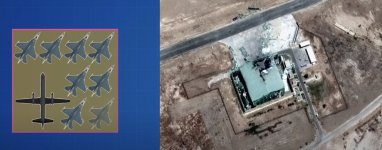
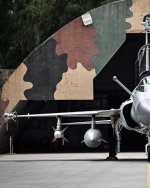


Which also has a hi-res thermal camera with target recognition. So if it makes it to the general area even with spoofing it is looking for a specific target. Question more so comes in how India got such a high res photo of the intended target that Scalp had that info in play. Satellite info on that would need meter level slant photography at the very least.
Wild indian imagery world. They think Pakistan parked F16s inside this hanger like canned sardines.
View attachment 168083
View attachment 168084
These indians dont even know that every airbase has HAS for each fighter jets where they are safely kept.
Any upcoming scenario will under the fear of mushroom clouds from either side...the conflict will be short otherwise the probability of misjudgment will be increasing exponentially. Indians would be looking for multiple targets simultaneously ....Yes but to what end?
Firstly, if they begin at the top of the escalation ladder then there's not much to go from there than tactical nukes (unless both carry out a couple CM strikes and call it a day).
Secondly, should such a conflict maintains duration, then their CMs can't be operationally sustained throughout the day, and more conventional force will have to be engaged nonetheless at both ends.
And thirdly, in an ideal case where their very first CM strikes takes out our ABs (let's assume that improbable scenario) - what do you think our response to that would be? And does India want to call out our bluff while confining us into a corner?
Any upcoming scenario will under the fear of mushroom clouds from either side...the conflict will be short otherwise the probability of misjudgment will be increasing exponentially. Indians would be looking for multiple targets simultaneously ....
Now your asked about our response .... I think, CDF and company is more aggressive than Bajwa/kiyani/Raheel....and it was proved in May 2025.
Response would be (and should be) 2 x Indian attack and who knows Pak Navy comes into preemptive action...
Just one more point: each Pakistani missile launch will cause new fear/confusion in the Indian camp because they know that if it is a nuclear delivery, either being struck or intercepted will result in huge destruction. This confusion is extremely dangerous and may invite Indians to launch Nuclear strike in first place.
Do you think any entity would survive even in a low level of exchange? for short time period India may have advantage but as time passes the entire region would be hugely affected by Nuclear contamination ... and the whole new crisis will engulf the region.We shud always look things realistically …
may be a nuke war is itself the only solution to bring peace for longterm in this region.
whosoever survives as a entity will get chance to build new cities and clean up the remaining enemies without shame and finally njoy the landmass and who so ever is killed in war goes to Heaven