Pakistan-India Conflict 2025: News Updates and Discussion

Polite request hai Indian members on forum se : meray paper January mai hai. Koi panga lena hai toh tab aao
Beta, Tumharey imtahaan hain. Focus karo.

Waisay bhee, panga lainay kay leya yahan line kafe lumbi hai aur tum kafe peechay ho.

Barey phlay...
 
Meanwhile, the Indians keep dreaming. :ROFLMAO:

To view this content we will need your consent to set third party cookies.
For more detailed information, see our cookies page.

ADI Achint is the most MR TOUGH KNUCkLES ahh guyy in the indian defence circles...
bro posts videos of him going through very famous sites and garrisons all known across the internet and reads reports of FAS like a script and in the end claims that he has found where we hide our nukes and "I Know better then all defence analysts" etc etc
absolute cornball
 
The four-day near-peer air war
Source: Australian Air and Space Power Centre.
Author: Peter Layton
Griffith University and Australian Defence Force.
17.11.2025

In May 2025, India and Pakistan fought a near-peer air war. Such conflicts are rare,
providing insights the more frequent lop-sided air wars do not. At the time, understanding the
conflict was hindered by considerable active disinformation (Mushtaq, 2025). Accordingly,
events are first revisited before operational implications are discussed.
Wednesday, 7 May
Just after midnight, India attacked nine designated terrorist camps as part of a strategy of
deterrence by punishment (Clary, 2025). Seven were near the border with Pakistan and
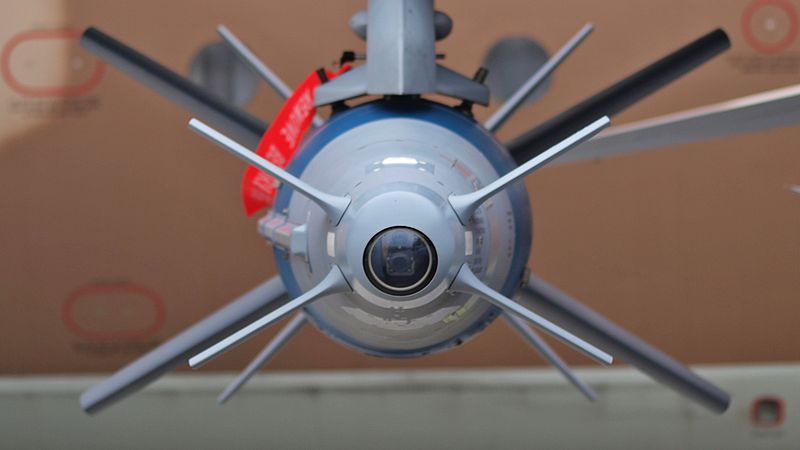
attacked using precision-guided artillery and drones, reportedly SkyStriker loitering munitions.
The deep strikes involved SCALP subsonic cruise missiles, AASM Hammer missiles, and
some BrahMos supersonic cruise missiles launched from Rafale, Mirage 2000 and Su-30MKI
aircraft. This operation involved some 72 Indian fighters undertaking offensive and defensive
missions in four coordinated waves (Syed, 2025b).
As the Indian aircraft took off, 42 Pakistani air defence fighters were launched to be in place
when the attack commenced (Syed, 2025a). Pakistan appeared to have had a high-quality air
picture, fused from data passed by airborne early warning and control (AEW&C) aircraft,
ground based short- and long-range radars, electronic surveillance and allegedly space-based
sensors (Rawat, 2025). This allowed Pakistan to score its biggest success of the four days:
the downing of two, maybe three, Indian fighters: a Rafale, a Mig-29 and perhaps an Su-30.
These losses were apparently to PL-15 air-to-air missiles fired from the J-10C fighters of 15
Squadron (Syed, 2025c).
The Rafale loss occurred at an unusually long range of some 180 kms. Third party
targeting, reportedly from AEW&C aircraft, was used so the target was unaware it was being
engaged until less than a minute before PL-15 impact (Defence Security Asia, 2025).
Tactically surprised, India suspended crewed aircraft operations for two days. The problem
appears an underestimation of Pakistan’s air-to-air missile ranges and so an Indian
intelligence failure (Shah & Patel, 2025). Of interest, no Indian or Pakistani aircraft entered the
other country’s airspace during the four-day air war.
Thursday, 8 May
Pakistan retaliated principally by launching drones against more than 12 military facilities
in both north-western India and Kashmir (Patil & Rawat, 2025). Most were shot down. India in
response attacked air defence radars and systems at some 11 military facilities using Israeli￾made Harpy and Harop anti-radar drones. Banshee target drones were probably used as
decoys. It seems a least one air defence system in Lahore was damaged. Pakistan claimed
25 drones shot down (Biswas, 2025).
Friday, 9 May
A mutual drone war began involving ongoing reconnaissance missions, electronic emitter
mapping missions, strikes and decoy flights (White, 2025). India continued targeting air
defence sites, striking four while losing 48 drones to Pakistani fire. Pakistan escalated,
launching some 300-400 drones, mostly of Chinese and Turkish origin, against 26 Indian
locations. Thesedamaged at least four military airbases (Ministry of External Affairs, 2025).
Overall, India assessed it engaged about 600 Pakistani drones across the war using 750 short￾range SAMs and some 1,000 anti-aircraft guns coordinated through the Akashteer automated
air defence control and reporting system (Sharma, 2025; Singh, 2025).
Saturday, 10 May
Late on 9 May, Pakistani shifted to more sophisticated drones, including the Turkish￾Pakistani Yiha-III loitering munition, and began using the 140km range Fatah-I rocket
(Rawalpindi, 2025). Pakistan targeted some 15 Indian airbases but only achieved limited
damage at four locations as most drone and rocket attacks were defeated. Hinting at a
possible escalatory step, Pakistan launched a 400km range Fatah-II rocket in the direction of
Delhi however, this was intercepted over Sirsa just after midnight (De, 2025).
About two hours later, India launched a large-scale attack against 11 Pakistani airbases
using decoy and anti-radar drones, 15 BrahMos missiles, SCALP cruise missiles, and
Rampage air-launched ballistic missiles. This disabled runways and damaged command
centres and aircraft shelters forcing Pakistan to relocate aircraft to rear bases outside Indian
missile range (TOI News Desk, 2025). A ceasefire was agreed at 3:35pm that day.
Evaluation
India achieved its initially stated aim of damaging the assessed terrorist camps on the first
night. In contrast, Pakistan’s retaliatory attacks were not just ineffectual but demonstrated that
India’s air defence systems were effective. India’s additional attacks after the first night further
suggested India could potentially readily gain air superiority over eastern Pakistan through an
offensive counter-air campaign (Organiser, 2025). While Pakistan’s fighters could defend
against Indian crewed aircraft attacks, the nation’s air defence system could not
comprehensively prevent rocket, missile and drone attacks. Pakistan’s eastern airbases would
become unusable if hostilities continued. The four-day air war became an air superiority battle

that India implicitly won.
Implications
The four-day air war continued the trend of the last few years of crewed combat aircraft
being just one of the means air operations now use (Layton, 2025b). Crewed aircraft are now
being used increasingly cautiously with rockets, missiles and drones instead picking up more
and more of the warfighting burden. This increased use of dissimilar means dramatic changes
for air defences as fighter aircraft alone are no longer sufficient. Ground-based surface-to-air
missiles, anti-aircraft guns and electronic warfare jammers are now essential, even if many of
each are needed to provide area coverage or to defend multiple widespread point targets.
Pakistan’s fighter success highlights that third party targeting is likely in future fighter￾versus-fighter engagements. An AEW&C aircraft or a ground-based radar may be distant but
will now present a threat in being able to cue and guide air-to-air missiles launched by radar￾silent fighters. In electronic warfare terms, not just the higher frequency radars of hostile fighter
aircraft will need to be countered but also the lower frequency radars of these now potential
cueing systems.
Third party targeting also means longer range air-to-air engagements will become common.
This reinforces the decades-long trend of shorter range visual engagements becoming rare
(Stillion, 2015). Moreover, it suggests aircraft flying near national borders could be engaged
by hostile aircraft that remain even well inside their own territorial airspace. Borders are
becoming wide potential weapons engagement zones, perhaps 150km or more deep.
The short sharp air war between India and Pakistan fits into the broad trends shaping air warfare. Air superiority still matters but now requires both defending against, and attacking with, rockets, missiles and drones. Crewed aircraft are no longer enough, making embracing heterogenous airpower important (Layton, 2025a). Air power is constantly evolving. Air forces
need to as well.


Link
lol Australian think thanks also claime Balakot was failure

But Indians dismissed it then. Now all of a sudden they believe Australian think thanks lmao
 
To view this content we will need your consent to set third party cookies.
For more detailed information, see our cookies page.


500 odd articles globally stating that India got her ass whooped on a conflict that India had sent months/years preparing to start and do, and 1 article says maybe one individual thinks otherwise ?
 
Four day near peer air war is quite a joke of an article.

Atleast 4 IAF shot down with some Indian AFB, fuel depots, S400 cheeseboard, Uri HQ hit. The best Indian army had to show for is to hit some of Pakistan’s AFB and a supposedly terrorist camp where a few innocent civilians died.

Just can’t make this sh!t up.

I guess its in the best interest of everyone that this argument goes until eternity.
 
To view this content we will need your consent to set third party cookies.
For more detailed information, see our cookies page.


hinduvtaa are like pagans of mecca
 
1764432033561.png
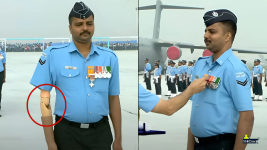
Always remember this chap, who lost his arm while repairing or operating S-400 under attack or whatever story from operation Bhindoor Indians cock up.

Always puts a smile to my face the embarrasment bhindoor turned out for india.

I mean, getting your top line aircraft shot down in your own airspace is next level achievement..........
 
To view this content we will need your consent to set third party cookies.
For more detailed information, see our cookies page.


Directly from ministry of defense.
 

Users who are viewing this thread

Back
Top