Why it took nearly a year for Operation Sindoor martyrs’ names to reach the National War Memorial
Every name engraved on the Tyag Chakra undergoes multiple levels of verification to ensure complete accuracy before becoming part of the country’s official military history
Published - June 27, 2026 03:33 pm IST - New Delhi
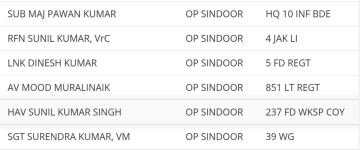
The names of six military personnel, Sub Maj Pawan Kumar, Rfn Sunil Kumar (VrC), L Nk Dinesh Kumar, Av Mood Muralinaik, Hav Sunil Kumar Singh of the Indian Army, and Sgt Surendra Kumar (VM) of the Indian Air Force, who died in the line of duty during Operation Sindoor in 2025, inscribed on a wall at the National War Memorial as a tribute to the fallen heroes, in New Delhi on June 26, 2026. | Photo Credit: PTI
Nearly a year after
Operation Sindoor, the government has formally honoured
six Indian Armed Forces personnel who laid down their lives during the cross-border operation in May 2025 by entering their names in the National War Memorial’s Roll of Honour. Their names will now be permanently inscribed on the Tyag Chakra (Circle of Sacrifice), the memorial’s central commemorative wall, marking the nation’s enduring tribute to their supreme sacrifice.
The delay in putting their names on National War Memorial was not an attempt to conceal casualties but the result of a structured administrative and legal process followed by the Indian Armed Forces before any battle casualty is officially recorded and commemorated at the National War Memorial.
War memorials are not merely monuments; they are permanent national records of military sacrifice. Every name engraved on the Tyag Chakra undergoes multiple levels of verification to ensure complete accuracy before becoming part of the country’s official military history.
According to a senior Army officer, battle casualties are never hidden. During the Operation Sindoor media briefing, the DGMO Lieutenant General Rajiv Ghai publicly confirmed the casualties of military personnel. The Chief of the Air Staff personally visited the family of the airman who made the supreme sacrifice. However, the Armed Forces follow a prescribed procedure before a soldier’s name can be officially declared and inscribed on the memorial.
The process begins immediately after a soldier is killed in action. The commanding officer of the unit submits an initial casualty report detailing the circumstances of the death. Simultaneously, the next of kin are informed through official channels, while medical authorities and civil administration issue the necessary death certificates required for pension, insurance and financial benefits.
However, the initial casualty report alone is insufficient for inclusion at the National War Memorial.
Each case must first be examined to determine whether it qualifies as a Battle Casualty under the regulations of the Indian Armed Forces. This classification is governed by detailed rules issued by the Service Headquarters of the Army, Navy and Air Force.
Officials examine whether the death occurred during combat, hostile action, war-like operations, counter-terrorist missions, or other notified operational circumstances. Supporting operational reports, eyewitness accounts and command endorsements are scrutinised before the case is processed further.
Only after these verifications does the competent authority at the respective Service Headquarters issue a formal Battle Casualty Report (BCR). The report serves as the official military certification that the soldier died in action under qualifying operational conditions.
The documentation then undergoes further scrutiny before being approved by the Ministry of Defence and the concerned Service Headquarters. Only after all records are verified are the names cleared for inclusion in the annual Roll of Honour maintained by the National War Memorial.
Officials say the memorial follows strict criteria because it is intended to remain a permanent national record. Any error in name, rank, unit or operational status would become part of history and therefore cannot be corrected casually after the names are engraved.
The National War Memorial, inaugurated to honour armed forces personnel who have laid down their lives since Independence, commemorates more than 26,000 soldiers. At its heart lies the Tyag Chakra, comprising 16 concentric granite walls inspired by the ancient Chakravyuh battle formation. Each fallen soldier is honoured on an individual granite tablet with the name etched in golden letters alongside rank and unit.
The six personnel now formally recognised for Operation Sindoor are Subedar Major Pawan Kumar of Headquarters 10 Infantry Brigade, Rifleman Sunil Kumar, Vir Chakra, of 4 Jammu and Kashmir Light Infantry, Lance Naik Dinesh Kumar of 5 Field Regiment, Agniveer Mood Muralinaik of 851 Light Regiment, Havildar Sunil Kumar Singh of 237 Field Workshop Company, and Sergeant Surendra Kumar, Vayu Sena Medal, of 39 Wing.
Their names were released along with the annual list of armed forces personnel who made the supreme sacrifice during various operations in 2025, including Operation Rakshak and Operation Hifazat.
Operation Sindoor was launched on May 7, 2025, in response to the
April 22 Pahalgam terror attack that claimed the lives of 26 civilians. During the operation, the Indian Armed Forces carried out precision strikes on nine terror-linked targets in Pakistan and Pakistan-occupied Kashmir (Pakistan Azaad Kashmir) before military operations ceased on May 10 following an understanding reached through the two countries’ Directors General of Military Operations.
With their names now entered into the Roll of Honour and set to be engraved on the Tyag Chakra, the six personnel have received the highest form of official national recognition. The nearly one-year interval reflects not secrecy, but the meticulous institutional process through which the Indian Armed Forces verify every battle casualty before permanently recording it in the nation’s military history.
Discover why it took nearly a year to honor Operation Sindoor martyrs at the National War Memorial, ensuring accuracy in records.

www.thehindu.com