Navigation
Install the app
How to install the app on iOS
Follow along with the video below to see how to install our site as a web app on your home screen.
Note: This feature may not be available in some browsers.
More options
Style variation
You are using an out of date browser. It may not display this or other websites correctly.
You should upgrade or use an alternative browser.
You should upgrade or use an alternative browser.
Pakistan International Arlines (PIA) : News / Updates
- Thread starter ghazi52
- Start date
More options
Who Replied?


PakFactor
Elite Member
Remarkable thing is that this 70+ year old businessman with no background in airline industry has so much ideas and knowledge at his finger tips. He speaks cautiously and compassionately even about those leeching employees milking the PIA.
In business, the quality of a true leader is not knowing everything but surrounding himself with those who do. If Pakistanis learn this quality, they can leap ahead nationally and internationally, if corruption is controlled at the state level.
I have known many who drive a Rolls Royce, signing documents away, while their financial analyst, accountant, and advisors take the subway home.
Business is an art.

Meengla
Elite Member

In business, the quality of a true leader is not knowing everything but surrounding himself with those who do.
Right.
Recently saw a political analyst in Pakistan telling a story about UK's Margarete Thatcher: Upon her success in turning things around for the UK, some reporters told her that she herself should not be particularly credited for the turnaround and that it were her advisors who did the job. She replied, Yes, but who chose those advisors?
[Not want to go into the politics but the context was how Imran Khan had surrounded himself with subpar team members while he was the PM of Pakistan].

Hussain
Trusted Member

باتیں کڑوڑوں کی ، دکان پکوڑوں کی
Traveled on his shitty air blue last summer, the seat had worn down to the frame of the seat, just the cover was hanging on. Two hour flt felt like eternity. Batien karwaloon in say....
Ba$tards still haven't paid compensation for the 2010 crash
Islamabad court awards Rs5.4bn compensation to families of AirBlue crash victims
Published December 22, 2025
Hussain
Trusted Member
Apologies in advance, if already posted.
PIA: ready for take-off
Khurram Husain Published December 25, 2025
THE deal under which Pakistan International Airlines (PIA) has just been privatised is good news and imparts much-needed momentum onto the structural reform efforts of the government, that were largely absent up till this point. It also signals a restart of the privatisation programme after nearly 20 years in the wilderness, since the Supreme Court halted sale of the steel mills back in 2005.
There are two important questions to raise in connection with this deal. The less-important question is the one that asks whether the government fetched the best deal that it could under the circumstances. The answer here is yes. People who are asking after the “sale price” are missing the point. This is not a kilo of tomatoes or a plot of land that has just been sold. This is a business enterprise whose auditors said more than a decade ago that it is “no longer a going concern.”
The company ran losses year after year, averaging around Rs50 billion per year and rising to as high as Rs105bn in recent years. By now its total accumulated losses have grown to beyond Rs650bn. Pakistan could have built a large dam or refurbished a large part of our railway network with this kind of money. There was no sense whatsoever in carrying this enterprise forward any longer. It should have been dumped over a decade ago when its losses were around half this level.
But in privatising it there was a problem. Nobody wants to buy the losses. I had occasion to sit down and speak with former CEOs of PIA over the years, and one thing they all told me was how much of their time is consumed in simply managing the financial sinkhole the company had become. Every week some new loan would be maturing and they spent their time scrambling to arrange a rollover or try to pull money from any source they could to try and make the payment. A company whose senior management spends most of its time scrambling to meet its creditor obligations cannot be turned around.
There was no sense in carrying this enterprise forward any longer. It should have been dumped over a decade ago.
So the government undertook a corporate rearrangement in March 2024 to prepare the company for a sale. All the accumulated losses, which were sitting as debt on the company’s balance sheet, were separated into a holding company, called Holdco. Some of its “non-core properties” like the Scribe or Roosevelt hotels, were also separated.
As a result of this rearrangement PIA reported its first net profit in almost two decades. From a loss of Rs 104bn in 2023, it went to a profit of Rs26bn in 2024. A number of factors were responsible for this sharp swing. Most important was a Rs70bn gain for the company on account of financing cost, since that component of its cost moved to the holding company. After this there was a reduction of Rs18bn in operating cost and a sharp reduction of Rs24bn in exchange rate loss, presumably because in 2023 the company bore the brunt of the devaluation while 2024 saw a more or less stable exchange rate.
This is how the company was prepared for sale, by carving it into separate entities, taking the debts, liabilities and non-core assets and giving them to one, and the “operating assets” (planes, landing slots etc) to another. It was a smart move and there was no other way to do it.
This means the government is still left with the debts of the company, while the investor receives a clean balance sheet upon which to build anew. What has actually been sold, therefore, is a running business with a clean balance sheet, and the prospect of running this business into profitability in the years to come. There is nothing the investor can do with what they have purchased, other than operate it as an airline. They cannot strip down its assets (it hardly has any).
And to hold the buyer to their end of the bargain, the government has required that they take 92.5 per cent of the money they will be bidding for and invest it in the airline itself. So the government only receives 7.5pc of the total bid price, an amount just sufficient perhaps to cover the cost of the deal.
This is how it’s supposed to work. No government can expect to make money out of selling PIA, not when the company has over Rs650bn of accumulated losses on its books. You can either shut the company down altogether, and still be left with all that debt to service and repay, because it was guaranteed by the government. Or you can try and salvage the airline by asking a private investor to take its intangible assets and bid over how much they can commit to invest in it to try and rebuild the airline anew. That’s the path the government opted to take, and it worked.
The second, perhaps more important and certainly more interesting, question is the involvement of Fauji Fertiliser Company (FFC) in the consortium that is buying the airline. The day after the bidding FFC informed the stock exchange that it intends to join the consortium. The announcement made no mention of how much FFC will contribute towards the Rs135bn that the winning consortium had bid for the airline.
That is interesting for the simple reason that FFC can also be considered a state-owned company, even though technically it’s not classified as such. Regardless of the size of its participation, its presence in the consortium is a sign that what has just happened with PIA is an unconventional privatisation given continuing state-owned stakes. The new consortium gearing up to take ownership of the airline could well usher in a new period of state and business partnerships in the years to come.
Meengla
Elite Member
No government can expect to make money out of selling PIA, not when the company has over Rs650bn of accumulated losses on its books. You can either shut the company down altogether, and still be left with all that debt to service and repay, because it was guaranteed by the government. Or you can try and salvage the airline by asking a private investor to take its intangible assets and bid over how much they can commit to invest in it to try and rebuild the airline anew. That’s the path the government opted to take, and it worked.
By now, I have seen both sides of the arguments: For or against the privatization of PIA and not just in this forum. The against are mostly politically driven and it is always good to have the Opposition challenging the govt, especially on domestic issues. But I have concluded that PIA is really going to take off after this privatization and, as I said above, we can have this discussion again in December 2026 and then again in December 2030 compare 'before and after'. There won't be a denying the facts by 2030.
Speaking of the 'against' voices, there are some apparently neutral economist who have spoken against the privitization and their arguments, too, where sound but what they missed was this: If, under the govt owned PIA could be turned around then why has it not for the last several decades despite many attempts? The answer is not hard to guess: No govt had the backbone for the political storms to face. But this time the military's 'Danda' is enforcing the decisions and once the private companies are in the commanding seat, the govt's political hobbling would be neutralized.

SiliconBit (silicon0000)
Trusted Member
By now, I have seen both sides of the arguments: For or against the privatization of PIA and not just in this forum. The against are mostly politically driven and it is always good to have the Opposition challenging the govt, especially on domestic issues. But I have concluded that PIA is really going to take off after this privatization and, as I said above, we can have this discussion again in December 2026 and then again in December 2030 compare 'before and after'. There won't be a denying the facts by 2030.
Speaking of the 'against' voices, there are some apparently neutral economist who have spoken against the privitization and their arguments, too, where sound but what they missed was this: If, under the govt owned PIA could be turned around then why has it not for the last several decades despite many attempts? The answer is not hard to guess: No govt had the backbone for the political storms to face. But this time the military's 'Danda' is enforcing the decisions and once the private companies are in the commanding seat, the govt's political hobbling would be neutralized.
Agreed, Your analysis is very well-reasoned. I agree with your analysis completely, except for the December 2026 review. The new management takes charge in April 2026, and the first 6–9 months will mostly be a handover period. Having seen several mergers and acquisitions in my career (though not in the airline industry), I believe PIA’s performance from January to December 2027 will be the true reflection of the new management. I also fully agree with your 2030 review and the rest of your points; I have observed the same patterns myself.
Last edited:
PakFactor
Elite Member
Right.
Recently saw a political analyst in Pakistan telling a story about UK's Margarete Thatcher: Upon her success in turning things around for the UK, some reporters told her that she herself should not be particularly credited for the turnaround and that it were her advisors who did the job. She replied, Yes, but who chose those advisors?
[Not want to go into the politics but the context was how Imran Khan had surrounded himself with subpar team members while he was the PM of Pakistan].
Indeed, she is right; it's her assembling the team, with advisors' advice, at this stage as well. Thus, each step must be guided by sound data and reasoning.
In the business community, and I would say could apply to the bureaucratic level, the goal shouldn't be to work inside the said business or country, but on top of it. Meaning: one must be competent enough to delegate authority and establish accountability. The moment you start working inside, you lose your center of gravity and are pulled in all directions.
This issue has plagued all parties and personalities, not just PTI, but those before it.
Last edited:

PK781
Trusted Member
hopefully more WIDEBODIES are added to the fleet to grow international network to more countries so that Pakistanis abroad can travel directly rather than having to rely on the stupid transit/layovers in the mideast........current size not enough.
Direct flights offer less travel time and easy journey compared to transit thru mideast, specially for families and seniors and those who want to get there faster.
Hopefully we see more European routes as well as Australia perhaps and more routes in North America....JFK, NY would be nice addition! Toronto needs to be 7 days a week!
Can we wish for newer planes like B787 or A350s for PIA , inshAllah
Direct flights offer less travel time and easy journey compared to transit thru mideast, specially for families and seniors and those who want to get there faster.
Hopefully we see more European routes as well as Australia perhaps and more routes in North America....JFK, NY would be nice addition! Toronto needs to be 7 days a week!
Can we wish for newer planes like B787 or A350s for PIA , inshAllah

PK781
Trusted Member
pia wants partnership with other international airline. can any body care to explain why they want it ,whats the concept anfle how it works. just curious
they can "interline" for connecting flights (easy transfer of passengers and luggages etc) on same itinerary. It helps travelers for connections to other smaller destinations on other smaller or partner airlines of other countries
Joining an alliance requires bringing everything upto certain standards which will take time and efforts and efficiencies. PIA can do but needs more planes/fleet for that.

ghazi52
THINK TANK: CONSULTANT
- Thread starter
- #822
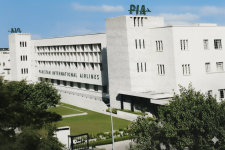
PIA’s operations began from Karachi in 1955 with the establishment of the Pakistan International Airlines Corporation (PIAC).
In 1956–57, a project was launched to construct PIA’s head office near Karachi Airport, aiming to manage all administrative affairs of the new national airline from a single center. The initial construction of the PIA Building was completed between 1958 and 1959.
Designed in a modern architectural style by leading Pakistani and foreign engineers of the time, the building represented contemporary design excellence.
The construction was supervised by the Civil Aviation Department along with PIA’s early Engineering and Finance wings.
According to government records from 1958–60, a huge amount was spent on developing PIA’s core infrastructure, which included the Karachi head office, maintenance base, and staff housing colonies.


Jango
THINK TANK: CONSULTANT
But but but Fauji foundation is private sector.
UAE to acquire stack in Fauji to settle 1 billion of the 3 billion debt on government of Pakistan.
@Jango
Sir already awaiting an answer

Also...I thought Fauji Foundation was a separate civilian entity. So why is the UAE buying $ 1 billion shares in a private entity as a sovereign guarantee for a loan?
Curious to hear ab hamain is deal kay fazayel kaun bataye ga, and the new ways in which our intelligence is yet again insulted.
Curious to hear ab hamain is deal kay fazayel kaun bataye ga, and the new ways in which our intelligence is yet again insulted.

Ab to respond karnay ka dil bhi nhn karta. If someone chooses to be so ignorant and belligerent, or take everyone else for a fool, just smile and wave...

Meengla
Elite Member
Ab to respond karnay ka dil bhi nhn karta. If someone chooses to be so ignorant and belligerent, or take everyone else for a fool, just smile and wave.
I guess this was directed to @mythbuster to respond while you desperately cling to terminologies to make a political point. As far as I am concerned: I don't GAF who bought PIA. As long as there is less burden on Pakistan's economy, more options for the passengers, every Pakistani should be happy.
Let's have this conversation some years later. If not December 2026 then, per a poster above, starting with early 2027. But the facts should be obvious by December 2030. And facts would speak for themselves. Until then... you and others of a certain political background can hope and pray for PIA's downfall. You'd be disappointed though.
Users who are viewing this thread
Total: 1 (members: 0, guests: 1)
Pakistan Defence Latest
-
 Federal cabinet gives nod to imposition of emergency in KP; summary sent to president (24 Viewers)
- Latest: IceCold
-
 KP govt backs out of counterterrorism commitments during talks: Naqvi (8 Viewers)
- Latest: hydrabadi_arab
-

-

-
Country Watch Latest
-
-
 India Has Lost Air Superiority to Pakistan, No Jets Left to Fight (12 Viewers)
- Latest: Vikramaditya1
-

-
-

Latest Posts
-
Federal cabinet gives nod to imposition of emergency in KP; summary sent to president (24 Viewers)
- Latest: IceCold
-
-
-
India Has Lost Air Superiority to Pakistan, No Jets Left to Fight (12 Viewers)
- Latest: Vikramaditya1
-
 Makkah Defence Alliance: Turkey, Saudi Arabia, and Pakistan, news & updates (23 Viewers)
- Latest: El Sidd