
Mighty_Dragon_Strike
Trusted Member

find and watch some videos of unexploded FAB bombs, which weigh around a tonneWhy is that you think? Why would it land on the ground without disturbing the ground or creating an impact crater?
Follow along with the video below to see how to install our site as a web app on your home screen.
Note: This feature may not be available in some browsers.
find and watch some videos of unexploded FAB bombs, which weigh around a tonneWhy is that you think? Why would it land on the ground without disturbing the ground or creating an impact crater?

This isn't a FAB bomb. How much do you think it weighs?find and watch some videos of unexploded FAB bombs, which weigh around a tonne

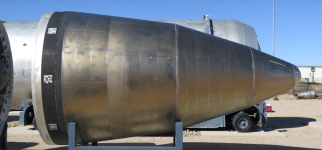
The engineer and rocket nerd in me is so intrigued by this picture.
It definitely LOOKS like the Ababeel payload fairing. It looks intact though and doesn't seem like the standard clamshell separation/jettison type which is strange.
That set of thrusters is also very interesting. They could be from the Post-Boost Vehicle/payload bus since I doubt that they would be used for fairing separation.
Also, looking at the "roughness" / "crudeness" / "build quality" of the thrusters, they're definitely Made in Pakistan.
Would appreciate @JamD's insights.
Firstly, I think that guess of separation mechanism seems spot on.my guess is that since it is small diameter ( 5.9 ft) this is simpler and cheaper solution to the clamshell design , for eg flacon 9 is 12 ft .
View attachment 162834
and boosters are at the top and angled downwards ,so they work Like Saturn 5's LES , and effectively lifting the whole payload fairing in one go
View attachment 162832
The implication being that I am responsible for all launches at specific times and locations not being seen near population centers? You do realize it's kind of rare for the launch to be:Any reason why it's only been noticed now for the very first time since 1989?


Yes considering the reduced range, it does look like a modified Ababeel(for conventional delivery). Maybe new upcoming Fateh ??This is way too small to be considered as the fairing of ABABEEL...looks super flimsy and light,the supposed thruster wont provide much thrust even for manuvering the bus in outer space and if that thruster is real(can be bought on ebay) then where is the rest of the PBV or bus ....and why is it shinny like it was painted just back in awaran...the nose of cones of thes missile are heavy and made from carbon composites or alloys...they are quite thick...below is nose cone of the peacekeepr icbm...
View attachment 165378
Ababeel and the role it plays isn't viable for conventional strikes even the iranian concept of using khoramshar-4s submunitions for conventional strikes isn't very efficient IMO(not an expert) we do have the Ghaznavi for smaller ranges..(its probably in goodish numbers as it was one of the first type of missile bought with tot from china).Yes considering the reduced range, it does look like a modified Ababeel(for conventional delivery). Maybe new upcoming Fateh ??
I had asked @Panzerkiel (i think) about it some time ago about the accuracy of the MLRS being improved because they had been missing their targets a lot...so according to him they were already being improved upon after the may conflict..so i think they are being worked up.while going through last few days post on the india-pak conflict thread the question just popped in my head if we are working to improve the CEP of Fatah series. If i am not mistaken Fatah 1-2 have a CEP of around 10-15 meters.
Given the fact that the next war will be more aggressive shouldn't we be focusing on improving the CEP and resilience of the Fatah series?
Thank you for the reply. I missed that post of yours and the reply too.Ababeel and the role it plays isn't viable for conventional strikes even the iranian concept of using khoramshar-4s submunitions for conventional strikes isn't very efficient IMO(not an expert) we do have the Ghaznavi for smaller ranges..(its probably in goodish numbers as it was one of the first type of missile bought with tot from china).
but if its a new system for the rocket force then its great..but considering shorter range missiles just dont dump there nosecones like this..so probably a propaganda piece.
I had asked @Panzerkiel (i think) about it some time ago about the accuracy of the MLRS being improved because they had been missing their targets a lot...so according to him they were already being improved upon after the may conflict..so i think they are being worked up.
Despite years of crap in SPD orgs, there is still enough talent there that Pakistan can make brilliant designs and products. Our Achilles heel is thinking about it industrially. For example, when Iran makes a BM and puts it into production they likely think about how the production line is going to work and how many they can produce annually. Whereas for Pakistan the question is can we make 1 or 2 in a lab somewhere in a mountain? When you have such low numbers you don't establish processes/jigs/lines anything. The way normal orgs make prototypes, we make final products. So Taimoor ALCM is a great system but can Pakistan make 10 of those annually? Unlikely. So it is not that some secret technology is missing. It is that the incentive structure is so warped that our entire R&D setup is design heavy and production (polio) light. Just look at all the products GIDS displays (often new products everytime) at tradeshows. It's like Pakistan has a Lockheed Martin Boeing but there's literally no market. The business model (hope) is to show designs, fish for investment, and use that investment to do production. I haven't seen much success of this model so far. You need to demonstrate some basic level of production to secure any sales - contracts can't be signed on promises that we will figure out how to produce this at scale once you give us the money.@JamD
Thanks for the great technical contributions to the thread. Your claims that Pakistan still lacks in critical aspects of missile technology is quite worrying, especially as Pakistan has had decades of experience in missile production. If they are still struggling, then that means the technical knowledge isn’t as developed as we often assume, and might not even compare to Iran and North Korea, let alone India.
The issue is that Pakistan may have decades of experience producing missiles, but it lacks both the experience and capacity to produce those missiles at scale.
This is an economic problem in general and an industrial constraint in particular. We don't have policies, let alone mechanisms and funding, geared towards industrial defence programming.
Hence why we're at a point where some folks (including our resident ex-PAF IR scholar) are stuck on PAC apparently being better at making JF-17s than HAL is with Tejas, but completely, entirely, and shamelessly ignoring how HAL can source alloys, composites, DEECs inputs, gas turbine inputs, flight control systems, etc, etc, all indigenously while PAC must import all of that from China or other sources.
In general, our side can't even converse or think clearly on this matter, much less come to an understanding of what's necessary, hence why people like @JamD have to repeat this over and over and over again until it lands.
And the bigger tragedy is that we did have industrial experts, i.e., the many folks and entities that contributed towards our nuclear program. Thus, if nat-sec leadership held itself accountable, we probably could rekindle the spirit and start building that industrial capacity.
There are pockets of brilliance that are responsible for the majority of the successes. Very small pockets that shrink each passing day. I've written about the reasons for the decline of SPD orgs way too much at this point and I don't want to repeat myself.Thanks for the additional insights. Having read The Islamic Bomb, Eating Grass and Mansoor Ahmed’s Pakistan’s pathway to the bomb, I have been amazed at the resilience and resourcefulness, not to mention the sheer determination, of Pakistan’s nuclear establishment in getting the bomb. I imagined similar trait existed in the missile program. Unfortunately, it seems GHQ has also poisoned Pakistan’s strategic community by introducing politics and toxicity.


