View attachment 78245
By Tahir Qureshi
New Delhi: India conducted five nuclear tests on 11 May 1998 and 13 May 1998 at Pokhran, Rajasthan and the news spread like wildfire. Pakistan PM Nawaz Sharif was under immense pressure from Pakistanis within the country and from outside the country as well to give a “befitting reply” to the arch-rivals.
Pakistan conducted its nuclear tests a few days later on 28 May 1998 and 30 May 1998 in the Chagai Hills of Balochistan Province.
In India, there was a joke doing the rounds:
Why did Pakistan take 17-18 days to blast their device?
Because the instructions were in Chinese.
Reportedly, China supplied a nuclear reactor to Pakistan in 1993 and nuclear technology before that for the Chashma Nuclear Power Plant helped to achieve it.
Whatever it was, it was over, now it was up to Pakistan’s missile programme as it conducted one missile test after the other which it said was to match India’s might.
Given the involvement of China in Pakistan’s defence sector, Pakistan’s missile programme has been under scrutiny and suspicion by defence experts.
The experts are of the view that Pakistan’s missiles have been based on imported technology, specifically China, and to some extent, North Korea.
“Many of Pakistan’s missiles, ranging from man-portable air-defense systems (MANPADS) like the Anza series to its medium-range ballistic missiles (MRBMs), show signs of being repurposed or rebranded versions of Chinese missiles,” says idrw.org (Indian Defence Research Wing).
IDRW has pointed out that the following missile systems are taken from Chinese systems:
Anza man-portable air-defence systems (MANPADS) and the Chinese QW-1
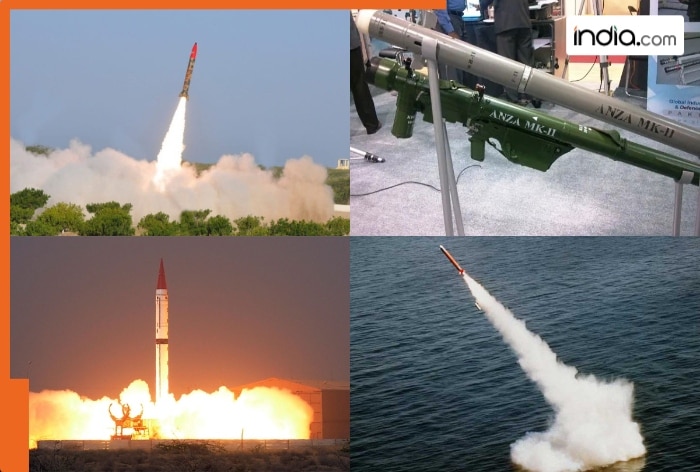
The Anza is a series of shoulder-fired, man-portable surface-to-air missiles guided by an infrared homing seeker. It is a short-range missile used for air defence. The Anza series of MANPADS was initially presented as an indigenous creation. However, analysts have pointed out strong similarities between the Anza MK-I and MK-II systems and China’s QW-1 series. The Anza MK-III also shares similarities with the QW-2, an improved version of China’s own MANPADS.
2. The Shaheen Missile and the Chinese DF and M-Series
According to the IDRW, Pakistan’s Shaheen series, ranging from the short-range Shaheen-I to the medium-range Shaheen-III, shares many design and operational similarities with the Chinese DF-11 and DF-15 ballistic missiles.
3. Abdali Missile Series and China’s DF and M-Series
The Abdali missile series has the characteristics of the M-11 missile of China’s M-series.
The Abdali missile system was initially rejected by the Defense Ministry during which opted to acquire Chinese M-11 missiles in 1994. In 1993, the Pakistani government initiated discussions regarding the acquisition of M-11 missiles from China for rapid deployment. However, while Pakistan succeeded in procuring the M-11 missiles, attempts to reverse-engineer the Chinese system to extend its range and add nuclear capability were unsuccessful.
4. Ghauri and Shaheen medium-range ballistic missiles (MRBMs): Blending of Chinese and North Korean Designs
The Ghauri missile, one of Pakistan’s medium-range ballistic missile (MRBM) programs, has created a buzz that Ghauri and Shaheen MRBMs are based on Chinese and North Korean technologies.
5. Babur Missile has Stamps of China’s C-602 and C-802
Babur missile was tested by Pakistan in 2005 and its performance surprised even the USA and American analysts levelled serious allegations on China of helping Pakistan when they pointed out the similarities of the missile with Chinese and American designs, namely the DH-10 and Tomahawk, reports idrw.org.
“Pakistan’s entry into cruise missile technology also bears a Chinese influence, particularly in its Babur and Ra’ad series. The Babur cruise missile, designed for land-attack missions with a range of approximately 700 km, has structural and technical similarities with China’s C-602 cruise missile. Its range, guidance system, and flight profile closely mirror those of the Chinese missile, suggesting a transfer or adaptation of Chinese cruise missile technology,” adds the report.
6. Ra’ad Cruise Missiles and China’s C-802 missile
The Ra’ad is an air-launched cruise missile and has a striking resemblance to China’s C-802 missile. Both Ra’ad and C-802 are subsonic and low-flying designed to evade radar detection. These missiles provide Pakistan with a standoff capability against high-value targets, but they appear to be derived from China’s established cruise missile technologies.
7. The Nasr Tactical Ballistic Missile and China’s WS Series
The Nasr missile, developed for tactical nuclear warfare, has a short range of around 60-70 km and is designed to be highly mobile and quickly deployable. Many defence experts believe it draws from China’s WS-2 tactical ballistic missile. Both systems share similar launch platforms and capabilities, providing Pakistan with a tactical deterrent against conventional military incursions.
8. P-282 (SMASH) and China’s CM-401
Pakistan tested the SMASH missile, also known as P-282, on November 5. It is believed to be a copy of the Chinese CM-401 anti-ship ballistic missile (ASBM).
“Leaning on Chinese support for security, Pakistan conducted a test launch of a new ship-based ballistic missile, reportedly named ‘SMASH,’ with a range of 350 kilometers,” is how india.com described this missile.
According to IDRW and Indian Open Source Intelligence Networks (OSINT), the Pakistani Navy developed the missile with the help of Chinese technology, specifically the CM-401 Anti-Ship Ballistic Missile.
The experts are of the view that Pakistan’s missiles have been based on imported technology.

www.india.com