Pakistan Space Related News & Discussions

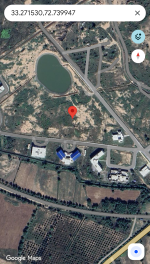
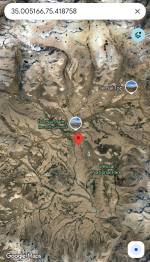
Co-ordinates for site selected for Pakistan's Deep Space Astronomical Observatory.

35.0051658, 75.4187581

Deosai Plains, Pakistan

Screenshot_20260813-180555_Maps.png
 
Pakistan's first lunar rover named 'Jinnah-1': Suparco
News Desk
Published August 13, 2026

1786641231659.png
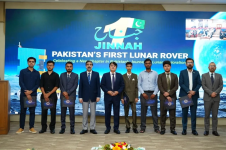
Tayyab Karim, a 17-year-old from Bahawalnagar, was named as the winner for proposing the name 'Jinnah-1' for Pakistan's first lunar rover. —Photo courtesy of Suparco

Pakistan Space and Upper Atmosphere Research Commission (Suparco) on Thursday announced “Jinnah-1” as the official name of the country’s first lunar rover.

The rover is scheduled to be sent to the Moon in 2029 as part of China’s Chang’e-8 mission, where it will conduct scientific research at the lunar south pole, Suparco said.

The Moon’s south pole is known for its challenging terrain and potential to yield significant scientific discoveries.

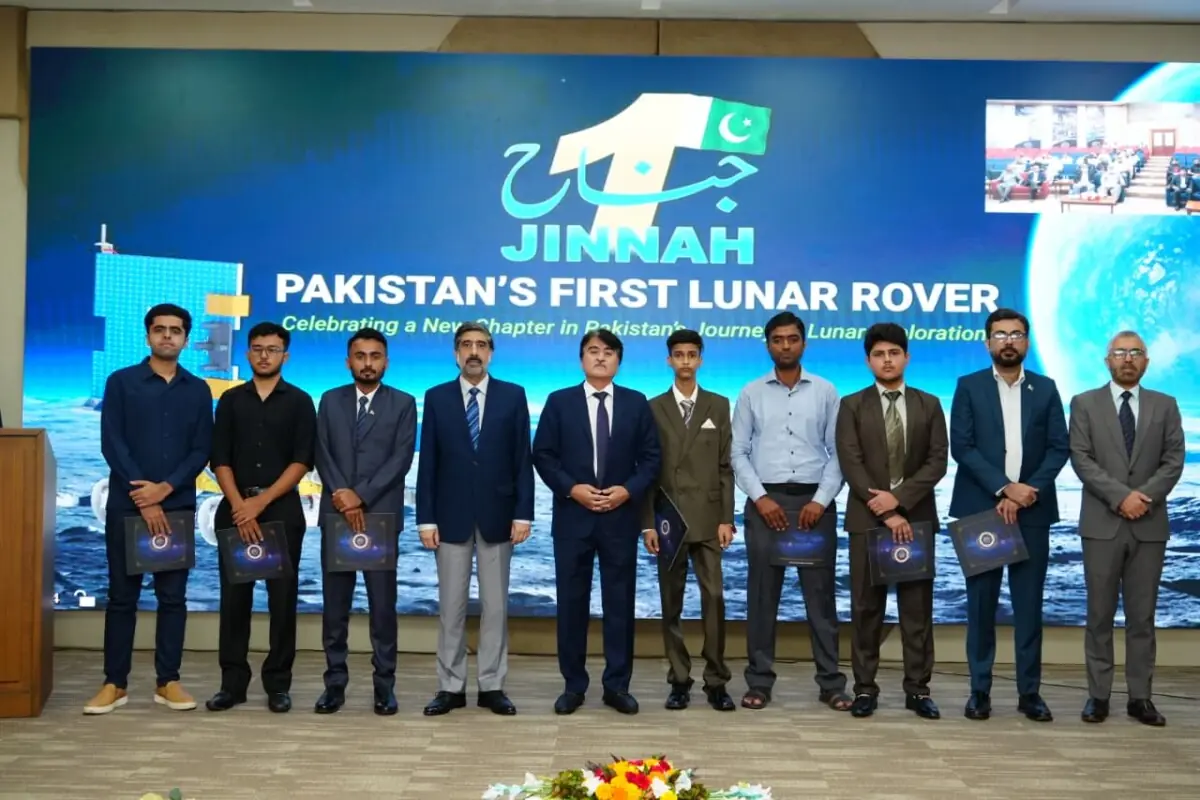
In a ceremony held in Islamabad, Suparco said that the name was selected from 4,000 proposals received in a countrywide competition.

Seven participants had proposed the name “Jinnah-1” and the winner was selected through a lucky draw, according to a statement from Suparco.

Tayyab Karim, a 17-year-old from Bahawalnagar, was declared the winner for proposing the name, Suparco said.

The name pays tribute to Quaid-i-Azam Muhammad Ali Jinnah and symbolises “Pakistan’s resolve, progress and new space horizons”, Suparco Chairman said.

Jinnah-1 will study plasma, radiation and the lunar surface’s geology, as well as conduct key experiments related to future lunar research and the prospect of human presence on the Moon, Suparco said.

1786641284777.png
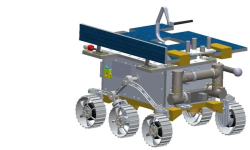
Pakistan’s first lunar rover, Jinnah-1, will be a part of China’s Chang’e-8 mission to the Moon’s south pole in 2029. —Photo courtesy of Suparco

Suparco announced the collaboration with China’s Chang’e-8 mission in 2024.

“This collaboration marks a significant milestone for Pakistan’s space programme, as Suparco’s indigenous rover will be part of the mission to explore the lunar surface,” the space agency said at the time.

Nasa is targeting 2028 for the first-ever landing of astronauts on the Moon’s south pole, as part of Artemis IV, seeking to beat China’s planned crewed mission, Chang’e-8, to the same lunar region.

In 2023, India managed to land a craft — the unmanned Chandrayaan-3 — near the Moon’s south pole.

Its landing came days after a Russian probe crashed in the same region and four years since the previous Indian attempt failed at the last moment.


Pakistan names first lunar rover ‘Jinnah-1’​

Published August 13, 2026

1786641816277.png

By BR Web Desk

Pakistan’s first lunar rover has officially been named “Jinnah-1”, the Pakistan Space and Upper Atmosphere Research Commission (SUPARCO) announced on Thursday.

The name was selected by a jury after a comprehensive review of more than 4,000 entries received from across the country in a nationwide naming competition, reflecting strong public interest in Pakistan’s space exploration programme.

According to SUPARCO, seven participants had proposed the name “Jinnah-1”. A draw was subsequently held during a special ceremony to select the winner fairly among the participants.

Addressing the ceremony, SUPARCO Chairman Muhammad Yousuf Khan appreciated the enthusiastic participation of citizens and highlighted the national significance of naming the rover after Quaid-e-Azam Muhammad Ali Jinnah, the founder of Pakistan.

“Jinnah-1 is not merely a name but a symbol — of resilience, determination and the pursuit of progress that was exemplified by our founder, Quaid-e-Azam Muhammad Ali Jinnah,” he said.

“By naming our first lunar rover after him, we are sending a strong message to the world that Pakistan is ready to carry forward its legacy, determination, hard work and leadership to new frontiers, particularly in the realm of space,” he added.


SUPARCO said Jinnah-1 will be launched to the Moon’s south pole in 2029 as part of China’s Chang’E-8 mission.

The locally developed rover will be equipped with advanced scientific instruments to study lunar plasma and radiation, map the geographical features of the lunar surface, and conduct experiments vital for future lunar research and sustainable human presence on the Moon.

The mission marks a significant step in Pakistan’s efforts to expand its capabilities in space science and lunar exploration.

 
Last edited:

Pakistan names first lunar rover ‘Jinnah-1’​

Published August 13, 2026

View attachment 210608

By BR Web Desk

Pakistan’s first lunar rover has officially been named “Jinnah-1”, the Pakistan Space and Upper Atmosphere Research Commission (SUPARCO) announced on Thursday.

The name was selected by a jury after a comprehensive review of more than 4,000 entries received from across the country in a nationwide naming competition, reflecting strong public interest in Pakistan’s space exploration programme.

According to SUPARCO, seven participants had proposed the name “Jinnah-1”. A draw was subsequently held during a special ceremony to select the winner fairly among the participants.

Addressing the ceremony, SUPARCO Chairman Muhammad Yousuf Khan appreciated the enthusiastic participation of citizens and highlighted the national significance of naming the rover after Quaid-e-Azam Muhammad Ali Jinnah, the founder of Pakistan.

“Jinnah-1 is not merely a name but a symbol — of resilience, determination and the pursuit of progress that was exemplified by our founder, Quaid-e-Azam Muhammad Ali Jinnah,” he said.

“By naming our first lunar rover after him, we are sending a strong message to the world that Pakistan is ready to carry forward its legacy, determination, hard work and leadership to new frontiers, particularly in the realm of space,” he added.


SUPARCO said Jinnah-1 will be launched to the Moon’s south pole in 2029 as part of China’s Chang’E-8 mission.

The locally developed rover will be equipped with advanced scientific instruments to study lunar plasma and radiation, map the geographical features of the lunar surface, and conduct experiments vital for future lunar research and sustainable human presence on the Moon.

The mission marks a significant step in Pakistan’s efforts to expand its capabilities in space science and lunar exploration.

According to official Chinese sources, the Chang'e-8 mission has been cancelled.

China Lunar Exploration Project (CLEP); also known in Chinese as the Chang'e Project.
China's manned lunar exploration program is another lunar exploration project in China.

In May 2026, the China Manned Space Agency (CMSA) announced the merger of two projects into a single project. The merged entity was known as the "Lunar Exploration Project". It was decided during the subsequent implementation of the merger that the Chang'e-8 mission would be cancelled. The Chang'e-7 mission will be the final mission of the CLEP.

The mission payloads originally slated for Chang'e-8 are currently still under discussion.
Regarding Pakistan's lunar rover, current information suggests it will be carried to the moon on another lunar mission in 2030/2031.
 
According to official Chinese sources, the Chang'e-8 mission has been cancelled.

China Lunar Exploration Project (CLEP); also known in Chinese as the Chang'e Project.
China's manned lunar exploration program is another lunar exploration project in China.

In May 2026, the China Manned Space Agency (CMSA) announced the merger of two projects into a single project. The merged entity was known as the "Lunar Exploration Project". It was decided during the subsequent implementation of the merger that the Chang'e-8 mission would be cancelled. The Chang'e-7 mission will be the final mission of the CLEP.

The mission payloads originally slated for Chang'e-8 are currently still under discussion.
Regarding Pakistan's lunar rover, current information suggests it will be carried to the moon on another lunar mission in 2030/2031.
So, the robotic and manned missions have been combined into a single programme, now known as the “Lunar Exploration Project”.
 
So, the robotic and manned missions have been combined into a single programme, now known as the “Lunar Exploration Project”.
Although both are part of China's lunar exploration efforts, they were previously led and operated by distinct teams and organizational systems.

Now, merging them into a single project allows for significant resource savings and accelerated development.

CLEP is a project of the China National Space Administration (CNSA), which is a purely civilian agency.
The crewed lunar exploration program falls under the China Manned Space Agency (CMSA); as the CMSA is a military agency, this initiative is classified as a civil-military integration project.
 
Although both are part of China's lunar exploration efforts, they were previously led and operated by distinct teams and organizational systems.

Now, merging them into a single project allows for significant resource savings and accelerated development.

CLEP is a project of the China National Space Administration (CNSA), which is a purely civilian agency.
The crewed lunar exploration program falls under the China Manned Space Agency (CMSA); as the CMSA is a military agency, this initiative is classified as a civil-military integration project.

Thanks for the information. I wasn't aware that China had a civilian run agency alongside a military one.
 

China's space diplomacy lifts Pakistani astronaut toward orbit​

Reuters
September 28, 2026

1790592943335.png

Pilots Zeeshan Ali and Khurram Daud have spent months training at the China Astronaut Research and Training Center in Beijing. —PMO/File

Two Pakistani pilots are memorising Mandarin, spinning in centrifuge drills and learning to eat, sleep and repair equipment while weightless as a decision nears on which one will become the first foreign astronaut aboard China’s Tiangong space station.

The voyage into space would be a first for the South Asian nation. It is part of broader cooperation with Beijing that straddles the Belt and Road Initiative and has produced Chinese-launched Pakistani satellites, a joint satellite-navigation system and a Pakistani-built rover due to fly on China’s Chang’e 8 lunar mission around 2028.

Pilots Zeeshan Ali and Khurram Daud have spent months training at the China Astronaut Research and Training Center in Beijing for a mission that was conceived by the two countries in 2019, said Amer Gilani, who oversees human spaceflight cooperation at Pakistan’s space agency, Suparco.
 
China has not said which of the two will fly or when, but Gilani said a final astronaut selection decision is expected in mid-to-late October.

Whoever is chosen will not return to Pakistan before launch, setting off into space directly from training in China and returning home after a recovery period following the return to Earth, Gilani told Reuters in an interview.

Training includes intensive Chinese-language instruction, learning spacecraft systems, and adapting to both the microgravity of orbit and the g-forces of liftoff, he added.

The two men beat out roughly 20 finalists culled from an initial Pakistani pool of pilots and scientists, screened for medical fitness, psychological resilience and, according to Suparco’s director of artificial intelligence Uzair Ansari, a tolerance for g-forces that few scientists possess.

“You cannot easily find scientists who are familiar with travelling and facing high-level g-forces,” he said, explaining this is why the two men with backgrounds in high-speed flying were chosen.

The details shared by Gilani and Ansari are the first insight provided by Suparco to foreign media since the pilots were selected and deployed to China.

China’s space agency did not respond to a request for comment about the selection process.
 

Users who are viewing this thread

Pakistan Defence Latest

Country Watch Latest

Back
Top