Pakistan Space Related News & Discussions

Europa is believed to have a liquid ocean under the ice crust

is there any Chinese development in this regard, because the US is already developing breakthrough starshot
China is also planning to send probes to explore Jupiter and Neptune, and venture out solar system, maybe launched in 2030s.
 
If USA can send Kate Perry, Pakistan will send Maryam nawaZ as astroNAUGHT
 

Two Pakistani astronauts to receive spaceflight training in China​


2025-04-23 12:36:00
BEIJING, April 23 (Xinhua) -- China will select and train two Pakistani astronauts for space missions, with one slated to serve as a payload specialist on a future Chinese space station flight, the China Manned Space Agency (CMSA) announced on Wednesday.

The selected Pakistani astronaut will conduct scientific experiments designed by Pakistan while performing regular crew responsibilities when in orbit, CMSA spokesperson Lin Xiqiang told a press conference in Jiuquan in northwest China.

The selection process for Pakistani astronauts is underway following the signing of a bilateral cooperation agreement in late February, Lin said.

The selection involves a three-round procedure that includes a preliminary selection phase in Pakistan, and secondary and final selection phases in China, Lin said.

Lin noted that China is currently engaged in discussions with other nations regarding potential foreign astronaut participation in the country's future space station missions.


==========================================
Payload specialist.
This should be a scientist rather than a pilot. So, it is highly likely that a PAF pilot is excluded.

Joint flight.
I guess it means that 2 Chinese astronauts + 1 Pakistani astronaut will enter the Chinese Tiangong space station for a standard six-month space mission.

Two Pakistani astronauts came to China for training, and one of them will take part in the joint mission, which means the other is in backup status.
Live video of the press conference. (Chinese and English audio, no subtitles)


Pakistani astronaut will become first foreign national to enter Chinese space station​

CNN
Published 3:51 AM EDT, Thu April 24, 2025

A model of China's Tiangong space station, at the Shanghai Astronomy Museum in Shanghai, China, in 2021.

A model of China's Tiangong space station, at the Shanghai Astronomy Museum in Shanghai, China, in 2021.
Long Wei/FeatureChiina/AP/File

CNN —
A Pakistani astronaut will become the first foreign national aboard China’s Tiangong space station, as Beijing steps up space diplomacy amid a burgeoning battle with the United States for supremacy in orbit.

The mission of the Pakistani astronaut – who is yet to be selected – tightens already close space ties between Beijing and Islamabad. Last year, Pakistan sent a satellite to the Moon aboard China’s lunar explorer, alongside payloads from the European Space Agency, France, and Italy, according to Chinese state media.

Tiangong is one of two currently operating space stations, alongside the International Space Station, launched in 1998. Since it started operating in 2021, it has only hosted Chinese astronauts.

The mission is “a significant step in the internationalization of the Chinese space station,” said Quentin Parker, an astrophysicist and professor at the University of Hong Kong.

“When you internationalize things properly, you build something greater than the sum of the parts, and that’s true in the internationalization of the space station,” he said.

During a press conference on Wednesday, the China Manned Space Agency announced the astronaut selected will be a payload specialist, handling daily tasks during the mission, as well as scientific experiments for Pakistan.

Amjad Ali, deputy director of Pakistan’s space agency SUPARCO, lauded the news as a milestone for the South Asian nation, whose government is taking a renewed interest in its more than 60-year-old space program.

“It is very important for Pakistan, being the first foreign country whose astronauts are entertained by China and taken by the Chinese mission,” he told Reuters news agency on Wednesday.

Ali said Pakistan space bosses will compile a list of five to 10 candidates for the mission over the next month, for China to then shorten to two.

The pair will then go through training in China for six months to a year, with one eventually being sent to space as early as October next year, while the other acts as a reserve, Ali said.

Strategic partnership​

The two countries’ growing space ties coincide with their increasing economic collaboration and trade on Earth.

Under Beijing’s China-Pakistan Economic Corridor, a major project within its broader Belt and Road Initiative, China has invested heavily in infrastructure in the north and south of Pakistan, including a deep-water port in the southwestern city of Gwadar, as well as multiple technological projects between the two countries.

An agreement signed in February between the two countries on space cooperation was a precursor the mission announced Wednesday.

On Tuesday, a delegation from Chinese space tech company Galaxy Space met with Pakistan’s Prime Minister Shehbaz Sharif, according to a statement from Sharif’s office.

The delegation expressed a “keen interest in investing in Pakistan’s space technology industry and joint ventures with Pakistani space technology institutions and private telecom companies,” the statement added.

Sharif, calling China his country’s “most reliable friend and strategic partner,” said that Pakistan was “looking to increase cooperation with China in the fields of space technology, space satellites and satellite internet.”

Amer Gilani, who oversees human spaceflight cooperation at SUPARCO, told CNN that the experiments to be conducted during the planned mission were still being selected, but will have “high scientific, industrial and social impact.”

China has rapidly advanced its space power in recent decades through ambitious lunar and deep-space exploration programs, as well as expanding its space station.

On Thursday, another manned mission will launch from the Jiuquan Satellite Launch Center in northwestern China, carrying three astronauts to Tiangong.

The Shenzhou-20 crew is scheduled to blast off at 5:17 p.m. on Thursday local time (5:17 a.m. ET), state media reported on Wednesday. It will be the ninth crewed mission headed for China’s space station since it was fully assembled in 2022.

The main purpose of the mission is to complete the in-orbit rotation with the Shenzhou-19 crew, which is scheduled to return to earth on April 29, China Manned Space Agency officials said at a press conference.

While in space, the astronauts will conduct science and application experiments, install a space debris protection device, as well as extravehicular payload and equipment, and perform recovery tasks, according to the agency.

The mission will also carry small animals and organisms for life-science experiments at the space station. They will include zebrafish, flatworms known as planarians, and streptomyces bacteria.

China has signed nearly 200 intergovernmental space cooperation agreements with foreign countries and international organizations, covering fields from satellite development and lunar exploration to manned space flight, state media reported in December.

China’s space administration announced Thursday it has also approved loans of lunar samples collected by China’s earlier moon exploration mission to seven institutions across six countries, including Pakistan.

Parker, from the University of Hong Kong, emphasized the importance of international space cooperation.

“The way that things are in the world at the moment is increasingly complex – but it’s important that this outreach and collaborative spirit is maintained,” he said.

 
China-Pakistan relationship tugs new string of space collaboration, friendship
Published: Apr 26, 2025 09:53 PM

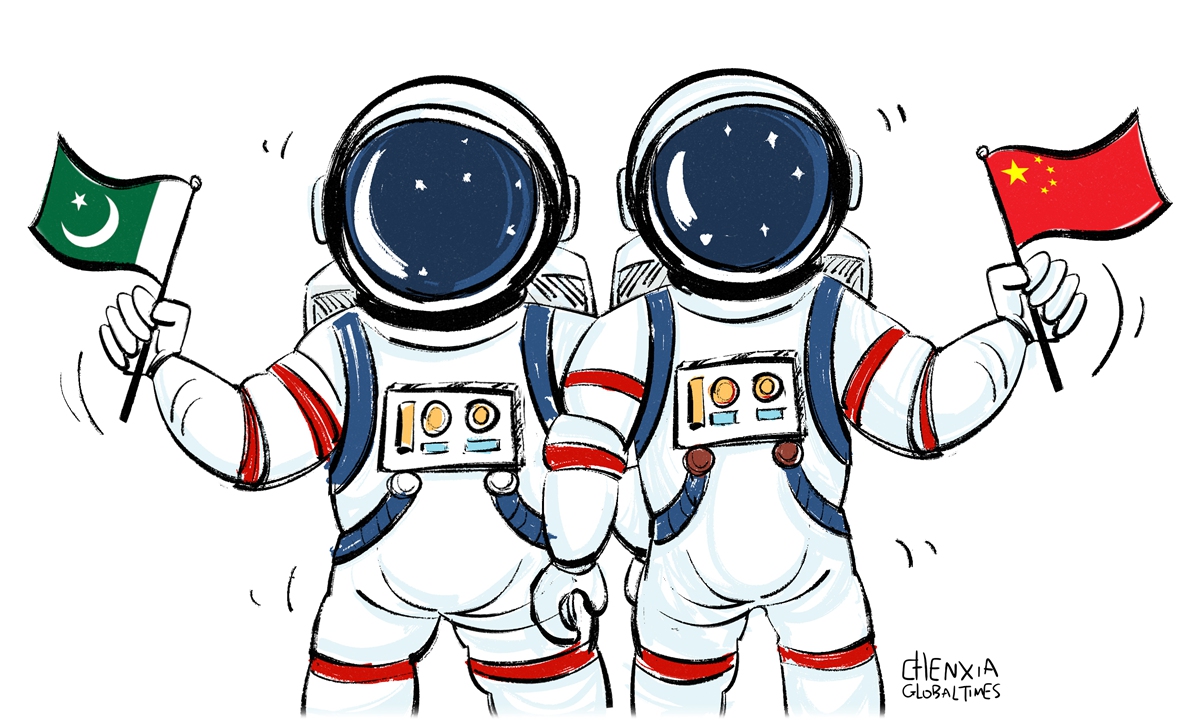
Illustration: Chen Xia/GT

Illustration: Chen Xia/GT

On Friday, the three astronauts aboard China's Shenzhou-20 spaceship entered the country's Tiangong space station and started a new round of in-orbit crew handover. A day earlier, when the Shenzhou-20 crewed spaceflight mission left the Jiuquan Satellite Launch Center in Northwest China, it marked another milestone in China's space development and is leading to a high point for China-Pakistan friendship. In the backdrop of Shenzhou-20, the Tiangong space station and China's space program, the tenacious China-Pakistan relationship will tug the new string of space collaboration and friendliness.

On Wednesday, the China Manned Space Agency announced that China will select and train two Pakistani astronauts for space missions, with one slated to serve as a payload specialist on a future Chinese space station flight. In February, China and Pakistan signed an agreement to send a Pakistani astronaut to the Tiangong space station, marking the first time a foreign national will be aboard the facility.

This is an epic development in space exploration for both China and Pakistan. The inclusion of a Pakistani astronaut in an international mission unveils an awesome milestone for Pakistan's space ambitions, seeking to deepen its scientific and technological cooperation with China.

Pakistani Prime Minister Shahbaz Sharif instilled profound avidity in expanding Pakistan-China cooperation in space technology, satellite communications and internet services during a meeting with a delegation from a Chinese space technology company in Islamabad on Tuesday. As a "very trusted friend" and "strategic partner," Sharif has envisioned Beijing as the cornerstone for Pakistan's ambitious space technology sector.

While China's space cooperation with Pakistan has set an exemplary case for cooperation between countries, the Shenzhou-20 spaceflight mission means a lot for the international community, especially the Global South.

Guided by the concept of building a community with a shared future for mankind, China's space program, making a new stride through Shenzhou-20, is working with other countries to carry out international space exchanges and cooperation, safeguarding outer space security, and striving for long-term sustainability in activities related to outer space.

By doing so, China is contributing more and more to protecting the Earth, improving people's well-being and serving human progress. Peaceful high-tech exploration, technological development and utilization of outer space are rights equally enjoyed by all countries. China calls on all countries to work together to build a community with a shared future for mankind and carry out in-depth exchanges and cooperation in outer space on the basis of equality, mutual benefit, peaceful utilization and inclusive development.

China's space initiatives are not self-centered. Rather, they safeguard the central role of the United Nations in managing outer space affairs, abiding by the Outer Space Treaty, in the formulation of international rules regarding outer space and promoting greater sustainability of space activities.

According to a white paper titled "China's Space Program: A 2021 Perspective" released by China's State Council Information Office in 2022, since 2016, China has signed 46 space cooperation agreements or memoranda of understanding with 19 countries and regions and four international organizations. It has promoted global governance of outer space, and carried out international cooperation in space science, technology and application through bilateral and multilateral mechanisms.

China has helped Global South countries to boost their space science and research, and build satellite research and development infrastructure. For instance, in Africa, China has strengthened space partnerships through investing in satellites, ground stations, and research infrastructure. Moreover, it has also pressed ahead with the construction of the Belt and Road Initiative Space Information Corridor, and opened China's space facilities to developing countries. China is taking the lead in making human progress.

 
Pakistan starts preliminary selection of astronaut candidates for China Space Station crewed spaceflight mission: SUPARCO deputy director

By Deng Xiaoci in Shanghai
Published: Apr 24, 2025 09:54 AM


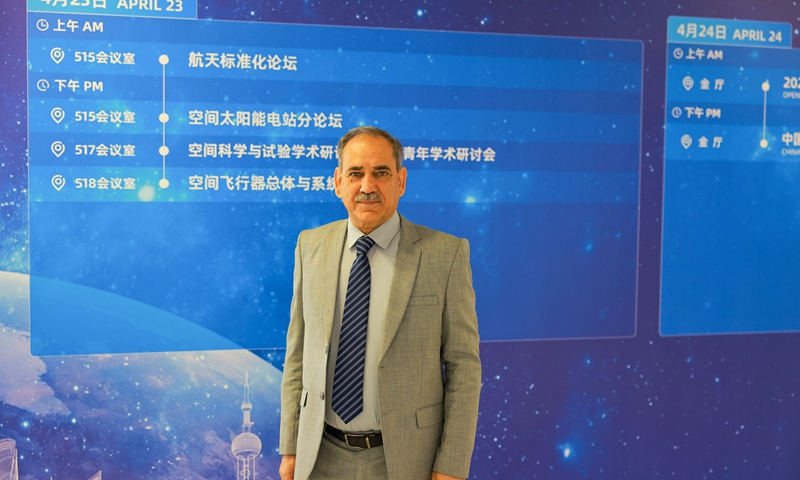
Amjad Ali, deputy director general of SUPARCO, Pakistan's national space agency Photo: Deng Xiaoci/GT

Amjad Ali, deputy director general of SUPARCO, Pakistan's national space agency Photo: Deng Xiaoci/GT

China and Pakistan in February signed a cooperation agreement on spaceflight of a Pakistani astronaut on China Space Station, the first time for a foreign astronaut, marking a new chapter of China-Pakistan aerospace cooperation. Updating on the process, Amjad Ali, deputy director general of SUPARCO, Pakistan's national space agency, revealed to the Global Times that they have started preliminary selection in Pakistan and they will select about 10 to 15 candidates.

"We will select about 10 to 15 candidates. And then they will be further shortlisted to two before they undergo through trainings in China for six months to a year. After the training there will be one candidate to fly into space," Ali told the Global Times on the sideline of the International Conference on Developers of the International Lunar Research Station, a seminar held in Shanghai on Wednesday, as part of the national celebration of the 10th Space Day of China that falls on Thursday.

It will be China's first foreign astronaut and Pakistan's first astronaut, so it is a big event for both sides, Ali hailed.

Earlier on Wednesday, the China Manned Space Agency (CMSA) announced that China will select and train two Pakistani astronauts for space missions, with one slated to serve as a payload specialist on a future Chinese space station flight, Xinhua reported.


Lin Xiqiang, a CMSA spokesperson addressed a Wednesday press conference that the selected Pakistani astronaut will conduct scientific experiments designed by Pakistan while performing regular crew responsibilities when in orbit.

The selection process for Pakistani astronauts is underway following the signing of a bilateral cooperation agreement in late February, Lin said.

The selection involves a three-round procedure that includes a preliminary selection phase in Pakistan, and secondary and final selection phases in China, Lin said.

Lin noted that China is currently engaged in discussions with other nations regarding potential foreign astronaut participation in the country's future space station missions.

China has announced that its first astronauts from the Hong Kong and Macao special administrative regions, selected as payload specialists, are on track to make their inaugural spaceflight as early as 2026, Lin said at the conference.
 
China National Space Agency Shares Moon ‘Wealth’ with International Scientists
Friday / 25 April 2025

LED-25-April-ChangE-5-Sample-Awardees2.jpg


Zhongde Shan, CNSA Director, announced 24 April, China Space Day that 7 applicants are awarded lunar regolith samples from Chang’E-5 for scientific research; awardees are
  • Institute of Geophysics of Paris (France),
  • University of Cologne (Germany),
  • Osaka University (Japan),
  • Space and Upper Atmosphere Research Commission of Pakistan,
  • Open University of United Kingdom,
  • Brown University of United States and Stony Brook University of State University of New York,
with 5 signing “Lunar Sample Loan Agreement” that day; Shan emphasizes China lunar exploration program follows principles of equality, mutual benefit, peaceful use and cooperative success

Credits: CNSA, IPGP, U of Cologne, The Open U, Brown U, Osaka U, Stony Brook, SUPARCO; Dir. Zhongde photo courtesy Harbin U


China to lend moon rocks to NASA-funded US universities

By Eduardo Baptista
April 24, 2025 11:43 AM


Screen shows news footage of a Chinese national flag carried by Chang'e-6 probe's lander on the moon, in Beijing

[1/2]A large screen shows news footage of a Chinese national flag carried by Chang'e-6 probe's lander on the far side of the moon, in Beijing, China June 4, 2024. REUTERS/Tingshu Wang/File Photo Purchase Licensing Rights,

1747090027826.jpeg
[2/2] The Chang'e 6 lunar probe and the Long March-5 Y8 carrier rocket combination sit atop the launch pad at the Wenchang Space Launch Site in Hainan province, China May 3, 2024. REUTERS/Eduardo Baptista/File Photo Purchase Licensing Rights


Summary
  • China says it will let US scientists analyse moon rocks
  • China became third country to collect moon rocks in 2020
  • China-US collaborate in space despite tensions
SHANGHAI, April 24 (Reuters) - China's national space agency announced on Thursday it would let scientists from the U.S. and allied countries analyse rocks it retrieved from the moon, Beijing's latest move to increase the international influence of its lunar exploration programme.

The announcement highlights how U.S.-China cooperation in some areas like space has not completely ended, despite tensions between the two countries over geopolitics and tariffs.

Two U.S. universities that receive NASA funding, Brown University and the State University of New York at Stony Brook, are among the seven institutions that have been allowed to borrow lunar samples China retrieved from the moon in 2020.

The remaining authorised institutions are from Japan, France, Germany, Britain, and Pakistan.

With its uncrewed Chang'e-5 mission in 2020 China became only the third country to collect rocks from the lunar surface, joining the Soviet Union and the United States, which last went to the moon and retrieved samples in 1972.

China's subsequent uncrewed Chang'e-6 mission, completed in June last year, made it the first country to bring back rocks from the side of the moon facing away from Earth.

U.S.-China cooperation on space has long been deterred by a 2011 U.S. law that seeks to ensure American technologies stay out of the hands of China's military. Under the law, NASA must work with the FBI to certify to Congress that any such talks with China would not threaten U.S. national security.

NASA head Bill Nelson told Reuters in October that NASA and the China National Space Administration (CNSA) were discussing the terms of Beijing's loan agreement for the Chang'e-5 moon rocks after he assured American lawmakers that the talks would not pose national security concerns.

Four U.S. universities had applied for access to the Chang'e-5 samples, Nelson said then, adding he thought the talks would end with China agreeing to provide access to samples.

However, he said he expects NASA to have to work with the FBI for another national security certification to enable any moon rock deliveries to U.S. universities for research.

Beijing hopes to use its space prowess to forge closer political ties with close partners and U.S. allies alike.

"It seems the United States is quite closed off now despite being open in the past, while we were closed off in the past and are now open; this is because of the increase in our nation's overall strength and consequent rise in self-confidence," Wu Weiren, chief designer of China's lunar exploration programme, told Reuters in an interview on Wednesday, adding that growing U.S. "isolationism" would not help its space ambitions.

A CNSA official said on Wednesday the Chang'e-4 and 6 missions had four international payloads, while the Chang'e-7 mission next year will have six international payloads and "cooperation with 10 countries" is being discussed for the subsequent Chang'e-8 mission.

China hopes Chang'e-7 and 8 can help provide the information it needs to decide where and how to build a permanent manned lunar base by 2035.

Reporting by Eduardo Baptista; Editing by William Maclean

 
Last edited:
Astronaut mission – Pakistan set sights on stars
Under this agreement, two Pakistani astronauts will undergo rigorous training at Astronaut Centre of China.

APP
May 12, 2025

ISLAMABAD: In a milestone that marks a new chapter in Pakistan's scientific evolution, the nation is preparing to send its very first astronaut into space – an achievement once seemed a distant dream, now transforming into a tangible reality.

With the ink freshly dried on a landmark cooperation agreement between Pakistan's national space agency Suparco and the China Manned Space Agency (CMSA), the countdown has begun for a historic journey to Chinese Space Station (CSS), Tiangong.

Under this agreement, two Pakistani astronauts will undergo rigorous training at Astronaut Centre of China. One of them will ultimately be chosen as a scientific payload specialist, entrusted with conducting advanced research aboard the CSS.

The selection process, slated for completion by 2026, will culminate in the astronaut joining one of China's upcoming missions. The significance of this venture extends far beyond the symbolic achievement of a Pakistani in space.

The astronaut's mission aboard the CSS will include cutting-edge scientific experiments in biology, fluid mechanics, medical science, material studies, space radiation and more fields with far-reaching implications for life on Earth.

The Chinese station is equipped with state-of-the-art research modules that offer a unique microgravity environment, allowing scientists to conduct studies impossible to replicate on Earth.

"This agreement is a landmark in Pakistan's space journey," said Space and Upper Atmosphere Research Commission (SUPARCO) Chairman Mohammad Yousuf Khan. "It reflects our perseverance, adaptability, and technological strides we have made in recent years."


Users who are viewing this thread

Pakistan Defence Latest

Latest Posts

Back
Top