Navigation
Install the app
How to install the app on iOS
Follow along with the video below to see how to install our site as a web app on your home screen.
Note: This feature may not be available in some browsers.
More options
Style variation
You are using an out of date browser. It may not display this or other websites correctly.
You should upgrade or use an alternative browser.
You should upgrade or use an alternative browser.
Pakistan Space Related News & Discussions
- Thread starter ghazi52
- Start date
More options
Who Replied?


ghazi52
THINK TANK: CONSULTANT
- Thread starter
- #213
Growing space cooperation between Pakistan, China presents risks and opportunities, experts say
March 03, 2025By Sarah Zaman
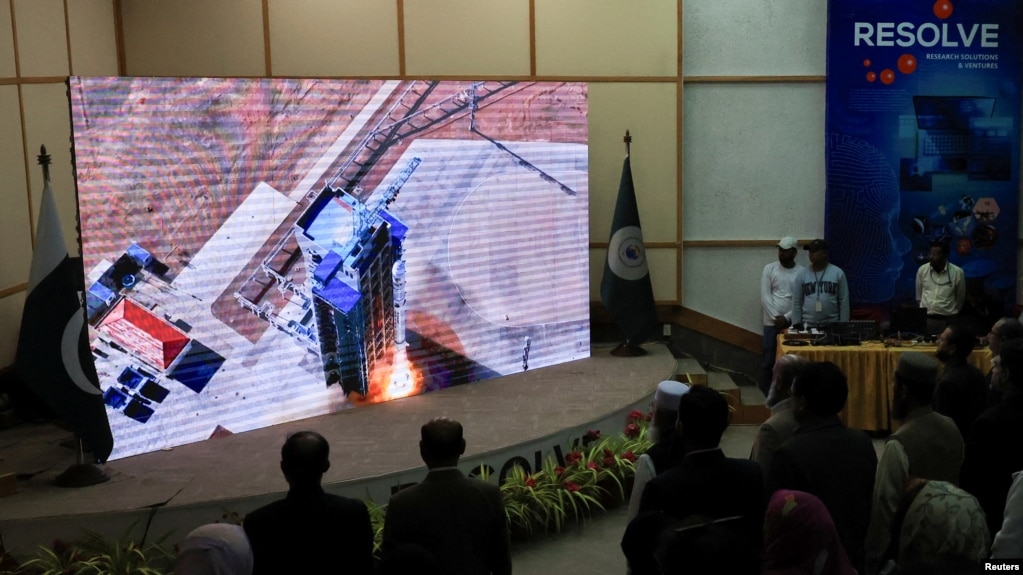
FILE - People watch a screen displaying the launch of Pakistan's indigenous Electro-Optical (EO-1) satellite from the Jiuquan Satellite Launch Centre in northern China, at the Pakistan Space and Upper Atmosphere Research Commission Complex in Karachi, Jan. 17, 2025.
Islamabad — China is ramping up cooperation with Pakistan in space exploration, but experts say Islamabad must develop its own strengths if it aims to benefit from Beijing.
Pakistan’s Space & Upper Atmosphere Research Commission, or SUPARCO, and China Manned Space Agency, or CMSA, announced Friday they will train Pakistan’s first astronaut for a mission aboard Chinese space station Tiangong.
The agreement comes just weeks after the two sides announced China’s Chang’e-8 moon lander mission in 2028 will carry a Pakistani rover.
Last year, China put Pakistan into the moon’s orbit taking the first Pakistani lunar satellite ICUBE-Q, aboard its historic Chiang’e 6 mission, designed to retrieve samples from the little explored far side of the moon.
Picking Pakistan
The latest agreement makes Pakistan the first country with an astronaut to work at Tiangong.
Experts say picking Pakistan as the first guest for China’s space station is not surprising as Islamabad hosts the flagship project of China’s global Belt and Road infrastructure initiative. The multibillion-dollar program includes a plethora of investment projects aimed at extending Beijing’s influence, especially in the developing world.
“In this kind of increased polarization of interest in the world, China, both politically and also from the technological point of view, is trying to be the front-runner of, we can say, the Global South,” said Carlo Iorio, director of the Center for Research and Engineering in Space Technology at the Free University of Brussels.
“So, it's quite straightforward to think that one of the possible first candidates to be granted to use the Chinese Space Station could have been Pakistani astronauts or an astronaut,” Iorio told VOA.

Last October, China announced a 25-year plan outlining its ambitious vision for space exploration.
It includes Beijing’s goals of searching for extraterrestrial life, exploring Mars, Venus, and Jupiter, sending space crews to the moon and building an international lunar research station.
“Pakistan's participation in the China Space Station program reflects the deep-rooted ties between the two countries,” said Lin Xiqiang, director general of CMSA, according to the Pakistani statement.
Lin was quoted as saying Pakistan’s inclusion “will contribute to mutual knowledge-sharing and the broader vision of peaceful space exploration for the benefit of humanity.”
Equal footing
Collaboration with China opens access to a treasure trove of technical knowledge and expertise for Pakistan as Beijing has managed the world’s first soft landing and roving on the far side of the moon and landed a rover on Mars.
“They have capabilities to indigenously design and develop satellites and launches for all types of applications,” said Amer Gilani, secretary of the Pakistan Human Spaceflight Cooperation at SUPARCO about China’s capabilities.
“Pakistan wants to achieve self-reliance in design and development of satellites for remote sensing, communication, deep space exploration, lunar missions,” Gilani told VOA in written comments. “With collaboration with China our space ambitions can progress much better.”
Pakistani Prime Minister Shehbaz Sharif hailed the latest space collaboration as “a defining moment in the nation’s space journey,” but experts say the nuclear-armed country will benefit from the collaboration only if it becomes an equal partner.
“What I want to see is cooperation on equal footing,” said Yarjan Abdul Samad, assistant professor of aerospace engineering at Khalifa University in UAE.
Samad, who is also affiliated with the University of Cambridge, said that while Pakistan may not be able to contribute equally now, it should aim to do so in the near future.
“If you go on these projects and you are just on the receiving end and you get services, what you asked for, then your technological development is very limited,” Samad told VOA.
Chinese edge
The International Space Station, or ISS, and China’s Tiangong are currently the only two space stations orbiting Earth.
Managed by a partnership among 15 countries, the ISS is set to be retired in 2030.
Elon Musk, the owner of SpaceX and special advisor to U.S. President Donald Trump, recently called for deorbiting the ISS soon in favor of missions to Mars.
ghazi52
THINK TANK: CONSULTANT
- Thread starter
- #214
“Pakistan will select astronauts from Pakistani citizens with background suited for astronauts which could be flying, medical fitness, physical fitness, psychological fitness, research/analytical skills, and high qualifications etc.,” Gilani told VOA. “Hopefully [we] will be able to get good candidates.”

Pakistani Dragon
Elite Member

Pakistan to send first Astronaut into space through China partnership
May 13, 2025

Pakistan's national space agency, SUPARCO and the China Manned Space Agency (CMSA) have signed a cooperation agreement for Pakistan's first astronaut mission to the Chinese Space Station (CSS) Tiangong.
Under the Agreement, two Pakistani astronauts will undergo training in at the Astronaut Centre of China.
One of them will be selected to join a future mission aboard China’s Tiangong Space Station as a scientific payload specialist.
The astronaut is expected to conduct a range of experiments in microgravity, including research in biology, material science, medical studies, fluid dynamics, and space radiation areas that could yield insights with practical benefits on Earth.
 www.radio.gov.pk
May 13, 2025
Pakistan's national space agency, SUPARCO and the China Manned Space Agency (CMSA) have signed a cooperation agreement for Pakistan's first astronaut mission to the Chinese Space Station (CSS) Tiangong.
Under the Agreement, two Pakistani astronauts will undergo training in at the Astronaut Centre of China.
One of them will be selected to join a future mission aboard China’s Tiangong Space Station as a scientific payload specialist.
The astronaut is expected to conduct a range of experiments in microgravity, including research in biology, material science, medical studies, fluid dynamics, and space radiation areas that could yield insights with practical benefits on Earth.
Pakistan to send first Astronaut into space through China partnership
Pakistan to send first Astronaut into space through China partnership
www.radio.gov.pk
ghazi52
THINK TANK: CONSULTANT
- Thread starter
- #216
Pakistani astronauts to embark on space mission with China

Two Pakistani astronauts will undergo training in China, with one expected to join a future mission aboard the Tiangong space station, the China-Manned Space Agency (CMSA) confirmed Wednesday.
The development follows a bilateral agreement signed in late February between China and Pakistan. CMSA said the selection process for the Pakistani astronauts has already begun.
“Consistent with the stringent criteria used for Chinese astronaut selection, a three-stage process (preliminary, secondary, and final) will govern candidate selection,” CMSA spokesperson Lin Xiqiang said at a press conference.
Lin added that a Pakistani astronaut will join the mission as a payload specialist and conduct scientific experiments for Pakistan, in addition to standard crew duties.
The announcement came alongside China’s confirmation of its latest crewed spaceflight. The Shenzhou-20 mission is scheduled to launch at 5:17pm on Thursday from the Jiuquan Satellite Launch Centre, Lin said.
Leading the mission will be Chen Dong, a 46-year-old veteran astronaut and former fighter pilot who, in 2022, became the first Chinese astronaut to spend more than 200 cumulative days in orbit.
“Every space journey is very unique, so I look forward to bringing in more experience and breakthroughs in the flight,” said Chen, who is embarking on his third spaceflight.
Joining Chen are first-time fliers Chen Zhongrui, 40, a former air force pilot, and Wang Jie, 35, a former space technology engineer.
The current crew aboard Tiangong is expected to return to Earth on April 29 after completing handover procedures with the Shenzhou-20 team, according to Mr Lin.
The Shenzhou-20 crew will carry out scientific experiments in physics and life sciences and install protective equipment against space debris.
China has been barred from participating in the International Space Station since 2011, when the US prohibited NASA from collaborating with Chinese space agencies. Since then, Beijing has sought to build partnerships with other countries — including Pakistan — in its expanding space programme.
Pakistani Dragon
Elite Member
Launching New Frontiers: Why Pakistan Needs Public-Private Partnerships In Space Exploration
Analysis
May 20, 2025

A new phase of exploration has begun in space. Private firms are providing new visions, more economical solutions, and a spirit of entrepreneurship to the space sector due to their greater discretion in spending funds and making investments as compared to governments, which often have centralised, bureaucratically distributed budgets. They are better equipped to take risks and experiment. Arguably, public-private partnerships (PPPs) provide a realistic avenue towards the actualisation of the strengths of both sectors, favouring cost-effectiveness and innovation, while building capabilities in the space sphere.
State agencies have always played a pivotal role in space. However, over time, the trend has been shifting due to increasing reliance on the private sector through PPPs. This allows the public sector to extract innate value from innovation and commercial efficiencies through such partnerships to achieve better results. The two key players can then share the costs, risks, and responsibilities of joint projects and ventures. This creates an environment and fast-tracks opportunities for innovations and cost-cutting methods.
In her book, Former NASA Deputy Administrator Lori Garver calls PPPs “visionary government resources with the scrappiness of risk-taking entrepreneurs.” Therefore, missions are cheaper and more effective, breaking new ground for synergy by combining private-sector innovation with government oversight.
While the space sector has become increasingly democratised through PPPs globally, Pakistan still relies heavily on the public sector. The global space economy has moved. It is no longer just government-launched rockets, now there are private companies designing satellites and building launch vehicles and sending missions to the Moon.
Multiple examples indicate the potential of PPPs; many developing states in Africa, Asia, and Latin America are advancing space ambitions through these partnerships. In Central Asia, Kazakhstan’s national space agency has collaborated with a private company, Eurasian Space Ventures (ESV), in various projects to establish joint space hubs, develop aerospace manufacturing methods for prototyping, and attract investments in designing spacecraft. Additionally, Nigeria’s space agency, the National Space Research and Development Agency (NSRDA), has established a phased PPP model. The government will fund all space-related activities and partner with the private sector for long-term space development.
India has also adopted a similar model. India’s space sector relies on private sector innovation coupled with government leadership. The Indian Space Research Organisation (ISRO) and the Indian National Space Promotion and Authorization Center (IN-SPACe) facilitate inclusive private sector participation in space-related activities. Recently, huge investments have been made in space startups in India. To reduce import dependence, IN-SPACe launched a Technology Adoption Fund of $58 million in February 2025, intended to financially support early-stage space technologies in transitioning to commercialisation. Subsequently, a separate venture capital fund of $119 million was approved by the Government to support 40 startups in October 2024, with funding ranging from 100 million to 600 million rupees, depending on the stage of maturity of the startup.
Pakistan’s efforts to revive its space sector are evident in recent years. In 2024-2025, there have been ambitious achievements, including sending the iCube-Qamar nano-satellite into lunar orbit, the launch of the PakSat MM-1 communication satellite, and the deployment of the PRSC-EO1 Earth observation satellite. With enhanced cooperation with China, Pakistan also joined the International Lunar Research Station project and Chang’e-8 moon mission in 2028, and an agreement was signed to train astronauts for future missions on China’s space station.
Apart from international partnerships, there are signs of positive change domestically. The National Incubation Center for Aerospace Technologies (NICAT) at the National Aerospace Science and Technology Park (NASTP) ecosystem, a flagship initiative by the Pakistan Air Force, is nurturing the private aerospace ecosystem by providing mentorship, funding, R&D facilities, and infrastructure, thereby indicating a strategic shift toward innovation and collaboration in space exploration.
Yet, there is a need for broader efforts from the government. The aforementioned international and regional precedents offer a clear lesson that PPPs are not supplementary but are indispensable. To maintain the current pace and ensure that it remains globally competitive, the Pakistan government must adopt a proactive approach by creating enabling policies, offering incentives, regulatory support, and fostering collaboration between public institutions and private innovators. With the right strategic direction, Pakistan can bring together public sector ambition and private sector ingenuity to build a self-reliant and globally competitive space sector.

 thefridaytimes.com
Public-private partnerships are vital for advancing Pakistan’s space sector, blending government support with private innovation to boost efficiency, competitiveness, and long-term sustainability
Ezba Walayat KhanAnalysis
May 20, 2025
A new phase of exploration has begun in space. Private firms are providing new visions, more economical solutions, and a spirit of entrepreneurship to the space sector due to their greater discretion in spending funds and making investments as compared to governments, which often have centralised, bureaucratically distributed budgets. They are better equipped to take risks and experiment. Arguably, public-private partnerships (PPPs) provide a realistic avenue towards the actualisation of the strengths of both sectors, favouring cost-effectiveness and innovation, while building capabilities in the space sphere.
State agencies have always played a pivotal role in space. However, over time, the trend has been shifting due to increasing reliance on the private sector through PPPs. This allows the public sector to extract innate value from innovation and commercial efficiencies through such partnerships to achieve better results. The two key players can then share the costs, risks, and responsibilities of joint projects and ventures. This creates an environment and fast-tracks opportunities for innovations and cost-cutting methods.
In her book, Former NASA Deputy Administrator Lori Garver calls PPPs “visionary government resources with the scrappiness of risk-taking entrepreneurs.” Therefore, missions are cheaper and more effective, breaking new ground for synergy by combining private-sector innovation with government oversight.
Pakistan’s space ambitions have mainly been nurtured by the public sector, through the Space and Upper Atmosphere Research Commission (SUPARCO). Its initial foray into space was promising. According to the National Space Policy, Pakistan successfully launched two indigenous satellites, Badr-1 in 1990, followed by Badr-2 in 2001. Thus, Pakistan initially became the first-ever Muslim country to successfully launch satellites into orbit. After completing its operational life, the Badr programme was officially decommissioned in 2012. This clearly shows that while there were advances towards space technology development in Pakistan, progress slowed down because of SUPARCO’s resource constraints and the imposition of international sanctions.With enhanced cooperation with China, Pakistan also joined the International Lunar Research Station project and Chang’e-8 moon mission in 2028, and an agreement was signed to train astronauts for future missions on China’s space station
While the space sector has become increasingly democratised through PPPs globally, Pakistan still relies heavily on the public sector. The global space economy has moved. It is no longer just government-launched rockets, now there are private companies designing satellites and building launch vehicles and sending missions to the Moon.
Multiple examples indicate the potential of PPPs; many developing states in Africa, Asia, and Latin America are advancing space ambitions through these partnerships. In Central Asia, Kazakhstan’s national space agency has collaborated with a private company, Eurasian Space Ventures (ESV), in various projects to establish joint space hubs, develop aerospace manufacturing methods for prototyping, and attract investments in designing spacecraft. Additionally, Nigeria’s space agency, the National Space Research and Development Agency (NSRDA), has established a phased PPP model. The government will fund all space-related activities and partner with the private sector for long-term space development.
India has also adopted a similar model. India’s space sector relies on private sector innovation coupled with government leadership. The Indian Space Research Organisation (ISRO) and the Indian National Space Promotion and Authorization Center (IN-SPACe) facilitate inclusive private sector participation in space-related activities. Recently, huge investments have been made in space startups in India. To reduce import dependence, IN-SPACe launched a Technology Adoption Fund of $58 million in February 2025, intended to financially support early-stage space technologies in transitioning to commercialisation. Subsequently, a separate venture capital fund of $119 million was approved by the Government to support 40 startups in October 2024, with funding ranging from 100 million to 600 million rupees, depending on the stage of maturity of the startup.
Pakistan’s efforts to revive its space sector are evident in recent years. In 2024-2025, there have been ambitious achievements, including sending the iCube-Qamar nano-satellite into lunar orbit, the launch of the PakSat MM-1 communication satellite, and the deployment of the PRSC-EO1 Earth observation satellite. With enhanced cooperation with China, Pakistan also joined the International Lunar Research Station project and Chang’e-8 moon mission in 2028, and an agreement was signed to train astronauts for future missions on China’s space station.
Apart from international partnerships, there are signs of positive change domestically. The National Incubation Center for Aerospace Technologies (NICAT) at the National Aerospace Science and Technology Park (NASTP) ecosystem, a flagship initiative by the Pakistan Air Force, is nurturing the private aerospace ecosystem by providing mentorship, funding, R&D facilities, and infrastructure, thereby indicating a strategic shift toward innovation and collaboration in space exploration.
Yet, there is a need for broader efforts from the government. The aforementioned international and regional precedents offer a clear lesson that PPPs are not supplementary but are indispensable. To maintain the current pace and ensure that it remains globally competitive, the Pakistan government must adopt a proactive approach by creating enabling policies, offering incentives, regulatory support, and fostering collaboration between public institutions and private innovators. With the right strategic direction, Pakistan can bring together public sector ambition and private sector ingenuity to build a self-reliant and globally competitive space sector.
Launching New Frontiers: Why Pakistan Needs Public-Private Partnerships In Space Exploration
Public-private partnerships are vital for advancing Pakistan’s space sector, blending government support with private innovation to boost efficiency,
thefridaytimes.com
Pakistani Dragon
Elite Member
Pakistan eyes Starlink to bridge digital divide amid engagement with SpaceX
BR Web Desk
Published May 21, 2025

Photo: Reuters
Rizwan Saeed Sheikh, Ambassador of Pakistan to the United States, has said that the transformative potential of SpaceX’s Starlink, which provides internet access to remote locations by low Earth orbit satellites, can bridge Pakistan’s digital divide.
The remarks came during Sheikh’s high-level visit to the headquarters of SpaceX, a leading American aerospace and tech firm, based in Los Angeles. He was accompanied by Asim Ali Khan, Consul General of Pakistan in Los Angeles, and other officials of the consulate.
During the visit, the Pakistani envoy received a briefing on the ongoing discussions regarding potential collaboration between Pakistan and SpaceX, particularly concerning the Starlink satellite internet project and broader satellite technologies.
“The Pakistan delegation was warmly welcomed at SpaceX Headquarters by the Vice President of Starlink Global Business Operations and the Director of Global Business Development, who highlighted how Starlink’s low-Earth orbit satellite infrastructure and SpaceX’s commercial capabilities could support Pakistan’s digital transformation,” read the statement.
The discussion focused on expanding broadband access and strengthening national connectivity, especially in underserved and remote regions of Pakistan.
Meanwhile, the ambassador reaffirmed Pakistan’s commitment to promoting innovation-led development through strategic international partnerships.
He appreciated the constructive dialogue and expressed hope that continued engagement would lead to tangible cooperation in space technology, digital infrastructure, and commercial innovation, read a statement from the Consulate General of Pakistan, Los Angeles.
The engagement with SpaceX forms part of Sheikh’s broader engagement in California, focused on strengthening technological and economic ties between the private sectors of Pakistan and the United States.
Despite frequent engagements, Pakistan, home to one of the world’s largest freelancing communities, is still awaiting the operational launch of Starlink.
Last month, Federal Minister for Information Technology and Telecommunication Shaza Fatima Khawaja announced that the licensing process for Starlink will be completed soon, adding that the satellite-based internet provider will launch its services in Pakistan by November 2025.
“Following the license issuance, we will commence the installation of the necessary equipment, and Starlink will be available in Pakistan from November,” Shaza Fatima said while briefing the National Assembly’s standing committee.
In March, Islamabad approved the temporary registration of Starlink, paving the way for the launch of satellite-based internet services in the country.

BR Web Desk
Published May 21, 2025
Photo: Reuters
Rizwan Saeed Sheikh, Ambassador of Pakistan to the United States, has said that the transformative potential of SpaceX’s Starlink, which provides internet access to remote locations by low Earth orbit satellites, can bridge Pakistan’s digital divide.
The remarks came during Sheikh’s high-level visit to the headquarters of SpaceX, a leading American aerospace and tech firm, based in Los Angeles. He was accompanied by Asim Ali Khan, Consul General of Pakistan in Los Angeles, and other officials of the consulate.
During the visit, the Pakistani envoy received a briefing on the ongoing discussions regarding potential collaboration between Pakistan and SpaceX, particularly concerning the Starlink satellite internet project and broader satellite technologies.
“The Pakistan delegation was warmly welcomed at SpaceX Headquarters by the Vice President of Starlink Global Business Operations and the Director of Global Business Development, who highlighted how Starlink’s low-Earth orbit satellite infrastructure and SpaceX’s commercial capabilities could support Pakistan’s digital transformation,” read the statement.
The discussion focused on expanding broadband access and strengthening national connectivity, especially in underserved and remote regions of Pakistan.
Meanwhile, the ambassador reaffirmed Pakistan’s commitment to promoting innovation-led development through strategic international partnerships.
He appreciated the constructive dialogue and expressed hope that continued engagement would lead to tangible cooperation in space technology, digital infrastructure, and commercial innovation, read a statement from the Consulate General of Pakistan, Los Angeles.
The engagement with SpaceX forms part of Sheikh’s broader engagement in California, focused on strengthening technological and economic ties between the private sectors of Pakistan and the United States.
Despite frequent engagements, Pakistan, home to one of the world’s largest freelancing communities, is still awaiting the operational launch of Starlink.
Last month, Federal Minister for Information Technology and Telecommunication Shaza Fatima Khawaja announced that the licensing process for Starlink will be completed soon, adding that the satellite-based internet provider will launch its services in Pakistan by November 2025.
“Following the license issuance, we will commence the installation of the necessary equipment, and Starlink will be available in Pakistan from November,” Shaza Fatima said while briefing the National Assembly’s standing committee.
In March, Islamabad approved the temporary registration of Starlink, paving the way for the launch of satellite-based internet services in the country.
Pakistan eyes Starlink to bridge digital divide amid engagement with SpaceX
Rizwan Saeed Sheikh, Ambassador of Pakistan to the United States, has said that the transformative potential of...
www.brecorder.com
Pakistani Dragon
Elite Member
Thank you Mods / Admins for merging the threads over the last few days.
Pakistani Dragon
Elite Member
Eidul Azha likely to fall on June 7: Suparco
Umaid Ali
Published May 22, 2025
The festive occasion of Eidul Azha is likely to be celebrated across Pakistan on June 7, 2025, according to the Space and Upper Atmosphere Research Commission (Suparco).
In a statement, the commission issued a prediction regarding the sighting of the crescent moon for the month of Zilhaj 1446 AH, “based on scientific analysis, astronomical data, and modern observational techniques.”
It said according to astronomical models, the birth of the new moon for Zilhaj will occur on May 27, 2025, at 8:02pm PST.
The scientific analysis for May 27, 2025 (29 Ziqa’ad) in Pakistan indicates the age of the moon at sunset will be approximately 11 hours and 34 minutes, it mentioned.
“Even under the most optimal weather conditions, the possibility of the moon being sighted across the country is extremely low, as there will only be a 37-minute interval between sunset and moonset,” it added.
The commission said 1st Zilhaj is expected to fall on May 29. Therefore, Eidul Azha will be celebrated across Pakistan on June 7.
It added that the Central Ruet-e-Hilal Committee holds the final authority to confirm the moon’s sighting based on eyewitness testimonies and weather conditions.
Celebrated on the 10th of Zilhaj, Eidul Azha marks the culmination of Haj, one of the five pillars of Islam.

Umaid Ali
Published May 22, 2025
The festive occasion of Eidul Azha is likely to be celebrated across Pakistan on June 7, 2025, according to the Space and Upper Atmosphere Research Commission (Suparco).
In a statement, the commission issued a prediction regarding the sighting of the crescent moon for the month of Zilhaj 1446 AH, “based on scientific analysis, astronomical data, and modern observational techniques.”
It said according to astronomical models, the birth of the new moon for Zilhaj will occur on May 27, 2025, at 8:02pm PST.
The scientific analysis for May 27, 2025 (29 Ziqa’ad) in Pakistan indicates the age of the moon at sunset will be approximately 11 hours and 34 minutes, it mentioned.
“Even under the most optimal weather conditions, the possibility of the moon being sighted across the country is extremely low, as there will only be a 37-minute interval between sunset and moonset,” it added.
The commission said 1st Zilhaj is expected to fall on May 29. Therefore, Eidul Azha will be celebrated across Pakistan on June 7.
It added that the Central Ruet-e-Hilal Committee holds the final authority to confirm the moon’s sighting based on eyewitness testimonies and weather conditions.
Celebrated on the 10th of Zilhaj, Eidul Azha marks the culmination of Haj, one of the five pillars of Islam.
Eidul Azha likely to fall on June 7: Suparco
First Zilhaj expected to fall on May 29, Suparco predicts.
www.dawn.com

Rational Philosopher
Trusted Member

Govt proposes Rs24 billion Suparco budget to advance space missions. First manned spaceflight, satellite systems, and lunar project set for major funding in FY2025–26

Pakistan is poised to make major fiscal commitments toward space exploration in the upcoming federal budget, with the government proposing a significant allocation of Rs24 billion for the Space and Upper Atmosphere Research Commission (Suparco) in the development budget for FY2025–26.
As reported by the Express Tribune.
According to officials, the proposed funding includes Rs600 million earmarked for Pakistan’s landmark manned space mission, a project hailed as a source of national pride.
The lion’s share of the budget — over Rs18 billion — is expected to go toward the development of the Multi-Mission Communication Satellite System. In addition, Rs400 million has been proposed for a new Pakistan Lunar Exploration initiative, Rs1.8 billion for a Deep Space Astronomical project, and Rs1.7 billion for the Pakistan Optical Remote Sensing Satellite program.
Beyond space-related spending, the budget proposal includes more than Rs500 million for the Special Investment Facilitation Council (SIFC), over Rs50 billion for the Cabinet Division, and another Rs50 billion set aside for schemes backed by members of parliament.
Additional allocations include Rs134.2 million for infrastructure projects in Islamabad, Rs100 million for the restoration and upgrade of the National Archives, and Rs650 million for building a new Hajj Complex in Lahore.

 profit.pakistantoday.com.pk
Pakistan is poised to make major fiscal commitments toward space exploration in the upcoming federal budget, with the government proposing a significant allocation of Rs24 billion for the Space and Upper Atmosphere Research Commission (Suparco) in the development budget for FY2025–26.
As reported by the Express Tribune.
According to officials, the proposed funding includes Rs600 million earmarked for Pakistan’s landmark manned space mission, a project hailed as a source of national pride.
The lion’s share of the budget — over Rs18 billion — is expected to go toward the development of the Multi-Mission Communication Satellite System. In addition, Rs400 million has been proposed for a new Pakistan Lunar Exploration initiative, Rs1.8 billion for a Deep Space Astronomical project, and Rs1.7 billion for the Pakistan Optical Remote Sensing Satellite program.
Beyond space-related spending, the budget proposal includes more than Rs500 million for the Special Investment Facilitation Council (SIFC), over Rs50 billion for the Cabinet Division, and another Rs50 billion set aside for schemes backed by members of parliament.
Additional allocations include Rs134.2 million for infrastructure projects in Islamabad, Rs100 million for the restoration and upgrade of the National Archives, and Rs650 million for building a new Hajj Complex in Lahore.
Govt proposes Rs24 billion Suparco budget to advance space missions
Pakistan is poised to make major fiscal commitments toward space exploration in the upcoming federal budget, with the government proposing a significant allocation of Rs24 billion for the Space and Up
profit.pakistantoday.com.pk
Pakistani Dragon
Elite Member
Remote sensing satellite project: VTT Global and SUPARCO collaborate on roadmap strategy
Recorder Report
Published June 6, 2025

ISLAMABAD: VTT Global (Private) Limited, Pakistan’s leading strategy and management consultancy firm, held a high-level workshop with SUPARCO to strategise the roadmap and potential impact for Pakistan’s upcoming remote sensing satellite project and the broader expansion of space-based geospatial infrastructure.
This satellite launch will unlock transformative impact across Pakistan’s economic resilience, fiscal planning, space innovation, data sovereignty, and development priorities, anchoring the nation’s place in the emerging global geospatial ecosystem.
Designed through VTT’s multidisciplinary approach, the project integrates legal, financial, and technical frameworks to ensure strategic alignment with Pakistan’s Vision 2025, National Space Policy 2023, and Sustainable Development Goals (SDGs) 2015.
Space technology: PM expresses his desire to enhance ties with China
Based on the proposed model for public-private partnerships, investment mechanisms, and regulatory pathways, the project has vast potential. It can catalyse entrepreneurial advancement and drive Pakistan’s long-term economic sustainability.
Moreover, with enhanced access to real-time, high-resolution satellite data, the initiative promises wide-ranging implications. These include agricultural optimisation, climate adaptation, national security, urban planning, and disaster risk management.
Ultimately, this initiative positions Pakistan to build a self-sustaining, space-enabled knowledge economy by reducing dependence on external systems and contributing to long-term GDP growth through sovereign geospatial intelligence.

Recorder Report
Published June 6, 2025
ISLAMABAD: VTT Global (Private) Limited, Pakistan’s leading strategy and management consultancy firm, held a high-level workshop with SUPARCO to strategise the roadmap and potential impact for Pakistan’s upcoming remote sensing satellite project and the broader expansion of space-based geospatial infrastructure.
This satellite launch will unlock transformative impact across Pakistan’s economic resilience, fiscal planning, space innovation, data sovereignty, and development priorities, anchoring the nation’s place in the emerging global geospatial ecosystem.
Designed through VTT’s multidisciplinary approach, the project integrates legal, financial, and technical frameworks to ensure strategic alignment with Pakistan’s Vision 2025, National Space Policy 2023, and Sustainable Development Goals (SDGs) 2015.
Space technology: PM expresses his desire to enhance ties with China
Based on the proposed model for public-private partnerships, investment mechanisms, and regulatory pathways, the project has vast potential. It can catalyse entrepreneurial advancement and drive Pakistan’s long-term economic sustainability.
Moreover, with enhanced access to real-time, high-resolution satellite data, the initiative promises wide-ranging implications. These include agricultural optimisation, climate adaptation, national security, urban planning, and disaster risk management.
Ultimately, this initiative positions Pakistan to build a self-sustaining, space-enabled knowledge economy by reducing dependence on external systems and contributing to long-term GDP growth through sovereign geospatial intelligence.
Remote sensing satellite project: VTT Global and SUPARCO collaborate on roadmap strategy
ISLAMABAD: VTT Global (Private) Limited, Pakistan’s leading strategy and management consultancy firm, held a...
www.brecorder.com
Pakistani Dragon
Elite Member
Pakistan allocates funds for manned space mission and lunar rover
Pakistan-China lunar mission Chang'e‑8 is scheduled for 2028
Samaa Web Desk
Jun 10, 2025

Pakistan manned space mission
The Central Development Working Party (CDWP) has approved significant allocations to bolster Pakistan's space programme including ongoing and for two new schemes.
On May 21, 2025, senior officials endorsed the Pakistan Manned Space Mission, allocating Rs 2.186 billion under the Public Sector Development Programme (PSDP). Of this, Rs 600 million is specifically set aside to support the historic manned spaceflight initiative in the 2025-26 budget document.
The funding forms part of a broader Rs131.295 billion package proposed for SUPARCO (Space and Upper Atmosphere Research Commission) in the FY 2025–26 budget, covering several high-profile projects.
Notably, the allocation includes Rs400 million for the Pakistan Lunar Exploration Rover, signaling continued momentum toward lunar exploration in the budget 2025-26.
These strategic advancements, structured under Pakistan’s space agenda, aim to elevate the country’s scientific capabilities, foster space innovation, and reinforce bilateral collaboration, especially with China on lunar missions such as Chang'e‑8, scheduled for 2028.
 www.samaa.tv
Pakistan-China lunar mission Chang'e‑8 is scheduled for 2028
Samaa Web Desk
Jun 10, 2025
Pakistan manned space mission
The Central Development Working Party (CDWP) has approved significant allocations to bolster Pakistan's space programme including ongoing and for two new schemes.
On May 21, 2025, senior officials endorsed the Pakistan Manned Space Mission, allocating Rs 2.186 billion under the Public Sector Development Programme (PSDP). Of this, Rs 600 million is specifically set aside to support the historic manned spaceflight initiative in the 2025-26 budget document.
The funding forms part of a broader Rs131.295 billion package proposed for SUPARCO (Space and Upper Atmosphere Research Commission) in the FY 2025–26 budget, covering several high-profile projects.
Notably, the allocation includes Rs400 million for the Pakistan Lunar Exploration Rover, signaling continued momentum toward lunar exploration in the budget 2025-26.
These strategic advancements, structured under Pakistan’s space agenda, aim to elevate the country’s scientific capabilities, foster space innovation, and reinforce bilateral collaboration, especially with China on lunar missions such as Chang'e‑8, scheduled for 2028.
Pakistan allocates funds for manned space mission and lunar rover
Pakistan-China lunar mission Chang'e‑8 is scheduled for 2028
www.samaa.tv
Pakistani Dragon
Elite Member
SUPARCO’s space projects receive Rs5,418 million budgetary allocation
By: News DeskPublished: 12:38 AM, 11 Jun, 2025

The federal government has allocated Rs. 5,418.523 million for Space and Upper Atmosphere Research Commission (SUPARCO) in the Public Sector Development Programme (PSDP) 2025-26 to advance Pakistan’s space capabilities through six ongoing and new projects.
An amount of Rs. Rs 4,418.523 million has been allocated for the four ongoing projects while Rs. 1,000 million has been reserved for the two new projects.
Among the ongoing projects, the highest allocation of Rs. 1,518.523 million has been made for the “Establishment of Pakistan Space Centre” while significant funding of Rs. 1,300 million has been earmarked for the “Establishment of Deep Space Astronomical Observatories in Pakistan”.
The Pakistan Optical Remote Sensing Satellite (PRSS-O2) program has received Rs. 1,200 million allocation while Rs. 400 million will go for Pakistan Multi-Mission Communication Satellite System (PakSat-MM1).
Among the new space exploration projects, Rs. 600 million has been allocated for the ambitious “Pakistan Manned Space Mission” program and Rs. 400 million for development of the “Pakistan Lunar Exploration Rover” (PLEXR) for the Change E-8 Mission, representing Pakistan’s first foray into lunar exploration.
These allocations demonstrate Pakistan’s commitment to developing indigenous space capabilities, including satellite communications, remote sensing, and now manned space missions and lunar exploration.

SUPARCO’s space projects receive Rs5,418 million budgetary allocation
The federal government has allocated Rs. 5,418.523 million for Space and Upper Atmosphere Research Commission (SUPARCO) in the Public Sector Development
 24newshd.tv
Users who are viewing this thread
Total: 4 (members: 0, guests: 4)
Pakistan Defence Latest
-

-
 Federal cabinet gives nod to imposition of emergency in KP; summary sent to president (3 Viewers)
- Latest: Meengla
-

-

-

Country Watch Latest
Latest Posts
-
Saudi Arabia Executes Two Bangladeshi Nationals Over 'Having Sex' Inside Mecca Mosque (44 Viewers)
- Latest: Owaiz
-
 Makkah Defence Alliance: Turkey, Saudi Arabia, and Pakistan, news & updates (36 Viewers)
- Latest: Starlord
-

-
 SCMP: Security fears in Norway as Chinese smart cars record sensitive military data (5 Viewers)
- Latest: atmi_bum
-
