Pakistan Space Related News & Discussions

On 05 September, China’s Yicai Global reported that PIESAT Information Technology Co. signed a USD $406 million deal with the Government of Pakistan to assist the latter build “an integrated satellite system for global real-time communication and remote sensing.”

In its first phase, the program will see the “launch and operation of 20 satellites, the construction of a satellite manufacturing facility, and the development of supporting software.” Overall, the goal of the program is to “help Pakistan develop independent capabilities in satellite manufacturing, operations, and applications.”

Founded in 2008 and listed on Shanghai’s Star Market in 2019, PIESAT’s flagship initiative is the new “Nuwa” constellation. Nuwa is slated to be China’s largest commercial synthetic aperture radar (SAR) network, with a target of 114 satellites, 13 of which have reportedly launched.

The Pakistan deal is valued at nearly twice PIESAT’s 2024 revenue, and given the softer domestic demand in the Chinese market in 2025, the contract could be a financial lifeline for PIESAT.

For Pakistan, the agreement aligns with its long-term aim to design, manufacture, and potentially launch satellites domestically. In 2021, the government earmarked funding for a feasibility study of a local production site, the Pakistan Space Centre (PSC). However, those studies did not materialize into an actual facility, much less any substantive large-scale satellite manufacturing work.

It now appears the PSC concept has been rolled into this PIESAT contract. If this is the case, this new contract compresses the multi-year learning curve by packaging transfer-of-technology (ToT), factory setup, and constellation deployment into a single, integrated program rather than ad hoc purchases.

The acquisition also speaks to capability gaps observed during Pakistan’s recent conflict with India, notably the absence of a strong, sovereign imaging intelligence (IMINT) pipeline for target selection and post-strike battle damage assessment (BDA).

The problem was not solely a lack of satellites; rather, it was unreliable access to cloud-free, daylight electro-optical (EO) imagery and delays between the tasking and delivery. SAR – i.e., PIESAT’s core offering – addresses both constraints by providing an all weather, all-day, and rapid IMINT capability by enabling frequent ‘refreshes’ of the battlefield picture.

In short, this reported deal signals three key shifts in Pakistan’s space development.

  • First, it is the clearest sign yet that Pakistan is decoupling SUPARCO from satellite procurement – and, in time, manufacturing. This follows a near-92% cut to SUPARCO’s annual budget (from USD $235 million in 2024–2025 to USD $19.5 million in 2025–2026).

    While this would shrink SUPARCO’s role in dual-use and defence-oriented space programs, it will also restore its original mandate to scientific research and economic applications. Hence, the acquisition of new satellites will be managed by a separate entity, likely from within the military’s structure.

  • Second, the Strategic Plans Division (SPD) would likely stand up a new entity to manage satellite acquisition and, eventually, production. PIESAT could support the SPD in building that organization’s assembly, integration, and testing (AIT) lines, quality assurance, and a rolling-refresh plan to sustain performance over the constellation’s life.

  • Third, the PIESAT package points to an ISR expansion with an emphasis on timely IMINT that can directly support Pakistan’s growing focus on preemptive strikes via Army Rocket Force Command (ARFC) and the Pakistan Air Force (PAF).

PIESAT specialises in remote sensing satellites with an emphasis on interferometric SAR (InSAR). With sufficient satellites, the company claims revisit rates of up to 60 minutes at sub-0.5 m resolution. In effect, Pakistan could generate fresh imagery within a 24-hour cycle, potentially up to within one hour in certain conditions.


Credit to @Quwa

Yes this will be game changer. Dont forget about keeping eye on terrorists movement on western borders.
 
Any work going on on local launch capability?
 

Pakistan to launch advanced hyperspectral satellite for mineral, climate research​


Among OIC countries, Pakistan making remarkable progress in space, satellite imaging

Asif Mahmood
September 22, 2025


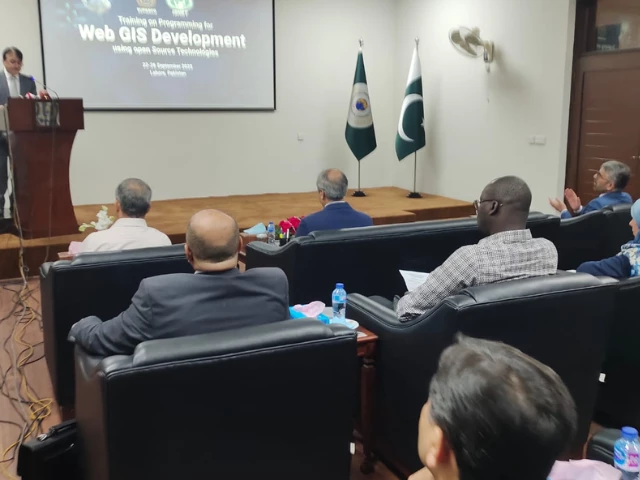
session of a five day training workshop organized in lahore under the auspices of asnet the intra islamic network on space sciences and technology


Session of a five-day training workshop organized in Lahore under the auspices of ASNET (the intra-Islamic Network on Space Sciences and Technology)

Pakistan is preparing to launch an advanced hyperspectral satellite next month, which will assist in exploring underground mineral resources and enhance research in agriculture, forestry, wildlife, flood monitoring, glacier melt, air pollution, and smog.

SUPARCO Chairman Muhammad Yousaf Khan said, “The hyperspectral satellite, scheduled for launch in October, will analyze different wavelengths of light reflected from the Earth’s surface, generating precise information about minerals, vegetation, soil, and water quality.

Surveys that previously required years and cost millions can now be completed in just days and at a fraction of the expense. This advancement will enable Pakistan to independently map its mineral reserves and pave the way for more efficient use of natural resources.”

Speaking at the inaugural session of a five-day training workshop in Lahore under the auspices of ASNET (the Intra-Islamic Network on Space Sciences and Technology), Yousaf Khan added, “Pakistan is not only playing a leading role among the member states of the OIC but is also achieving remarkable progress in space and satellite imaging.”

The workshop, being held from September 22 to 26, has participants from Iraq, Senegal, Libya, Türkiye, and Tunisia and aims to provide training in web GIS development through open-source technologies, enabling participants to integrate satellite data into effective applications for multiple sectors.

Dr. Muhammad Mansha, head of web applications development at SUPARCO, said, “The use of open-source technologies for web GIS is a fundamental need of the present era. Such training will allow experts to integrate sectoral data with satellite imagery to create applications useful for agriculture, environmental monitoring, and disaster management.

This technology will empower researchers and policymakers to make decisions that are both timely and evidence-based.”

He added, “Hyperspectral imagery provides much more detailed data than conventional satellite imaging, capturing hundreds of spectral bands in every pixel.

Globally, this technology is being applied in environmental monitoring, species identification, and pollution control. While Pakistan already operates remote sensing satellites for agriculture and disaster management, the new hyperspectral satellite is expected to multiply these capabilities many times over.”
 
International participants observed, “The ongoing workshop in Lahore is not only enhancing technical skills but also opening new avenues for collaboration and innovation.”

SUPARCO officials expressed confidence that “through this program, Pakistan will further consolidate its position in advanced space technologies and emerge as a model for other countries in the region.”
 
To view this content we will need your consent to set third party cookies.
For more detailed information, see our cookies page.
 

Achievements of Pakistan’s Space Programme

Sustainable development on earth needs space exploration

By Syed Zeeshan Haider
September 28, 2025


1759158301936.jpeg

Pakistan achieved a major milestone on 31 July by launching its latest remote sensing satellite, PRSS-2, in collaboration with the China Electronics Technology Group Corporation (CETC) and MICROSAT China from China’s Xichang Satellite Launch Centre (XSLC). According to a press release of the Ministry of Foreign Affairs of Pakistan, “the satellite would significantly enhance Pakistan’s capacity for high-resolution, round-the-clock earth observation as the cornerstone of an integrated Earth Observation system.” The Chairman of Pakistan’s national space agency, Space and Upper Atmosphere Research Commission (SUPARCO), Muhammad Yousaf Khan, in his statement highlighted that “the satellite would serve national priorities and contribute meaningfully” to Pakistan’s socio-economic development.

Space is fast emerging as a strategic domain and every state resourceful enough is investing in the development of its own ‘eyes in the sky’. For Pakistan, advancing space capabilities is crucial not only for strengthening national defence through access to timely intelligence and surveillance, but also for driving socioeconomic development through its applications in communication, agriculture, disaster management and education


Pakistan launched its first satellite, Badr-1, on 16 July 1990. Since then, the country’s space programme has progressed steadily. Pakistan subsequently launched satellites in collaboration with China in 1996, 2001, 2011, 2013, 2018, 2024 and 2025. As of now, Pakistan has seven satellites in orbit. Pakistan’s space programme has achieved unprecedented progress in recent years. SUPARCO has made significant strides in space exploration and satellite technology through indigenous capacity building and with international collaboration. These efforts are in line with the “Space Vision 2047,” that aims to launch five geostationary satellites, six Low Earth Orbit (LEO) satellites, send an astronaut into space and build Pakistan’s own satellite launch capability. It has not only accelerated Pakistan’s technological progress but also elevated its profile in the international spacefaring community.

On 3 May 2024, Pakistan achieved a historic milestone by sending its first lunar orbiter, iCube-Qamar (iCube-Q), into the Moon’s orbit. The lunar orbiter, designed by the Institute of Space Technology (IST) Islamabad, has multiple objectives, including capturing detailed images of the Moon’s surface, processing visual data in orbit, and testing emerging technologies such as nanosatellite-level communication systems and low-cost platforms for deep space exploration. The iCube-Q was launched from China’s Hainan Space Launch Site as part of the Chang’e-6 mission. The lunar orbiter took nearly two years to develop, through close technical coordination and sustained research efforts between IST faculty and students, SUPARCO and China’s Shanghai Jiao Tong University (SJTU). With the launch of this mission, Pakistan became the sixth country in the world to send a research orbiter to the moon, joining a select group of nations that have achieved this milestone.

On 30 May 2024, just days after the historic launch of the lunar mission, Pakistan launched a new communication satellite, PakSAT-MM1, a joint venture between SUPARCO and the China Aerospace Science and Technology Corporation. According to information released by SUPARCO, PakSAT-MM1 is a high-power, multi-mission satellite designed to provide various communication services. It is equipped with a space-based augmentation system (SBAS), which offers public and authorised services to users in aviation, transportation, survey and mapping, precision agriculture, urban planning and disaster management. Moreover, the MM1 satellite is designed to enhance the efficiency and reliability of internet and telecom services nationwide.

On 17 January, SUPARCO launched Pakistan’s first indigenous Electro-Optical (EO-1) satellite from China’s Jiuquan Satellite Launch Centre, marking a significant achievement for Pakistan’s space programme. According to SUPARCO, the satellite employs electro-optical sensors to collect data by detecting and measuring reflected sunlight and emitted radiation. It will bolster Pakistan’s ability to manage natural resources, respond to natural disasters and support sustainable development efforts. It will also help to monitor agricultural productivity and predict agricultural yield. The launch of EO-1 signifies two essential factors: first, Pakistan’s advancement in the indigenisation of space technology, and second, continuing cooperation between Pakistan and China in the aerospace domain.

In February 2025, Pakistan and China signed an agreement under which China has committed to selecting and training two Pakistani astronauts, who are expected to join a mission to the Tiangong Space Station in October 2026 after a training period of one year in China. According to China Manned Space Agency’s (CMSA) spokesperson, Lin Xiqiang, Pakistani astronaut will participate in the joint space mission as payload specialist and will be responsible for conducting experiments.

The successive achievements of Pakistan’s space programme are not confined solely to advancements in space science and technology but also encompass growing collaboration with international institutions and forums. SUPARCO enjoys permanent membership in several international organisations, institutes and United Nations (UN) entities. Pakistan is also a party to all five UN treaties on international space law, which govern the peaceful uses of outer space.

Pakistan is also a member of the United Nations Committee on Peaceful Uses of Outer Space (UNCOPUOS), an international forum that discusses future developments and issues related to space activities. The forum provides Pakistan with a platform to exchange views with other states with advanced space programmes. Since 2010, Pakistan has also been part of the United Nations Platform for Space-based Information for Disaster Management and Emergency Response (UN-SPIDER), a platform that was initiated in 2006 with the mission to “ensure that all countries and international and regional organisations have access to and develop the capacity to use all types of space-based information to support the full disaster management cycle.”

China, the ironclad brother and all-weather friend of Pakistan, has played a pivotal role in boosting Pakistan’s space programme. According to Statista Research Department’s report released on 28 January, China is the second-leading space power after the USA, with an expenditure of $19 billion on its space programme in 2024. China’s major milestones, such as the Tiangong Space Station, lunar sample-return missions, and the development of the BeiDou Navigation Satellite System, as well as the Zhurong, a robotic rover mission to Mars, highlight its technological prowess in the realm of space technology.

The most remarkable achievement of Pak-China space collaboration is the establishment of the Asia-Pacific Space Cooperation Organisation (APSCO). According to the convention of APSCO, the organisation aims to strengthen multilateral cooperation among the countries of the Asia-Pacific region in the field of space based on principles of multilateral cooperation in the peaceful application of space science and technology. Pakistan, as a founding member of the organisation, participated in the Small Multi-Mission Satellite (SMMS) programme, which helped Pakistan design and develop its indigenous satellites.

Space is fast emerging as a strategic domain and every state resourceful enough is investing in the development of its own ‘eyes in the sky’. For Pakistan, advancing space capabilities is crucial not only for strengthening national defence through access to timely intelligence and surveillance, but also for driving socioeconomic development through its applications in communication, agriculture, disaster management and education.

Pakistan’s space programme is designed to serve the national interest across the spectrum of space applications. Pakistan is endeavouring to integrate space data and applications into all aspects of government planning to achieve eight UN Sustainable Development Goals (SDGs): SDG 2 – zero hunger, SDG 3 – good health and well-being, SDG 4 – quality education, SDG 6 – clean water and sanitation, SDG 8 – decent work and economic growth, SDG 9 – industry, innovation and infrastructure, SDG 13 – climate action and SDG 15 – life on land.


Users who are viewing this thread

Country Watch Latest

Latest Posts

Back
Top