Pakistan Tehreek-e-Insaf's (PTI) Rallies / Protests

This behn ka lodra lost his seats in election both in 2018 and then 2024 but declared winner by Election Commission.
Can you tell about your ethnicity? Are you Punjabi or Urdu speaker? Asking because of the expletive you used - behen ka loda.

@Sal12
 
Can you tell about your ethnicity? Are you Punjabi or Urdu speaker? Asking because of the expletive you used - behen ka loda.

@Sal12

The use of ‘d’ instead of ‘r’ is a very Indian way of pronouncing words. Like using ‘j’ instead of ‘z’. Unfortunately, many younger Pakistanis seem to have adopted Indian pronunciations because of watching too many Indian movies.

If you’re going to give a gaali, do it properly. And stop watching Indian movies.
 
The use of ‘d’ instead of ‘r’ is a very Indian way of pronouncing words. Like using ‘j’ instead of ‘z’. Unfortunately, many younger Pakistanis seem to have adopted Indian pronunciations because of watching too many Indian movies.

If you’re going to give a gaali, do it properly. And stop watching Indian movies.
This is the problem with internet discussion forum. People don't have time to read and hence read hurriedly. Actually they don't even read hurriedly but just skim hurriedly, thus missing the point made.

The point is not about spelling. It's about the words the poster used.

@Tamerlane
 
Anyone telling Pakistanis what to do, who is not proud of his Pakistani attire, or too ashamed to be in such attire on the international stage is not one of youView attachment 90216

You may think I'm being ridiculous....but I know how the Anglo saxon extremists and their friends think. Their uniform is a suit. A 2 piece suit.

Anyone who dare show up in anything different is a red flag to them. Im not saying you can never wear one, but for God's same at least wear your traditional attire SOMETIMES on the international stage.

Trump actully liked Imran Khan. He is a fan of men of men. Trump doesn´t like feminine men
 
This is the problem with internet discussion forum. People don't have time to read and hence read hurriedly. Actually they don't even read hurriedly but just skim hurriedly, thus missing the point made.

The point is not about spelling. It's about the words the poster used.

@Tamerlane

You may have taken offense at the words but I took offense at the spelling.
 
You may have taken offense at the words but I took offense at the spelling.

This is unironically funny in so many ways, discussing the etymology and/ or pronunciation of a cuss word. And your statement was the topper. 😂

On topic so, I get the difference I ‘j’ and the ‘z’ sounds because even in India it’s not as if we uniformly use ‘j’. People who have a smattering of Urdu use ‘z’ comfortably.

But the difference in ‘r’ and ‘d’ was new to me. Are you saying that Loda is Lora in Pakistan? Very interesting
 
This is unironically funny in so many ways, discussing the etymology and/ or pronunciation of a cuss word. And your statement was the topper. 😂

On topic so, I get the difference I ‘j’ and the ‘z’ sounds because even in India it’s not as if we uniformly use ‘j’. People who have a smattering of Urdu use ‘z’ comfortably.

But the difference in ‘r’ and ‘d’ was new to me. Are you saying that Loda is Lora in Pakistan? Very interesting

Yes, it’s supposed to be spelled with a ‘r’ and the more you emphasize the ‘r’ the more properly effective it sounds.
 
Yes, it’s supposed to be spelled with a ‘r’ and the more you emphasize the ‘r’ the more properly effective it sounds.

The other way in India. The harder the ‘d’ (pun intended) sound, the more soul satisfying it is.
 

PTI-govt negotiations kick off

Dawn.com | Irfan Sadozai
December 23, 2024

The first meeting between committees representing the government and the opposition PTI takes place on Monday. — screengrab via author


The first meeting between committees representing the government and the opposition PTI took place on Monday, kicking off long-anticipated talks between the rival parties to defuse prevailing political tensions.

Earlier this month, former premier and PTI founder Imran Khan announced his party’s committee for talks with “anyone”.

Subsequently, following the recommendation of National Assembly (NA) Speaker Ayaz Sadiq, Prime Minister Shehbaz Sharif yesterday formed a committee comprising ruling coalition members.

Today’s in-camera meeting was chaired by the NA speaker. According to Sadiq, the next meeting was proposed for January 2, where the opposition would present its “charter of demands”.

Of the nine members of the government committee, seven attended the talks, including all three PML-N leaders — Deputy Prime Minister and Foreign Minister Ishaq Dar, PM’s political aide Rana Sanaullah and Senator Irfan Siddiqui.

Others present included PPP’s Raja Parvez Ashraf and Naveed Qamar, and Istehkam-i-Pakistan Party (IPP) leader Aleem Khan, also the privatisation minister.

Pakistan Muslim League-Quaid leader and Religious Affairs Minister Chaudhry Salik Hussain, and Balochistan Awami Party’s Sardar Khalid Magsi — members of coalition parties who were named as part of the committee — were not in attendance. While Education Minister Dr Khalid Maqbool Siddiqui was named as part of the committee, MNA Farooq Sattar attended from the Muttahida Qaumi Movement-Pakistan instead.

Meanwhile, on the PTI’s side, three opposition lawmakers attended the meeting — namely PTI MNA Asad Qaiser, Sunni Ittehad Council Chairman Sahibzada Hamid Raza, and Senator Raja Nasir Abbas of the Majlis Wehdat-i-Muslimeen (MWM).

The PTI’s committee formed earlier this month also included Leader of the Opposition in the National Assembly Omar Ayub Khan, Khyber Pakhtunkhwa Chief Minister Ali Amin Gandapur and PTI Secretary General Salman Akram Raja.

However, according to a statement by the NA Secretariat released last night, Sadiq had said the meeting would comprise the “government’s and opposition’s members of the National Assembly”.

Interestingly, Defence Minister Khawaja Asif, who has remained a permanent feature in past government committees for political dialogues, is not part of the group this time.

Following the meeting, the NA speaker expressed the hope that if everyone joined their heads together and worked for Pakistan’s betterment, the country would see “improvement in democracy and the challenges faced by Pakistan would be eased”.

He stressed that it would be better if the speculations on the outcome of the meeting were kept to a minimum.

Speaking to reporters, Qaiser said that they had kept their demands forward for the release of their party leaders, including Imran, and the formation of a judicial commission comprising the senior-most judges of the Supreme Court.

He said that since all of the party leadership was unavailable for the meeting today, they had decided to form a charter of demand to present it in the meeting on Jan 2.

Qaiser said that they had also demanded the resumption of their communication with the incarcerated PTI founder, adding that the government, while accepting their demands, has assured them of arranging their meetings with Imran.

“Let us see when the meeting [with Imran] is arranged,” he added. He said that the “actual negotiation” would start next month and today’s meeting was an “initial” discussion.

Addressing the meeting, Sadiq hailed both sides’ decision to form committees to discuss the problems faced by the country, adding that he had recommended the premier to form the committee on Gohar’s request.

“I am grateful to all of you […] for forming a committee without delay. I think the seriousness of the negotiation is evident from the seniority of the leadership that is present,” Sadiq said.

“I hope that we will talk about Pakistan’s benefit,” he said, adding that the solution to every problem was in negotiations.

Prior to today’s meeting, the government committee met with Sadiq separately. Speaking to reporters earlier, the NA speaker said, “My job is to facilitate the meeting and both sides will decide themselves.

“Talks are the only solution in a democracy,” he noted, stressing that the country’s economic prosperity depended on political stability.
 
Sanaullah was asked by reporters who the guarantor of the meeting was, and whether the PTI was accepting Shehbaz Sharif’s leadership in the absence of a guarantor.

In response, Sanaullah said, “There is no guarantor. When the two sides are having a political dialogue amongst themselves, there is no question of ‘who is the guarantor’ or ‘how will you be satisfied’.

“The matter is that they [the PTI] are participating [in the talks] with an open heart, and so are we. There is no such condition as to what could or could not be said during the talks. They can say whatever they want to, and our point of view will be presented, and only after we’ll reach a middle ground.
 
He continued: “Political dialogue means both sides sit together with an open heart and listen to what is being said, and then find a way forward. It cannot be that they accept 100 per cent of our demands or vice versa. The middle ground is the best ground.:

Responding to another question, the senior PML-N leader said: “If the PTI has been calling us thieves, we have also said a lot in response. They have said things to us, we have said things to them. But even then, if the rule of parliamentary democracy is to move forward, it cannot happen without political dialogue. We will have to do that.”
 
Qaiser says Imran’s release among demands

While the PTI committee is mainly tasked with a two-point agenda — the release of PTI’s workers and supporters from prisons, and judicial inquiry into the events of the May 9 riots and the November 26 crackdown — Qaiser also added Imran’s release to the list.

“We have made our agenda very clear that we will talk about the release of our (PTI’s) political prisoners and our leader Imran Khan, and a judicial inquiry should be carried out in the events of May 9 and November 26,” Qaiser told Geo News today.

It is left to be seen how the government would react to PTI’s foremost demand: the release of its founder, Imran, from prison.

Imran’s legal troubles are expected to multiply as the verdict against him and his wife in the £190m Al-Qadir Trust case is set to be announced on January 6.

Since Imran’s incarceration last year based on several cases, his party’s relationship with the government, as well as the establishment, has turned exceedingly sour. The PTI has held several protests over the last year, most of which escalated into violence after facing state repression.
 
Following the PTI’s ‘Final Call’ power show last month, tensions escalated as there were renewed calls to ban the party and task forces formed against an alleged “malicious campaign” as the PTI claimed a dozen deaths of its supporters, which the government officially denies.

However, after Imran formed a five-member committee to hold talks with “anyone” and his lawmakers had a softened stance in the parliament, the government constituted its own committee comprising ruling coalition members.

Separately, Imran has assigned the responsibility of uniting opposition parties to Barrister Saif, according to sources. The jailed PTI founder directed Saif to expedite negotiations with opposition leaders and unite them under the leadership of CM Gandapur.
 

EU concerned at May 9 convictions by military courts​


Says verdicts inconsistent with Pakistan's obligations under ICCPR

Kamran Yousaf
December 23, 2024

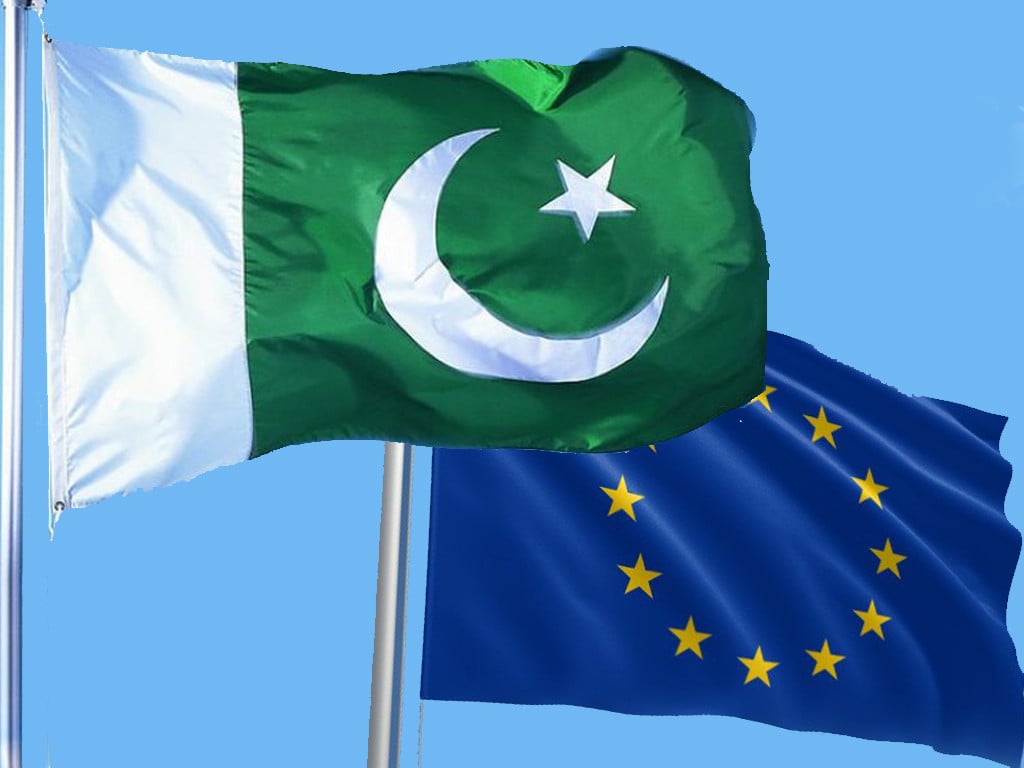
pakistan and european union flags photo afp


AFP

ISLAMABAD:
The European Union (EU) on Sunday expressed concerns over the conviction of 25 civilians after being found guilty of attacking army installations by the military court, insisting the verdict was inconsistent with Pakistan's commitments to ensure a 'fair and public' trial of every person.

"The European Union notes with concern the sentencing of twenty-five civilians by a military court on 21 December in Pakistan," read a statement issued by the European External Action Service (EEAS) in Brussels.

The EU reaction came after military courts sentenced 25 civilians to prison terms ranging from two to 10 years for attacking military installations during riots which erupted following the arrest of former prime minister Imran Khan in May last year.

In a detailed statement, the military said that the nation on May 9 witnessed tragic incidents of "politically provoked violence and arson at multiple places, marking a dark chapter in the history of Pakistan" when, building on a sustained narrative of hate and lies, politically orchestrated attacks were carried out on the army installations and monuments of martyrs.

"These blatant acts of violence not only shocked the nation but also underscored the necessity of checking this unacceptable attempt of political terrorism to impose own perverted will through violence and coercion," it stated.

According to the statement, a field general court martial sentenced 25 individuals in the first phase, following a thorough review of evidence and the completion of proper legal procedures.

However, the EU voiced concerns over the military court verdicts.

"These verdicts are seen as inconsistent with the obligations that Pakistan has undertaken under the International Covenant on Civil and Political Rights (ICCPR)," the statement added.

"In line with article 14 of ICCPR, every person is entitled to a fair and public trial in a court that is independent, impartial and competent, and has the right to adequate and effective legal representation. It also stipulates that any judgement rendered in a criminal case shall be made public," the statement further said.

It also pointed out that under the EU's generalised scheme of preferences plus (GSP+), beneficiary countries, including Pakistan, have voluntarily agreed to implement effectively 27 international core conventions - including the ICCPR - in order to continue benefitting from GSP+ status.

The GSP+ provides wide-ranging tariff preferences for imports to the EU from vulnerable developing countries to support poverty eradication, sustainable development and their participation in the global economy as well as reinforce good governance.

Eligible countries like Pakistan can export goods to the EU market at zero duties for 66% of tariff lines.

This preferential status is conditional on GSP+ countries demonstrating tangible progress on the implementation of 27 international conventions on human and labour rights, environmental protection, climate change and good governance.

GSP+ has been very beneficial for Pakistani business increasing their exports to the EU market by 65% since the country joined GSP+ in 2014.

With over 440 million consumers, the European single market is Pakistan's most important destination. Pakistan exports worth 5.4 billion (approximately Rs1.2 trillion), namely garments, bedlinen, terry towels, hosiery, leather, sports and surgical goods.
 

Users who are viewing this thread

Pakistan Defence Latest

Country Watch Latest

Latest Posts

Back
Top