Pakistan Telecom, IT, Tech updates

Engro Connect buys Jazz-owned towers in $560 million deal


Kalbe Ali
June 7, 2025

ISLAMABAD: In a first-of-its-kind move, Engro Connect has acquired all 10,500 telecom towers owned and managed by Jazz.

After obtaining approvals from relevant regulators, including the Competition Commission of Pakistan, and clearing all cases in the Islamabad High Court, the $560 million deal has materialised.

Jazz, the largest telecom operator in the country, has become the first telecom to offload all of its telecom towers. Deodar, the cell-site tower management subsidiary of Jazz, has been sold to Engro Connect.

However, Jazz will pay rent for all the cell sites installed at these towers to Engro Connect, a subsidiary of Engro Corp.

Move to establish ‘cells’ of multiple telecom operators at a single tower

The deal was one of the most significant private-sector infrastructure transactions in the country’s digital evolution. Jazz was currently using around 14,500 telecom towers; other tower companies, including Engro Enfrashare, the largest independent tower infrastructure company in Pakistan, and Edotco managed the remaining 4,000 towers.

Meanwhile, TAWAL Pakistan, a Saudi-based company, has recently launched its operations as the fourth ‘towerco’.

A senior official of the company stated that the telecos invested heavily in the tower around 20 years ago, as there was no infrastructure available at that time, and the strength of the telecos was measured by their coverage areas and the number of subscribers.

Meanwhile, Jazz CEO Aamir Ibrahim has said, “As we pivot to a digital-first future, this milestone enables us to remain asset-light while doubling down on what we do best — delivering impactful, tech-driven solutions for Pakistan’s evolving needs.”

He added that the company would focus on being a full-fledged service, with a portfolio spanning fintech, cloud, entertainment, and digital health.

The concept of towercos was gaining popularity globally as they have become experts in infrastructure development and management by taking on the responsibilities of paying annual taxes and duties for towers, power supply, generator management, and security.

Under this concept, a towerco can establish the ‘cells’ of multiple telecom operators at a single tower.

Currently, there are around 50,000 telecom towers in the country, and it is expected that as the concept of tower companies grows, other telecom operators will also offload their tower management responsibilities.

A senior official from the IT ministry stated that while it is anticipated that many towers will be consolidated in urban areas, the overall number of towers will increase in several new regions where telecom services have not yet been established.

“But it was less likely that Telenor and Ufone would make such a decision soon — as their merger was underway and many business decisions of both the companies were on hold till the CCP decides on merger,” the official added.

Apart from the telecoms, telecom towers are also becoming key interchanges for the optical fibre network, and many fibre companies and internet service providers are also paying rent to the tower operators for internet cable services.

Published in Dawn, June 7th, 2025

 

Local mobile production up, sales down​


High base effect, longer replacement cycles, and inflation push demand down by 8%

Usman Hanif
July 06, 2025

local mobile production up sales down

Despite growing local manufacturing, Pakistan's mobile phone market continues to face headwinds, as locally manufactured and assembled handset sales declined by 8% year-on-year during both the first five months of 2025 and the broader 11-month period of FY25, according to data released by the Pakistan Telecommunication Authority (PTA).

Despite a 4% year-on-year rise in production during April and May 2025, reaching 4.84 million units, overall demand remains subdued compared to 2024, when sales were buoyed by pent-up consumer buying following the easing of import restrictions, noted Sunny Kumar of Topline Securities.

Local mobile phone companies manufactured or assembled 4.84 million units during April and May 2025, reflecting a 4% year-on-year increase compared to 4.65 million units produced in the same period of 2024, according to PTA. This brings the total number of locally assembled units in 11MFY25 to 26.09 million, which, however, marks an 8% decline in sales compared to the corresponding period last year. Similarly, for the first five months of 2025, locally manufactured or assembled sales stood at 12.05 million units, also down 8% year-on-year.

Industry sources attribute the decline in overall mobile phone sales to several factors. Firstly, there is a high base effect from 2024, when the industry experienced exceptional growth due to pent-up demand after the lifting of import restrictions. Secondly, the average mobile replacement cycle has extended from 2.5 years to 3.5 years, driven by a lack of compelling new model launches. Lastly, persistently high inflation and weaker rural consumer demand have dampened overall spending on mobile devices.

Despite the volume decline, Pakistan has significantly increased its reliance on local assembly. In the first five months of 2025, 94% of mobile phone demand was met through local manufacturing and assembly, compared to the five-year (2020-2024) average of 77% and the nine-year (2016-2024) average of 52%.

Of the 12.05 million units assembled during the first five months of 2025, 54% (6.53 million) were 2G feature phones, while the remaining 46% (5.52 million) were smartphones. The top 10 locally assembled brands included Infinix (1.34 million units), VGO Tel (1.33 million), itel (1.07 million), Vivo (0.96 million), Samsung (0.67 million), Xiaomi (0.65 million), G'Five (0.64 million), Tecno (0.62 million), Nokia (0.52 million), and QMobile AL (0.5 million).

Within the listed companies, Air Link Communication (AIRLINK), which assembles Tecno and Xiaomi phones, stood out as a key player, with both brands ranking among the top 10 during the first five months of 2025.
 

IT exports hit record at $4.6b​


Minister links 26% growth to unified strategy; industry complains about dearth of support

ZAFAR BHUTTA
July 19, 2025


Pakistan's information technology, IT-enabled services (ITeS) and freelancers' exports hit an all-time high of $4.6 billion in fiscal year 2024-25, higher by 26.4% from the previous year, but stakeholders still complained about the lack of government support.

The total exports included $3.8 billion in services' exports and $779 million in earnings from freelancing and remote work, up 90%.

The Ministry of IT and Telecom stressed that the government focused on action across five core areas that contributed to the massive growth. These areas comprised positioning Pakistan globally, investing in talent and infrastructure, protecting and supporting through policy, ensuring stable high-speed internet and digitalisation, especially digitising the economy and cashless initiatives.

IT and Telecom Minister Shaza Fatima Khawaja said that Pakistan was well on its way to achieve $15 billion in IT exports by 2030. She credited the achievement of $4.6 billion in IT exports to a unified national strategy, led by the government and supported by the Special Investment Facilitation Council (SIFC) and allied institutions.

Speaking to the media, the minister said, "This success is the result of close coordination between the civilian and military leadership, along with contributions from the Pakistan Telecommunication Authority, Ministry of Finance, Planning Commission, Universal Service Fund (USF), Ignite and Pakistan Software Export Board (PSEB)."

She highlighted the government's focus on developing human capital, with over 350,000 youth trained through joint programmes with PSEB, Ignite, National Vocational and Technical Training Commission (NAVTTC), Higher Education Commission (HEC) and global tech leaders like Google, Huawei and Microsoft.

Shaza Fatima said that the IT ministry had launched 43 new co-working spaces and 23 Special Technology Zones last year, taking the total number of tech parks to 44. These facilities now house over 18,000 professionals engaged in freelancing, remote work and tech startups.

She also announced government-backed incentives to expand those spaces into tier-2 and tier-3 cities through interest-free loans. "We're rapidly emerging as a regional digital and data hub," she stated.
 

TikTok removed nearly 25m Pakistani videos in early 2025​


Platform took down nearly 211m videos globally over violation of community guidelines: report

Our Correspondent
July 23, 2025

tiktok logo is seen in this illustration taken june 2 2023 photo reuters

TikTok logo is seen in this illustration taken, June 2, 2023. PHOTO: REUTERS


TikTok removed nearly 25 million videos in Pakistan during the first quarter of 2025, according to its Q1 2025 Community Guidelines Enforcement Report, which covers activity from January to March.

According to the report, a total of 24,954,128 videos were taken down in Pakistan for violating the platform’s community guidelines. The proactive removal rate in the country remained exceptionally high at 99.4 percent, with 95.8 percent of the flagged videos removed within 24 hours of being posted.

Globally, TikTok removed approximately 211 million videos during the same period, which accounts for about 0.9 percent of all content uploaded to the platform. Of those, over 184 million were detected and removed through automated systems, while more than 7.5 million were reinstated following a secondary review.The proactive removal rate stood at 99.0%, with 94.3% of the flagged content removed within 24 hours of posting.

The report further revealed that 30.1% of all removed videos globally contained sensitive or mature themes, making it the most common reason for enforcement. Other violations included breaches of privacy and security guidelines (15.6%), safety and civility standards (11.5%), misinformation (45.5%), and the use of edited media or AI-generated content (13.8%).

TikTok said that its quarterly enforcement reports are part of its ongoing commitment to transparency and accountability. The company noted that the reports are designed to help users, regulators, and the general public better understand how content moderation is carried out at scale and what types of violations are being addressed most frequently.

The full Q1 2025 report is available on TikTok’s Transparency Centre, accessible in both Urdu and English, where users can explore the platform’s community guidelines, reporting tools and content safety policies in greater detail
 

Pakistan’s Systems Limited explores acquisition in IT and ITES sector

Systems Limited, one of Pakistan’s largest software firms, has announced that it is exploring the potential acquisition of an Information Technology (IT) and IT-enabled services business.

The listed software firm disclosed the development in its notice to the Pakistan Stock Exchange (PSX) on Wednesday.

“We hereby wish to inform you that as authorised by the Board of Directors in the meeting held on Wednesday, 23rd July, 2025, Systems Limited is considering a potential acquisition of Information Technology (IT) and IT-enabled services business,” read the notice.

The acquisition is subject to finalisation of negotiations of commercial terms, completion of due diligence, execution of definitive agreements and receipt of regulatory approvals.

Systems Limited was founded in 1977 as a private limited company and was converted into a public listed company in 2005. SYS was listed on PSX in 2015.

The principal activity of the company is the development and trading of software and business process outsourcing services. In short, SYS assists its clients in their digital transformation journey. Besides having a strong footprint in the local market, the company has a firm presence in the US, UK, EU and Middle East.

Earlier in March, Systems Limited informed its stakeholders that it plans to double its investment in Saudi Arabia.

“Saudi Arabia presents a significant growth opportunity, with the potential to scale 3-5x compared to the UAE market. The depth across multiple sectors aligns well with the company’s expertise. “Consequently, the company is doubling its investments and expanding its Saudi operations,” it said back then.

Systems said that with Saudi Arabia investing heavily in Artificial Intelligence (AI), including a $100 billion AI fund, there is a vast opportunity for the Company to leverage these developments.
 

IT exports – record high

BR Research
July 28, 2025

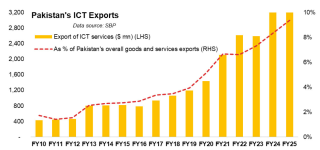
Pakistan’s IT and ICT exports touched a historic high in FY25, clocking in at $3.8 billion. That’s an 18 percent jump over last year, though shy of the government’s $4 billion target and slower than the 24 percent growth seen in FY24.

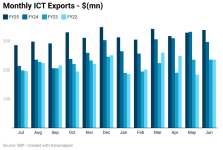
June alone brought in $338 million, up 14 percent year-on-year and 3 percent month-on-month, taking monthly exports above the 12-month average of $314 million. Net IT exports (after imports) also reached $306 million for the month, up 20 percent year-on-year.

1753733413751.png

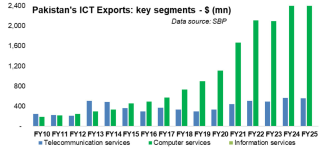
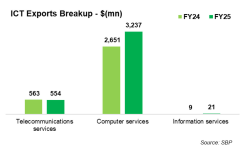
The story remains anchored in computer services, which pulled in $3.24 billion, up from $2.65 billion last year, while telecom exports stalled at $554 million. Information services, though small, more than doubled to $21 million, hinting at a slow but growing diversification within the export basket.

Yet, even with the record-breaking performance, the missed target underscores persistent structural bottlenecks. Pakistan’s IT sector still grapples with talent shortages, rising wage pressures, and patchy connectivity, while global tech spending slowed as firms cut back on budgets.

1753733442410.png

Tax and payment reforms have also lagged, limiting exporters’ ability to fully ride global demand. The slower growth rate in FY25 compared to FY24 can also be attributed to a base effect since FY24 had already seen an unusually high jump of 24 percent year-on year.

Policy support has, however, cushioned the sector. The State Bank allowed exporters to retain 50 percent of their foreign earnings (up from 35 percent) and even invest abroad, encouraging them to repatriate a larger share of profits.

1753733457843.png

Pakistani IT firms have also been busy expanding their global footprint, tapping into the GCC market, and highlighting at international events like London Tech Week 2025 and the Pak-US Tech Investment Conference.

A decade ago, IT exports accounted for barely 2–3 percent of Pakistan’s goods and services exports; today, they are close to 10 percent.

1753733477614.png

The government’s ambition is to hit $10 billion by FY29 under the “Uraan Pakistan” plan, which implies an annual growth rate of 27 percent. Whether that materializes will depend on how fast Pakistan can fix infrastructure gaps, build a skilled talent pipeline, and simplify its regulatory framework.
 

Pakistan produces 14.24 million mobile phones in first half of 2025​


By Tahir Ali | Gwadar Pro
Jul 28, 2025

Pakistan produces 14.24 million mobile phones in first half of 2025


Source PTA.

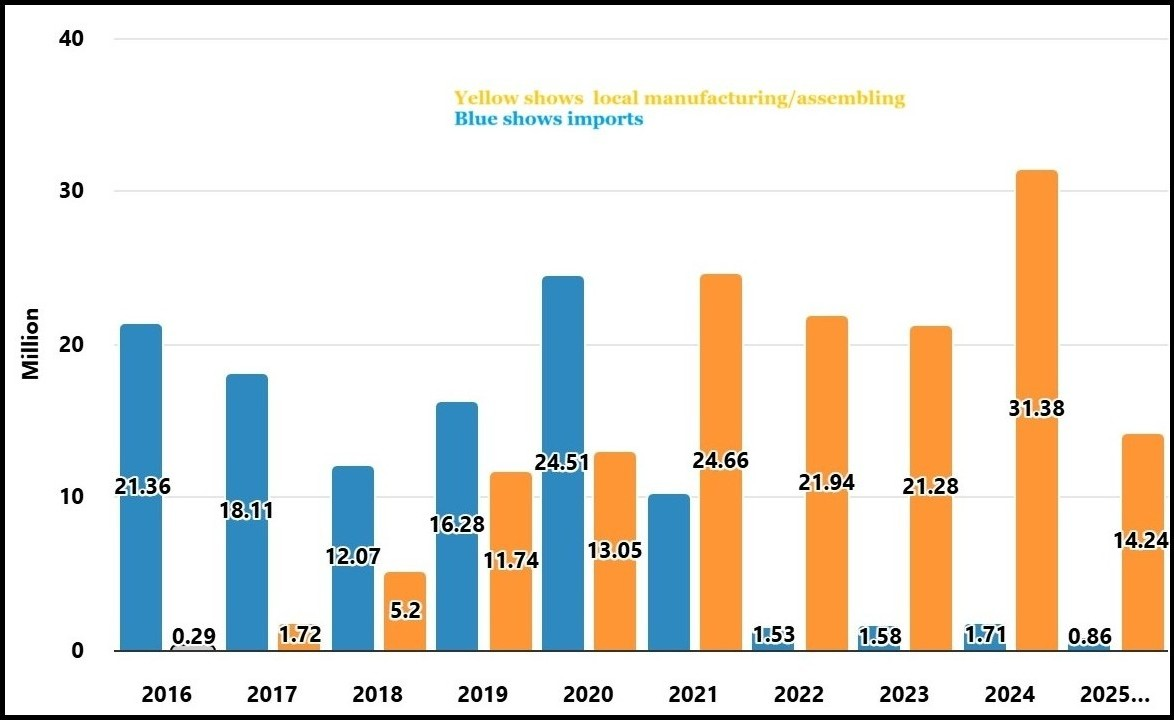
ISLAMABAD, Jul 29 (Gwadar Pro) - Pakistan has locally manufactured and assembled 14.24 million mobile phones during the first half of 2025, while importing only 0.86 million units, reflecting a strong shift toward domestic production and growing self-reliance in the mobile phone sector.

According to the latest data released by the Pakistan Telecommunication Authority (PTA), this trend has been gaining momentum since 2021, when local production, boosted significantly by Chinese companies establishing assembly plants in the country, first surpassed mobile phone imports.

Of the 14.24 million locally produced units in the first six months of 2025, 7.63 million were second-generation (2G) GSM phones, commonly referred to as keypad phones, while the rest were smartphones. Despite the increasing availability of smartphones, basic keypad devices remain in steady demand due to affordability and practicality.

In response, manufacturers have enhanced feature phones with longer battery life, dual SIM support, LED flashlights, wireless FM radio, and limited internet connectivity, making them more relevant for cost-conscious consumers, especially in rural and semi-urban areas.

Until 2020, Pakistan was heavily dependent on imports to meet domestic mobile phone demand. That year, 24.51 million phones were imported compared to only 13.05 million locally produced. However, the introduction of a Mobile Manufacturing Policy in 2020 and subsequent Mobile Device Manufacturing (MDM) Regulations issued by PTA in 2021 led to a dramatic turnaround in the industry by incentivizing companies to establish local manufacturing and assembly facilities.

In 2021, Pakistan produced 24.66 million mobile phones locally, while imports dropped to 10.26 million. In 2022, local production stood at 21.94 million, with imports falling further to 1.53 million. The year 2023 saw 21.28 million phones produced locally and 1.58 million imported. In 2024, local manufacturing hit a record high of 31.38 million units, while imports declined to just 1.71 million.

Chinese Brands Continue to Dominate Local Mobile Production:

Pakistan produces 14.24 million mobile phones in first half of 2025


Source PTA.


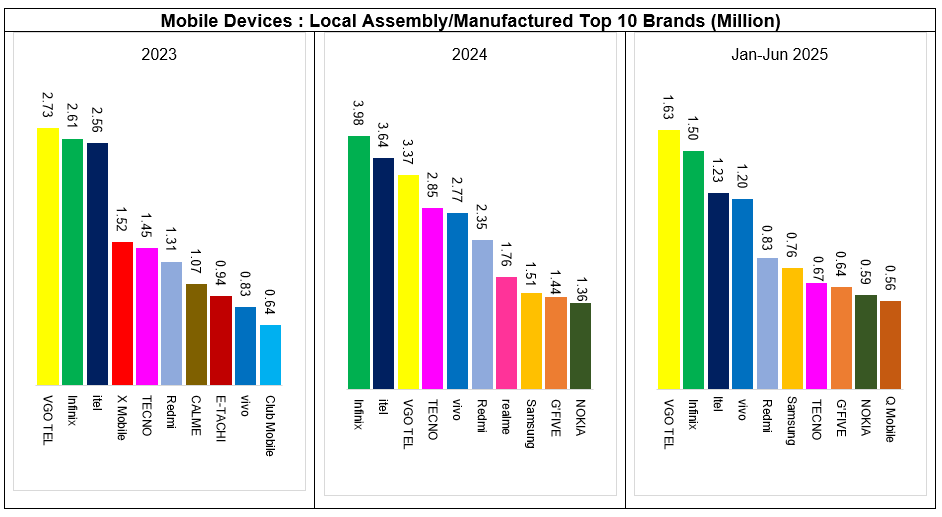
Chinese mobile phone manufacturers have played a key role in transforming Pakistan’s mobile industry by leading local production and creating employment opportunities for thousands of Pakistanis. Their dominance in the country’s manufacturing and assembly sector has continued in 2025, as reflected in the latest official statistics.

PTA data for the first half of 2025 shows that VGO Tell led local production with 1.63 million units, followed by Infinix with 1.50 million units. Itel ranked third with 1.23 million units, while Vivo produced 1.20 million and Redmi 0.83 million. Samsung, the only South Korean brand in the top tier, stood sixth with 0.76 million units, closely followed by China’s TECNO with 0.67 million. G’FIVE produced 0.64 million units, Nokia 0.59 million, and QMobile secured the tenth position with 0.56 million units.
 

IT exports – record high

BR Research
July 28, 2025

Pakistan’s IT and ICT exports touched a historic high in FY25, clocking in at $3.8 billion. That’s an 18 percent jump over last year, though shy of the government’s $4 billion target and slower than the 24 percent growth seen in FY24.

This is good news but not enough. Our target is above $ 20 billion IT business. Obviously it will be on long term basis. Policies are done and hopefully, the current trade agreement with the US will have some aspect of the IT policy at work and we'll officially have a target around $7 to 10 billon and then further growth. But the target is around $ 25 billion in next 3-5 years. If the ministers can't deliver, fire them and replace with talent from overseas who can deliver it. This is not that big of a deal because Pakistan is well known across the world for having a strong IT labor pool after India.
 
@RajaBaja

Raja Babu,

This is not that big of a deal because Pakistan is well known across the world for having a strong IT labor pool after India.

You have a point here. IND exports of IT and enabled services is around USD 200 billion. PAK's population is 1/6th of IND and even after adjusting for the fact that PAK perhaps has a weaker education system, an export of 1/10th IND is certainly very much on cards. A USD20 bn target over the next 3-5 years is feasible.

Regards
 
If Pakistan so might advance in IT, why can't they digitalize police stations? Is building missile is more difficult or digitalizing police stations and their process of entering FIR?
 

Telenor’s acquisition by PTCL: CCP seeks further clarity on key issues


BR Web Desk
August 5, 2025

The Competition Commission of Pakistan (CCP) has sought further clarity from the Pakistan Telecommunication Company Limited (PTCL) on key issues related to the proposed acquisition of 100% shareholding in Telenor Pakistan (Private) Limited (TP) and Orion Towers (Private) Limited (OT), according to a CCP statement on Tuesday.

The development comes as PTCL officials briefed the CCP about the proposed acquisition of Telenor Pakistan and Orion Towers.

“In continuation of proceedings under Section 11(6) of the Competition Act, 2010, the senior management of Pakistan Telecommunication Company Limited appeared before the bench of the Competition Commission of Pakistan.
 

Pakistan’s IT exports grow $354mln in July


Tahir Amin
August 19, 2025

The country’s information technology and IT-enabled services (ITeS) exports remittances comprising computer services and call centre services registered around 24 percent growth in the first month (July) of current fiscal year 2025-26 as it remained $354 million compared to $286 million during the same period of last fiscal year.

According to official data IT exports remittances increased by around 5 per cent on month-on-month basis in July 2025 and stood at $354 million when compared to $339 million in June 2025.

Pakistan’s IT and IT-enabled services (ITeS) exports have seen significant growth, with a nearly 18% increase in FY 2024-25, reaching $3.810 billion. This growth is part of a larger trend, with the IT sector declared one of the fastest-growing segments of the national economy.

The government had set a target of $4.2 billion in IT exports for 2025, but missed it by around $400 million. The government has set the target of $5 billion from IT exports for the current fiscal year.

The IT ministry has identified several constraints including inconsistency in policies, taxation issues and banking hurdles which are hampering the country’s information technology sector’s export potential of around $15 billion.

Pakistan’s IT industry has huge potential. Many experts believe it can bring in more dollars for the country. It can also create jobs for the youth. To reach the $5 billion goal, the government and private sector will need to work together.

Better training, faster internet, and support for startups can help. If the momentum continues, Pakistan’s IT sector can become one of the top earners for the economy in the coming years, experts added.
 
To view this content we will need your consent to set third party cookies.
For more detailed information, see our cookies page.
 
Internet services across Pakistan experienced a disruption on Tuesday evening, with connectivity levels plunging to nearly 20 percent of normal levels, according to global internet observatory NetBlocks.

The outage, which began late in the evening, impacted multiple regions, leaving millions of users unable to access online services.

“Metrics show a major disruption to internet connectivity across Pakistan with high impact to backbone operator PTCL; overall national connectivity is down to 20% of ordinary levels,” NetBlocks said in a post on X (formerly Twitter).
 

Users who are viewing this thread

Pakistan Defence Latest

Country Watch Latest

Back
Top