Pakistan Telecom, IT, Tech updates

Pakistan’s IT Sector Surges as PSEB Certifies Dozens of Companies, Trains Thousands, and More​

By ProPK Staff | Published Nov 19, 2025 | 1:08 pm

The Pakistan Software Export Board (PSEB) has certified 40 IT and IT-enabled Services (ITeS) companies under the ISO27001 and ISO27701 standards.

Of these companies, 18 are located in Islamabad, 16 in Punjab, and six in Sindh.

Additionally, 8,600 candidates received specialized training and certifications under the “Certification of IT Professionals” program. These include 1,846 individuals in ICT, 2,450 in Punjab, 2,270 in Sindh, 969 in Balochistan, 893 in KPK, and 172 in GB.


Capacity-building initiatives have also grown, with 2,700 fresh graduates placed in internships under the “ICT Internship Program.” This includes 1,517 interns in Punjab and ICT, 197 in Sindh, 170 in Balochistan, 612 in Khyber Pakhtunkhwa, and 204 in Gilgit-Baltistan.

As part of its efforts to standardize the country’s customer support industry, PSEB has also provided financial and technical support to 31 call centers to help them achieve ISO 18295 certification. These certified call centers include seven in Islamabad, 19 in Punjab, and five in Sindh. The certification is meant to improve service quality, ensure customer protection, and increase operational efficiency for both domestic and international contact center operations.

PSEB has also facilitated the enlistment of Pakistani IT companies on the GEM Board of the Pakistan Stock Exchange (PSX). The initiative is intended to increase the number of listed tech firms on both the Main Board and the GEM Board, helping strengthen the financial ecosystem of the IT and ITeS sector. The Board expects that greater market visibility will boost investor confidence and enhance the global perception of Pakistan’s technology industry.


Alongside these efforts, PSEB has expanded nationwide infrastructure by establishing 25 Software Technology Parks (STPs). These include 14 in Punjab and Islamabad, four in Sindh, one in Balochistan, four in Khyber Pakhtunkhwa, and two in Gilgit-Baltistan. The STPs are designed to support growth for startups, SMEs, and established tech companies.


Freelancers in Gilgit-Baltistan are making $15m a year, way more than its IT firms: study

  • Before 2018, GB had virtually no dedicated IT parks, co-working spaces, or incubators
https://defencepk.com/forums/javascript:void(0)
Follow us
KARACHI: In Gilgit-Baltistan, the estimated annual revenues of the freelancing community has surged to $15 million, greatly surpassing the revenue of IT companies in the region, which stands at $3.5 million per year.

According to the Gilgit-Baltistan IT and ITeS Sector Diagnostic Report released by IT industry association P@SHA, the estimated annual revenue generated by the region’s tech sector ranges between $15 million and $18 million. The freelancing community —numbering around 3,000 to 4,000 individuals — earns between $10 million and $15 million annually, while about 110–120 IT companies generate approximately $3.5 million collectively.

Gilgit-Baltistan is rapidly becoming a hub for freelancing in Pakistan, with many young professionals offering services to global clients. Popular freelancing platforms such as Upwork and Fiverr have attracted GB’s youth, who apply their skills in fields like graphic design, software development, content writing and digital marketing.


This remote-work model enables talented individuals to remain in GB while serving international markets—an arrangement well-suited to the region’s geographical remoteness, the report noted.

‘The land of GB is exceptional due to its high literacy rate despite challenges in infrastructure, connectivity and weather’
The report mentioned that GB has one of the highest literacy rates in Pakistan and a motivated pool of young talent, but there remains a gap in advanced IT skills and mentorship. There is still a need for structured skills training, internships, and continuous learning programmes to fully harness this human capital.

Pakistan Freelancers Association (PAFLA) Chairman Ibrahim Amin said the talent of freelancers in Gilgit-Baltistan is surprisingly outstanding, which was made possible by collaboration among skills-development institutions, commercial banks, service providers, non-governmental organizations (NGOs), and the government.

Talking to Business Recorder, he urged stakeholders to invest in youth facilitation and skills development across GB’s districts to attract foreign exchange earnings.

The land of GB, he said, is exceptional due to its high literacy rate, which enables strong human capital productivity and contributes significant revenues to the country despite challenges in infrastructure, connectivity and weather.

He reaffirmed that PAFLA will continue organizing events such as the Freelance Fest Gilgit 2022 to empower the freelancing community across GB’s districts and connect them with the broader national freelancing ecosystem.

Visible developments in digital transformation include the expansion of mobile broadband, the establishment of the region’s first technology parks, and the rise of local tech startups and freelancer communities, all signaling the beginning of a major shift.

Before 2018, GB had virtually no dedicated IT parks, co-working spaces, or incubators. This began to change when the government’s Special Communications Organization (SCO) launched initiatives to support the tech ecosystem. Software Technology Parks were set up in Gilgit and Skardu, providing office space, reliable internet, and backup power. These facilities have created more than 1,000 jobs and trained over 3,000 IT students, while hosting some of GB’s first formally registered IT companies.

The SCO, in collaboration with the Aga Khan Development Network, also established a freelancing hub in Gilgit, which currently hosts 14 IT companies and 45 freelancers, serving as a nucleus for innovation and collaboration. The Aga Khan Foundation has set up three major tech hubs in different areas of GB, offering co-working spaces, training facilities, and incubation support.

Meanwhile, the National Vocational and Technical Training Commission (NAVTTC) has launched multiple skills-development programmes. These include short-term certifications in web development, mobile app development, and digital marketing, conducted with local training institutes.

Gilgit-Baltistan’s IT/ITeS sector remains small but shows promising growth. Approximately 300 IT/ITeS companies in the region are registered with the Securities and Exchange Commission of Pakistan, though only 100–120 are believed to be active. A snapshot of the sector reveals a small number of registered IT firms in GB’s urban centers, alongside a large community of freelancers and informal teams. The total tech workforce is estimated at 6,000 to 7,000 individuals, including both company employees and freelancers.

Unreliable electricity and limited high-speed internet remain the most pressing challenges. Around 88% of IT firms report disruptions due to power outages, while patchy broadband coverage continues to hinder business operations. These constraints highlight the urgent need for improvements in power supply and telecommunications infrastructure across GB, the report said.
 
Pakistan's government is targeting February 2026 for its first-ever 5G spectrum auction after multiple delays, aiming to introduce over 600 MHz of new spectrum to improve network capacity, boost digital transformation, and address widespread complaints of slow internet speeds.

1763824926128.png
 

New internet cable lands in Pakistan, to boost connectivity​

Umaid Ali

The launch of the SEA-ME-WE 6 submarine cable. — Photo courtesy information technology ministry
Internet connectivity is set to get a boost after the launch of the South-East Asia-Middle East-Western Europe (SEA-ME-WE) 6 cable, the information technology ministry said on Saturday.

“Pakistan has strengthened its global digital connectivity with the deployment of the SEA-ME-WE 6 submarine cable system, a 19,200-km high-capacity fibre network linking Pakistan to countries between Singapore and France,” said the statement from the ministry.

The cable has a total capacity of over 100 terabit per second and it will provide “one of the lowest-latency routes between Southeast Asia, the Middle East, and Western Europe”.

It added that Pakistan has been allocated a total of 13.2tbps, with 4tbps being activated immediately — expanding the country’s international bandwidth capacity and enhancing support for cloud services, data centres, fintech, e-commerce, streaming, and the broader digital economy.

The press release added that SEA-ME-WE 6 features “more fibre pairs and more than double the capacity” of previous SEA-ME-WE systems, enhancing resilience and diversification across high-traffic Asia-Europe routes through trans-Egypt geo-diversified crossings and landing points.

“The system enables rapid scalability, improved fault protection and lower total network ownership costs for participating service providers, while adding an essential new redundancy layer to the global internet backbone.”

It added that the consortium involved in the project included Pakistan’s Transworld Associates, Bangladesh Submarine Cable Company, Bharti Airtel, Dhiraagu, Djibouti Telecom, Mobily, Orange, Singtel, Sri Lanka Telecom, Telecom Egypt, Telekom Malaysia and Telin.

In February, Pakistan Telecommunication Company Ltd successfully landed the Africa-1 submarine internet cable at Karachi.

In December, Transworld Associates linked the Africa-2 cable to its landing station in Karachi.

Currently, six cables, with a capacity of 13tpbs, bring internet to Pakistan: Asia-Africa-Europe 1 (AAE-1), South East Asia-Middle East-West Europe 4 (SMW4) and India-Middle East-Western Europe (IMEWE), managed by PTCL; and South East Asia-Middle East-West Europe 5 (SMW-5) and Transworld Associates 1 (TWA-1), operated by Transworld Associates.

Cyber Internet Services operates the sixth cable named Pakistan and East Africa Connecting Europe (PEACE).
 
For those o

For those of you interested in the detail of this. The connectivity is part of the SEA-ME-WE 6 submarine cable system.


Out of 100Tbps connectivity, Pakistan is getting 13.2 Tbps of it.

Overview of the connectivity. It comes via Egypt thankfully. Lots of info on the new link here :


Nice map of it all : https://www.submarinecablemap.com/submarine-cable/seamewe-6

It does seem that all of Pakistan's connectivity goes via Karachi. I can't imagine that being good strategically and diversification to other locations in Pakistan might be prudent ?

( I was curious and wanted to know more on this front ! ).
 

Chinese Brands Push Pakistan’s Jan–Sep 2025 Mobile Output to 22.8M Units​

By Tahir Ali | Gwadar Pro
Nov 18, 2025

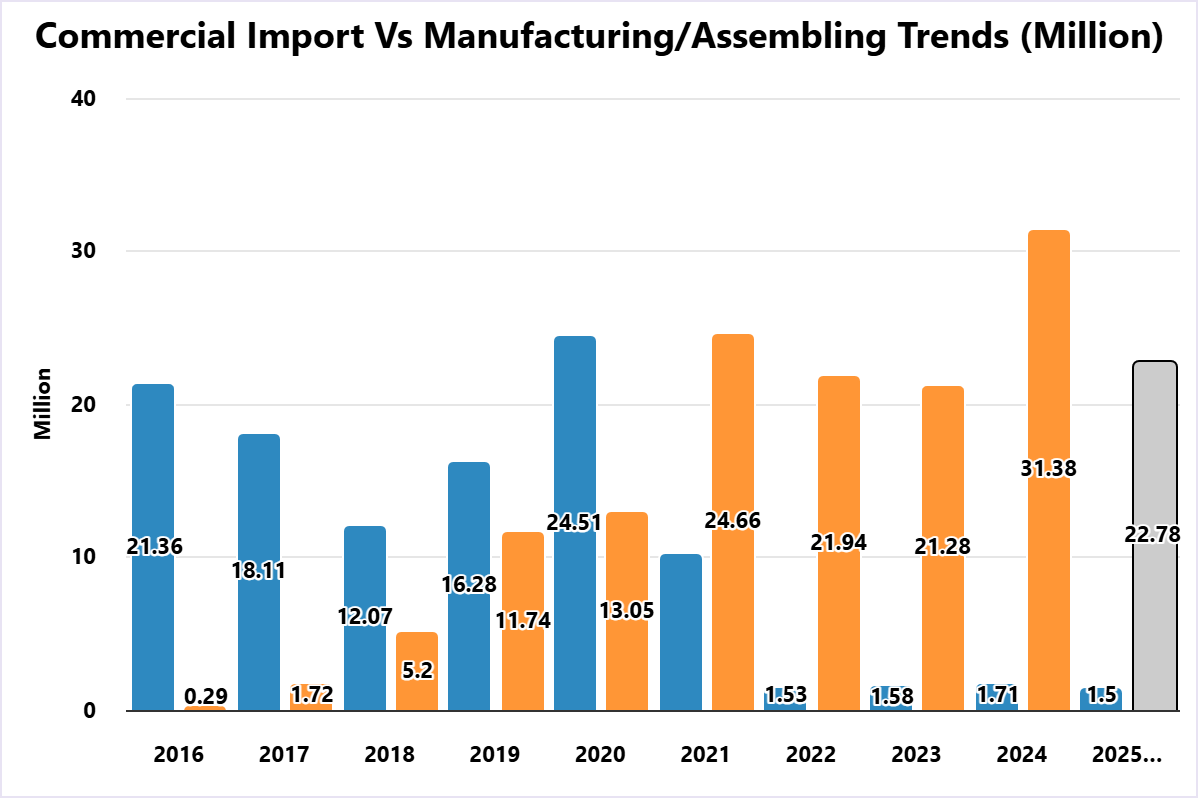
ISLAMABAD - Pakistan’s mobile phone industry has undergone a dramatic structural shift, as locally assembled and manufactured devices surged to 22.78 million units in the first nine months of 2025 while commercial imports fell sharply to just 1.5 million units, according to new data from the Pakistan Telecommunication Authority. The figures highlight the sustained impact of the Mobile Device Manufacturing Policy and the increasingly leading role of Chinese companies in the country’s mobile production landscape.

Chinese Brands Push Pakistan’s Jan–Sep 2025 Mobile Output to 22.8M Units


[Source PTA]

The change from previous years is striking. In 2016 Pakistan imported more than 21 million handsets commercially, while local manufacturing stood at only 0.29 million units. Imports remained high through 2020 when they peaked at 24.51 million units, but a combination of local assembly incentives, tariff adjustments, and growing Chinese industrial participation gradually reversed the trend. By 2022 commercial imports had dropped to 1.53 million units while domestic production rose to nearly 22 million. The shift accelerated in 2024 as local manufacturing climbed to 31.38 million units and imports declined to 1.71 million, marking a near-complete turnaround from the pre-policy environment.
 

Mobile phone production plunges 34pc


Kalbe Ali
November 26, 2025

ISLAMABAD: The budgetary move to impose 18 per cent sales tax on mobile phones has begun to impact the market, leading to a decrease of approximately 34 per cent in local assembly for October compared to the same month last year.

The overall roll-out of locally produced mobile phones has increased due to the effective implementation of the Device Identification, Registration, and Blocking System (DIRBS) by the Pakistan Telecommunication Authority (PTA). This system restricts the usage of non-tax-paid imported phones. However, consumers have begun to show reluctance to purchase new phone sets.

The PTA data showed that local monthly mobile phone manufacturing plunged 34pc year-on-year to 2.33 million units in October from 3.53m, and fell 23pc from September.

Responding to Dawn’s query, Pakistan Mobile Phone Manufacturers Association (PMPMA) Deputy Vice-Chairman Zeeshan Mianoor said that the mobile roll-out was higher in the previous months as market forces too increased their inventories ahead of the unveiling of the budget 2025-26.

“The distributors and retailers already have excess inventory, whereas the sales have declined with the imposition of 18pc sales tax; as a result, the prices of the sets have increased,” Mr Miannoor added.

Eventually, manufacturers have reduced production to avoid further stock accumulation, and cumulative local manufacturing could reach 25.11m units in 10 months of the calendar year 2025.

Out of these, 13.2m units, or 53pc, were smartphones, while 47pc, or 11.9m, were feature phones.
 
Currently, over 97pc of mobile phones sold in the country are locally manufactured. PMPMA data showed that during the first 10 months of this calendar year, a total of 675,177 phones were imported by commercial importers and individuals returning from abroad.

The highest number of 238,712 sets imported in 10MCY25 belonged to iPhones (Apple), followed by 208,940 feature phones from Nokia.

In 2024, a total of 154,836 iPhones were imported. A senior member of the PMPMA pointed out that while many view the iPhone as a status symbol — often opting for older models — most new iPhone models are purchased primarily to be given as gifts. Whereas, in 2024, locally assembled phones reached 32.80m units, and only 792,208 sets were imported.

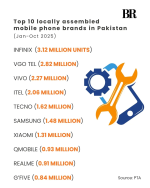
During the period January-October, the highest-selling locally produced phone in the country was Infinix with 2.90m roll-out, followed by Vgotel (2.74m), Vivo (2.36m), Itel (2.13m), Tecno (1.49m), Xiaomi (1.42m), and Samsung (1.32m).Gfive is the largest producer of feature phones in the country, manufacturing 1.17m units in 10MCY25.
 
KARACHI: Smartphone production in Pakistan continues to rise, reaching 53 percent of total mobile phone output in October. The shift reflects both growing manufacturing capacity among local and foreign assemblers and an increasing national demand for smart devices.

According to data released by the Pakistan Telecommunication Authority (PTA), more than 25.11 million mobile phones were produced locally during the first 10 months of the current year. Of these, smartphones accounted for 53 percent, or 13.2 million units, while the remaining 47 percent, 11.9 million units, were 2G feature phones.

Four months earlier, local mobile phone output stood at 14.24 million units, with feature phones comprising 54 percent of production and smartphones 46 percent in June 2025.
 
KARACHI: Smartphone production in Pakistan continues to rise, reaching 53 percent of total mobile phone output in October. The shift reflects both growing manufacturing capacity among local and foreign assemblers and an increasing national demand for smart devices.

According to data released by the Pakistan Telecommunication Authority (PTA), more than 25.11 million mobile phones were produced locally during the first 10 months of the current year. Of these, smartphones accounted for 53 percent, or 13.2 million units, while the remaining 47 percent, 11.9 million units, were 2G feature phones.

Four months earlier, local mobile phone output stood at 14.24 million units, with feature phones comprising 54 percent of production and smartphones 46 percent in June 2025.
 

Pakistan targets $15 billion in IT exports by 2030​

IT minister says Rinova AI-RCM Matter deal to bring AI medical billing, create thousands of skilled jobs in Pakistan


Pakistan targets $15 billion in IT exports by 2030


Minister for Information Technology and Telecom, Shaza Fatima Khawaja, said Pakistan has witnessed a 25 percent growth in IT exports, and the government aims to maintain this momentum to achieve an export target of $15 billion by 2030.

“Government is working to boost a technology-driven and knowledge-based economy under the concept of a True Digital Pakistan,” the IT minister said, while addressing a signing ceremony between Rinova AI and RCM Matter. The agreement between the two companies aims to bring AI-enabled medical billing to Pakistan and create thousands of skilled jobs that strengthen the country’s digital economy.

Shaza highlighted the contribution of private-sector IT companies to the economy and said the government is focusing on two priorities: supporting the private sector to position Pakistan as a tech destination, and transforming the country into a digital nation.

“The government is training half a million human resources annually at no cost, with a focus on demand-driven training,” she said. She added that a roadmap for True Digital Pakistan has been developed, and a commission led by Prime Minister Shahbaz Sharif is ensuring data access for both government and private sectors.

Read More: PSX surges past 165k milestone as optimism builds over IMF meeting

“Data will be made available for technology-driven private sector initiatives,” she said. She also highlighted that Pakistan has approved a national AI policy to facilitate patenting of AI products, and that data centers and cloud infrastructure are available locally. The government is establishing Centres of Excellence at universities to train IT professionals, she added.

During the ceremony, Edge Co-Founder Iffi Wahla announced plans to scale up investment from $17 million to $50 million over the next eighteen months, providing employment for more than 1,000 people in Pakistan.

Edge CEO Iffi Wahla said the company will provide more than 1,000 jobs in the next 18 months, with a minimum salary benchmark of Rs350,000. He described Rinova AI as an advanced tool to grow the medical billing industry. RCM Matter CEO Mudassar Hanif said the partnership represents a positive step for growth in the healthcare sector and will create 1,000 jobs in the coming months.
 

Users who are viewing this thread

Pakistan Defence Latest

Back
Top