Pakistan Telecom, IT, Tech updates

Pakistan’s mobile phone imports surge 40.5% to $801mn in first five months of FY2025–26

  • On a Month-on-Month basis, Pakistan’s mobile phone imports saw a 8.30 percent growth,
Tahir Amin

Pakistan imported mobile phones $801.139 million in the first five months (July-November) of current fiscal year 2025-26 compared to $570.184 million during the same period of last year, registering a growth of over 40.51 percent growth.

Official data revealed that in terms of rupees, the total value of mobile phone imports stood at Rs 226.133 billion during July-November 2025 compared to Rs 158.518 billion, registering 42.65 percent growth.

On a Month-on-Month (MoM) basis, Pakistan’s mobile phone imports saw a 8.30 percent growth, totaling $156.565 million in November 2025, compared to $1444.563 million in October 2025. Year on year mobile imports witnessed a negative growth of 4.81 percent when compared to $149.378 million in November 2024.

Pakistan imported mobile phones worth $1.494 billion in the last fiscal year 2024-25, registering a fall of 21.31 per cent compared to $1.898 billion during the previous year, 2023-24.

In terms of Pakistani rupees, the total value of mobile phone imports stood at Rs 417.351 billion during fiscal year 2024-25. This represents a 22.09 percent decline when compared to Rs535.690 billion in the same period of 2023-24.
 
The local manufacturing/ assembling plants manufactured/ assembled 25.11 million mobile handsets during the first ten months (January-October) of the calendar year 2025 compared to 1.7 million imported commercially.

Official data revealed that 2.33 million mobile handsets were manufactured/ assembled in October 2025 against 0.2 million imported commercially.

The local manufacturing/ assembling plants manufactured/ assembled 25.11 million mobile handsets included 13.2 million smart phones and 11.9 million 2G phones.

Besides, as per the PTA data, 70 per cent of mobile devices are smartphones, and 30 per cent are 2G on the Pakistan network.
 

IT minister says spectrum auction to be completed early next year, will pave way for better internet services

News Desk
December 23, 2025

1766494886389.png

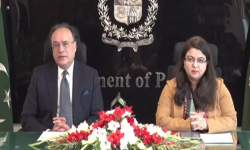
Finance Minister Muhammad Aurangzeb and IT Minister Shaza Fatima Khawaja address a press conference on December 23. — DawnNewsTV

Information and Technology Minister Shaza Fatima Khawaja on Tuesday said that the auction of 600 MHz spectrum would be completed early next year, stating that it would pave the way for providing better internet services in the country.

She made the remarks while addressing a press conference alongside Finance Minister Muhammad Aurganzeb in Islamabad. At the outset of the press conference, Aurangzeb said the Economic Coordination Committee (ECC) had approved the recommendations of the Spectrum Advisory Committee.

In her remarks, Khawaja said that the recommendations would now be taken to the federal cabinet.

“After that, the Pakistan Telecommunication Authority (PTA) will issue an information memorandum based on which consultations and negotiations will be held with stakeholders and the telecom sector,” she said.

“We are trying to ensure that the auction is completed by the end of January or early February,” she added. Explaining the significance of the development, she said that the internet quality in Pakistan was not at par with international best practices or even the quality in the region.

“The major reason for this is that the spectrum is not available in Pakistan,” she said. The IT minister said that Pakistan’s population of 240 million was operating on a spectrum of 274 MHz.

“This means we are using two lanes for traffic which requires eight, which is why there is congestion, your internet does not work and you face challenges,” she said. “For that reason, the spectrum auction is being carried out.”

She said that during auctions held in the past, around 60MHz of spectrum was acquired. She said that the government was going to auction 600 MHz, making it the largest-ever.

The IT minister said that during the auction, additional bands were being auctioned in Pakistan for the first time, which meant that for consumers, not only 3G and 4G quality would improve, but it would also ensure the rollout of 5G services.

She said the PTA would ensure that all these rollouts would be completed between four to six months of the auction so that services could “visibly” improve after this period.

She said that the government was making efforts to ensure that 5G services would roll out after six months.

The minister stressed that the internet was integral to the government’s digitisation efforts as part of the Digital Nation Pakistan Act, 2025.
 
“According to Connect 2030 — which the prime minister will inaugurate soon — we will ensure that over the next five years the minimum connectivity available to users should 100 Mbps.“

In November, the consultant for the 5G spectrum auction presented its report to the government, which had remained stalled due to the merger of PTCL and Telenor and litigation over the 2600MHz band.

The report, prepared by US-based consultancy firm National Economic Research Associates (NERA), noted that Pakistan was offering 606MHz of new spectrum across six major bands: 700MHz, 1800MHz, 2100MHz, 2300MHz, 2600MHz and 3500MHz.

The 2600MHz band was considered the most suitable for 5G.

The report also outlined key policy recommendations, including auction design, methodology, base price, duration and other terms and conditions.
 

5G rollout set for major cities by next year, says IT minister

  • By mid-2026 Pakistan will have significant improvement in internet speed, says Shaza Fatima
Baseer Ahmed
December 24, 2025

Federal Minister for IT & Telecommunications Shaza Fatima Khawaja on Wednesday said 5G rollout is expected in five cities, including Karachi, Lahore and Islamabad, in the first quarter of next financial year.

Addressing a webinar organised by the IT ministry, Shaza said a spectrum auction is scheduled to be held in February 2026 and after about six months of the auction fifth generation of mobile network technology, offering significantly faster data speeds and lower latency than previous generations, is expected to be launched in the federal capital and four provincial capitals. She also said that 4G technology is anticipated in four months of the February auction.

“The demand for auction has come from telecom sectors,” she reiterated.
 
She added that recommendations for the spectrum auction—including the bidding model and base pricing—have been submitted to the Federal Cabinet. The IT minister confirmed that these key decisions will be formalised following the Cabinet approval today.

The development comes a day after the Economic Coordination Committee (ECC), chaired by Finance Minister Muhammad Aurangzeb, approved key recommendations for Pakistan’s largest-ever spectrum auction, enabling the country’s first commercial rollout of 5G services.

The approval is based on proposals of the Spectrum Advisory Committee, also chaired by the finance minister, following consultations with stakeholders, including users, the Pakistan Telecommunication Authority (PTA), and a review of international and regional benchmarks on spectrum pricing, payment terms, and auction design.

“We have been on the journey of Digital Pakistan, and accelerating that journey,” said Aurangzeb, adding that the spectrum auction is an important enabler in this regard.

Speaking at the presser alongside the finance minister, Shaza said the ECC’s decision clears a critical policy hurdle and that the recommendations would now be placed before the federal cabinet for final approval.
 
Once cleared by the cabinet, the PTA will issue an Information Memorandum, initiating formal consultations and negotiations with telecom operators.

“The government aims to complete the auction by the end of January or in the first week of February,” she said.

Under the plan, nearly 600 megahertz (MHz) of spectrum will be auctioned, in addition to the 274 MHz currently in use, making it the largest spectrum auction in Pakistan’s history.

Except for the 1800 MHz and 2300 MHz bands, all frequency bands will be auctioned for the first time in the country.
Addressing the webinar, the IT minister said the spectrum auction will effectively improve internet speed. “Once the auction is complete, we will make sure that user experience of internet improves,” she said.

Internet speed will definitely be higher with the introduction of 5G technology, but we will also try to improve speed of 4g, she stressed, adding that by mid-2026 Pakistan will have significant improvement in internet speed.
 
Pakistan has formally launched its National Semiconductor Initiative, INSPIRE, on October 21, 2025, marking a significant step toward integrating into the global $600 billion semiconductor ecosystem, with ambitions to surpass $1 trillion by 2030. The initiative, unveiled by Prime Minister Shehbaz Sharif, focuses on building a domestic semiconductor ecosystem through human capital development, infrastructure, and innovation, with an initial emphasis on fabless chip design rather than manufacturing.

  • INSPIRE Initiative (2025): The National Semiconductor Initiative, INSPIRE, was launched by the Ministry of Information Technology and Telecommunication (MoITT) and executed by the Pakistan Software Export Board (PSEB). It aims to position Pakistan within the global semiconductor value chain by fostering research, education, and industry collaboration.
  • National Semiconductor Plan (2022–2030): A draft Semiconductor Policy & Action Plan has been developed, focusing on three pillars: human capital development through Semiconductor Education & Research Clusters (SERCs), infrastructure building with incentives, and innovation via academia-industry partnerships. The plan targets training 1,000 semiconductor engineers by 2030.
  • Economic Projections: The semiconductor market in Pakistan is projected to reach US$522.60 million in revenue by 2025, with optoelectronics being the dominant segment at US$332.60 million. The market is expected to grow at a CAGR of 6.90% from 2025 to 2029, reaching US$682.40 million by 2029.
  • Government Incentives: The plan includes a National Semiconductor Fund of Rs 10 billion, tax rebates (25% for employees and R&D staff), duty exemptions on imported equipment, soft loans with interest rebates, and benefits under Special Technology Zones (STZs).
  • Strategic Focus: Pakistan is prioritizing fabless chip design and Assembly, Testing & Packaging (ATP) facilities over full-scale manufacturing, which is capital-intensive and resource-heavy. The country aims to become a competitive ATP hub in South Asia.
  • International Collaboration: The government has engaged with Chinese stakeholders, with the Special Technology Zones Authority (STZA) negotiating strategic cooperation for chip design services. The government has also issued letters to over 200 Chinese tech companies to attract investment.
  • Challenges: Key challenges include high capital requirements for fabrication plants, energy and infrastructure constraints, fiscal limitations due to IMF agreements, and the risk of talent retention. Despite these, experts believe Pakistan can make a significant impact with an initial investment of around $250 million in design and testing.
  • Current Status: As of 2025, Pakistan’s semiconductor industry remains in a nascent phase, with all equipment and chips currently imported. However, the launch of INSPIRE and the National Semiconductor Plan signal a strategic pivot from digital services to deep-tech innovation.
 
You usually need to demonstrate mastery of the basics, reliable power, logistics, supply chains, talent, and capital by first building a locally competitive potato chips industry, before talking seriously about computer chips.
 
You usually need to demonstrate mastery of the basics, reliable power, logistics, supply chains, talent, and capital by first building a locally competitive potato chips industry, before talking seriously about computer chips.
I don't see any Indian potato chips let alone Silicon chips in the world market
 
I don't see any Indian potato chips let alone Silicon chips in the world market

Very true, but Kerala has some nearly world class Banana chips and I doubt the labour unions there would allow for any other type of chips to be made
 

PTA launches district-level internet licenses

BR Web Desk
January 1, 2026

The Pakistan Telecommunication Authority (PTA) on Thursday commenced issuance of class licenses for the provision of internet services at the district level across Pakistan to promote local entrepreneurship, strengthen broadband infrastructure and enhance digital inclusion.

The new licensing regime will allow small and medium-scale operators to offer internet services at the district level, particularly improving last-mile connectivity in under-served and remote areas.

According to the PTA, the class license will be valid for a period of ten years. Applicants will be required to pay a one-time initial license fee of Rs300,000 along with an Annual License Fee (ALF) of Rs100,000 for the first year, which must be deposited before the license becomes effective.

The ALF for subsequent years will be payable in advance and will be subject to an annual increase of 10 percent. Interested parties have been advised to apply as per the prescribed checklist through PTA’s online application portal, while the template of the class license has also been made available on the authority’s official website.

The PTA reiterated that the initiative reflects its continued commitment to expanding broadband penetration, promoting digital inclusion and facilitating sustainable growth in the telecommunications sector across the country.
 
The PTA a week ago had revised its regulatory framework for Internet of Things (IoT) and Short Range Devices (SRD), aiming to accelerate the development of a nationwide IoT ecosystem through both licensed and shared frequency bands.

The updated framework provides detailed guidelines for IoT service provisioning, with a strong focus on the use of shared and unlicensed spectrum for Low Power Wide Area Networks (LPWAN) on a non-interference, non-protection basis. PTA had said the move aligned with international best practices and the government’s vision for digital transformation.

Under the revised policy, IoT and SRD services were categorised based on spectrum usage. Services using licensed or exclusively assigned frequency bands might be offered by Cellular Mobile Operators (CMOs) and other licensees under existing license conditions. Mission-critical IoT services will continue to operate only on licensed spectrum.
 

Users who are viewing this thread

Pakistan Defence Latest

Country Watch Latest

Back
Top