Pakistan Telecom, IT, Tech updates

Pakistan aims to reboot digital connectivity with three new subsea cables​


Cables to support 5G rollout, reduce outages, unlock broader economic opportunities, says IT minister

Web Desk
August 28, 2025


shaza also revealed that chinese satellite internet firms including galaxy space and shanghai space have expressed interest in entering the pakistani market photo app


Shaza also revealed that Chinese satellite internet firms, including Galaxy Space and Shanghai Space, have expressed interest in entering the Pakistani market. PHOTO: APP

Pakistan is set for a major digital upgrade this year as the government prepares to lay new submarine Internet cables to strengthen connectivity and support 5G technology rollout.

Federal Information Technology Minister Shaza Fatima Khawaja said on Thursday that the project would not only enhance internet speed but also improve reliability, reduce outages, and unlock broader economic opportunities, according to a statement published by state broadcaster Radio Pakistan.

“The new cables will expand bandwidth capacity, reduce dependence on older systems, and place Pakistan as a stronger participant in global digital networks,” said Fatima.

Earlier, Pakistan also actively participated in major global subsea projects, including the 2Africa cable, installed in Karachi in late 2024 and expected to go live by the end of 2025 with a capacity of 180 Tbps. Other projects such as Africa‑1, PEACE, and MGG‑1, are expected to collectively add over 26 Tbps of bandwidth.
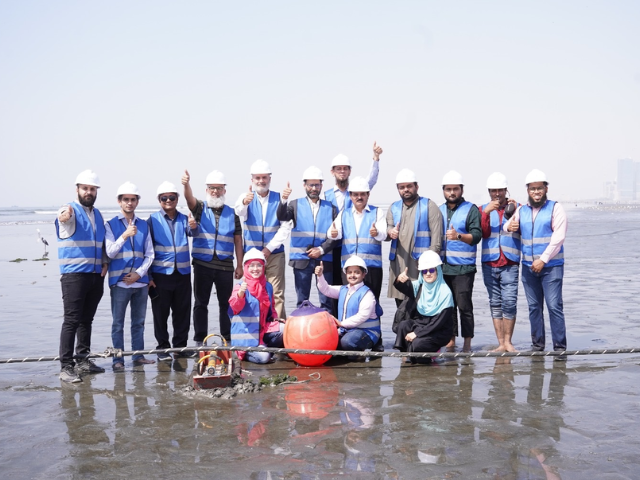
Photo: PTCL


Photo Courtesy: PTCL

The additional infrastructure, including the three new cables, is expected to help overcome recurring problems linked to outage-prone cables such as Asia-Africa-Europe-1 (AAE-1) and South East Asia–Middle East–Western Europe 4 (SMW-4), according to Fatima.

The government views the expansion as central to its wider digital strategy, aiming to attract investment, improve service delivery, and enable businesses to scale in a more connected economy.

Industry experts say the move could pave the way for faster adoption of 5G and strengthen Pakistan’s regional position in digital trade, claimed the statement.

 

Pakistan PM gives go-ahead for 5G auction


Tahir Amin
September 3, 2025

1756935644737.png


ISLAMABAD: Prime Minister Shehbaz Sharif gave a go-ahead for the long-awaited 5G spectrum auction to be completed by December 2025, despite delays caused by cellular company mergers, litigation over prime bands, and economic hurdles.

The decision was shared on Tuesday during the Senate Standing Committee briefing by the Special Secretary of the Ministry of Information Technology and Telecommunication, which was chaired by Palwasha Mohammad Zai Khan.

The auction advisory committee, chaired by Finance Minister Muhammad Aurangzeb, will meet on Monday to review proposals from an international consultant. The Pakistan Telecommunication Authority (PTA) and Frequency Allocation Board (FAB) confirmed that 606 MHz of spectrum has been made available, including 154 MHz currently under litigation.

DG Licensing Amer Shahzad emphasized that mid-band frequencies—particularly 2600 MHz for 4G/5G and 3500 MHz for 5G— are key to improving service quality and coverage. Pakistan’s IMT spectrum remains significantly lower than regional benchmarks.

To ensure transparency, former minister Anusha Rahman proposed including the National Accountability Bureau (NAB) in the auction committee. Legal representatives also briefed the committee on ongoing stay orders, with the next hearing set for September 17. Lawmakers warned that further delays could hinder Pakistan’s digital and economic progress.

The National Cyber Crime Investigation Agency (NCCIA) briefed the committee on alarming developments in cyber fraud, revealing that scams have cost citizens over Rs. 3 billion. Officials reported the dismantling of 63 illegal call centers, recovery of Rs. 40 million, and the arrest of approximately 450 individuals.

The agency flagged exploitative loan apps charging interest rates up to 1,800 percent, often operated by non-banking financial entities. Committee members voiced concern over digital loan scams, gambling platforms, and misinformation campaigns on social media. Efforts to curb cybercrime include enhanced coordination with banks to detect skimming devices and intensified digital surveillance during sensitive national events.

The Chairperson directed NCCIA to present a comprehensive report on cyber-linked offences in the next session. The briefing underscored the urgent need to restore digital trust and protect vulnerable users from financial exploitation.

The committee was briefed by the PTA and the Auditor General of Pakistan regarding audit findings that allege telecom giant Jazz overcharged users by Rs. 6.58 billion through quarterly tariff hikes of up to 15 percent.
 

Services exports rise 18.3pc in July


Mubarak Zeb Khan
September 5, 2025

ISLAMABAD: Pakistan’s exports of services rose by 18.27 per cent year-on-year in July — the first month of FY26 — mainly on the back of a strong performance in telecommunication, computer, and information services, official data showed on Thursday.

According to figures released by the Pakistan Bureau of Statistics, services exports increased to $745.52 million in July, up from $630.38m in the corresponding month of the previous fiscal year. On a month-on-month basis, exports rose by 4.47pc.

In rupee terms, services exports grew 20.74pc to Rs211.89bn in July compared to Rs175.49bn in the same month last year, indicating continued strength in foreign currency inflows from the sector.

The data highlights that the double-digit growth was primarily driven by a 23.77pc surge in telecommunication, computer, and information services, which reached $354m in July compared to $286m in the same period last year, according to the State Bank of Pakistan.

IT-related services lead a 23.8pc rise in telecom, computer, and information exports

Other business services also posted robust growth, rising 17.96pc to $151m from $128m a year earlier. Transport services exports increased by 21.54pc to $79m from $65m.

However, the export of travel services declined sharply by 20.33pc, falling to $47m from $59m in the same month of FY25, reflecting subdued demand or reduced outbound activity in the travel segment.

Despite the overall rise in services exports, imports of services marginally declined by 0.61pc to $871.44m in July compared to $876.83m in the corresponding month last year. On a monthly basis, however, imports rose by 3.41pc.

The slight decline in imports was largely due to reduced spending on transport and business-related services. Transport services imports dropped 2.97pc to $391m in July FY26 from $403m a year earlier. In contrast, travel services imports rose 16pc to $210m from $181m in the same period.

As a result of rising exports and easing imports, Pakistan’s trade deficit in services narrowed significantly by 48.91pc in July FY26, falling to $125.92m from $246.45m in the same month last year.

In FY25, the country’s services exports grew 9.23pc to $8.39bn, compared to $7.68bn in FY24. The momentum has largely been fuelled by consistent growth in IT-related exports since February 2024, though the sector did witness a 6.5pc dip in August 2024.

Analysts believe the performance of the services sector — especially IT and digital services — will remain a key driver of foreign exchange earnings in the current fiscal year, particularly amid volatility in goods exports.
 

IT ministry, Alibaba partner to boost digital trade


Kalbe Ali
September 6, 2025

1757156689911.png

Beijing: Federal Minister for IT & Telecom, Ms. Shaza Fatima Khawaja, witnessed the signing of multiple landmark MoUs during the 2nd Pakistan-China B2B Conference in China on September 5. — Press Information Department (PID)

ISLAMABAD: The Ministry of Information Technology has partnered with Alibaba to boost digital trade and support SME growth in Pakistan.

Minister for IT and Telecommunication Shaza Fatima Khawaja and Roger Luo, head of South and Southeast Asia at Alibaba.com, signed a memorandum of understanding in this regard in Beijing during the 2nd Pakistan-China B2B Investment Conference. Alibaba.com, a leading global B2B e-commerce platform, has signed the MoU with Ignite — National Technology Fund, which operates under the IT ministry.

The collaboration aims to strengthen Pakistan’s digital economy and expand global opportunities for small and medium-sized enterprises (SMEs) and startups.

Under the agreement, Alibaba.com will organise and facilitate online and offline promotional activities, such as Pakistan trade shows and an online national pavilion. It will also deliver targeted B2B e-commerce training and provide AI-powered tools to selected SMEs and startups.

Ignite will assist in implementation by identifying potential exporters, coordinating seminars in major cities, and promoting Alibaba-led initiatives across the country.

Shaza Fatima said Pakistan stood at the cusp of global e-commerce opportunities, where the passion and entrepreneurial skills of its youth could enable them to showcase their products and abilities at the international level. She described the partnership with Alibaba.com as an important step for Pakistan’s digital economy.

“By equipping our SMEs and startups with advanced e-commerce tools and access to global markets, and by aligning our institutions with international best practices, we aim to foster innovation, support export growth, and strengthen Pakistan’s participation in global digital trade,” she added.

Alibaba.com has already played an active role in Pakistan, rolling out its Trade Assurance service with an 85 per cent activation rate within months of its launch. It has also helped sellers adopt its AI-powered Smart Assistant, which is now used by 80pc of Pakistani sellers, enhancing trust and operational efficiency.
 
“By equipping our SMEs and startups with advanced e-commerce tools and access to global markets, and by aligning our institutions with international best practices, we aim to foster innovation, support export growth, and strengthen Pakistan’s participation in global digital trade,” she added.

Alibaba.com has already played an active role in Pakistan, rolling out its Trade Assurance service with an 85 per cent activation rate within months of its launch. It has also helped sellers adopt its AI-powered Smart Assistant, which is now used by 80pc of Pakistani sellers, enhancing trust and operational efficiency.

In the second quarter of 2025, Pakistan recorded a 60pc year-on-year increase in new suppliers on Alibaba.com, led by the apparel, sports and entertainment, and surgical instruments sectors.

Following the signing of MoU, the Pakistani delegation visited Alibaba’s campus in Beijing and discussed ways to expand Pakistan’s role in global supply chains, improve e-commerce training for SMEs, and explore further cooperation in AI and digital trade facilitation.

Published in Dawn, September 6th, 2025
 
Federal Minister for IT and Telecommunication Shaza Fatima Khawaja on Tuesday said that the IT sector will be a “core element” under the newly inked Strategic Mutual Defence Agreement (SMDA) between Saudi Arabia and Pakistan

Speaking at the inauguration ceremony of ITCN Asia-2025 in Karachi, the minister stated: “We have received a note from London stating that the IT sector will be a core element for investment opportunities under the newly signed SMDA.”

Last week, Saudi Arabia and Pakistan signed SMDA during Prime Minister Muhammad Shehbaz Sharif’s visit to Riyadh, which clearly states: “Any aggression against either country shall be considered an aggression against both.”


While primarily a defence pact, economic experts believe that the agreement has opened a new chapter in bilateral relations with much potential to boost investment and explore joint ventures, foreign direct investment, oil & gas energy cooperation and IT exports.

Highlighting Pakistan’s digital journey, Shaza informed that Pakistan’s tech sector has registered annual growth of 20% in recent years. She informed that in the last two years, Pakistan’s internet and data usage increased by 24%.

The number of Pakistan’s freelancers and remote workers has doubled in one year, she said.

The minister informed that the government intends to make Pakistan a data transit hub of the region.

The minister added that the government is prioritising the resolution of IT and internet-related issues and is taking concrete steps to ensure 5G access across all regions of the country.

She said that the government intends to conduct spectrum auction by the end of this year. “The auction will increase spectrum availability from 274MHz to 1,000Hz, but will also introduce 5G into the country,” she said.

Shaza reaffirmed the government’s commitment to equipping one million youth with AI skills.

According to the State Bank of Pakistan (SBP), IT exports rose to $691 million during the period of July to August as compared to $584 million reported in the same period of the last year, while showing a surge of $107 million year-on-year.
 
its just a start. we have our role in vision 2030
 

Huawei and Pakistan government to train 300,000 youth under AI and ICT initiatives​


Huawei, in partnership with the Pakistan government, is working to train 300,000 young people to bridge the skills gap in the tech industry. The initiative targets youth from secondary education to trained professionals, aiming to equip them with skills in AI, ICT, and networking systems. The IT ministry launched a training portal at Huawei’s Islamabad office, and the program is part of Pakistan’s broader goal to develop a digital-based economy, which was recently supported by the federal cabinet’s approval of the National AI Policy.


Prime Minister Shehbaz Sharif signed the agreement with Huawei in 2024 at the company’s Shenzhen headquarters. Since then, the Higher Education Commission (HEC) has been running training sessions for both trainers and students. Huawei has established 100 academies across universities in Pakistan, certifying over 300 trainers to teach students in bachelor’s programs and providing ICT labs on campuses.

The training portal offers 18 courses, including AI, cloud computing, and three-month research projects, available in self-paced formats. The courses culminate in certification exams, and students can progress through different levels—associate, professional, and expert. Around 700,000 people are enrolled in the DigiSkills platform, with the government targeting 10% of these for the training initiative.


Despite the progress, challenges remain, such as the lack of hands-on experience in certain subjects, which the portal cannot provide. The program aims to reach 300,000 individuals, though meeting the broader target of one million remains unclear. The government’s efforts are ongoing to expand the program, including in-person sessions for professionals and extending training to provincial schooling systems.
 
Pakistan needs more competition in the FTTP market. Also what the heck is with IP stream products not being available in remote part of Pakiatan. Surely could use Wimax to bridge speed/coverage issues.

No thanks to all the heavy taxation on the Telco sector - cell operators have been reluctant to invest in new BTS sites - often relying on co-operating one BTS to serve increasing larger subscribers area - which results in spotty service, poor signal and snailpaced speeds.
 

Pakistan, China move closer to laptop manufacturing partnership​


By Shafqat Ali | Gwadar Pro
Sep 22, 2025

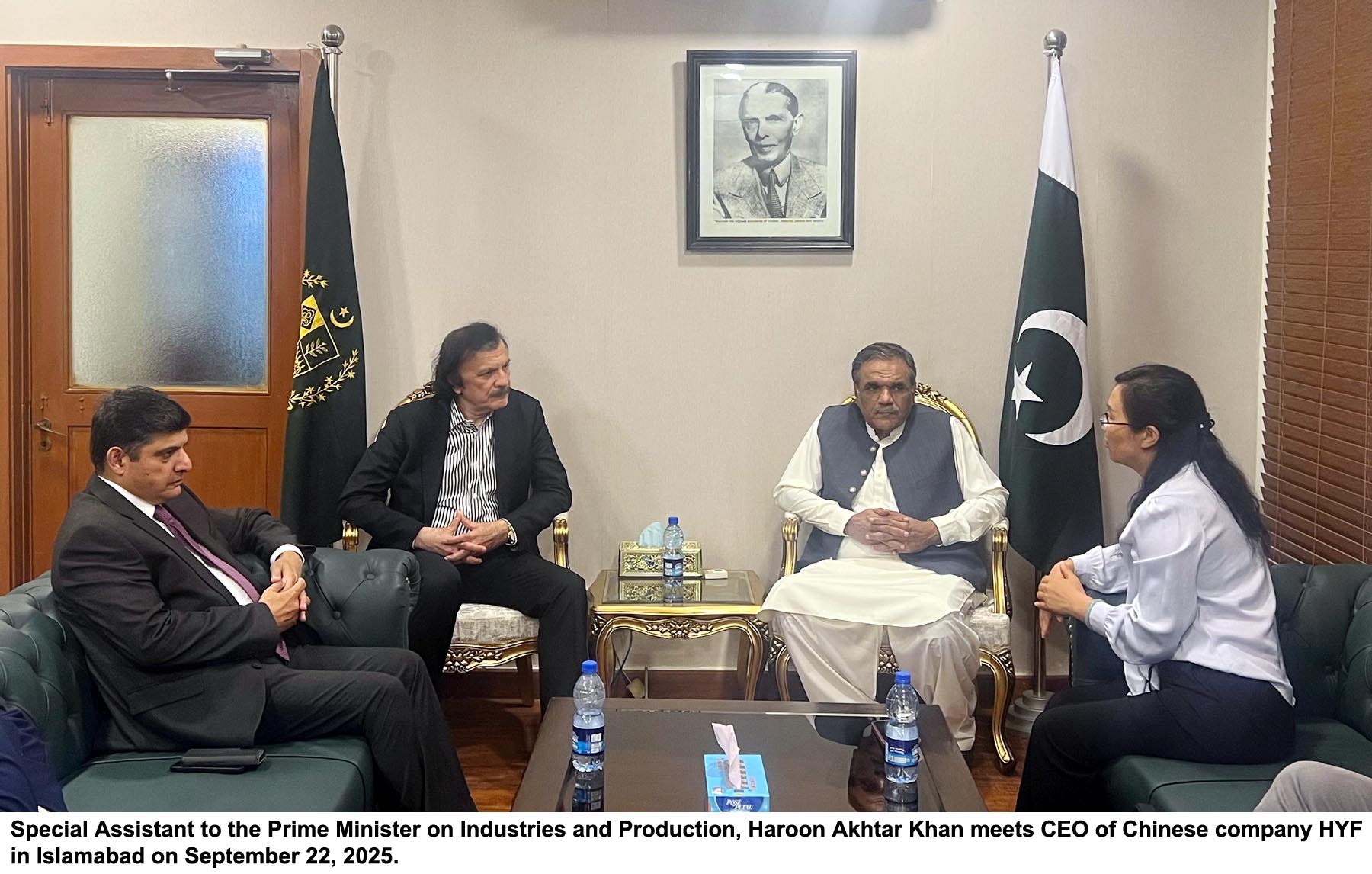
ISLAMABAD - In a key development for Pakistan’s technology sector, Special Assistant to the Prime Minister (SAPM) Haroon Akhtar Khan on Monday afternoon held talks with the CEO of HYF, a leading Chinese electronics firm, on setting up a laptop and tablet manufacturing plant in Pakistan.

Pakistan, China move closer to laptop manufacturing partnership


The Chinese company specializes in laptops, fingerprint devices, and digital tablets, and is now considering investing in local production facilities in Pakistan. Haroon Akhtar reassured the visiting delegation that Prime Minister Shehbaz Sharif has directed full facilitation for Chinese investors, declaring them “a top priority” for Pakistan’s economic agenda.

He announced that a new Mobile Device Policy, covering laptops and tablets in addition to smartphones, will soon be unveiled, creating an enabling environment for investors. He also highlighted that visa procedures for Chinese businesspersons had been streamlined, with visit and business visas now processed within 24 to 72 hours.

According to an official statement, the SAPM instructed the Pakistan Industrial Development Corporation (PIDC) and the Engineering Development Board (EDB) to extend full support for HYF’s entry into Pakistan. Analysts note that this move could not only reduce Pakistan’s reliance on imported electronics but also create jobs, boost technology transfer, and enhance local skills training.

The initiative reflects a growing trend of Chinese companies shifting from infrastructure investments to high-tech industrial cooperation in Pakistan, thereby diversifying the scope of bilateral economic engagement.
 

Expanding operations: Air Link to establish production facility in Lahore


BR Web Desk
September 30, 2025

1759267386747.png


Air Link Communication Limited (AIRLINK), a Pakistani technology firm, has unveiled a major expansion plan, establishing a state-of-the-art production facility at the Sundar Green Special Economic Zone (SGSEZ) in Lahore.

The production facility, spanning eight acres with 1.4 million sq. ft. of purpose-built infrastructure, would integrate sustainable energy solutions and aims to boost Pakistan’s industrial and export base, the company said.

Of the eight acres, three acres are owned by Air Link and five acres by its wholly owned subsidiary, Select Technologies (Pvt.) Limited.

“The facility will integrate a 1 megawatt (MW) solar power generation system, which will reduce the cost of production, lower the company’s carbon footprint, and support long-term sustainable operations,” read the notice.

The company informed that the facility is expected to commence commercial operations by the end of 2025.

“By operating within the SGSEZ framework, AIRLINK will benefit from ten years of fiscal incentives, enhancing competitiveness and long-term growth.

“In line with its strategic vision, the new facility is designed to support future exports of mobile phones, laptops, LED TVs, electronics, home appliances, and other high-tech products by international brands from Pakistan, reinforcing AIRLINK’s role in strengthening the country’s industrial and export base,” it added.

Furthermore, the company shared that it has launched a Samsung Multi Experience Store at the Dolmen Mall, Lahore.

“The initiative reflects AIRLINK’s commitment to integrated retail expansion and enhanced brand engagement across Pakistan,” it added.

Air Link Communication Limited was incorporated in Pakistan as a private limited company in January 2014 and was converted into a public limited company in April 2019.

The company is engaged in import, export, distribution, identification, wholesale, and retail of communication and IT-related products and services, including smartphones/ cellular phones, tablets, laptop accessories, and related products.
 

Competition Commission of Pakistan approves PTCL’s acquisition of Telenor with conditions


Umaid Ali
October 1, 2025

The Competition Commission of Pakistan (CCP) has approved Pakistan Telecommunications Limited’s (PTCL) acquisition of mobile carrier Telenor Pakistan and Orion Towers shareholdings, according to a press release issued on Wednesday.

According to the telecommunication company’s website, one of its subsidiaries is mobile carrier Ufone. As part of the deal, Telenor and Ufone will merge.

According to the press release, the merger was announced today at a press conference at the CCP’s head office. CCP Chairman Dr Kabir Ahmed Sidhu, CCP Registrar and Head of Legal Ambreen Abbasi and members Salman Amin and Shahzad Hussain shared the key highlights of the agreement.

“They explained that [the] CCP conducted a comprehensive review of the merger transaction,” the press release read. “The review examined market structure, concentration levels, efficiencies, and potential competition risks.”

Dr Sidhu emphasised that the commission’s decision “ensures a level playing field for all telecom operators and safeguards consumer interests”.

“The merger aims to enhance service quality, expand product offerings and accelerate technological innovation, including the rollout of 5G,” he was quoted as saying.

“The CCP [has] studied various international precedents, including orders from the United States, United Kingdom and European Union, involving similar transactions before granting approval.”

According to the press release, Abbasi explained that the assessment considered possibly lessening competition in the relevant sub-markets, market shares and efficiency claims. She underlined that the merger was approved conditionally, with safeguards designed to prevent anti-competitive conduct.

Some of the key conditions listed in the press release were:

  • PTCL and the merged entity will maintain separate boards and independent management structures.
  • Chief executive officers and senior management must meet strict competency and integrity requirements, with UAE-based telecom company Etisalat ensuring professional leadership.
  • An independent third-party will monitor compliance, audit transactions, and submit quarterly reports to CCP for five years.
  • Related party transactions and cross-subsidisation will be prohibited unless conducted competitively and at arm’s length.
  • Non-discriminatory access will be applied to capacity and infrastructure for all operators. PTCL and MergeCo shall submit all its existing and future Reference Interconnect Offers (RIO) to the Pakistan Telecommunications Authority (PTA) for approval. PTCL shall offer interconnection to all operators in accordance with RIO as approved by the PTA.
  • PTCL shall seek the PTA’s approval for its wholesale pricing structure in relation to IP Bandwidth, LDI, Domestic Leased Line and telecom infrastructure services provided to PTA licensees, as well as associated companies including MergeCo. PTCL shall not set predatory retail prices.
  • Mandatory compliance will be ensured with service quality standards, innovation policies and PTA tariff approvals.
  • PTCL and Telenor must demonstrate that claimed efficiencies are passed on to consumers through better services, pricing and infrastructure investments.
  • The CCP reserves the right to direct divestiture of assets or business segments in case of future violations.
 

PTCL accepts terms for $1b Telenor deal​


Watchdog's probe faces political pressure but sets safeguards to prevent dominance

Our Correspondent
October 01, 2025


a ptcl spokesperson said that the application for the acquisition of telenor pakistan is currently being reviewed by the competition commission and we will not comment on the ongoing regulatory proceedings photo file


A PTCL spokesperson said that the application for the acquisition of Telenor Pakistan “is currently being reviewed by the Competition Commission and we will not comment on the ongoing regulatory proceedings”. photo: file

The Board of Pakistan Telecommunication Company Limited (PTCL) has officially approved its commitment to comply with the stringent terms and conditions set by the Competition Commission of Pakistan (CCP) regarding its $1 billion acquisition of Telenor Pakistan. This development paves the way for the CCP to issue its long-awaited order on the significant merger, which has been pending for over 18 months.

CCP carried out one of the most exhaustive merger reviews in its history, applying the Substantial Lessening of Competition (SLC) Test to assess whether the deal could distort market dynamics.

As per the statement, its review spanned multiple sub-markets, including cellular mobile services, long-distance and international (LDI) services, fixed-line telephony, leased lines, and IP bandwidth.

Between September 2024 and August 2025, the Commission held five open hearings and several confidential sessions with PTCL, Telenor, and other stakeholders. It demanded extensive documentation – from separated accounts to interconnection agreements and business plans – to evaluate dominance concerns. Despite delays, incomplete disclosures, and technical complexities, CCP secured all required information.
 

Users who are viewing this thread

Latest Posts

Back
Top