Pakistan: The Archaeological Marvel

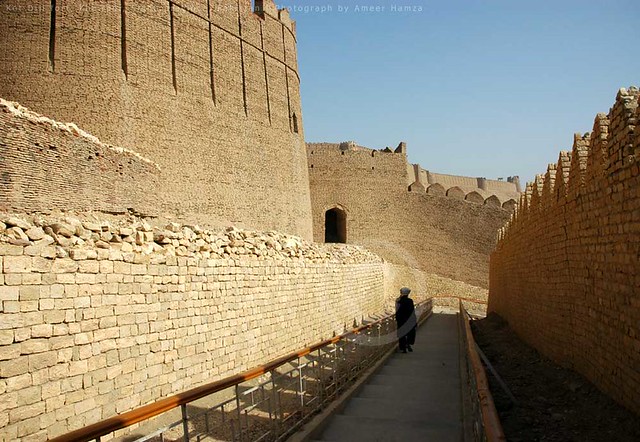
Kot Diji

6901475967_0dee65695f_z.jpg


Around 3500-3000 B.C, another civilization came into being while the Indus Valley Civilization was just underway. Located about 22 km south of Khairpur in the Sindh of province, Pakistan, the Kot Dijli site is some 60 km away from Mohenjo-daro.

Excavated in 1955, the site’s culture is characterized by the use of the red-slipped globular jar with a short neck painted with a black band. During the peak of this civilization, the region was divided into two. The first part was a Citadel for the elites, separated by a defensive wall from the general public. The second was a Lower Town with mud houses. Terracotta found from this site has characteristic horizontal and wavy lines, or loops and triangular patterns. Remains of jars, balls, bangles, beads, pots and figures have also been discovered at the site.

The ancient site is speculated to have been burned down, though the reasons for this end are yet to be discovered.
 
Ancient well discovered in Charsadda's centuries old graveyard

PESHAWAR: An ancient well was unearthed in an old graveyard in Charsadda on Saturday when unknown people exhumed a grave, said an official from the archaeology department.

The well was uncovered when a grave was dug along a roadside graveyard.

"It is an ancient well, almost 60 feet deep," said Mir Hayat Khan, an official from the archaeology department.

The official added that various such wells have been identified, and are thought to be from the British era. Khan could not confirm if any artifacts were discovered from the well.

57f903f78c0d1.jpg


"We will be able to say something after proper investigation is carried out with the help of local police," he said.

An area resident claimed that after recovering the artifacts, the perpetrators did not bury the well as they were in a hurry to leave and not get caught.

Khyber Pakhtunkhwa Archaeology Department Director Dr. Abdul Samad said: "Charsadda is rich in archaeological sites and a number of archaeological sites have been identified in the area."

The Charsadda graveyard located in the Palang area is the second largest graveyard in South Asia, the director claimed.

“I will inform our relevant officials in the district and report to the area police to further investigate the issue,” Dr. Samad told.

Charsadda was the first capital of Ghandhara civilization, but Dr. Samad believed that the well was built during the British Raj era.

Most of the archaeological sites in the area have been occupied by artifact robbers and they are regularly involved in digging at the sites, added the director.

http://www.dawn.com/news/1288851/ancient-well-discovered-in-charsaddas-centuries-old-graveyard
 
Iconic Buddha in Swat valley restored after nine years when Taliban defaced it

FAZAL KHALIQ

5820acb570e34.jpg


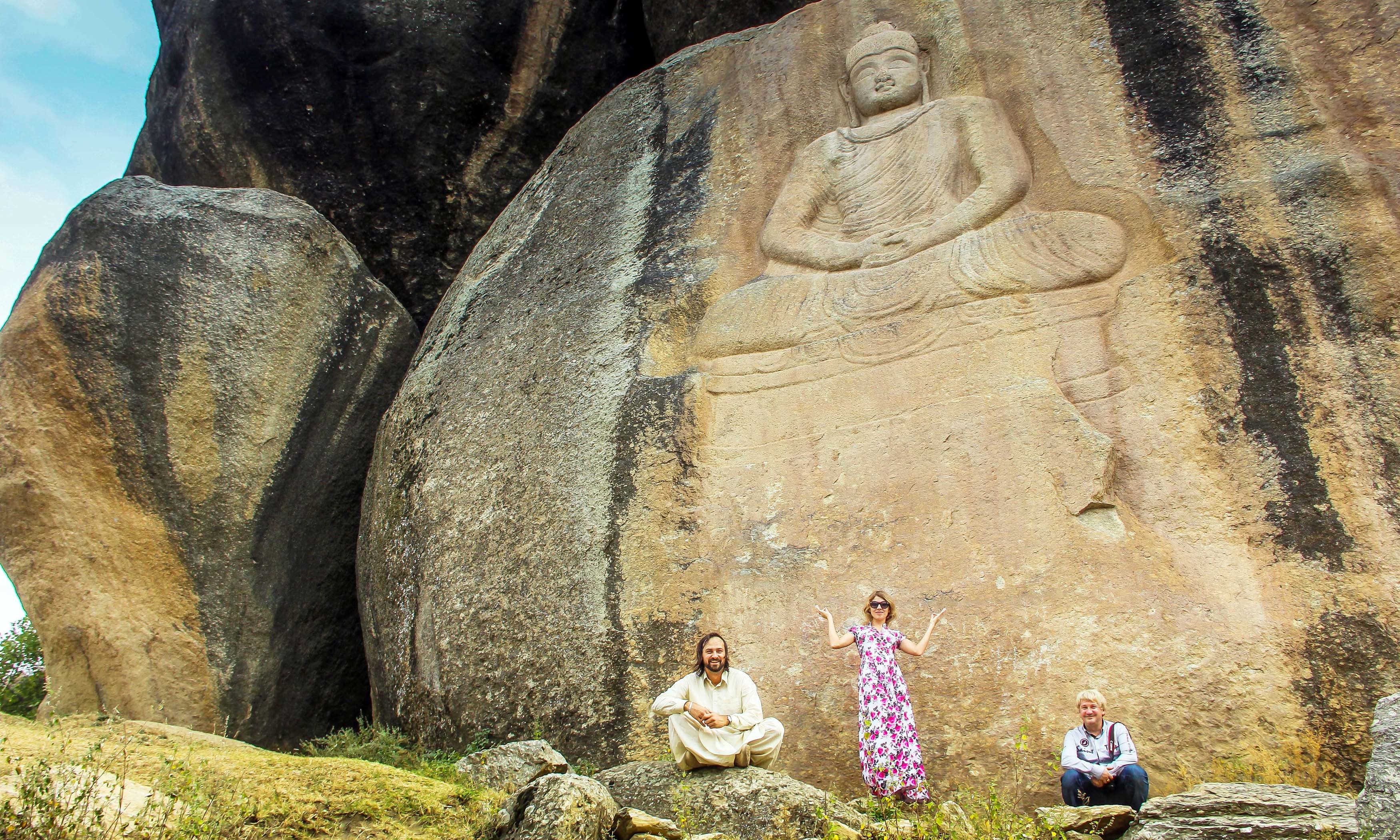
The iconic seventh-century defaced Buddha at Jahan Abad, Swat, at last, got its face back after a nine-year-long wait following a scientific restoration process conducted by Italian archaeologists.

The 7th century Buddha seated in a meditative posture which is considered one of the largest rock sculptures in South Asia was attacked in September 2007 by the Taliban, who blew up half the statue's face by drilling holes into the face and shoulders and inserting explosives.

The explosives in the face, when detonated, destroyed half its face, but the explosives in the statue's shoulders failed to detonate.

The defacement of the Buddha sparked worldwide anger and concern among the Buddhist community, historians and archaeologists.

5820ac222aee5.jpg


The Italian Archaeological Mission in Pakistan were able to restore the statue to its original form after six scientific missions.

"It was our professional and moral obligation toward the people and heritage of Swat and Pakistan which forced us to restore the Buddha. It took about five missions of about a month each from 2012-2016 in its complete conservation program," said head of the Italian Archaeological Mission, Dr Luca Maria Olivieri, adding that international experts worked on the restoration process.

“Two restorers/trainers, two 3D scan experts/trainers, one chief restorer, five local restorers, 20 field workers, two carpenters, and three watch-keepers were involved in the restoration process, while the 3D equipment was provided all-inclusive by the University of Padua, Italy,” he said

"It was restored under the Archaeology Community Tourism (ACT) Field School project funded by Italian government, a joint project of the Directorate of Archaeology and Museums of Khyber Pakhtunkhwa and the Italian Archaeological Mission," Olivieri added.

Fabio Colombo, a restorer and member of the Italian Archaeological Mission who has vast experience in the field of conservation and who worked on-site in Bamyan, Afghanistan, said that he enjoyed the work at Jahan Abad as it was a very important historical site where the locals also gave him love and respect.

5820ac2588bc7.jpg


"It is one of the biggest rock sculptures in the region and different traces showed that it was once a central Buddhist location in the past. The surrounding of Buddha statue is peaceful, picturesque and serene. Owing to its historical, religious and archaeological importance," he told Dawn.

"I hope local people understand its value as it is one part of their history which also belongs to the entire world.”

Syed Niaz Ali Shah, an official and representative of the Archaeology department with Italian Archaeological Mission in the ACT project, said that Tibetan pilgrims who visited Swat in the past mentioned about the Jahan Abad Buddha along with a Buddhist temple here.

“Some of the highly technical and experienced Italian experts worked in the conservation and restoration process using 3-D technology for which we are thankful to them."

He said that the site would, once again, become a tourist spot as it was in the past. “I hope Buddhist visitors and other tourists will once again visit this place, not only to enjoy the area serenity but the rich cultural heritage of the region here,” Niaz Ali Shah hoped.

He said that the Buddha sculpture would play a vital role in the revival of International and national tourism.

5820aca200194.jpg


After restoration of the Buddha the first foreign delegation which visited the site was Russians, who appreciated the classic sculpture art and the scenic location.

Yury Zhorno, a Russian tourist who visited Swat valley to see Buddhist archaeological monuments and rock carvings, said he was excited to visit the iconic Buddha.

“The Buddha sculpture is really amazing not only for its history but also for its nifty carving. The view from the foot of Buddha is also amazing as Swat valley is beautiful,” he told Dawn.

He invited people from across the world who took interest in Buddhism and natural beauty and said there was no need to be afraid as there was perfect peace.

Another Russian tourist who is tour agent in Moscow and brings Russian tourists to Pakistan also liked the location of Buddha and said that it was good sign that the situation in Pakistan was improving.

“The security situation here in Swat valley is very good and when we came here so the army assisted us everywhere and we feel safe here,” he said, adding that Pakistan had huge potential for tourists with diverse landscapes and rich culture heritage and people from across the world should visit it.

Abdul Bari a resident of Gilgit Baltistan and an owner of the tourist company said Swat was the most beautiful place in Pakistan with oldest Buddhists records in form of archaeology.

“People of the valley are also hospitable so I want tourists to come here and discover all these things at the same time,” he said, adding that the government must promote tourism and attract tourists from across the world here.

http://www.dawn.com/news/1294246
 
Kunala Stupa

5828d01428cbf.jpg


TAXILA: Kunala Stupa from Ashoka’s time near the Sirkap City, also known as the second city of the ancient Taxila Civilisation.

A path to the site will also be established and the stairs to the stupa will be renovated.

The stupa dates back to the second century BC and has importance in Buddhist history and the Gandhara civilisation, according to Department of Archaeology and Museums (DOAM) Deputy Director Mohammad Irshad Khan.

The stupa was named after Emperor Ashoka’s son, Kunala, who was heir to the Mauryan Empire and the stupa marks the place where Kunala was blinded by a step mother.
 
Archaeologists discover 110 sites in Pakistan that are 30,000-year-old

Archaeological department in Pakistan’s Khyber Pakhtunkhwa province has unearthed as many as 110 sites that are 30,000-year-old. The sites include some that are of Buddhist importance.


Peshawar : Archaeological department in Pakistan’s Khyber Pakhtunkhwa province has unearthed as many as 110 sites that are 30,000-year-old. The sites include some that are of Buddhist importance.

Archaeological department with the help of Political Administration and Pakistan Army made the discoveries, Political Agent Khyber Khalid Mehmood said.

Eight sites that are of significant Buddhist importance have also been found in the survey, said Khalid Mehmood.

The archaeological survey was carried out for nearly 75 days in tehsil Jamrud of Khyber Agency and the result was the discovery of thirty thousand years old 110 ancient sites.

A variety of relics including pictures and paintings carved on stones were discovered from the sites.

Also discovered from the sites were the remnant of mosques, forts, gallows, tunnels and other buildings of Ameer Taimur period.

“Surveys were also conducted in these areas during British rule but they failed to achieve any success. Though deep excavation has not been conducted but we discovered sites with the evidence having historic value of thirty thousand years,” Mehmood said.
 
UNESCO accepts Pakistan proposal to include eight sites in heritage list

Derawar-Fort.jpg


ISLAMABAD: United Nations Educational, Scientific and Cultural Organisation (UNESCO) accepted Pakistan’s recommendation to include eight Pakistani sites in its list of World Heritage Sites.

The eight sites suggested by Pakistan were Cholistan’s Derawar Fort, Hingol Cultural Landscape in Balochistan, Nagarparkar Cultural Landscape in Sindh, Central Karakoram National Park and Deosai National Park in Gilgit-Baltistan, Ziarat Juniper Forest and Karez System Cultural Landscape in Balochistan and the Khewra Salt Range in Punjab.

These locations, holding significant importance for Pakistan in tourism sector, are included in the list prepared by the Department of Archaeology and Museums (DOAM) and accepted by UNESCO.

The archaeology and museums department will start the documentation process once UNESCO formally announces the approval.

The process will be completed within two to three years.

http://arynews.tv/en/unesco-accepts-pakistan-proposal-to-include-eight-sites-in-heritage-list/
 
The Indus Valley Civilization (IVC) was a Bronze Age civilization (3300-1300 BCE; mature period 2600-1900 BCE) extending from what today is northeast Afghanistan to Pakistan and northwest India. Along with Ancient Egypt and Mesopotamia it was one of three early civilizations of the Old World, and of the three the most widespread It flourished in the basins of the Indus River, one of the major rivers of Asia, and the Ghaggar-Hakra River, which once coursed through northwest India and eastern Pakistan.

At its peak, the Indus Civilization may have had a population of over five million. Inhabitants of the ancient Indus river valley developed new techniques in handicraft (carnelian products, seal carving) and metallurgy (copper, bronze, lead, and tin). The Indus cities are noted for their urban planning, baked brick houses, elaborate drainage systems, water supply systems, and clusters of large non-residential buildings
 
Katas Raj

1748272576727.png
1748272602855.png

Katas Raj
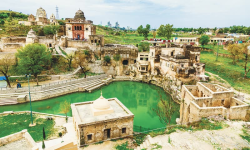
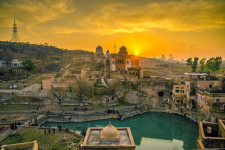
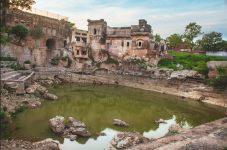
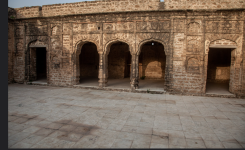
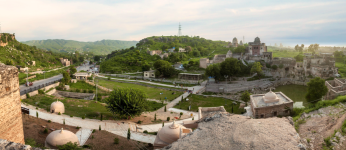
is located about 16 kilometers (10 miles) from Kallar Kahar on the road between Kallar Kahar and Choa Saidan Shah, in District Chakwal of province Punjab, Pakistan. It is situated about 40 kilometers from the city of Chakwal making it a popular tourist place among people of Chakwal. Basically, Katas Raj is a temple complex consisting seven ancient temples called Satgraha, some temples of middle ages and some recently constructed temples. The oldest temple dates back to 6th century A.D. All these temples are built around a pond acknowledged holy to Hindus.

In the mountains of Pothohar Plateau, these Hindu temples are famous worldwide. A large number of people belonging to Hinduism visit these temples each year to perform their religious practices and rituals. The pond in the center of temples is considered holy among Hindus because they believe it is filled by the tears of Shiva and taking bath in this pond provides forgiveness to sins.

It is said old name of Katas Raj was Kataksha, which in classic Sanskrit means “God’s Tears”. A visit to Kataj Raj Temple provides great information about the history of religions and about Hinduism. It would be better to take some time to visit Kalar Kahar Lake nearby for spending a picnic and boating.


1748272638578.png
 

Preserving Pakistan’s archeological heritage​


There’s a very close relationship between Italian archeologists and the ancient sites that dot the restive area

November 05, 2018
Syed Hamad Ali

Supplied


It is one of the most prominent symbols of Pakistan’s Buddhist heritage — a giant 7th-century rock sculpture of Buddha sitting in a meditative pose in Jahanabad, Swat. It’s an image of peaceful contemplation far removed from the hustle and bustle of modern urban life.

That peace was shattered on September 2007 when the Taliban blew up half of the sculpture’s face by drilling holes and putting explosives in it. It takes only a few minutes (and little skill) to carry out such an act of wanton destruction. But to fix it requires years of patience and devotion. In 2012, the Italian Archaeological Mission in Swat started the restoration of Buddha’s face. The process lasted a few years and was eventually completed in October

“The entire face was damaged by two blasts,” says Dr Luca Maria Olivieri (right), the director of the Italian Archaeological Mission in Pakistan. “We collected all the available fragments and with the help of 3D technology, we were able to reconstruct the original volumes.”

The reconstruction of the Jahanabad Buddha is just one of many accomplishments of the mission, whose work in Swat spans more than six decades.

“If you consider that the Italian mission has been present... working here practically without interruption for more than 60 years, you can imagine what is the magnitude of the fieldwork that we did. And how many people were involved in total,” Olivieri says.

The first time he came to Swat was in 1987 when he was 25 years old and still a university student.

Olivieri — who always wanted to be an archaeologist — graduated from Rome University and did his PhD in Berlin. Before coming to Swat, he participated in many excavations in Rome on the Colosseum and Palatine Hill. “As soon as I put my feet on the soil of Swat, I remember that I crossed my fingers, hoping that they would call me back again because I immediately fell in love with Swat,” he says.


15th century Jam Nindo tomb at Makli crumbling

5a8c7e997249e.jpg


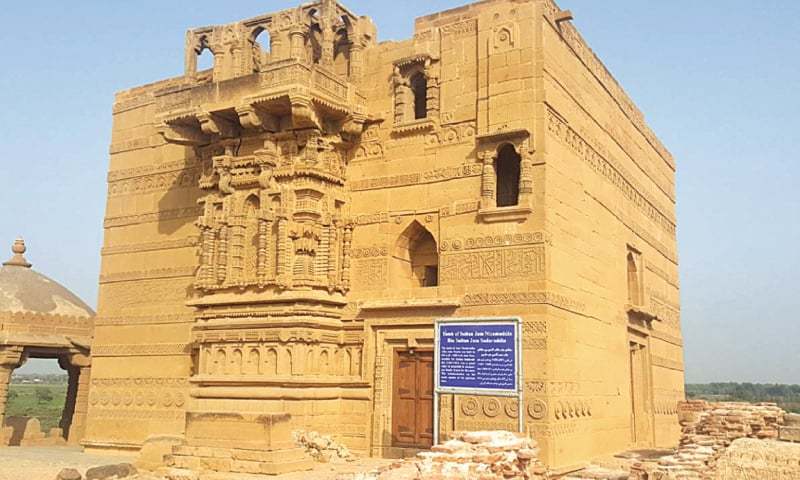
THATTA: The 15th century architectural marvel, the shrine of Samma ruler Jam Nizamuddin II alias Jam Nindo (1439-1509), at Makli necropolis has developed large cracks and may vanish into oblivion if the authorities concerned fail to take steps on a war footing to preserve the heritage site, fear conservationists.

Jam Nindo was the most famous ruler of the Samma dynasty, which ruled Sindh, parts of Punjab and Balochistan from 1351 to 1551 CE. His capital was Thatta and his reign was considered the golden age of Sindh.

Inscribed with 12 bands of decoration running around the building from top to bottom comprising stone-carved diamonds, lotuses, Quranic inscriptions and geometric patterns, the structure is one of the most attractive in the necropolis.

Sarfaraz Jatoi, the necropolis conservator, disclosed that in recent months Matthias and Rand Eppich, structural engineers, architects and conservationists from Germany and Spain, respectively, carried out geo-technical studies of the monument on behalf of Unesco with a view to protecting the heritage site. They were yet to submit reports, he said.

Qasim Ali Qasim, former director general of archaeology department, disclosed that Unesco was highly concerned about the monument which had been included in the master plan of the archaeology department.

He said that during his tenure the department had installed ‘gauges’ in the tomb on professionals’ recommendations to measure changes in the size of the cracks due to earthquake or other underground activity. But he could not say if the gauges were still working properly or not, he said.

5a8c7ebd7baf3.jpg


THE visible detachment of stones from their joints. / Photos by the author

About the present status of the structure, he said, when the position of columns was measured through plumb bob and other measuring instruments experts found the 33-foot tall structure with an equal size of plinth leaning seven inches towards the ground which was quite alarming.

Mr Qasim said that Mohan Lal, an engineer affiliated with Endowment Fund Trust for the Preservation of the Heritage of Sindh, had told him the fund was considering erecting a concrete wall at the back of the structure to save it from collapse.

He said that Unesco had warned the Pakistan government during its last meeting in Poland on June 17 last year that if required steps, including the construction of outer yard boundary wall, end to burial of outsiders and strengthening of the monument, were not taken according to the World Heritage Site rules, the Jam Nindo tomb would be struck off the list of endangered heritage sites of the world.

Former director general of archaeology Dr Mohammad Ali Manjhi called for immediate steps to save the structure, one of the most attractive tombs of necropolis, from vanishing into oblivion.

Activists of Thatta Historical Society and Sindh Cultural Forum, Sadiq Lakho, Allah Juriyo Burfat, Maaru Khushik, Ahmed Khushik and Nawaz Ali Qureshi, said that political personalities and vested interest groups were a major obstruction to construction of seven kilometre boundary wall around the necropolis, end to unabated practice of burials and encroachments within the limits of the heritage site.

They said that although the department appeared to make some efforts for the preservation of heritage sites, it had largely failed to live up to expectations after it took control of historical monuments under the 18th Amendment.

https://www.dawn.com/news/1390656/15th-century-jam-nindo-tomb-at-makli-crumbling
 
The art of rock carving is present in all regions of Gilgit Baltistan, mainly in the districts of Diamir, Hunza & Nagar and Baltistan in Pakistan. Speaking specifically of Baltistan, these engravings can be seen on former settlements and popular old routes along the Indus


467228014_3940727769540575_1893271336069757480_n.jpg
 
The oldest and largest Buddhist complex, Dharmarajika Stupa, or locally known as Chir Tope, is located on an eastern route along the Tamra stream, south of Hathial, about three kilometers from the Taxila Museum. The name Dharmarajika originates from the fact that the stupa was erected over the body relics of Gautama Buddha, the true Dharmaraja. Taxila was one of the many cities in the Maurya Empire that received a share of the holy relics from Ashoka. The Dharmarajika Stupa was erected by Ashoka himself to enshrine these relics.

The Dharmarajika complex covers almost the entire history of Buddhism in Taxila, from the 3rd century BCE to the 7th century CE. The main stupa was constructed during the Mauryan period but suffered damage in an earthquake in 40 CE. It was rebuilt twice during the Kushana period. The Dharmarajika complex is divided into two parts: the stupa area, which comprises a variety of constructions, and the monastic area to the north, which contains the living quarters and workspaces for monks.

The main stupa is built in a circular plan, with a diameter of 131 feet and a height of 45 feet. It is constructed of solid masonry and has a raised terrace around its base, ascended by four flights of steps. The structure is surrounded by an open paved passage that served as a procession path in ancient times. The courtyard of the stupa area is bordered by numerous chapels and several votive stupas, erected by pilgrims and visitors, dating from the 1st century BCE to the 1st century CE and from the 3rd to the 5th century CE, respectively. These stupas were decorated with Buddha images and figurines.

Several objects have been excavated from Dharmarajika Stupa, all of which are preserved and displayed at the Taxila Museum. Among these, the most remarkable finding was a reliquary in one of the side chapels containing a silver scroll that records the enshrinement of Buddha relics at Dharmarajika Stupa. In 1917, a casket was found here that contained the relics of Lord Buddha. This was presented by the then Viceroy of British India to the Buddhist community of Ceylon and has since been enshrined in the Temple of the Tooth in Kandy, Sri Lanka.

Dharmarajika was excavated between 1912 and 1916 by Mr. Ghulam Qadir under the directions of Sir John Marshall, and between 1934 and 1936 by Mr. A.D. Siddiqui. In 1980, it was included in the World Heritage List by UNESCO for its cultural, historical, and scientific significance. The Directorate General of Archaeology Punjab is responsible for the preservation and conservation work at Dharmarajika, which is under its control.


494155294_1201248532012201_1837984963464295856_n.jpg
 
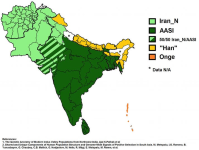
Mapping the Single Largest Ancestral Component in South Asian populations.


1748288326273.png
 

Users who are viewing this thread

Country Watch Latest

Back
Top