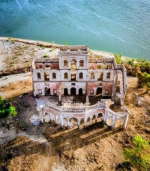
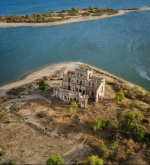
Pakistan: The Archaeological Marvel

Archaeological investigations focused on the western edge of the Stupa (Citadel) Mound to better understand its construction history. Through excavation, coring, and the reassessment of Sir Mortimer Wheeler’s 1950 excavations, researchers established that the feature previously interpreted as a “bund” is, in fact, a substantial mudbrick perimeter city wall extending along the western side of the mound.

Evidence from multiple construction phases indicates that the wall originated during the Early Harappan period, significantly revising current understanding of Mohenjo-daro’s early urban development.

Radiocarbon dating of charcoal samples recovered from excavated contexts and mudbrick cores produced dates ranging from approximately 2708–2576 cal BCE for the earliest phase of wall construction and 2460–2280 cal BCE for later occupation levels.

Together with the discovery of Kot Diji Phase pottery, these findings provide the first definitive chronological evidence that Mohenjo-daro’s defensive perimeter wall was constructed during the Early Harappan period.

The project also introduced innovative conservation and interpretation initiatives, including the production of replica mudbricks and the construction of a demonstration section of the ancient city wall to assist public interpretation. Comprehensive drone mapping, three-dimensional documentation, geological studies of mudbrick production, metallurgical analyses of copper artefacts, and systematic artefact documentation have further strengthened the scientific record and future conservation planning for the site.
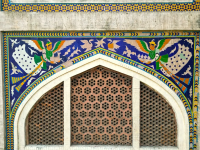
 

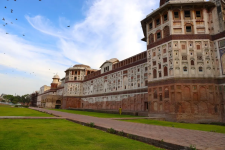
Lahore Fort Picture Wall restoration: a milestone for heritage conservation

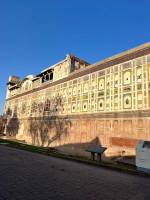
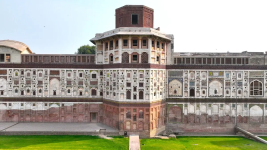
Pakistan's Lahore Fort Picture Wall, a 475-meter Mughal masterpiece, is fully restored after a decade-long, UNESCO-backed effort, setting new global benchmarks for heritage conservation.

Ibitisam Haq

1785354210364.png

The United Nations Educational, Scientific and Cultural Organization (UNESCO) has described the completion of restoration works on the Picture Wall at Lahore Fort as one of Pakistan’s most ambitious heritage conservation efforts.

The Picture Wall is among the world’s largest and most extraordinary Mughal murals, stretching approximately 475 metres in length and rising to an average height of 17 metres. Completed in April 2026 following around a decade of scientific research, multidisciplinary collaboration, and international partnerships, the project represents a major achievement in safeguarding cultural heritage for future generations.

1785354229635.png

Fuad Pashayev, UNESCO Representative in Pakistan, underscored that the completion of the Picture Wall restoration is a testament to what can be achieved when scientific rigour, international cooperation and local expertise come together. “UNESCO is proud to have witnessed this journey and to see that the conservation work has been recognized as strengthening the Outstanding Universal Value of this exceptional World Heritage property. We encourage Pakistan to carry this model of excellence forward,” he said.
 
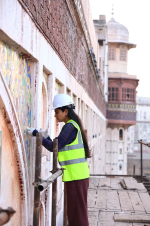
Beginning in 2015, the project adopted a phased, science-led approach to conservation, with restoration interventions officially commencing in 2018 following an extensive preparatory phase that included strategic documentation, evaluations and workshops.

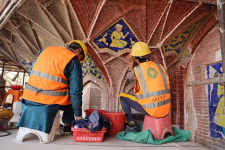
Rigorous research using technologies including 3D laser scanning, electronic distance measurement devices, and high-resolution ortho-rectified photography informed the restoration process. Throughout the project, emphasis remained on preserving original structures and materials rather than redesigning them, ensuring both authenticity and long-term sustainability.

1785354308692.png


The initiative brought together architects, engineers, scientists, conservators, artists and craftspeople whose combined expertise established new benchmarks for conserving complex historic structures in Pakistan. It also enabled the transfer and revival of traditional skills.

Many workers who initially joined as apprentices subsequently developed into skilled practitioners and trainers, contributing to the sustainability of traditional conservation knowledge and expertise. The project also generated significant employment opportunities, engaging hundreds of skilled and unskilled workers over many years.

1785354333088.png
 
1785354359171.png


In addition to conserving a historic monument, the initiative demonstrates how heritage preservation can support social, cultural and economic development. With Lahore Fort receiving millions of visitors annually, the restored Picture Wall is expected to further strengthen tourism, increase visitor engagement and support livelihoods linked to the city’s cultural economy.

The completion of the restoration marks not an end but an important milestone in a broader conservation journey. Through continued partnerships, further efforts are planned by the stakeholders involved in the Picture wall project, to conserve additional historic structures and strengthen interpretation and public engagement across the Lahore Fort and its wider historic setting.


1785354414296.png
 
I have not been to Pakistan since the early 80's but when I do get around to it, this place is #1 on my bucket list for when I make it over there.

Early 80s, wow, what are you waiting for?
That's the time i left, the country certainly has changed a lot since then, highly doubt you'll recognise it but it seems to have kept it's soul. I don't go back that often either but I can sense the soul of Pakistan, it's alive and well.
 
A screen grab from a video I made when I was at the National Museum of Pakistan in Karachi during my 2019 trip to Pakistan. I was vaguely aware of the rich ancient heritage of Pakistan but I was blown away by the artifacts in the museum: Looking at literally 5000+ old coins and statues and figurines and so much more.
I don't know what this screen grab shows but it was outside the Museum:

View attachment 198372

I think it shows various stages of Buddha's life, it seems to be a regular theme in various depictions of Buddha.
 
btw - disappointed that India holds the dancing girl even though it was excavated in Pakistan. Appreciate it got caught with the partition but there is no logical basis on which India can lay claim to anything from the Indus Valley Civilization, and all artifacts excavated in Pakistan should be returned to Pakistan without exception.


The issue is that india has tried extremely hard to grab Pakistan's pre-Islamic history. You have to recognise that in 1947 india was in a far better position in every shape or form, they simply swapped chairs with the British.
The British gave them a fully functioning state, with full capabilities. Whereas Pakistan was forced to build everything anew, in a short space of time and in extremely difficult circumstance.
The situation was designed so that Pakistan would not be able to function as an independent state after independence.
Partition is a redundant term, it amounts to a lie because it creates a false reality.

Long story short, the above situation allowed india to grab the narrative because we had other things to worry about. I'll give you couple of example to highlight my point.

In a interview a retired Pakistani diplomat served at the United Nations recalled a story during his service. He was taking part in a meeting, i do not remember the exact details but it's the overall point which is relevant. there was also an indian participant.
In the meeting the Pakistani diplomat highlighted Pakistan's rich heritage, such as the Indus valley civilisation.
After the meeting the indian diplomat had the audacity to protest to the Pakistani diplomat.

He said your history starts with the arrival of Islam, rest of the history of South Asia belongs to us indians, this is the shameful audacity of indians. I am certain it must have happened on many other occasions, with other people. We have been busy dealing with various issues and they have been busy grabbing the narrative, grabbing our history.

Only recently have we started to answer back but it's still not forcibly enough, still there's too much let's share and all that rubbish. Largely because we not understand the value and importance of words and applying correct context when saying something.


Another story, just couple of years old. That ignorant fool William Dalrymple has a podcast. In a discussion about the Indus valley civilisation with a Western expert, this is how he asked a question;

Me sitting here in india with it's rich history, blah blah, after a full statement he asked about the Indus valley civilisation in a framing of it being indian. That's how a narrative is created, grabbed and established.
I loved the answer given by that expert.
He said the Indus civilisation, who's centre is of-course in Pakistan and continued with rest of his answer lol
He destroyed that Harami Dalrymple's statement in the very first sentence.


Indians have tried to change the name of Indus Valley civilisation many times.

Indus/saraswati civilisation,
Indus Ghagar hakra civilisation,
they failed each time.

Now they are pushing the term Harappan civilisation.
Harappa is a phase in the Indus civilisation, not a civilisational term in itself, but this is what's being pushed.
Although Harappa is in Pakistan, but it pushes the centre of gravity further East, it sits near the border, it allows them to force their claim far easier.
The Indus is further West and very much in the centre of Pakistan. visually Indus sits firmly in Pakistan, while Harappa is near the border, allowing India to create a narrative that suits their needs.

They have not succeeded yet, but i have seen few Pakistanis here use the term without realising it.
Like i said, we are extremely poor in word choice and applying correct context when discussion issues.


Have you also noticed how suddenly everyone has started using the term "Ji" for Indian leaders, it did not happen by accident or naturally, that's another narrative building exercise, but since it's not relevant here, i won't delve deeper just yet.
 
The Indus is further West and very much in the centre of Pakistan. visually Indus sits firmly in Pakistan, while Harappa is near the border, allowing India to create a narrative that suits their needs.
Well made point ad always! I shall take note accordingly.
 

Pakistan recovers 904 smuggled antiquities from US, France and Italy


The Newspaper's Staff Reporter
July 30, 2026

1785407984684.png

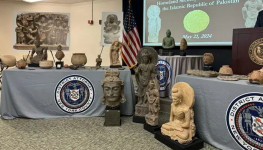
An image of recovered artefacts and US officials. — Photo courtesy @PakinNewYork/X

ISLAMABAD: Pakistan has achieved a major milestone in protecting its cultural heritage with the recovery and repatriation of 904 smuggled antiquities from the United States, France and Italy, the Ministry of National Heritage and Culture Division said on Wednesday.

According to a statement issued by the ministry, the effort, led by Federal Minister for National Heritage and Culture Aurangzeb Khan Khichi, marked one of the largest returns of stolen artifacts in the country’s history.

Officials said the recovered items included rare pottery, terracotta figurines, stone sculptures and other archaeological objects dating back thousands of years.

Many of the artifacts belonged to the ancient Mehrgarh Civilization (3500-2200 BC) and the Gandhara Civilization (2nd-5th Century CE), reflecting the region’s rich and diverse historical legacy.


The repatriation was carried out by the Department of Archaeology and Museums (DOAM) under the National Heritage and Culture Division in line with the 1970 Unesco Convention against the illicit trafficking of cultural property.

Authorities credited enhanced diplomatic engagement and coordination with foreign governments, law enforcement agencies and Pakistani missions abroad for overcoming legal and administrative barriers that had delayed the return of these objects for years.

According to official figures, 324 artifacts were brought back from the United States, 490 from France and 90 from Italy. The United States returned two consignments through coordinated efforts involving Pakistan’s Consulate General in New York and the New York District Attorney’s Office.

France facilitated the handover of a large collection following archaeological verification, while 22 objects identified as belonging to Iran were returned to the Iranian authorities in accordance with international law. Italy also handed over 90 artifacts, resolving a long-standing restitution case.

To ensure safe transportation, the Department of Archaeology and Museums established a transparent mechanism under public procurement rules. A specialised logistics system, designed for museum-grade handling, was used to securely transport the artifacts from multiple countries to Pakistan.

Officials described the development as a significant step forward in cultural diplomacy and heritage protection. The recovered antiquities are expected to be preserved and displayed for public education and research, allowing future generations to reconnect with the country’s ancient past.

The ministry said the government had reiterated its commitment to combating the illegal trafficking of cultural property and strengthening international cooperation to recover stolen heritage.
 
The issue is that india has tried extremely hard to grab Pakistan's pre-Islamic history. You have to recognise that in 1947 india was in a far better position in every shape or form, they simply swapped chairs with the British.
The British gave them a fully functioning state, with full capabilities. Whereas Pakistan was forced to build everything anew, in a short space of time and in extremely difficult circumstance.
The situation was designed so that Pakistan would not be able to function as an independent state after independence.
Partition is a redundant term, it amounts to a lie because it creates a false reality.

Long story short, the above situation allowed india to grab the narrative because we had other things to worry about. I'll give you couple of example to highlight my point.

In a interview a retired Pakistani diplomat served at the United Nations recalled a story during his service. He was taking part in a meeting, i do not remember the exact details but it's the overall point which is relevant. there was also an indian participant.
In the meeting the Pakistani diplomat highlighted Pakistan's rich heritage, such as the Indus valley civilisation.
After the meeting the indian diplomat had the audacity to protest to the Pakistani diplomat.

He said your history starts with the arrival of Islam, rest of the history of South Asia belongs to us indians, this is the shameful audacity of indians. I am certain it must have happened on many other occasions, with other people. We have been busy dealing with various issues and they have been busy grabbing the narrative, grabbing our history.

Only recently have we started to answer back but it's still not forcibly enough, still there's too much let's share and all that rubbish. Largely because we not understand the value and importance of words and applying correct context when saying something.


Another story, just couple of years old. That ignorant fool William Dalrymple has a podcast. In a discussion about the Indus valley civilisation with a Western expert, this is how he asked a question;

Me sitting here in india with it's rich history, blah blah, after a full statement he asked about the Indus valley civilisation in a framing of it being indian. That's how a narrative is created, grabbed and established.
I loved the answer given by that expert.
He said the Indus civilisation, who's centre is of-course in Pakistan and continued with rest of his answer lol
He destroyed that Harami Dalrymple's statement in the very first sentence.


Indians have tried to change the name of Indus Valley civilisation many times.

Indus/saraswati civilisation,
Indus Ghagar hakra civilisation,
they failed each time.

Now they are pushing the term Harappan civilisation.
Harappa is a phase in the Indus civilisation, not a civilisational term in itself, but this is what's being pushed.
Although Harappa is in Pakistan, but it pushes the centre of gravity further East, it sits near the border, it allows them to force their claim far easier.
The Indus is further West and very much in the centre of Pakistan. visually Indus sits firmly in Pakistan, while Harappa is near the border, allowing India to create a narrative that suits their needs.

They have not succeeded yet, but i have seen few Pakistanis here use the term without realising it.
Like i said, we are extremely poor in word choice and applying correct context when discussion issues.


Have you also noticed how suddenly everyone has started using the term "Ji" for Indian leaders, it did not happen by accident or naturally, that's another narrative building exercise, but since it's not relevant here, i won't delve deeper just yet.

Thanks for this post - very informative!
 

Users who are viewing this thread

Pakistan Defence Latest

Back
Top