Pakistan Weather News / Updates

PDMA warns of possible Indus flooding at Kalabagh, Chashma​


Indus likely to reach high flood level at Kalabagh, Chashma in 24 hours, warns Flood Forecasting Division

Web Desk
July 18, 2025

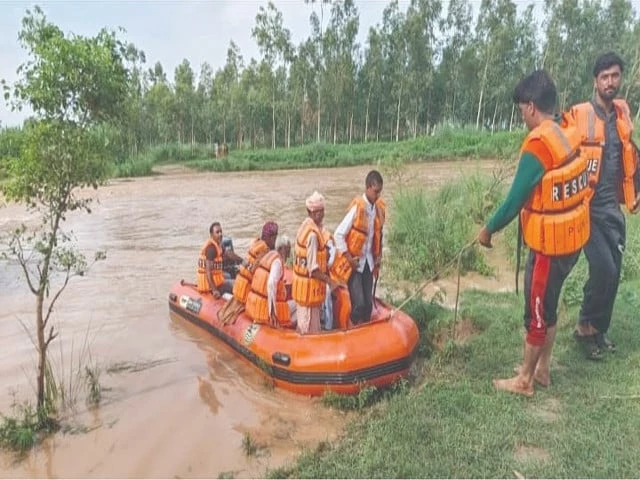
rescue officials ferry stranded villagers to safety as floodwaters engulf low lying areas near narowal amid relentless monsoon rains sweeping across punjab photo online


Rescue officials ferry stranded villagers to safety as floodwaters engulf low-lying areas near Narowal amid relentless monsoon rains sweeping across Punjab. PHOTO: ONLIN

Punjab’s Provincial Disaster Management Authority (PDMA) on Friday issued a high flood warning for the Indus River at Kalabagh and Chashma, following the province’s deadliest day of the ongoing monsoon season a day earlier, which claimed at least 63 lives amid widespread urban and riverine flooding.

The Flood Forecasting Division has warned that the Indus River is likely to attain high flood levels at Kalabagh and Chashma within the next 24 hours.

In a letter issued to the divisional commissioners of Sargodha and Dera Ghazi Khan, the PDMA stressed the need for heightened preparedness and directed district administrations to coordinate closely with relevant departments for a unified and prompt response.
 
Build as many dams as you possibly can

We need somewhere we can put this water to mitigate flooding and other issues, the water can then be used in times of need

Problem with South Asia is we always run behind NEED rather than DONE.

its common people irrespective of religion & tribe struggle with betrayal of promises.
 
Problem with South Asia is we always run behind NEED rather than DONE.

its common people irrespective of religion & tribe struggle with betrayal of promises.

Too much jahilat

Even at our slow pace we could have had so many more dams

Ethnic jahilat came into it, sindhis and pashtuns and someone played ethnic politics with the fools

Dam Nahi benega, I still remember these retarded slogans

We could have built so many dams at a cheaper rate decades ago if it wasn't for these haramis
 

At least 70 dead in 48 hours as monsoon rains lash Punjab​


Highest number of fatalities was recorded on Friday

Our Correspondent
July 19, 2025

tribune


LAHORE: At least 70 people died in the past 48 hours as relentless monsoon rains continue to wreak havoc across Punjab, raising the provincial death toll to 123 since late June, Express News reported. The Provincial Disaster Management Authority (PDMA) confirmed widespread damage due to roof collapses, landslides, and flash floods triggered by heavy rainfall.

At least 462 people have been injured since the onset of the monsoon spell on June 25, while several low-lying areas remain inundated. The highest number of fatalities was recorded on Friday, with 10 deaths reported from Lahore, Chiniot, Okara, Chakwal and Sargodha.

Chiniot and Lahore each recorded three deaths, while Okara saw two and both Chakwal and Sargodha reported one fatality each.

Chakwal remains the worst-affected district, where intense rainfall has caused severe landslides and flooding in local streams, displacing residents and damaging homes.
 
To view this content we will need your consent to set third party cookies.
For more detailed information, see our cookies page.
 
To view this content we will need your consent to set third party cookies.
For more detailed information, see our cookies page.
 

UN report maps trail of monsoon havoc

Punjab braces for floods as PDMA issues high alert
July 20, 2025

LAHORE:
The United Nations has highlighted the damages caused by monsoon rains in Pakistan that led authorities to declare disaster zones across parts of Punjab where lethal cloudbursts and flash floods killed dozens in a single day.

In a report published on its website, the UN said the unfolding crisis – rising rivers, forecasts of further downpours, fragile rural homes collapsing and transport links severed – has revived stark memories of the catastrophic 2022 floods that submerged a third of the country and affected more than 33 million people.

With the skies preparing to open for another round of torrential monsoon rains, the Punjab Disaster Management Authority (PDMA) on Saturday issued a flood pre-alert across the province, warning of a looming deluge in all major rivers and their tributaries.

At the national level, the National Disaster Management Authority (NDMA) has also issued a countrywide flood alert from July 19 to 25, warning of flash floods and landslides in multiple regions.

In Punjab, authorities anticipate a potentially critical flood situation beginning July 21, with the risk peaking on July 22, particularly in low-lying areas along the Chenab, Jhelum, Ravi, Sutlej and Indus rivers.

The floods loom as the province is also already reeling from heavy downpours, with at least 123 people having lost their lives and 462 having been injured in weather-related incidents across the province in the current monsoon season, which also saw damage to more than 150 buildings.

Citing unusual rises in water levels, PDMA spokespersons said a province-wide alert has been issued to all commissioners and deputy commissioners.

The disaster management authority directed a swift pre-emptive action, with Rescue 1122 instructed to complete all necessary arrangements without delay.

A high-alert status has also been declared for all relevant provincial departments, including local government, agriculture, irrigation, health, forest, livestock and transport.

PDMA Director General Irfan Ali Kathia has urged all administrative bodies to remain vigilant.

"In line with the chief minister's instructions, all emergency protocols must be in place in advance," he said, adding that emergency control rooms should remain staffed and active around the clock.

Fourth spell of monsoon

Meanwhile, the PDMA has also forecast the fourth spell of monsoon rains to begin on July 20, continuing through July 25. Widespread showers and windstorms are expected across most districts of Punjab.

The areas likely to experience significant rainfall include Rawalpindi, Murree, Galyat, Attock, Chakwal, Mandi Bahauddin, Hafizabad, Gujrat, Jhelum, Gujranwala, Lahore, Faisalabad, Sialkot, Narowal, Toba Tek Singh, Jhang, Sargodha, Mianwali, Dera Ghazi Khan, Bahawalpur, Bahawalnagar and Multan.

According to the PDMA, the rivers are already showing signs of distress. The Indus at Tarbela and Kalabagh is at low flood, while a medium-level flood has been recorded at Chashma, with the threat of a high-level flood developing.
 
hopefully the existing dams are perhaps full from all the water received......previously before the rains, there was a looming water shortage!!

Build more dams.
 

Resilience or ruin

Editorial
July 21, 2025

THE utter devastation witnessed across Pakistan this monsoon season is, tragically, neither new nor unexpected.

According to the NDMA, over 200 lives have already been lost since late June, and the country has experienced 80pc more rainfall than average. This is climate change in motion.

The recent River Swat tragedy, where tourists were swept away by a sudden surge of water, and the glacial floods submerging villages in Gilgit-Baltistan show clearly how global warming is reshaping our landscape and our vulnerabilities with it.

The loss is not just human or environmental. It is also economic. Every year, floods and climate-induced disasters wipe out crops, destroy infrastructure, displace communities and derail economic activity. These are costs we can ill afford. Our economic recovery is fragile, and yet, the billions spent on post-disaster relief and reconstruction remain a growing burden.

The fiscal cost of inaction, year after year, is far greater than what preventive infrastructure, climate-smart planning and resilience-building would require. Moreover, climate change should be viewed as a national security concern. Unpredictable monsoons, water scarcity, glacial melt and population displacement risk triggering social unrest over dwindling resources. The security establishment, quick to deploy personnel for rescue efforts, must also recognise that climate resilience is integral to long-term stability — as vital as any defence imperative.

Each disaster also reflects failed governance — at both the centre and the local level. Disaster management remains overly centralised, while municipal bodies and district administrations remain underfunded, disempowered and paralysed by red tape dysfunction. Climate adaptation can only succeed when local institutions have the autonomy, resources and capacity to act decisively. It is also a generational betrayal.

Each year of delay condemns future generations to greater hardship, fewer resources and a degraded environment. The political class must be held accountable not only for current failures but also for endangering the country’s long-term future and compromising its development trajectory.

What Pakistan needs is not just preparedness, but a climate-resilient economic vision that entails sustainability in agriculture, urban planning, water management and energy. The Living Indus Initiative must become more than a talking point. It should anchor a strategy linking glacier dynamics, river systems and urban planning in every province. Pakistan has every right to demand compensation under the Loss and Damage Fund.

But waiting for global payouts while lives are lost is an abdication of responsibility. To ensure accountability, the federal government should publish an annual disaster preparedness scorecard for each province, making transparent who has planned — and who has not. More rains are expected. Will Pakistan continue to pay in lives, livelihoods, and economic stability, or will it finally invest in survival?
 

Monsoon rains in Punjab to continue until July 25: PDMA


Imran Gabol
July 21, 2025

A spokesperson for the Punjab Provincial Disaster Management Authority (PDMA) on Monday said that there will be more monsoon rains in the province until July 25, according to a statement.

According to the Pakistan Meteorological Department (PMD), the Malakand and Hazara divisions of Khyber Pakhtunkhwa, the southern parts of Punjab and Sindh, eastern Balochistan and parts of Azad Jammu and Kashmir (AJK) were expected to receive rain and thunderstorms with strong winds.

Rain and thunderstorms were forecast for urban centres of Punjab in the south, such as Bahawalpur, Rahim Yar Khan, Rajanpur and Dera Ghazi Khan, though overall weather of the province was expected to remain partly cloudy and humid.

According to the PDMA, Punjab will receive a fourth wave of monsoon rains until July 25, which the authority says is “slightly more powerful”.

“Rain has been forecast in Rawalpindi, Murree, Galiat, Attock, Chakwal, Mandi Bahauddin, Hafizabad, Gujarat, Jhelum and Gujranwala,” the statement read. “Rain is also expected in Lahore, Faisalabad, Sialkot, Narowal, Toba Tek Singh, Jhang, Sargodha and Mianwali,” its statement read.

“Rain is also predicted in Dera Ghazi Khan, Bahawalpur, Bahawalnagar and Multan.”
 
All this fresh water can't divert it to a artificial Lake , or fill up Water Towers
Just need under ground pipe /tunnel to divert water towards Balochistan
 

Authorities issue red alert as heavy monsoon rains cause floods, landslides​


According to NDMA, at least 216 people have died, 582 injured since onset of monsoon season on June 26

Imran Adnan
July 21, 2025

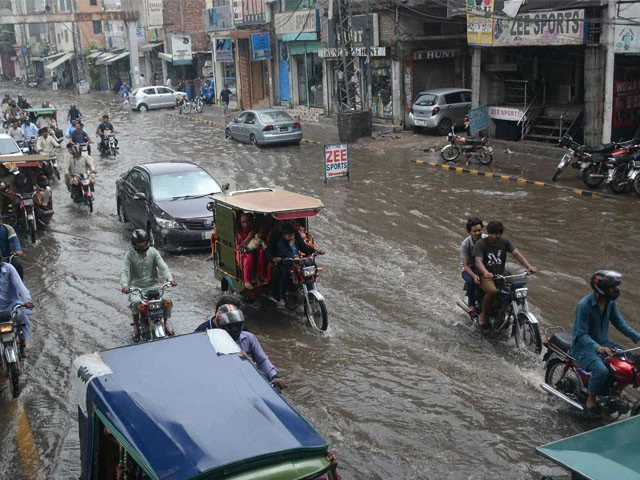
a view of vehicles passing through rain water photo inp


A view of vehicles passing through rain water. Photo: INP

LAHORE: Authorities across Pakistan have issued a red alert as heavy monsoon rains continue to lash wide swaths of the country, triggering flash floods, landslides, and rising river levels.

The downpour—expected to intensify through July 25—has already claimed at least 13 lives in the past 24 hours, with dozens injured, according to official figures.

The Pakistan Meteorological Department (PMD) forecasts persistent rain and thunderstorms across upper and central regions, including Khyber-Pakhtunkhwa, Islamabad, Punjab, Kashmir, Gilgit-Baltistan, and parts of Balochistan.
 

Users who are viewing this thread

Country Watch Latest

Back
Top