POST WAR assessment of recent conflict.

Wonder what does Modi has to say now

To view this content we will need your consent to set third party cookies.
For more detailed information, see our cookies page.
 
The crux is if India wants to uphold the ceasefire, it would stop arguing for war and anti-Pak propaganda and malign campaigns. It is not doing so, it means it wants blood. Why do we want to close our eyes to that?

We need political, financial, and the rest of regional stability more than ever.
 
Wonder what does Modi has to say now

To view this content we will need your consent to set third party cookies.
For more detailed information, see our cookies page.

bro.. this thread is meant to mainly post tactical and technical assessments after the war. The news posts can wait.
 
thats the million $ question
I don't think the Indians will be coming back for more any time sooner (this is nothing more the rhetoric and sabre rattling to save face to their own public, they're even sending their politicians from various parties to go abroad and give their bullshit stories... unfortunately that is too late and will not work).

In a conflict/war no parties have a fool proof systems that are not penetrable to each others defences - look at the Ukrainian and Russian conflict, despite the advance weapons on each side - both sides have been hit long range over their borders.

In regards to dealing with enemy capabilities (SWOT analysis), there are always different solutions:

Tackling the BrahMos supersonic missiles is a complex challenge for Pakistan due to their speed, precision, and versatility. Here are some strategies that could be considered:

1. Enhanced Air Defense Systems: Pakistan could invest in advanced air defense systems capable of detecting and intercepting supersonic missiles. The current HQ-9 surface-to-air missile system, while effective, may need upgrades or additional systems to handle the BrahMos' speed and maneuverability.

2. Electronic Warfare: Developing and deploying electronic warfare capabilities to jam or disrupt the guidance systems of incoming missiles could be another approach. This would require significant advancements in technology and infrastructure.

3. Early Warning Systems: Improving early warning systems to detect missile launches as early as possible would give Pakistan more time to respond. This could involve satellite surveillance, radar systems, and other detection technologies.

4. Counter-Strike Capabilities: Developing or acquiring similar capabilities to deter potential attacks. A credible counter-strike capability can serve as a deterrent against the use of such missiles.

Each of these strategies would require substantial investment and international cooperation. It's a multifaceted issue that involves not just military preparedness but also diplomatic and technological advancements.

In regards to Pakistani indiginouse projects - there are many that are in development:

Air-Launched Cruise Missiles (ALCMs)
1. RAAD-II: An advanced ALCM with a range of approximately 600 km, potentially nuclear-capable.
2. Taimur: A newer ALCM with a range of 290 km (export version), designed for precision strikes and integration with the JF-17 Thunder.

Drones

1. Sarkash Kamikaze Drone: A long-range loitering munition with a range of 1,000 km and a flight endurance of over 120 minutes.
2. Blaze Series Loitering Munitions:
- Blaze 25: Short-range, 75 km range, 60 minutes endurance.
- Blaze 50: Medium-range, 180 km range, 20 kg warhead.
- Blaze 75: Long-range, 500 km range, 30 kg warhead.
3. Wing Loong II: A Chinese-designed reconnaissance-attack drone with medium-altitude, long-endurance capabilities.
4. Burraq: A locally developed drone inspired by the US MQ-1 Predator, used for reconnaissance and attack.

Other GIDS Technologies

1. Spider Anti-UAV System: A comprehensive anti-drone system for detecting, tracking, and neutralizing UAVs.
2. Shahpar-III UCAV: An advanced unmanned combat aerial vehicle with a 20-hour endurance and multiple hardpoints for weapons.
3. FAAZ-2 BVR Missile: A long-range air-to-air missile with a range of 180 km and a maximum speed of Mach 3.5.
4. Fatah-II GMLRS: A guided multiple launch rocket system with a range of up to 250 km.

In addition, many of the above are increasing their ranges. Pakistan does not necessarily need to purchase all items from abroad as it's local industrial capacity is getting stronger by the day.
Conventionally, Pakistan can easily hold/go on the offensive in a short duration war....after that, then it escalated to a nuclear exchange. Which no sane side wants.
 
I think downing the Rafale was too much. Pakistan is keeping its tongue tight so that things might not escalate. I bet we have footage and everything like in 2019. However, I think this time the photos are of Chinese satellites, and Pakistan may not release it.
Whatever happened at Bolhari (AWACS or not), it didn't give India much excuse to cease fire. Pakistan was asking to cease hostilities since the onset of the battle.

@maverick I think there is no need to increase the army as both India and Pak will not fight to their guts and blood, we never did. We need to increase our drone strike capabilities.

Agreed on Drones… Drone is to decimate armor, artillery and Air defense sites….
but Pakistan has to take war to India, otherwise they will attack and sponsor terrorism and will push Pakistanis to brink of starvation…
the second part i do not agree with, as Pakistan only has 5-8 years if it did not implement these dire solutions
 
@Reichmarshal

The casualties caused at Balori AF were a cheap shot after the ceasefire was announced,

When was the ceasefire announced? When was Balori base hit?

@Goenitz

While the government and ISPR are silent.

Maybe there is a good reason they are silent?

Regards
Right before the ceasefire
 
@Goenitz

We need political, financial, and the rest of regional stability more than ever.

Good suggestion. All of us could do with it.

@Reichmarshal

What time PST was ceasefire announced?

Regards
 
Let’s not get impressed by the Indians using a sledgehammer for a nail. Sure, holes in roofs and roads, and collapsed hangars make for good press. But what are you achieving, really? The Fatah series can perform ‘surgery’ at the respective ranges. It is high supersonic in the terminal phase. Its profile is too thin for manual CIWS. And it can be used to saturate the target. All videos that have been shared portray the intention of not saturating the targets. I don’t know if that’s because of low inventory or simple ‘calibrated response’. But definitely if fired in numbers they will be a nightmare for the enemy.

We still haven't seen a rigorous assessment of how this weapon did, yes it did get through, and I do agree if used by the numbers it can be a major problem for them. However the damage so far has been linked to the air launched Chinese CM-400AKG.
 
1- India wouldn't use air force for strike again, but will use Brahmos and other cruise missiles air-launched or ground-launched
2- India realized that the threshold for escalation from the Pakistan side is very high, it can freely use weapons without any issues
3- Pakistan air defense has holes in it, which we all knew since the limited number of batteries we have, our doctrine was to depend upon air power, but we have underestimated the Indian ability to play with the war threshold
4- Pakistan was hesitant to strike deep inside India, and limited it strikes to within 200km
5- The indian navy and Air Force no longer has the ability to play any major role in short conflicts as it did in 1971
6- Pakistan need to upgrade its air defense for drone warfare (ECM, point defense) and needs a supersonic cruise missle to strike deep in India
7- India will up the covert ops in pakistan Balochistan and Afghanistan
 
I don't think the Indians will be coming back for more any time sooner (this is nothing more the rhetoric and sabre rattling to save face to their own public, they're even sending their politicians from various parties to go abroad and give their bullshit stories... unfortunately that is too late and will not work).

In a conflict/war no parties have a fool proof systems that are not penetrable to each others defences - look at the Ukrainian and Russian conflict, despite the advance weapons on each side - both sides have been hit long range over their borders.

In regards to dealing with enemy capabilities (SWOT analysis), there are always different solutions:

Tackling the BrahMos supersonic missiles is a complex challenge for Pakistan due to their speed, precision, and versatility. Here are some strategies that could be considered:

1. Enhanced Air Defense Systems: Pakistan could invest in advanced air defense systems capable of detecting and intercepting supersonic missiles. The current HQ-9 surface-to-air missile system, while effective, may need upgrades or additional systems to handle the BrahMos' speed and maneuverability.

2. Electronic Warfare: Developing and deploying electronic warfare capabilities to jam or disrupt the guidance systems of incoming missiles could be another approach. This would require significant advancements in technology and infrastructure.

3. Early Warning Systems: Improving early warning systems to detect missile launches as early as possible would give Pakistan more time to respond. This could involve satellite surveillance, radar systems, and other detection technologies.

4. Counter-Strike Capabilities: Developing or acquiring similar capabilities to deter potential attacks. A credible counter-strike capability can serve as a deterrent against the use of such missiles.

Each of these strategies would require substantial investment and international cooperation. It's a multifaceted issue that involves not just military preparedness but also diplomatic and technological advancements.

In regards to Pakistani indiginouse projects - there are many that are in development:

Air-Launched Cruise Missiles (ALCMs)
1. RAAD-II: An advanced ALCM with a range of approximately 600 km, potentially nuclear-capable.
2. Taimur: A newer ALCM with a range of 290 km (export version), designed for precision strikes and integration with the JF-17 Thunder.

Drones

1. Sarkash Kamikaze Drone: A long-range loitering munition with a range of 1,000 km and a flight endurance of over 120 minutes.
2. Blaze Series Loitering Munitions:
- Blaze 25: Short-range, 75 km range, 60 minutes endurance.
- Blaze 50: Medium-range, 180 km range, 20 kg warhead.
- Blaze 75: Long-range, 500 km range, 30 kg warhead.
3. Wing Loong II: A Chinese-designed reconnaissance-attack drone with medium-altitude, long-endurance capabilities.
4. Burraq: A locally developed drone inspired by the US MQ-1 Predator, used for reconnaissance and attack.

Other GIDS Technologies

1. Spider Anti-UAV System: A comprehensive anti-drone system for detecting, tracking, and neutralizing UAVs.
2. Shahpar-III UCAV: An advanced unmanned combat aerial vehicle with a 20-hour endurance and multiple hardpoints for weapons.
3. FAAZ-2 BVR Missile: A long-range air-to-air missile with a range of 180 km and a maximum speed of Mach 3.5.
4. Fatah-II GMLRS: A guided multiple launch rocket system with a range of up to 250 km.

In addition, many of the above are increasing their ranges. Pakistan does not necessarily need to purchase all items from abroad as it's local industrial capacity is getting stronger by the day.
Conventionally, Pakistan can easily hold/go on the offensive in a short duration war....after that, then it escalated to a nuclear exchange. Which no sane side wants.
Thank you for detailed reply, I am grateful. with your permission i want to talk about my perspective regarding two points of your post.

1st the Ceasefire and 2nd your point 4 - Counter strike weapon

I would disagree that ceasefire is normal. until unless there is a peace accord! situation cannot go back to normal. this assumption in unstainable on both sides. we cannot remain in crises stage. as of now things will go downhill.

With this prespective local options become null and void. what we have matters now!

2nd point: regarding Counter strike weapon (conventional) is desperately required this is where we are lacking to achieve deterrence. but weapon is required is type that can manage S400 and future threats as well. rockets and SRBMs (Abdali/Ghaznavi) type weapons will not work. why because of the nature of operations. we need aero-ballistic missile with MaRV.

Since we are in state of crises with ceasefire holding - we do not have enough time. fatteh 3 and 4 all are good, but they are not MaRV capable which is niche requirement to bring deterrence.

that is why i suggested to approach Iranians for Raad-500/Zohair SSM - 450-500km /320kg warhead MaRV Aero-Ballistic missile. with two ready to fire - TEL. that too civilian derived vehicle off the shelf and can work in GPS denied environment.
Iranians are selling to Houthis which do not have enough infrastructure, we in Pakistan can do better and in quick time.

all this is just an opinion - if we have enough time - which we have not enough. we will fight with what we have and by will of Allah will prevail.

Pakistan Zindabad!
 
Thank you for detailed reply, I am grateful. with your permission i want to talk about my perspective regarding two points of your post.

1st the Ceasefire and 2nd your point 4 - Counter strike weapon

I would disagree that ceasefire is normal. until unless there is a peace accord! situation cannot go back to normal. this assumption in unstainable on both sides. we cannot remain in crises stage. as of now things will go downhill.

With this prespective local options become null and void. what we have matters now!

2nd point: regarding Counter strike weapon (conventional) is desperately required this is where we are lacking to achieve deterrence. but weapon is required is type that can manage S400 and future threats as well. rockets and SRBMs (Abdali/Ghaznavi) type weapons will not work. why because of the nature of operations. we need aero-ballistic missile with MaRV.

Since we are in state of crises with ceasefire holding - we do not have enough time. fatteh 3 and 4 all are good, but they are not MaRV capable which is niche requirement to bring deterrence.

that is why i suggested to approach Iranians for Raad-500/Zohair SSM - 450-500km /320kg warhead MaRV Aero-Ballistic missile. with two ready to fire - TEL. that too civilian derived vehicle off the shelf and can work in GPS denied environment.
Iranians are selling to Houthis which do not have enough infrastructure, we in Pakistan can do better and in quick time.

all this is just an opinion - if we have enough time - which we have not enough. we will fight with what we have and by will of Allah will prevail.

Pakistan Zindabad

There are number of areas to look, that should give us a better understanding (and reassurance in Pakistan's capabilities). If you look at the military imbalance it favours India - but not enough for them to have an overwhelming superiority, as follows (estimated strengths):

India's Military Strength

1. Manpower: India boasts one of the largest military forces globally, with over 1.4 million active personnel and around 1.2 million reserve personnel.

2. Air Power: The Indian Air Force operates advanced aircraft such as the Sukhoi Su-30MKI, Dassault Rafale, and the indigenous HAL Tejas.

3. Naval Power: The Indian Navy includes aircraft carriers (INS Vikramaditya and INS Vikrant), destroyers, frigates, submarines, and patrol vessels.

4. Land Forces: India has a substantial number of tanks (e.g., T-90 and Arjun), artillery, and armored vehicles.

5. Nuclear Capability: India has a well-established nuclear arsenal with delivery systems like the Agni and Prithvi ballistic missiles.

Pakistan's Military Strength

1. Manpower: Pakistan has approximately 654,000 active personnel and around 550,000 reserve personnel.

2. Air Power: The Pakistan Air Force includes advanced fighters such as the F-16 Fighting Falcon, JF-17 Thunder (developed with China), and Mirage III/V.

3. Naval Power: The Pakistan Navy operates submarines, frigates, and patrol vessels, with a focus on enhancing maritime capabilities.

4. Land Forces: Pakistan has a significant number of tanks (e.g., Al-Khalid and T-80UD), artillery, and armored vehicles.

5. Nuclear Capability: Pakistan maintains a robust nuclear arsenal with delivery systems like the Shaheen and Ghauri ballistic missiles.

Strategic Considerations

- Geopolitical Alliances: Pakistan has strong military ties with China, which supplies significant military hardware and technology. India has strategic partnerships with countries like the United States, Russia, and Israel.

- Terrain and Geography: The challenging terrain, particularly in the Kashmir region, can impact military operations.

- Economic Factors: India's defense budget is significantly larger than Pakistan's, allowing for greater investment in advanced technology and modernisation.

Historical Context

- Past Conflicts: India and Pakistan have fought several wars (1947, 1965, 1971, and mini-wars 1999, 2019, 2025), often resulting in stalemates or ceasefires.
- Current Tensions: Ongoing disputes, especially over Kashmir, continue to be a flashpoint for potential conflict.

Conclusion

While India has a larger and more technologically advanced military, Pakistan's strategic alliances and nuclear capabilities create a complex balance. The risk of escalation to nuclear conflict remains a significant deterrent to conventional warfare.

So if you look at the above, despite the numerous advantages for Indian military and economic strengths, the size, the structure etc. it has never ever been able to subdue Pakistan (it can be argued that India has lost all wars on the western side - we will concede that we lost 1971 war due to the dismemberment of Pakistan and that too due to the internal turmoil/civil war supported by the large Indian forces).

Despite the massive military and economic balance - India has never been able to subdue Pakistan. India has had better/sophisticated technologies in all their armed forces - but still resulted in a kind of stalemate.

In this incident, India felt it can fight a conventional skirmish under a nuclear umbrella (Cold Start doctrine) - however, it has resulted in a higher escalation ladder and went quickly to a ceasefire when Pakistan struck hard conventionally. A full scale war will result in a nuclear war - where no side wins. The Indians (BJP RSS Nazis Hindutva) portray themselves as being daft, but they are not totally insane - as they know the ultimate consequences.

One thing to note, Pakistani counterattack resulted in India demanding a ceasefire behind the back door channels within the first 2 hours of the operation. The whole operation (counter strike), of approximately 6 hours was more intense the 1965 war - i.e. more firepower/tonnage of weapons were more than the 17 days 1965 war, that is impressive. That is shock and awe and it worked.

Indian Cold Start will always be a failure as ultimately it will result in an all out war/nuclear war. The escalation ladder is too high. If India had the upper hand, there would not have been a ceasefire straight away. India keeps forgetting that the Pakistan armed forces are a battle hardened force. Not like the large concentrations of troops in Indian Occupied Kashmir (500,000 regular troops and 200,000 Paramilitaries), yet despite these numbers they have only become experts in oppressing the local Kashmiri population.

In regards to getting support from other countries, such as Iran - this really depends on the trust factors, which is lacking - especially since the Pakistani counterstrike of terrorist targets in Iran. I'm not sure whether the Iranians will sell or give the technology?

In regards to the current conflict between India - only Israel and Afghanistan (Taliban) confirmed their support/allegiance to India. Pakistan needs to be in a situation that if required it does not need the support of others - which I believe Pakistan has a massive potential. It works towards allies, but if the shit hits the fan then it needs to fend for itself - with it's large nuclear weapons and delivery systems this will be easier for Pakistan. The nuclear weapons are the final guarantee to protect it's territorial integrity.

Pakistan has a massive missile capabilities - it needs its MIRV technology to be added to some new conventional missile systems. It needs to increase its hypersonic technology and develop laser technology.

Pakistan's laser technology development:

AI-Driven Laser Robots

- University Innovations: Pakistani university students have developed an AI-driven robotic prototype equipped with a high-powered laser gun. This innovation, showcased at the 4th Research and Technology Showcase in Karachi, aims to strengthen Pakistan’s defense capabilities.

- Capabilities: The robot can destroy targets within seconds, offering a safer and more cost-effective alternative to traditional military methods. It can accurately identify and target both moving and stationary objects on land or in the air.

- Technology: The laser gun, powered by a hybrid electric system, eliminates the need for conventional ammunition. It incorporates infrared sensors and high-resolution cameras for precise targeting.

Strategic Implications

- Potential Applications: While the current prototype has a range of six feet, there is potential for extending its range for broader applications, such as intercepting missiles or neutralizing airborne threats.
- Global Positioning: If adopted, Pakistan could become the first Islamic nation and the fifth globally to integrate such cutting-edge laser-based military technology into its defense systems, joining countries like the United States, South Korea, Israel, and Russia.

These advancements highlight Pakistan's efforts to enhance its defense technology and leverage local talent for national security. The development of laser technology, particularly through innovative projects like the AI-driven laser robot, represents a significant step forward for Pakistan's military capabilities.

Pakistan needs to work with it's strategic allies (China and others like Turkey)in developing theses technologies to further strengthen Pakistan defences.
 
In addition, Pakistan has been developing hypersonic technology for its military:

Hypersonic Missile Development

- Capabilities: The Pakistan Air Force (PAF) has claimed to possess hypersonic-capable missiles. These missiles can travel at speeds of Mach 5 or higher, making them extremely fast and difficult to intercept.

- CM-400AKG Missile: One of the hypersonic-capable missiles in Pakistan's arsenal is believed to be the CM-400AKG, which was acquired from China. This missile is designed for use with the JF-17 Thunder jets.

- Strategic Impact: The development of hypersonic missiles is part of Pakistan's broader modernisation efforts to enhance its military capabilities and maintain a strategic balance in the region.

Strategic Considerations

- Regional Dynamics: The introduction of hypersonic technology is seen as a move to counter evolving threats and rebalance power dynamics in South Asia.

- Technological Collaboration: Pakistan's collaboration with China has been crucial in acquiring and developing advanced military technologies, including hypersonic missiles.

These advancements in hypersonic technology highlight Pakistan's efforts to enhance its defense capabilities and maintain a strategic edge in the region.

Pakistan needs to continue developing it's defensive and offensive capabilities - if you want PEACE then prepare for WAR! :)
 
lmao they aren’t pics stop coping. There are videos from Bhatinda with various angles of the Rafale exploding in air then falling down where indian farmers are seen strolling around the wreckage.

The mirage 2000 in Pampore was recorded by a local as well who went to the crash site & started recording.

Mig-29 near akhnoor was recorded by Indian soldiers.

Did we forget how Indian officials picked up farmers in Bhatinda and asked them to delete their videos or how PunjabTv was forced to delete their image of the serial number of Rafale.

Pakistan did some blunders in this skirmish but we certainly aren’t bad of liars as the Indians
Buddy, ISPR showed an edited clip during the press conference and claimed a missile hit Afghanistan. Meanwhile, five ballistic missiles struck Punjab, launched by India. So please, don’t compare Pakistan with India.

Even the Air Chief admitted there was hardware loss—he didn’t deny anything, nor did he make vague claims like ISPR did. 6 planes, s 400, 26 bases
 
We still haven't seen a rigorous assessment of how this weapon did, yes it did get through, and I do agree if used by the numbers it can be a major problem for them. However the damage so far has been linked to the air launched Chinese CM-400AKG.
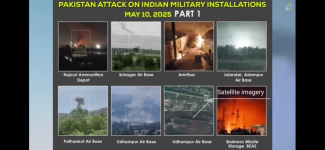
Apparently, this is a montage of our strikes:
 

Attachments

  • IMG_0487.png
    IMG_0487.png
    1.6 MB · Views: 17

Users who are viewing this thread

Pakistan Defence Latest

Latest Posts

Back
Top