POST WAR assessment of recent conflict.

100%. What do you want Pakistan to do? Bow down against Indian number superiority? You don't know Pakistanis do you?
First of all, you already had nuclear weapon, and they know you had nuclear weapons, and they still attack you this way, did it tell you something?

Second of all, look back at your history, you did de-escalation without surrendering (otherwise there wouldn't be a Pakistan) and without using nuclear weapons. As I said, this is not the only 2 options you know
 
First of all, you already had nuclear weapon, and they know you had nuclear weapons, and they still attack you this way, did it tell you something?

Second of all, look back at your history, you did de-escalation without surrendering (otherwise there wouldn't be a Pakistan) and without using nuclear weapons. As I said, this is not the only 2 options you know

Some attacks on Pakistan air bases runaways will not make Pakistan start mobilizing nuclear weapons, nuke threshold is much higher then that. For that we need all out war, its probably coming if India stop or divert Pakistan rivers water.

Ceasefire was announced after Pakistan retaliation on 26 Indian sites. One of them where S400 components were taken out. India was not ready to continue. For them these skirmish are just for local political drama by Modi. But things can get out of control.
 
Again, this is a limited strike, a limited strike is mostly not going for result, but is a way to look at how you responded and how much I can get away with it, that's what the Indian are doing. They are testing your redline.

In a broad strategic term, you need to re-establish your level of deterrence so Indian would think twice before doing it again, otherwise it's just going to be like a snowball, it's gonna get bigger as the snow ball keep rolling. You need to stop the snow ball roll otherwise the other side of that coin is that you need to prepare for a even bigger strike or an all out war in the near future if India start to see the your deterence is being melted away.

I would love to type out or hint at how Pakistan can do this, but I can't because of the article I wrote, I cannot share my idea with other people outside my employer
This is what I shared in a separate thread I started on the same topic
 
The thing is, they already did, look at this war and the response, and look at how India responded after 2008 Mumbai attacks? I would say the attack of Tourist in KP is not remotely the same league as Mumbai attack, yet the response are more aggreges here That's already an escalation.

They don't just wake up one day and decided to use this attack in KP to launch a strike like this and see how it get on with their Rafale or your J-10C. They are doing this for a purpose, and for what purpose and what can they get out of from this, now, that's a million dollar question.

This is what my post mean, India wants to dictate the tempo, but how you can get there to tone it down? What you are saying is, they show you bigger gun, and you show them an even bigger one. Again, that's come back to my previous point in my reply to another member, how big you are prepare to go with?
Is below along the right lines in your view?
Pakistan should work to build and consolidate non-nuclear asymmetric escalation capacity. The most practical and readily available seems to be cyber warfare and the Indians may have received a trailer of this in the form of alleged Sino-Pak cooperation in this domain during the recent heightening of hostilities. This is of course aside from Pakistan’s alleged traditional reliance on insurgent groups but the potency and practicality of such an option seems to no longer be sufficient for the Pakistani Intelligence apparatus.
 
Is below along the right lines in your view?
Yes, this is along the line, and you need offensive intelligence capabilities to goes with all those.

But there is a whole spectrum of things I think Pakistan needs to do, but again, I cannot be part of this discussion now as long as I still work for that think tank, but what I can do (or rather, try to do here) is to stimulate the discussion and try to push it in the right direction
 
Some attacks on Pakistan air bases runaways will not make Pakistan start mobilizing nuclear weapons, nuke threshold is much higher then that. For that we need all out war, its probably coming if India stop or divert Pakistan rivers water.

Ceasefire was announced after Pakistan retaliation on 26 Indian sites. One of them where S400 components were taken out. India was not ready to continue. For them these skirmish are just for local political drama by Modi. But things can get out of control.
Lol, that's the whole point of my post, you shouldn't wait until all-out war because by then you would run out of option, you need to "Nip the bud when it's still growing" and what you need to do have to be correspondent to the response.

The above poster already had pointed out the intelligence aspect of the situation, there are much, MUCH more to do, and you need to figure that out if you don't want to end up in an all out war and you need to mobilise your nuclear force.

Not sure if that make sense to you
 
First of all, you already had nuclear weapon, and they know you had nuclear weapons, and they still attack you this way, did it tell you something?

Second of all, look back at your history, you did de-escalation without surrendering (otherwise there wouldn't be a Pakistan) and without using nuclear weapons. As I said, this is not the only 2 options you know

You statement is extremely confusing.

I assume you recognise the fact that nuclear weapons are not toys, they exist within a policy framework.
Otherwise there wouldn't be a Pakistan? would you care to elaborate.
 
Did someone mention?
@FuturePAF @Michael

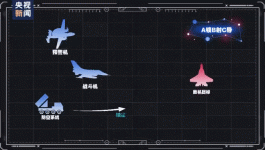
As easy as ABC? How Pakistan unified radars, jets and warning aircraft against India.
I posted about the analysis and official news many days ago.
Unfortunately, it was overwhelmed by the sheer volume of posts.

China's military has increased integration between its services since its massive military reform in 2016. No longer do any of the military branches fight independently (they have even lost the power to do so).
Now, we have realized that the Air Force, Navy, Army, and Rocket Force, as well as the three special support forces, are fighting together as a whole. Missiles launched from any platform can be controlled and guided by other platforms from other services.
ABC.gif
PAF has some of this capability. The “ABC tactics” of the India-Pakistan air war was its first operational application.

Next phase would be to integrate, space satellites (Pak has just few satellites so if China allows Beidou), all ground air defense systems, Naval ships, submarine, and MPA (Sea Sultan, P3 Orion) in same network centric C2 system
Pakistan has received military authorization for the Beidou satellite navigation system. You have full access to its military coded system. All weapons systems imported by Pakistan from China, as well as Pakistan's own weapons systems, have Beidou navigation capabilities within them.

However, Beidou is only a satellite navigation system. It cannot replace the functions of other military satellites.

Unfortunately - Pakistan has little BDA to prove its claims of 16 airbases hit in India.
Maxar wont cooperate and Chinese aren’t forthcoming with exposing their imagery capabilities.
I believe these satellite images are already on the desks of the PAF command.
But releasing them now is not in line with the logic of China's behavior. It will get us into trouble.
Sometime after the incident has subsided, the evidence will be gradually made public.
 
Last edited:
This is because most of the members are busy comparing and analysing the skirmish at tactical level. Bullet to bullet and missile to missile.

This skirmish created a complete shift in the dynamics.

The attacks carried in 2019 in the aftermath of Pulwama was against a single target in Kashmir.
This time many targets were engaged all over and the ensuing battle was at much higher level with possibility of escalation all the time.
This has changed the starting point and shifted it higher up the escalation ladder.
Next time it is likely to be against military targets directly.

Practically, it sounds like a tinderbox.
There is still a big lack of understanding from the Indians - they have a false sense of belief that somehow the Indians attacks on Pakistan are some smart move and that a new norm has been set in - any fool can lobb a missile/ projectile across each other - did it deter the other side?? If the other side does not retaliate back then you can argue that you've been successful, which in India's case didn't go well when Pakistan launched a strike on Indian military bases/infrastructure.

India is trying to establish it's Cold Start Doctrine - which is realistically bound to fail and lead to an all out war with a nuclear hangover (any side that is deemed to be losing, will use nuclear weapons to safeguard their territorial integrity).

Both sides are conventionally strong (Despite India's massive defence budget military inventory) - yet when Pakistan struck India hard on all its bases/military infrastructure it was extremely quick to agree/arrange a ceasefire. It had miscalculated Pakistan's resolve and capabilities - hence deterrence was achieved by Pakistan (so again, what norm has India set apart of attacking initially civilian targets in Pakistan, moving to military - it just means escalation ladder is higher up. The next time it could result in a full scale war with horrendous consequences for the region).


Indian Cold Start Doctrine (CSD)
The Cold Start Doctrine is India's military strategy designed to quickly launch attacks on Pakistan without escalating to a full-scale war. However, it has faced several issues:

1. Operational Challenges: The plan requires the Indian Army, Air Force, and Navy to work together very quickly and smoothly. This coordination has been hard to achieve in practice.
2. Political Risks: Starting such aggressive actions can lead to serious political and diplomatic problems. Other countries might react negatively, causing trouble for India.
3. Strategic Conflicts: The goals of the Cold Start Doctrine might not align well with India's larger strategic aims, potentially causing more harm than good.

Pakistan's Response

Pakistan has developed a strategy called Full Spectrum Deterrence to counter India's Cold Start Doctrine. This includes:

- Tactical Nuclear Weapons (TNWs): Pakistan has created small nuclear weapons that can be used on the battlefield. These weapons are meant to deter India from launching limited attacks by threatening a nuclear response even to conventional military actions.

Recent Conflict

In April 2025, tensions between India and Pakistan escalated dramatically following a terrorist attack in Pahalgam, Kashmir, which resulted in the deaths of 26 people. India accused Pakistan of supporting the attackers, leading to a series of military confrontations.

India attempted to implement its Cold Start Doctrine by launching rapid civilian strikes moving up to military strikes against Pakistan. However, Pakistan's Full Spectrum Deterrence strategy, including the threat of using tactical nuclear weapons, effectively countered these efforts. The conflict culminated in a ceasefire brokered by international mediators.

Pakistan had struck India really hard that the Indians backdoor diplomacy and imploring the USA and other of its allies to organise a quick ceasefire. It took Pakistani less than 6 hours of a large counterstrike for India to agree and ask for a ceasefire

Outcome

India's failure to achieve its objectives during this conflict highlighted the limitations of the Cold Start Doctrine. The inability to swiftly and effectively mobilise forces, coupled with the political and strategic risks, resulted in India being unable to gain a decisive advantage. Pakistan's robust counter-strategy, leveraging the threat of nuclear escalation, played a crucial role in deterring India's actions.

International Response

The international community reacted strongly to the conflict. The United States, the United Kingdom, and other major powers called for immediate de-escalation and a return to dialogue. Diplomatic efforts were led by the United States (once India had approached him), with Vice President JD Vance and Secretary of State Marco Rubio playing key roles in negotiating the ceasefire.

Losses and Attacks

During the conflict, India suffered significant losses:

- Combat Aircraft: Pakistan claimed to have downed several Indian fighter jets, including three Rafale aircraft.

- S-400 Air Defence System: Pakistan's JF-17 Thunder jets destroyed India's S-400 air defence system stationed in Adampur using hypersonic missiles.

- Military Bases and Sites: Pakistan targeted and destroyed several Indian military sites, including the BrahMos missile storage in Beas, airfields in Udhampur, Suratgarh, and Pathankot, and artillery positions in Dehrangyari (all reported by Indian military spokeswoman and it's media).

These losses underscored the vulnerabilities in India's military strategy and highlighted the effectiveness of Pakistan's countermeasures.

Influence of RSS and Modi

The Rashtriya Swayamsevak Sangh (RSS) is a Hindu nationalist organisation that has significantly influenced India's political landscape. Under Prime Minister Narendra Modi, who has strong ties to the RSS, Hindu fundamentalism has gained prominence. This ideology has often led to aggressive and uncompromising policies, including the Cold Start Doctrine.

Critics argue that the RSS-inspired policies have been reckless and foolish for several reasons:

1. Escalation Risks: The aggressive stance increases the risk of escalating conflicts, potentially leading to nuclear confrontations.

2. Diplomatic Isolation: Such actions can isolate India diplomatically, as seen in the international backlash during the recent conflict.

3. Internal Divisions: The focus on Hindu nationalism can exacerbate internal divisions and alienate minority communities.

India's Plea for Ceasefire

As Pakistan counterstriked with overwhelming force, India found itself in a precarious position. Please note, Pakistan dropped more firepower on India than during the 1965 war, causing extensive damage to military infrastructure and combat capabilities.

Faced with mounting losses and the threat of further escalation, India urgently sought international intervention. The Indian government, led by Prime Minister Modi, pleaded with the United States to broker a ceasefire to halt the devastating attacks and prevent further destruction.

The Solution: Plebiscite

The only viable solution to the ongoing conflict is for India to hold a plebiscite as per the United Nations resolution. This would allow the Muslim majority in Kashmir to decide their future, addressing the unfinished part of the partition. Historically, Kashmir should have gone to Pakistan, given its Muslim-majority population.

Defence Budget Comparison

Despite India's massive defence budget, which is nearly nine times larger than Pakistan's, India has consistently failed to achieve its military objectives. India's defence spending for FY2025-26 is around $78.7 billion, while Pakistan's is approximately $10.2 billion. This disparity highlights the inefficacy of India's military strategy and the resilience of Pakistan's countermeasures.

Dangers of Nuclear Conflict

Both India and Pakistan possess over 170 nuclear weapons each, enough to annihilate each other. A nuclear conflict would result in catastrophic consequences, with millions of lives lost on both sides.

The devastation would not be limited to the immediate impact of the explosions but would also include long-term environmental and health effects. The fallout would affect not only the warring nations but also the entire region and potentially the world.

The Horrors of War

War brings unimaginable suffering and destruction. The recent conflict between India and Pakistan has already caused significant loss of life and property. Families are torn apart, homes are destroyed, and communities are left in ruins. The psychological trauma of war affects generations, leaving deep scars that take decades to heal. The economic cost is also enormous, diverting resources away from development and welfare to military spending.

The Need for Peace

Given the potential for a nuclear catastrophe, it is imperative that both nations seek a peaceful resolution to their disputes. The only way to ensure lasting peace is through dialogue and mutual understanding. For Pakistan, preparing for war is seen as a necessary deterrent to maintain peace. However, the ultimate goal should be to find a diplomatic solution that addresses the core issues and prevents further conflict.

Political Change in India

To secure peace in the region, many believe that the RSS-inspired government needs to be voted out. A change in leadership could pave the way for more moderate policies and foster trust with neighbouring countries. This shift could help India focus on internal harmony and constructive international relations, reducing the risk of future conflicts.

All in all, this false norm that India is trying to set up (endorsed by the BJP and it's ilk) - has failed. It has not deterred Pakistan. All it has done is drastically increase the risk of an all out war - no matter how much bravodo from any sides, it will be catastrophic for the region and the global environment.

It could be argued that Pakistan has the confidence to launch attacks on the Indian military and infrastructure - something not done since 1971 war. The number of targets hit in India were massive (people can argue about the damage Inflicted, but the fact that these weapons were able to reach their targets means that in the escalatory ladder, more destructive weapons will get through and cause damage.

The Doves (Peace makers) need to be back in government and military hierarchies and the Hawks (War mongers) need to be curtailed.
 
I would love to type out or hint at how Pakistan can do this, but I can't because of the article I wrote, I cannot share my idea with other people outside my employer
Will your employer be printing this somewhere or its internal discussions.
 
That is IF, that's a big if, you can fend off EVERY attack coming from India.

I am not talking about a limited strike like this, I am talking about if this escalate, India stop seeing the deterrence from Pakistani side and they started intense strike package, I mean sure, you can deal with a few squadron of Rafale, but do you think you can really win a protacted war with India if there is one? Given that Indian military is around 3 times the sizes of yours.

The issue here is, quantity have their advantage over quality when you have a lot of them. It's like this Green Beret dude talking about some a movie about African rebel vs US Navy Seal at 22:14

To view this content we will need your consent to set third party cookies.
For more detailed information, see our cookies page.


If you have 200 rebel shooting all over the place over 8 Navy Seal, it doesn't really matter what the skill level you have, you are going to get dinked. That's the issue, if India don't see this strike as breaking the status quo, and there are going to be a point in time, there are going to be increasing military activities against you. Which mean unless you are finding a way to rebalance the situation, how far are you going to have to response if they keep escalating? Are you going to put all your force in alert? Which it would have economic complication, or are you going to nuclear? Which is going to have major implication.


China will not allow India to threaten the security of CPEC if it does so.

Our 54th Heavy Mixed Brigade deployed in Aksai Chin is prepared for such a scenario.

The tiny Aksai Chin, where the PLA has deployed a heavily armored synthetic brigade. Next to it, in Shigatse, there is the 52nd Mountain Brigade and the 53rd Medium Synthetic Brigade. At the end of the Karakorum Pass there are also the 76th and 77th Army Groups. In total, there are more than 100,000 troops. Do the Indians think that 100,000 troops are just for the defense of an Aksai Chin?

This is China telling India that China will not care if you and Pakistan shell each other or have an air war. But if India violates Pakistan's territory and threatens the security of CPEC, then the Heavy Composite Brigade will quickly break through this distance of less than 300km and appear outside New Delhi.
 
Last edited:
You statement is extremely confusing.

I assume you recognise the fact that nuclear weapons are not toys, they exist within a policy framework.
Otherwise there wouldn't be a Pakistan? would you care to elaborate.
Don't know how else I could put it if you thought the way I put it is confusing......(This is not a diss, I genuinely don't know)

Think of it like a game "Who blink first", if India is willing to do this without you hurting them in the heartland or somewhere actually inside of India. Now, put into the fact that THEY KNOW you have nuclear weapons, yet they were given your response this way. How or what you think you can do to stop the next attack, provocation or attempt? Knowing that if India don't think or don't care about deterrence anymore, each subsequent strike is going to get bigger and bigger, and eventually it may lead to an all out war.

Also put this in your mind, you ALREADY had nuclear weapon, you ALREADY had the plan/framework/what have you to use it, so by that definition, this strike, should not had happened at all, if that deterrence worked, again, you weren't hitting India in its own soil with a direct strike.

Now, does that make sense to you?
 
China will not allow India to threaten the security of CPEC if it does so.

Our 54th Heavy Mixed Brigade deployed in Aksai Chin is prepared for such a scenario.

The tiny Aksai Chin, where the PLA has deployed a heavily armored synthetic brigade. Next to it, in Shigatse, there is the 52nd Mountain Brigade and the 53rd Medium Synthetic Brigade. At the end of the Karakorum Pass there are also the 76th and 77th Army Groups. In total, there are more than 100,000 troops. Do the Indians think that 100,000 troops are just for the defense of an Aksai Chin?

This is China telling India that China will not care if you and Pakistan shell each other or have an air war. But if India violates Pakistan's territory and threatens the security of CPEC, then the Heavy Composite Brigade will quickly break through this distance of less than 300km and appear outside New Delhi.
Again, your 54th Brigade had ALREADY deployed before May 2025, right. Does it make any difference in that strike? Okay, if India attacked first and then China move 54th or 53rd Brigade into Aksai Chin or wherever, that's a response, it's not when it was already there.

by the way, they did hit Punjab in that attack, which is why I am saying this is quite obviously an escalation.
 

Users who are viewing this thread

Latest Posts

Back
Top