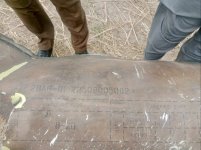
POST WAR assessment of recent conflict.

i am sorry, i did not read all the pages. i will certainly do it later.

we have a lot material available on internet about 7 May aerial combat and how it was probably excuted.

we need to know what equipment, assets and armament were used, particularly on 10 May.

against airbases, stockpile stores, radar sites, drones, and their purpose, etc.

people with accurate information can share the details.
 
i am sorry, i did not read all the pages. i will certainly do it later.

we have a lot material available on internet about 7 May aerial combat and how it was probably excuted.

we need to know what equipment, assets and armament were used, particularly on 10 May.

against airbases, stockpile stores, radar sites, drones, and their purpose, etc.

people with accurate information can share the details.

To view this content we will need your consent to set third party cookies.
For more detailed information, see our cookies page.
 
I would ENCOURAGE not to use this thread for name calling the ideology next door or attitudes. Instead be introspective, not criticism for the sake of criticism and not money hanging on trees scenarios.

Focus on what was done, what went right and what wrong. And potentially see where your enemy can tackle your successes.

For e.g the PL-15 kill chain was critical to success - what can the enemy do to both counter it and come up with their own solutions?
The Meteor does not have this capability and even if it does the entire ecosystem has to absorb it - what about the Astra in combo with their local SAMs and satellites.

The more local you are the more flexibility you have.
 
Agree with battle assesment part but you do not have sats and your hands are tied unless china give you army level of access to their own network which i do not know is realistic, second option is to make deal with Turkiye as they are in process building up their own advanced satelite constelation.
Yes, this is a gap that we need to plug somehow.

Part were i strongly disagree is your deterrence capability, i think it is even more solidified then ever due your air force performance in opening hours due that you limited indians for any eventual future attack with things that you mentioned which are all weaker than proper air attacks and by that you are still in advantage.

Let me explain myself more a little. As I said, the wildly successful PAF air battle took place on the first night. After this skirmish, both airforces were essentially not flying for several nights. We were "showing restraint" or whatever. During this time India was constantly attacking us with LMs and on the final night with BMs and Brahmos. Had the night 1 PAF-IAF skirmish been a deterrent, would the conflict continued after that? So that shows that PAF shooting down 5 aircraft is not a deterrent for what India wanted to achieve.

Another point on why I think deterrence failed. I should say conventional deterrence failed. India was continuing with their belligerence until the very last moment when US intervened. I don't buy either sides narrative on the other side running to US because:
A. US refused to intervene before.
B. Pakistan did not run to the US because Pakistan HAD to respond otherwise Pakistan should've surrendered to India.
C. India did not run to the US because they were willing to escalate till the absolute tipping point to see the boundary

What most likely happened (this is my guess) is that Pakistan skipped a few steps on the escalation ladder and started launched BMs and MAYBE doing some movement on nuclear assets. I say this because that's the only thing that could've suddenly forced the US to intervene and India to accept this intervention. Assuming that this is true, this is a failure of our conventional deterrence because we had to resort to our nuclear deterrence. You might argue this is what nuclear weapons are for but this increasing conventional weakness on our side is creating a dangerously unstable environment. Lowering the nuclear threshold is not good for either side - we need to really work on our conventional deterrence.
 
I say this because that's the only thing that could've suddenly forced the US to intervene and India to accept this intervention. Assuming that this is true, this is a failure of our conventional deterrence because we had to resort to our nuclear deterrence. You might argue this is what nuclear weapons are for but this increasing conventional weakness on our side is creating a dangerously unstable environment.

The weaker our economy becomes relative to India's, the worse this will become. Let not the current celebrations make us lose sight of this sobering reality.
 
Yes, this is a gap that we need to plug somehow.


Let me explain myself more a little. As I said, the wildly successful PAF air battle took place on the first night. After this skirmish, both airforces were essentially not flying for several nights. We were "showing restraint" or whatever. During this time India was constantly attacking us with LMs and on the final night with BMs and Brahmos. Had the night 1 PAF-IAF skirmish been a deterrent, would the conflict continued after that? So that shows that PAF shooting down 5 aircraft is not a deterrent for what India wanted to achieve.

Another point on why I think deterrence failed. I should say conventional deterrence failed. India was continuing with their belligerence until the very last moment when US intervened. I don't buy either sides narrative on the other side running to US because:
A. US refused to intervene before.
B. Pakistan did not run to the US because Pakistan HAD to respond otherwise Pakistan should've surrendered to India.
C. India did not run to the US because they were willing to escalate till the absolute tipping point to see the boundary

What most likely happened (this is my guess) is that Pakistan skipped a few steps on the escalation ladder and started launched BMs and MAYBE doing some movement on nuclear assets. I say this because that's the only thing that could've suddenly forced the US to intervene and India to accept this intervention. Assuming that this is true, this is a failure of our conventional deterrence because we had to resort to our nuclear deterrence. You might argue this is what nuclear weapons are for but this increasing conventional weakness on our side is creating a dangerously unstable environment. Lowering the nuclear threshold is not good for either side - we need to really work on our conventional deterrence.

Pakistan needs to increase it's missile inventory, air defence and bmd systems.

Having said that, india did not achieve missile superiority over Pakistan.
 
Yes, this is a gap that we need to plug somehow.


Let me explain myself more a little. As I said, the wildly successful PAF air battle took place on the first night. After this skirmish, both airforces were essentially not flying for several nights. We were "showing restraint" or whatever. During this time India was constantly attacking us with LMs and on the final night with BMs and Brahmos. Had the night 1 PAF-IAF skirmish been a deterrent, would the conflict continued after that? So that shows that PAF shooting down 5 aircraft is not a deterrent for what India wanted to achieve.

Another point on why I think deterrence failed. I should say conventional deterrence failed. India was continuing with their belligerence until the very last moment when US intervened. I don't buy either sides narrative on the other side running to US because:
A. US refused to intervene before.
B. Pakistan did not run to the US because Pakistan HAD to respond otherwise Pakistan should've surrendered to India.
C. India did not run to the US because they were willing to escalate till the absolute tipping point to see the boundary

What most likely happened (this is my guess) is that Pakistan skipped a few steps on the escalation ladder and started launched BMs and MAYBE doing some movement on nuclear assets. I say this because that's the only thing that could've suddenly forced the US to intervene and India to accept this intervention. Assuming that this is true, this is a failure of our conventional deterrence because we had to resort to our nuclear deterrence. You might argue this is what nuclear weapons are for but this increasing conventional weakness on our side is creating a dangerously unstable environment. Lowering the nuclear threshold is not good for either side - we need to really work on our conventional deterrence.
Fair point, if the things are perfect you would drink tea in Srinagar already, meaning that you will never know how preplanned strategy will work until it has real time opportunity being tested.
We can all hope that adjustments and improvements will be made to be more ready for enemy if times and circumstances allow it.
 
What most likely happened (this is my guess) is that Pakistan skipped a few steps on the escalation ladder and started launched BMs and MAYBE doing some movement on nuclear assets. I say this because that's the only thing that could've suddenly forced the US to intervene and India to accept this intervention.
That is what CNN/NYT stories were saying also....the US thought Pakistan had suddenly reached the tactical nuke level in the escalation ladder. I had thought Americans were being paranoid but seems there was more to it. Its a shame because Pakistan was not harmed in any significant way in the 4 days of Indian attacks and neither was it being conquered or collapsing, so why would you go to that step ??

With regards to conventional deterrence...I think Indians were paying close attention for years to Pakistan's economic doldrums , its foreign debt, its poor foreign image and the internal strife in the country and factoring that into consideration. So in todays world, it doesnt matter if you have 10k tanks because adversaries are looking at other things too. Conventional deterrence definition needs to be updated to include economic strength and political stability.
 
That is what CNN/NYT stories were saying also....the US thought Pakistan had suddenly reached the tactical nuke level in the escalation ladder. I had thought Americans were being paranoid but seems there was more to it. Its a shame because Pakistan was not harmed in any significant way in the 4 days of Indian attacks and neither was it being conquered or collapsing, so why would you go to that step ??

With regards to conventional deterrence...I think Indians were paying close attention for years to Pakistan's economic doldrums , its foreign debt, its poor foreign image and the internal strife in the country and factoring that into consideration. So in todays world, it doesnt matter if you have 10k tanks because adversaries are looking at other things too. Conventional deterrence definition needs to be updated to include economic strength and political stability.
I think nuclear movement is a complete nonsense. India came with limited objectives, Pakistan also didn't want to escalate, when both countries realised that further escalation will lead to full scale war, they decided to stop. None of the real capabilities of both Pakistan and India were fully tested.
 
but facts speak for themselves

aap batao, how many years of democracy has the relatively young nation of Pakistan had ?

IK ko kisnay nikala ? who running things there ?

who NEEDED a skirmish to fix their much tarnished reputation ?

you lot know much more intimately than me, iss cheez ki sacchai !
Are you saying Hindu Extremist PM Narendra Modi needed anti-Pakistan / anti-Muslim votes yet again, so he started this war?

Not surprised considering his persona is all about reinforcing his "Butcher of Gujarat" legacy.
 
Delayed Response: "Time and Place of Our Choosing"
It is exceedingly obvious that in the Indo-Pak theatre mounting defense is tricky. You really have to do offense. Pakistan's failure to respond for days emboldened the Indians to keep terrorizing Pakistani pubic.

This for me, and many others who take a critical look at things is something that needs scrutiny. The response, time wise was too far apart from the initial attack that the Indians actually managed to escalate several notches more. Standoff munitions should have gone straight back at them, within the hour.


The magnitude of the response: Unfortunately, our response was NOT proportionate - the Indians had been terrorizing us for 3 nights and launched so many Brahmos, Harops, Target drones at us. We only launched some F1 and F2. I understand that we are a poor country that can't afford much, but our response was weak.

As you can see I started the thread with that very same question. Where was Babur? Something which has been refined, had its range and payload extended. It was developed for such reasons and this was the perfect test scenario. Yet nothing.
 
Last edited:
Some things that Pakistan should immediately look into following the 2025 skirmish – [obviously all subject to economic realities, which should be #1 priority by default]:

Militarise Balochistan province given its strategic depth vis-a-vis India; underground air bases and missile bases.

Invest in an economical yet reliable integrated air defence system that can better protect your critical infrastructure including air bases in partnership with China.

Massively expand our tactical missile options; precise & manoeuvrable warheads that can reliably hit targets deep into Indian territory. Work on true hypersonic GVs, supersonic long range cruise missiles.

Refine & improve our long-range strategic missiles so they're survivable – MIRVs, second-strike capability. We ideally need something that is around ~4000km in range.

Locally produced reliable cheap suicide munitions that can be used for saturation attacks.

Stop ignoring the Navy. Expand the number of AIP equipped submarines to at least 12 total. More frigates. Look into SSBNs.

Air Force is the backbone, needs to remain well-funded, well-trained via Shaheen exercises, and remain professional. Work on retaining the EW, AEWACS, BVR edge you have.

Note: Israel arguably has one of the most dense and most advanced air defence systems in the world, yet Iran was able to penetrate through it. Realistically, no air defence will ever be fool proof against a well-armed military. This is why deterrence/proportionate retaliation is extremely important.

@Oscar @FuturePAF @arslank01 @Quwa
Militarize Baluchistan wouldn’t be how I would phrase it but I understand what you mean; build more underground facilities in the depth we have; bases even more complex than Khuzdar or the Kirana hills.

We do have to build up our air defenses in an economical manner, no doubt. But we should be looking to Turkey to tell us what worked in Ukraine. They have good info as a NATO member. They don’t have to tell us everything but guide us in the right direction.

We define rely need to improve our weapons, but we should avoid going. Over the 2750 km range, officially, to avoid unnecessary attention. Even our shortest ranged missiles should have survivable warheads against complex and modern air defenses. We need to work with China and Turkey on drones at all levels.

Our navy defiantly needs a dedicated air arm with J-35s and more capable ships; destroyers (such as the TF-2000) as well as SSNs. The AIP fleet at 11 is fine, but we need perhaps 4-6 of the semi-nuclear subs China is developing as well as at least 3 Type 093B subs (which can carry up to 24 missiles with a range of up to a 1000 km); they can operate in an attack as well as a decent enough strategic role. Our navy also needs a couple of caverns for the subs and smaller missile boats. We can’t keep most of our ships moored pier side, exposed to a surprise attack any more.

The Air Force is defiantly the backbone, so we need to expand it in economical way. Those that know know ;)

Finally we need to increase our nuclear stockpile to 500. Enough that we achieve MAD with India and ensure that India can’t get them all in a first strike or even a second strike. We should study the shell game concept and china’s underground Great Wall.
To view this content we will need your consent to set third party cookies.
For more detailed information, see our cookies page.

To view this content we will need your consent to set third party cookies.
For more detailed information, see our cookies page.

To view this content we will need your consent to set third party cookies.
For more detailed information, see our cookies page.


Our choice of suppliers should also be done carefully because we don’t need any suppliers that could cut us off. If we upgrade the F-16s they should be done with Turkey to get access to Turkish weapons and not be denied logistics or spare weapons during a critical moment.

All this will cost huge amounts of money so I hope the economic work picked up soon.
 
Last edited:

Users who are viewing this thread

Pakistan Defence Latest

Back
Top