power generation and capacity expansion news

Status
Not open for further replies.
ISLAMABAD: Total electricity generation capacity in Pakistan increased to 49,651 megawatts (MW) from July-March FY 2026. This was an 8.5% rise compared to 45,782 MW witnessed during the corresponding period of last fiscal year, FY 2025, as stated in the Economic Survey 2025-26, which was launched today by the Economic Adviser’s Wing of the Finance Division.

The reason for the spike is mostly attributed to net metering of the solar energy industry, as 7,319 MW of capacity was added in terms of power capacity. This is mostly driven by an increasing trend towards installing rooftop solar plants on account of increased power tariffs and load shedding.


Net metering is the force behind the headline figure but there’s more to the story thanks to IPP shutdowns.

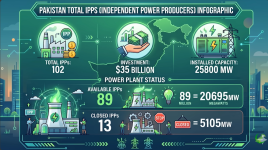
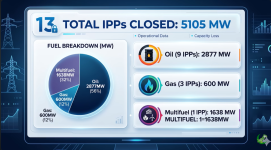
As we see robust growth in gross power capacity, Pakistan has seen 13 out of its total of 102 commissioned IPPs closed, thereby reducing their capacity by 5,105 MW. The list includes nine IPPs with RFO capacity of 2,877 MW, three IPPs using gas/RLNG capacity of 601 MW, and one multi-fuel IPP with a capacity of 1,638 MW.

Closure of the plants can be generally regarded as a good move. Firstly, power production from renewable fuels oil is one of the most costly and environmentally damaging sources of power generation in Pakistan. The other important point here is that due to the closure of these plants, Pakistan becomes less vulnerable to volatile international fuel prices. Nonetheless, it is clear that the actual growth of dispatchable power is much lower than indicated above.

Pakistan’s energy generation mix starts to favor anything but thermal energy

The structure of Pakistan’s energy generation mix has started changing. Energy generated from thermal plants, which were dominating until last year, have reduced to just 49.2% of total installed capacity, while hydel contributes 23.4%, renewable contribute 20.3%, and nuclear makes up 7.1%.

Importance lies not only in terms of capacity but also production-wise. With regard to the total electricity production of 92,835 GWh, the combined percentage of hydroelectricity, nuclear energy, and renewable energy sources is around 53.1%, which means for the first time, most of Pakistan’s electricity is being produced by non-thermal sources.

Electricity consumption grows by 3.8 percent; sector-wise analysis reveals more issues

Electricity consumption in the months of July to March for fiscal year 2026 stood at 83,143 GWh, marking an increase from 80,811 GWh in the corresponding months of fiscal year 2025, a total growth of 3.8 percent. However, this overall increase in consumption hides a critical shift among different sectors.

The domestic or household sector, which has been the largest consumer until now, witnessed a decline in its share from 49.6 percent (39,730 GWh) to 47.5 percent (39,472 GWh). Residential consumption declined marginally due to the impact of increased tariffs since 2023, pushing households to install solar systems or cut back on electricity consumption.

On the other hand, the industrial consumption rose to a high level from 21,083 GWh to 26,205 GWH, resulting in an increment of its share to 31.5%. The 24.3% increment in the industrial electricity consumption indicates a significant revival of manufacturing activity and improved utilization of the capacity within industries including textile, cement, and food processing.

On the contrary, there was a sharp decline of 42.3% in the case of agriculture, in which the electricity consumption fell from 4,566 GWH to 2,636 GWH. Its share in overall electricity consumption also fell by over half to 3.2%. There are several reasons cited for this steep decline, namely changes in irrigation timing, heavy rainfall requiring less pumping activity, and moving towards solar and diesel tube-wells due to high grid tariff prices.

Increase in petroleum usage on account of transportation requirements; Industry fuel switch

Total consumption of petroleum products in Pakistan between July-March FY 2026 was reported to be 13.64 million metric tonnes (MMT), which marks an increase of 3.5 percent over the previous fiscal year at 13.17 MMT.

The main cause behind increased demand for petroleum was seen to be increased activity in the transportation sector, comprising 82.5 percent of total consumption at 11.25 MMT, as compared to 10.55 MMT last year.

On the other hand, there was a fall in the usage of petroleum products in the industry by 42.6% to 433,500 metric tonnes against a previous figure of 754,600 metric tonnes. In terms of share in the consumption of petroleum products, the industry accounted for merely 3.2%. The fall can be attributed to active fuel switching since the industries in Pakistan have switched from furnace oil and diesel towards using natural gas, RLNG, and even solar energy and coal when prices are favorable.

The country imported 13.88 million metric tonnes (MMT) of petroleum products that marks an increase of 10.8% in quantity from 12.53 MMT. However, despite the increase in quantity of imported petroleum products, their value increased marginally from $8.4 billion to $8.9 billion in FY 2026. The imports of MS increased by 2.3% to 4.07 MMT, however, in terms of value, they decreased by 2.4% to $2.96 billion.
 
And how much capacity payments increased with it ????

It’s NOT a good news …. Aomeone has to pay for this generation increase …
 
And how much capacity payments increased with it ????

It’s NOT a good news …. Aomeone has to pay for this generation increase …
Nationally, total capacity payments across Pakistan have surged to an astronomical Rs 1.8 trillion to Rs 2.1 trillion annually
 

Moving from Collective Punishment to Targeted Accountability: Pakistan's Grid Overhaul

For decades, honest electricity consumers in Pakistan have shared a collective frustration: paying their utility bills in full every month, only to sit in the dark for hours. This "economic load shedding" was an unavoidable consequence of an outdated grid management strategy that punished entire neighborhoods for the theft of a few.

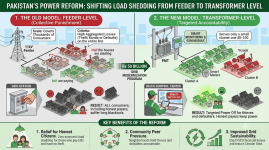
With the recent Rs 50 billion initiative launched by the Power Division to modernize grid monitoring, the era of collective punishment is finally coming to an end. Pakistan is shifting its load shedding protocols from the macro (feeder) level to the micro (transformer) level.
Here is how this fundamental shift changes the landscape of power distribution in the country.

The Old Model: Feeder-Level Load Shedding

To understand the solution, you have to understand the flaw in the existing system.
The national grid steps down high-voltage electricity at local grid stations and sends it out through 11kV feeders. A single feeder is a massive distribution line that can supply electricity to multiple neighborhoods, commercial markets, or several villages—often covering hundreds or thousands of consumers.

Historically, distribution companies (DISCOs like PESCO, LESCO, and K-Electric) categorized these feeders based on two metrics:

  1. Line Losses: The percentage of electricity lost to kunda (illegal hook connections) and technical inefficiencies.
  2. Recovery Rate: The percentage of billed amounts actually paid by consumers.
If a feeder had high theft or low bill recovery, the DISCO labeled it a "high-loss feeder" and subjected the entire line to prolonged economic load shedding (sometimes up to 14 hours a day) to minimize financial hemorrhaging.

The fatal flaw: The grid was blind. It could only turn the entire feeder on or off. Consequently, a household paying their bills with 100% compliance suffered the exact same blackouts as the house next door stealing electricity.

The New Model: Transformer-Level Precision

The government's new initiative moves the monitoring and control mechanisms closer to the consumer—specifically, to the Pole-Mounted Transformers (PMTs).
A distribution transformer serves a much smaller, localized cluster of users, typically around 50 to 100 homes or shops. By bringing technology to this level, DISCOs can finally separate the good actors from the bad.


How the Technology Works

The core of this shift relies on Smart Energy Meters and GSM-based monitoring modules (such as the TransfoCure systems being tested by companies like PESCO) installed directly onto the secondary windings of transformers.

  1. Micro-Monitoring: The smart module constantly measures the total power flowing out of the transformer and compares it against the total units billed to the 50-100 consumers connected to it.
  2. Theft Detection: If 100 units flow out of the transformer, but the smart meters on the houses only register 70 units, the system instantly flags a 30% loss rate for that specific street or block.
  3. Remote Switching: Instead of dispatching a lineman or shutting down the whole 11kV feeder at the grid station, the system allows the DISCO to remotely switch off only the specific transformer where the theft or default is occurring.

A Side-by-Side Comparison

FeatureFeeder-Level (The Old Way)Transformer-Level (The New Way)
Scale of ImpactThousands of consumers per line.50 to 100 consumers per block.
Collateral DamageHigh. Honest payers suffer for neighborhood theft.Zero. Only the specific block stealing electricity loses power.
Grid VisibilityBlind beyond the grid station.Granular, real-time data via GSM modules.
Action MechanismManual grid shutdown.Remote, automated relay switching.

The Socio-Economic Impact

This policy is about more than just technical upgrades; it is a behavioral engineering tool designed to change how communities interact with public utilities.

1. Protection for the Paying Citizen

The primary victory of this policy belongs to the honest consumer. Under the new paradigm, if you and your immediate neighbors pay your bills, your transformer stays on. The government has stated the explicit goal is to completely shield paying consumers from defaulter-driven blackouts.

2. Community Peer Pressure

When a whole city faces load shedding, the blame is placed on the government. However, when a single street's transformer is remotely disconnected while the adjacent street remains brightly lit, the dynamic shifts. It creates immense social pressure. Communities are far more likely to report illegal kunda connections or pressure defaulting neighbors to pay when their own electricity is directly on the line.

3. Plugging the Financial Drain

Pakistan's power sector circular debt is driven heavily by transmission and distribution losses, which have historically hovered around 18-20% of annual generation. By isolating high-loss transformers, DISCOs stop bleeding money into areas that refuse to pay, effectively capping their financial losses and stabilizing the national grid.

1782160645257.png
 

Moving from Collective Punishment to Targeted Accountability: Pakistan's Grid Overhaul

For decades, honest electricity consumers in Pakistan have shared a collective frustration: paying their utility bills in full every month, only to sit in the dark for hours. This "economic load shedding" was an unavoidable consequence of an outdated grid management strategy that punished entire neighborhoods for the theft of a few.

With the recent Rs 50 billion initiative launched by the Power Division to modernize grid monitoring, the era of collective punishment is finally coming to an end. Pakistan is shifting its load shedding protocols from the macro (feeder) level to the micro (transformer) level.
Here is how this fundamental shift changes the landscape of power distribution in the country.


The Old Model: Feeder-Level Load Shedding

To understand the solution, you have to understand the flaw in the existing system.
The national grid steps down high-voltage electricity at local grid stations and sends it out through 11kV feeders. A single feeder is a massive distribution line that can supply electricity to multiple neighborhoods, commercial markets, or several villages—often covering hundreds or thousands of consumers.


Historically, distribution companies (DISCOs like PESCO, LESCO, and K-Electric) categorized these feeders based on two metrics:

  1. Line Losses: The percentage of electricity lost to kunda (illegal hook connections) and technical inefficiencies.
  2. Recovery Rate: The percentage of billed amounts actually paid by consumers.
If a feeder had high theft or low bill recovery, the DISCO labeled it a "high-loss feeder" and subjected the entire line to prolonged economic load shedding (sometimes up to 14 hours a day) to minimize financial hemorrhaging.

The fatal flaw: The grid was blind. It could only turn the entire feeder on or off. Consequently, a household paying their bills with 100% compliance suffered the exact same blackouts as the house next door stealing electricity.

The New Model: Transformer-Level Precision

The government's new initiative moves the monitoring and control mechanisms closer to the consumer—specifically, to the Pole-Mounted Transformers (PMTs).
A distribution transformer serves a much smaller, localized cluster of users, typically around 50 to 100 homes or shops. By bringing technology to this level, DISCOs can finally separate the good actors from the bad.


How the Technology Works

The core of this shift relies on Smart Energy Meters and GSM-based monitoring modules (such as the TransfoCure systems being tested by companies like PESCO) installed directly onto the secondary windings of transformers.


  1. Micro-Monitoring: The smart module constantly measures the total power flowing out of the transformer and compares it against the total units billed to the 50-100 consumers connected to it.
  2. Theft Detection: If 100 units flow out of the transformer, but the smart meters on the houses only register 70 units, the system instantly flags a 30% loss rate for that specific street or block.
  3. Remote Switching: Instead of dispatching a lineman or shutting down the whole 11kV feeder at the grid station, the system allows the DISCO to remotely switch off only the specific transformer where the theft or default is occurring.

A Side-by-Side Comparison


FeatureFeeder-Level (The Old Way)Transformer-Level (The New Way)
Scale of ImpactThousands of consumers per line.50 to 100 consumers per block.
Collateral DamageHigh. Honest payers suffer for neighborhood theft.Zero. Only the specific block stealing electricity loses power.
Grid VisibilityBlind beyond the grid station.Granular, real-time data via GSM modules.
Action MechanismManual grid shutdown.Remote, automated relay switching.

The Socio-Economic Impact

This policy is about more than just technical upgrades; it is a behavioral engineering tool designed to change how communities interact with public utilities.

1. Protection for the Paying Citizen

The primary victory of this policy belongs to the honest consumer. Under the new paradigm, if you and your immediate neighbors pay your bills, your transformer stays on. The government has stated the explicit goal is to completely shield paying consumers from defaulter-driven blackouts.

2. Community Peer Pressure

When a whole city faces load shedding, the blame is placed on the government. However, when a single street's transformer is remotely disconnected while the adjacent street remains brightly lit, the dynamic shifts. It creates immense social pressure. Communities are far more likely to report illegal kunda connections or pressure defaulting neighbors to pay when their own electricity is directly on the line.

3. Plugging the Financial Drain

Pakistan's power sector circular debt is driven heavily by transmission and distribution losses, which have historically hovered around 18-20% of annual generation. By isolating high-loss transformers, DISCOs stop bleeding money into areas that refuse to pay, effectively capping their financial losses and stabilizing the national grid.

View attachment 202787

This is game changer for Pakistan power sector. By next june there will be no more feedar level load shedding.
 
... As we see robust growth in gross power capacity, Pakistan has seen 13 out of its total of 102 commissioned IPPs closed, thereby reducing their capacity by 5,105 MW. The list includes nine IPPs with RFO capacity of 2,877 MW, three IPPs using gas/RLNG capacity of 601 MW, and one multi-fuel IPP with a capacity of 1,638 MW. ...
The 13 IPPs that had their contracts terminated.

No.
IPP
Type / Fuel
Approx. Capacity
1​
Hub Power Company Limited (HUBCO)Oil / Thermal~1,292 MW
2​
Lalpir Power LimitedFurnace Oil / Thermal~362 MW
3​
Pakgen Power LimitedFurnace Oil / Thermal~365 MW
4​
Saba Power CompanyFurnace Oil / Thermal~134 MW
5​
Rousch Pakistan Power LimitedGas / Thermal~395 MW
6​
Chashma Sugar Mills Power PlantBagasse
7​
JDW Sugar Mills Power PlantBagasse
8​
Hamza Sugar Mills Power PlantBagasse
9​
RYK Mills Power PlantBagasse
10​
Al-Moiz Industries Power PlantBagasse
11​
Thal Industries Power PlantBagasse
12​
Shakarganj Sugar Mills Power PlantBagasse
13​
Crescent Bahuman Power PlantBagasse
 
Any one has a list of the contract end dates of the IPPs still operational in Pakistan.
 
Total electricity generation capacity in Pakistan increased to 49,651 megawatts (MW) from July-March FY 2026. This was an 8.5% rise compared to 45,782 MW witnessed during the corresponding period of last fiscal year,

Electricity consumption grows by 3.8 percent; sector-wise analysis reveals more issues


If somebody still believes we need more power plants (IPPs and dollar based guaranteed returns ), he is retarded. Just build solar farms with local investments , some wind farms in sindh, and 2-3 new dams. So that in coming years we can close down more IPPs.
 
If somebody still believes we need more power plants (IPPs and dollar based guaranteed returns ), he is retarded. Just build solar farms with local investments , some wind farms in sindh, and 2-3 new dams. So that in coming years we can close down more IPPs.
its just corruption nothing else. Nobody is going to buy this electricity, new factories all come with pre planned solar installation. these mian manshas, arif habib knows no limits!
 
its just corruption nothing else. Nobody is going to buy this electricity, new factories all come with pre planned solar installation. these mian manshas, arif habib knows no limits!
Factories don't run just from 10AM to 4PM. They still need state provided transmission lines.
 
Factories don't run just from 10AM to 4PM. They still need state provided transmission lines.
Battery is about to bite into that portion also. Specially, 2028 onwards when sodium batteries have achieved scale and major cost optimization.
 
ISLAMABAD, Jun 23 (APP):Pakistan is set to save USD 3.239 billion over the next 26 years — and USD 2.113 billion in foreign currency alone — by converting the Jamshoro Unit-01 power plant from imported coal to 100% indigenous Thar lignite, as a Bankable Feasibility Study (BFS) has confirmed the project is technically feasible, economically beneficial and environmentally manageable. The findings of the study, prepared by internationally renowned consultants Dornier …


ISLAMABAD, Jun 23 (APP):Pakistan is set to save USD 3.239 billion over the next 26 years — and USD 2.113 billion in foreign currency alone — by converting the Jamshoro Unit-01 power plant from imported coal to 100% indigenous Thar lignite, as a Bankable Feasibility Study (BFS) has confirmed the project is technically feasible, economically beneficial and environmentally manageable.


The findings of the study, prepared by internationally renowned consultants Dornier Group and EY Parthenon, were presented to Federal Minister for Power Sardar Awais Ahmed Khan Leghari during a briefing held here on Tuesday, according to a press release issued by the Ministry of Energy (Power Division).
The achievement of this milestone was made possible through the active support and collaboration of key stakeholders, including K-Electric (KE), Jamshoro Power Company Limited (JPCL), and the Private Power and Infrastructure Board (PPIB).

To steer this complex initiative, the Federal Minister constituted a high-level steering committee, which convened 38 dedicated sessions to proactively monitor and expedite the completion of the BFS. Of these, 15 sessions were personally chaired by the Minister, reflecting the Government’s unwavering commitment to this transformative project. The Minister has expressed his sincere gratitude to KE, JPCL, PPIB, and all other partners for their invaluable support in bringing this feasibility study to fruition.

The initiative flows directly from the Prime Minister’s Power Sector Reform Plan and reflects sustained efforts by the Ministry of Energy to advance fuel indigenisation, with the BFS marking a key milestone in that process.

The economic case for the conversion is exceptionally strong. The project delivers a cost-benefit ratio of 1.8x, which remains favourable across all sensitivity scenarios. Total net benefits over the 26-year project life amount to USD 3.239 billion, comprising USD 1.720 billion in net benefits to the power sector — including generation cost savings of USD 1.051 billion and Thar mine expansion benefits of USD 669 million — alongside USD 1.519 billion in government savings from reduced interest costs on foreign borrowings. Critically, the project generates USD 2.113 billion in foreign currency savings, directly strengthening Pakistan’s balance of payments and reducing exposure to volatile international coal prices and exchange rate fluctuations. The required conversion CAPEX is estimated at USD 86.2 million (with total project cost of USD 116.6 million), representing a highly attractive return on investment.

The BFS, prepared by the internationally renowned Dornier Group as lead technical consultant, confirms that Jamshoro Unit-01 — Pakistan’s ultra-supercritical power plant — can be converted to burn 100% Thar lignite through targeted engineering modifications rather than a large-scale boiler retrofit, thereby preserving the value of the existing plant asset. The project is structured as a bankability-led brownfield modification, with a stage-gate implementation approach that introduces no new coal capacity.

Beyond the direct financial savings, the conversion carries transformative economic co-benefits for Pakistan. The shift to Thar lignite will catalyse the expansion of coal mines in Tharparkar, generating employment, accelerating infrastructure development in one of Pakistan’s most underserved regions, and deepening the country’s domestic energy supply chain. By eliminating reliance on imported coal — subject to international commodity price fluctuations, foreign exchange volatility, and supply chain disruptions — Pakistan will move decisively towards energy self-sufficiency, consistent with the Government’s broader indigenisation agenda under the Power Sector Reform Plan.

With the BFS now formally presented, the Ministry of Energy (Power Division) will proceed to the implementation readiness phase. Immediate next steps include obtaining final policy approval, initiating the lender-consent workstream and loan amendment roadmap, preparing the NEPRA/TCEB/SEPA/PPRA/PPA/CSA/EPC consent and contract matrix, launching basic design tender verification — including CFD modelling, mill tests, FGD/ESP and balance-of-plant modifications, and HAZIG/HAZOP studies — and developing a comprehensive procurement and contracting strategy with appropriate interface allocation and guarantees.
The Government of Pakistan remains committed to the timely and bankable implementation of this landmark project, which represents a cornerstone of the national energy sector’s transition towards indigenous resources, fiscal sustainability, and long-term energy security.
 
Status
Not open for further replies.

Users who are viewing this thread

Pakistan Defence Latest

Latest Posts

Back
Top