President Zardari on 10-day official visit to China

I think he went for speech therapy ...because no Chinee govt high official came to the airport.
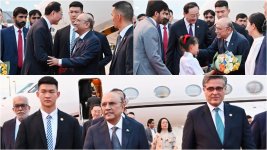
On arrival at Chengdu Shuangliu International Airport, he was received by Vice Foreign Minister Sun Weidong and Vice Governor of Sichuan Province Mr Huang Ruixue. Pakistan’s Ambassador to China Mr Khalil Hashmi, as well as the Chinese Ambassador to Pakistan, Mr Jiang Zaidong.


1757871683521.jpeg
 

Pakistan’s president becomes ‘first’ foreign leader to visit China’s Advanced Aircraft Complex​

Pakistan’s president becomes ‘first’ foreign leader to visit China’s Advanced Aircraft Complex

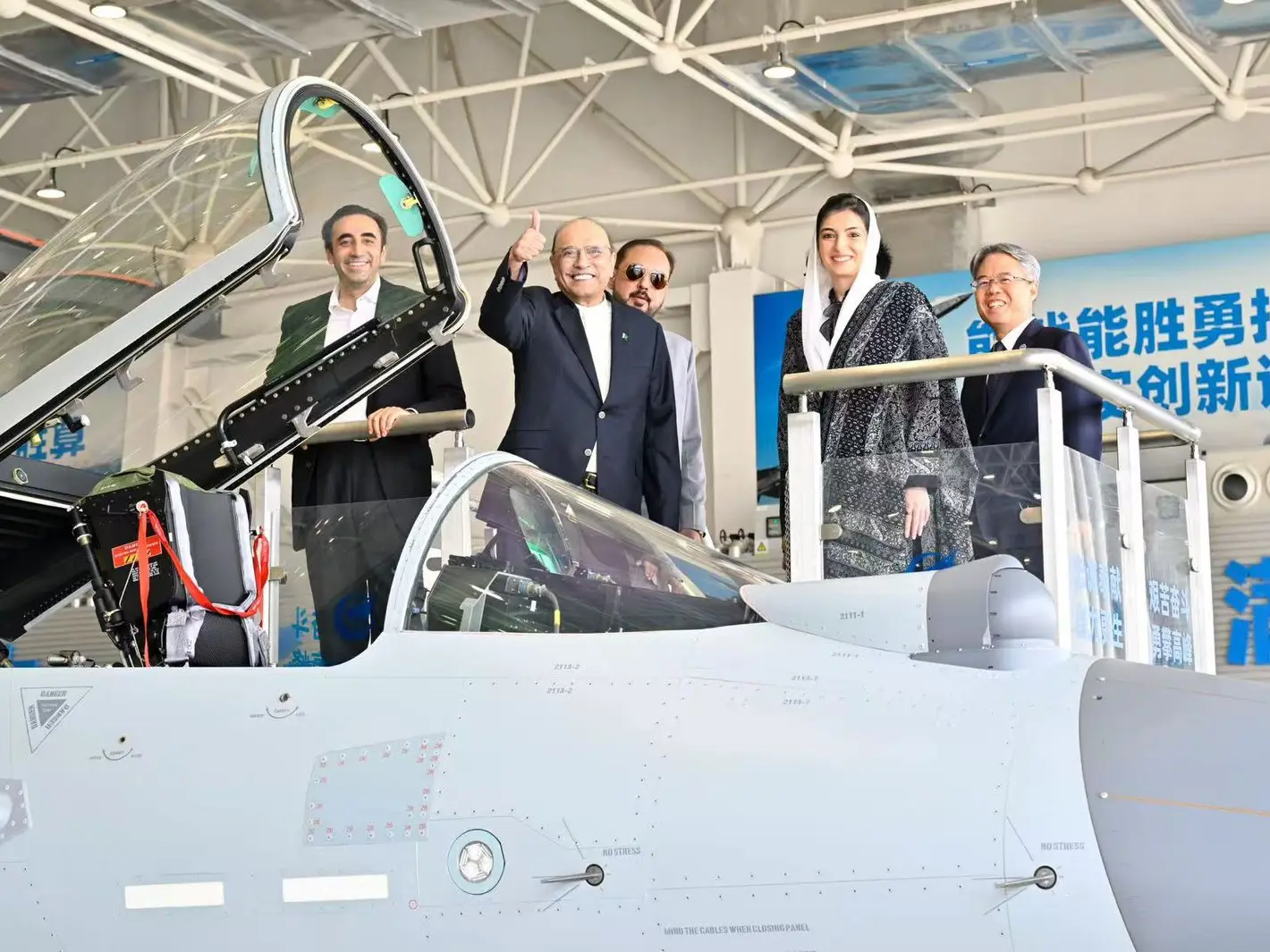
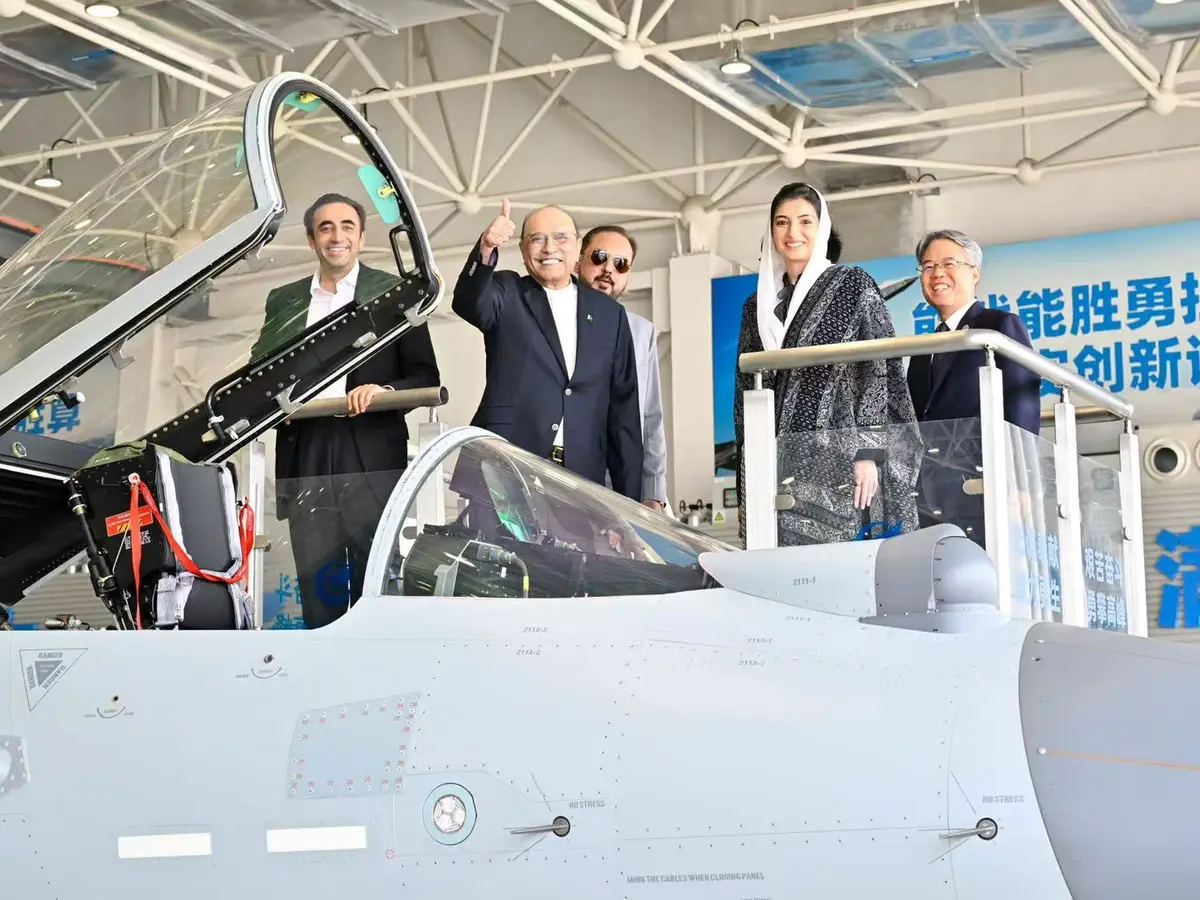
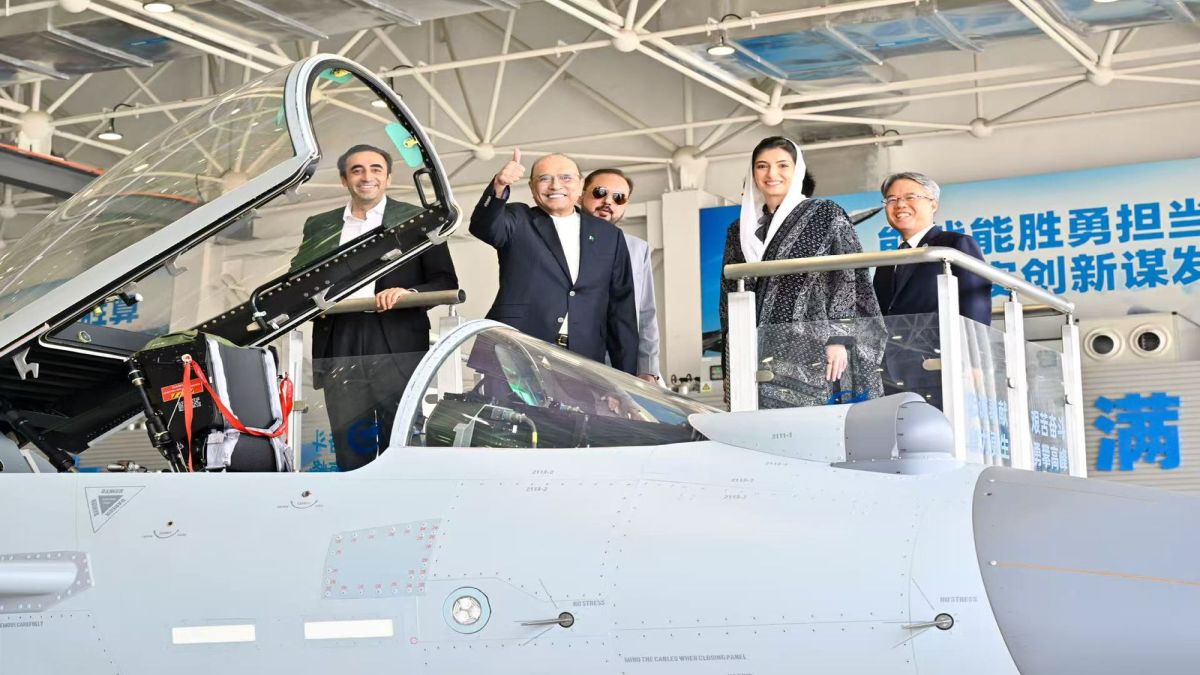
Pakistan President Asif Ali Zardari gestures during his visit at the Aviation Industry Corporation of China’s (AVIC) Advanced Aircraft Complex in Chengdu on September 14, 2025. (Handout/President Office)

September 14, 2025

  • The development comes months after Pakistan declared victory in a military standoff with India that saw Islamabad use China’s J-10Cs
  • President Zardari was briefed on co-production of JF-17s with Pakistan as well as progress in J-20 5th-generation stealth fighter jets
ISLAMABAD: Pakistan President Asif Ali Zardari has become the “first” foreign leader to visit Aviation Industry Corporation of China’s (AVIC) Advanced Aircraft Complex in Chengdu, the presidency in Islamabad said on Sunday, with the Pakistani leader pledging deeper defense ties.

The AVIC is China’s flagship aerospace and defense conglomerate engaged in the design and production of a wide range of military and civilian aircraft, according to President Zardari’s office.


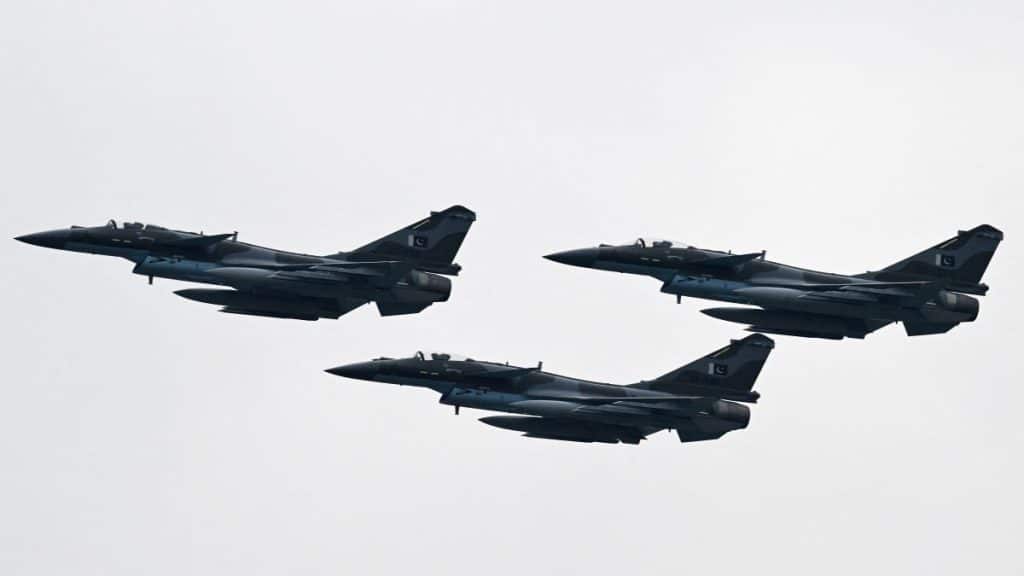
During the visit, the president toured the sprawling complex in its entirety, which produces the J-10C fighter jet that played a crucial role during the India-Pakistan military standoff in May.

Pakistan declared victory in the conflict, saying its air force used Chinese J-10C aircraft to shoot down six Indian fighter jets, including three French Rafales. Though Indian officials have acknowledged losses, they have not specified the number of jets downed by Pakistan.

“President Zardari was briefed on AVIC’s advanced capabilities, including the J-10 fighter jet, the co-production of the JF-17 Thunder with Pakistan, as well as progress in the J-20 stealth 5th-generation fighter aircraft, unmanned aerial vehicles, fully automated units, and integrated command-and-control systems for modern multi-domain operations,” his office said in a statement.

A rising military superpower, China hasn’t fought a major war in more than four decades but has raced under President Xi Jinping to modernize its armed forces, pouring resources into developing sophisticated weaponry and cutting-edge technologies. It has also extended that modernization drive to Pakistan, long hailed by Beijing as its “ironclad brother.”

Over the past five years, China has supplied 81 percent of Pakistan’s imported weapons, according to data from the Stockholm International Peace Research Institute (SIPRI). Those exports include advanced fighter jets, missiles, radars and air-defense systems. Some Pakistan-made weapons have also been co-developed with Chinese firms or built with Chinese technology and expertise.

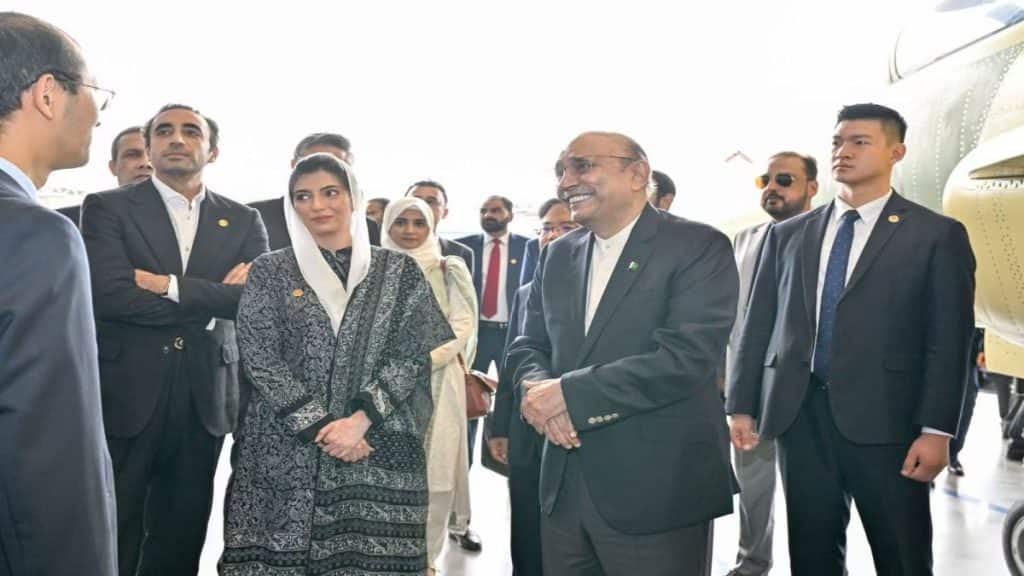
President Zardari, who was accompanied by Pakistan Peoples Party (PPP) Chairman Bilawal Bhutto-Zardari and First Lady Aseefa Bhutto-Zardari, met the AVIC’s engineers and scientists and listened to their insights on innovation, production and future technologies.

He noted that the J-10 and JF-17 aircraft have greatly strengthened the Pakistan Air Force, a fact clearly demonstrated during the May standoff, lauding the AVIC as a symbol of China’s technological advancement and of the enduring strategic partnership between Pakistan and China.

“President Zardari’s visit also marked a historic first, as no foreign head of state had previously visited the AVIC complex,” his office said. “He reaffirmed that the two countries would continue to expand collaboration in defense production and aviation, further deepening their all-weather strategic cooperative partnership.”

Zardari arrived in Chengdu on Friday on a ten-day China visit, which comes on the heels of an official trip to China by Prime Minister Shehbaz Sharif last week, during which Islamabad signed investment agreements and joint ventures worth $8.5 billion with Beijing.

Later, President Zardari traveled via a high-speed train from Chengdu to Mianyang, the second largest prefecture-level city of Sichuan province in southwestern China, covering the 139-kilometer journey in around half an hour.

Officials briefed the president that China now operates the world’s largest high-speed rail network of over 45,000km of dedicated track, carrying more than 2 billion passengers annually. With trains running at up to 350-km an hour, the network links almost all major Chinese cities, with a standardized, dedicated passenger system that has become a model of modern connectivity.

“The President praised China’s achievements in sustainable and resilient transport, including pollution-free electric propulsion and earthquake early-warning technologies, describing them as a marvel of railway engineering,” Zardari’s office said. “He noted that such innovations offer valuable lessons for other countries including Pakistan.”

 
10 days in China could mean he'll fine tune and finalize J-10C related procurement contract as well as gather details on J-35 also!
 

Pakistan President Zardari visits China’s secret defence military facility amid Indo-Pacific tensions​

Edited By Jatin Verma
Published: Sep 16, 2025, 11:19 IST | Updated: Sep 16, 2025, 11:19 IST

Pakistan President Zardari visits China’s secret defence military facility amid Indo-Pacific tensions

President Asif Ali Zardari became the first foreign Head of State to visit China’s AVIC aircraft complex in Chengdu

Story highlights
Pakistan's President Asif Ali Zardari toured China’s secret military hub AVIC, discussing deeper defence ties after Pakistan’s losses in Operation Sindoor

In a rare diplomatic gesture, Pakistan’s President Asif Ali Zardari was granted access to one of China’s most secure military facilities — the headquarters of the Aviation Industry Corporation of China (AVIC). Zardari is the first foreign head of state to receive such a tour, during which he explored China’s latest advancements in military aviation and defence technologies.
During his visit to AVIC on Sunday (September 14), Zardari received detailed briefings on a wide array of defence capabilities, including the J-10 fighter aircraft, the collaborative JF-17 Thunder program with Pakistan, and developments in the J-20 stealth fighter jet. The tour also covered cutting-edge unmanned aerial systems, fully automated combat platforms, and integrated command-and-control frameworks designed for multi-domain warfare.

While the Chinese Foreign Ministry downplayed the visit’s military implications, it instead highlighted Zardari’s support for the Global Security Initiative (GSI) — Beijing’s strategic vision presented as an alternative to Western-led security frameworks. Zardari’s 10-day official visit comes shortly after the end of cross-border hostilities between India and Pakistan, triggered by the Pahalgam attack that killed 26 civilians. In response, India launched Operation Sindoor on May 7, striking terror camps in Pakistan and Pakistan-occupied Kashmir. Both countries agreed to de-escalate by May 10, but the conflict revealed serious vulnerabilities in Pakistan's defence systems.

Zardari’s AVIC tour follows a series of high-level Pakistan-China engagements, including recent visits by Prime Minister Shehbaz Sharif and Army Chief Field Marshal Gen Asim Munir. The Pakistani leadership is believed to be exploring replenishment and upgrade options for its military assets, many of which were sourced from China and used during the brief conflict with India.

According to SIPRI, over 80% of Pakistan’s military equipment is supplied by China — a reliance that continues to shape defence cooperation between the two countries. Zardari was joined by PPP chairman Bilawal Bhutto-Zardari and First Lady Aseefa Bhutto-Zardari during the AVIC visit. His trip began on September 12, shortly after Sharif and Munir attended the Shanghai Cooperation Organisation summit and held talks with Chinese President Xi Jinping.


Pakistan President Asif Ali Zardari tours China’s military complex. Should India pay attention?​

FP Explainers September 16, 2025, 12:20:57 IST

As part of his 10-day visit to China, Pakistan President Asif Ali Zardari visited the state-owned aerospace and defence giant, Aviation Industry Corporation of China (AVIC), in Chengdu. This is significant, as it is the first time a foreign leader has toured the sprawling complex, where J-10C fighter jets are produced. But why is Beijing showing Zardari its secret military complex? What does this mean for India?

Pakistan President Asif Ali Zardari tours China’s military complex. Should India pay attention?

Pakistan President Asif Ali Zardari pictured during a visit to the Aviation Industry Corporation of China, alongside his children Bilawal and Aseefa. Image Courtesy: @PresOfPakistan/X

How close is China to Pakistan? The answer to this question can be gauged from Pakistan President Asif Ali Zardari’s visit to the Xi Jinping-led nation.

On Friday, Zardari began a 10-day visit to China close on the heels of a five-day visit of Prime Minister Shehbaz Sharif and Army Chief Field Marshal Asim Munir.

As part of his tour, Zardari visited the advanced aircraft complex of China’s state-owned aerospace and defence giant, Aviation Industry Corporation of China (AVIC), in Chengdu, making him the first foreign leader to visit, indicating the close ties between the two nations.

But what does this mean for India, who has revived its ties with Beijing? We analyse and get you the answer.

Zardari in Pakistan​

Last Friday, Pakistan President Asif Ali Zardari embarked on a 10-day visit to China, accompanied by son Bilawal Bhutto-Zardari, his daughter Aseefa Bhutto-Zardari, Senator Saleem Mandviwalla, Pakistan’s Ambassador to China Khalil Hashmi and China’s Ambassador to Pakistan Jiang Zaidong.

On Sunday (September 14), the Pakistani president as part of his trip visited Chinese jet maker, the Aviation Industry Corporation of China in the southwestern city of Chengdu. Zardari was briefed on AVIC’s advanced capabilities, including the J-10 fighter jet, the co-production of the JF-17 Thunder with Pakistan, as well as progress in the J-20 stealth fifth-generation fighter aircraft, Zardari’s office said in a statement.

He was also briefed on unmanned aerial vehicles, fully automated units, and integrated command-and-control systems for modern multi-domain operations.

Following his visit, the Pakistani president praised the jet maker as “a symbol of China’s technological advancement and of the enduring strategic partnership between Pakistan and China”.

pak2-2025-09-9f4c35f2ca499667bb6ad30b78e7da87-1024x576.jpg
During his 10-day visit to China, Pakistan President Asif Ali Zardari toured China’s largest military aviation manufacturer, Aviation Industry Corporation of China (AVIC), in Chengdu. Image Courtesy: @PresOfPakistan/X

Significance of Zardari’s visit to AVIC​

What makes Zardari’s visit to AVIC’s sprawling campus notable is that it is the first for a foreign head of state. It marks deepening security ties between Beijing and Islamabad, especially since the fighting between India and Pakistan.

In fact, it is AVIC that produces the J-10C fighter jet that played a role during the India-Pakistan military confrontation back in May. At the time, Reuters quoting American officials said Islamabad had used the Chinese-made J-10 aircraft to launch air-to-air missiles against Indian fighter jets.

Moreover, some experts had called it a “DeepSeek moment” for the Chinese weapons industry with Zhou Bo, a retired senior colonel in the Chinese People’s Liberation Army telling BBC, “The aerial fight was a big advertisement for the Chinese weapons industry. Until now, China had no opportunity to test its platforms in a combat situation.”

Now, many experts note that Zardari’s visit to China is part of Islamabad ramping up its military ties with Beijing. From 2020 to 2024, Pakistan has emerged as the largest importer of Chinese weapons, accounting for 63 per cent of all weapons exports, as per the Stockholm International Peace Research Institute (Sipri).

pak3-2025-09-97f52c927eed1a64c0ae22da25e6c730-1024x576.jpg
Chinese-made Pakistani J-10C fighter jets featured during the India-Pakistan military confrontation in May. File image/AFP

Sipri has noted that Pakistan’s purchase of Chinese weapons has significantly increased over the years. Between 2020 and 2024, China supplied 81 per cent of Pakistan’s arms imports. This is higher than the 74 per cent between 2015 and 2019.

And what all weapons have Pakistan imported from China? Pakistan has imported advanced fighter jets, missiles, radar and air defence systems. According to data available, as of today, the Pakistani Air Force operates 36 J-10C fighters and 161 JF-17s.

In addition to this, China has also reportedly offered to sell Pakistan its second fifth-generation fighter jet, the J-35, according to a Pakistani government announcement posted online in June.

In mid-June, it was reported that Pakistan was in talks with China for the acquisition of cutting-edge anti-ballistic missile systems, airborne early warning and control platforms, and stealth fighters to plug the holes in its air defences exploited by India during their hostilities in May.

At the time, Walter Ladwig, an associate professor of international relations at King’s College London, noted that China’s sale of advanced stealth jets, radar aircraft, and missile defences to Pakistan was a “strategic message” for India.

India looks on…​

But what does this visit mean for India and its now renewed ties with China? The Chinese Foreign Ministry has played down Zardari’s visit to AVIC and his call for stronger cooperation with China on defence production.

But experts note that it could be a reason to worry as the two look to mend broken ties. In the face of US President Donald Trump’s tariff war with Beijing and New Delhi, both countries have renewed their ties, which plummeted following the clash of troops at the Galwan Valley in 2020.

The biggest indication of an India-China thaw was Prime Minister Narendra Modi’s visit to Tianjin in late August for the Shanghai Cooperation Organisation (SCO) Summit where he had a bilateral meet with Chinese President Xi Jinping during which both sides reaffirmed that they are “partners not rivals”.

Moreover, Delhi and Beijing have agreed to restore direct flights and relax visa curbs that were imposed after the 2020 clash.

The question is that as China continues to arm Pakistan with weapons and military hardware, can it be a friend of India?

Amit Bhandari, senior fellow, energy, investments and connectivity at think tank Gateway House, told CNBC earlier, “The suspicion of China runs deep in India. It is unlikely that Chinese partnership will become like the one India has with Russia or US.”

 
10 days in China could mean he'll fine tune and finalize J-10C related procurement contract as well as gather details on J-35 also!
The best this chap of a president can do his fine tune his commission and see how much he can make it or get for his cronies....that's all.

The ground work is probably already laid by the respective defense officials from both countries, by the financiers and by the technical team.

This is more of a symbolic visit and yes perhaps to sign final documentation which would require the signatures of the head of state of Pakistan.
 

Users who are viewing this thread

Latest Posts

Back
Top