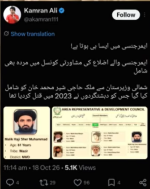
We can and should say the same.
If politics and party agenda mean more to people than the unity of the country then what can one say. I am certainly sorry that some people feel this way.
There isn't a single person who would have supported MQM had they said "because the state is carrying out Operation Clean-up against us, we will join hands with India."
Let's apply uniform principles when thinking about Pakistan. I firmly believe that the state should not push any ethnicity to the brink, but if the mass murder is being committed by Afghan citizens and their supporters abetted by the Taliban in Kabul/Kandahar, why the hesitation to go after these actors in a united manner with one voice?
I will grant our politics are dismal and there is very little maturity shown by either side (this includes the Establishment too), however, we have tashkeels and suicide bombers entering from Afghanistan and people have confusion about whether or not we should go after them.
Let's have clarity of thought on this fitna. Just because the Taliban go easy on PTI, that does not mean they should be given a free pass by the party supporters. As I have maintained, I can guarantee that if things continued, Taliban would have certainly turned their guns against PTI as well just like they did against the ANP (an avowedly secular, but pro Pakhtun rights party).
Ask yourself, what should Pakistan's security agencies be focused on? Should their primary mission be combating terrorism, dismantling militant networks, and ensuring the safety of citizens, or should national resources be consumed by political surveillance and efforts directed against political opponents?
Pakistan continues to face serious security challenges, from terrorism to economic instability. At a time when the country needs strong institutions working together, many people feel that too much energy is being spent on political engineering and too little on addressing the threats that directly affect ordinary Pakistanis.
The establishment is often perceived as having influence over almost every major decision in the country. If that perception is incorrect, then institutions should demonstrate transparency and accountability. If it is correct, then responsibility for the country's successes and failures cannot simply be shifted onto elected governments.
You cannot exercise influence over every important matter and then distance yourself from the consequences when things go wrong.
What is even more troubling is the assumption that the public cannot see what is happening.
Pakistanis are more informed than ever. The international community, journalists, analysts, and ordinary citizens all observe developments and form their own conclusions.
Treating people as if they are unable to distinguish reality from political narratives only further undermines public trust.
Perhaps the most striking example is healthcare. Pakistan is a nuclear-armed nation of more than 250 million people, yet when people discuss world-class cancer care within the country, one name consistently stands out,
Shaukat Khanum Memorial Cancer Hospital. For countless families, it is more than a hospital; it is a symbol of hope. Thousands of patients, many of whom could never afford expensive treatment, have relied on it during the most difficult moments of their lives.
If the government or the establishment believes that fear of one political figure justifies targeting every institution associated with him, then consider the consequences. Imagine if Shaukat Khanum were forced to close. The issue would no longer be politics. It would become a humanitarian crisis affecting cancer patients, families, doctors, nurses, and communities across Pakistan.In the end, institutions earn respect not through power, censorship, or political control, but through service, competence, and public trust.
The real measure of leadership is not how effectively it silences opponents, but how effectively it improves the lives of ordinary citizens.