In a climate of economic and political uncertainty, even a single article in a newspaper with a modest circulation is now viewed as a potential spark for mass unrest.
By Asif Ullah Khan
January 08, 2026
View attachment 170986
Wo baat saare fasaane mein jis ka zikr na tha Wo baat un ko bahut na-gawar guzri hai
—Faiz Ahmed Faiz
This famous couplet by the Pakistani Urdu poet Faiz Ahmed Faiz can be roughly translated as: “That one thing which was never even mentioned in the entire story — that is precisely the thing they found most offensive.” The verse captures how acutely sensitive — or insecure — the Pakistan Army has become, such that even the slightest hint of criticism triggers overreaction and high-handedness.
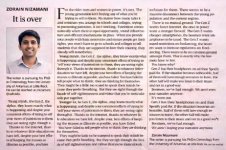
The issue at hand was an ostensibly simple op-ed in Pakistan’s English-language daily, The Express Tribune. The piece, titled “
It Is Over,” was written by Zorain Nizamani, a Pakistani Ph.D. student at the University of Arkansas. In it, he took potshots at “Baby Boomers,” arguing that Gen Z is no longer buying the traditional narratives sold by those in authority. He contended that the younger generation is better informed and has lost faith in the state’s so-called “official stories.”
However, the article soon shifted from sociology to a biting critique of the establishment. Without explicitly naming the military, Nizamani struck at the heart of the state’s current indoctrination efforts.
He wrote: “The younger generation is no longer buying what you are trying to sell them… You may promote patriotism as much as you like — it is no longer working. This entire machinery has completely failed… Patriotism is not created through lectures. It is born naturally when there are equal opportunities, strong infrastructure, and an effective system in place.”
Much like Faiz’s verse — “That one thing which was never mentioned… they found most offensive” — the article hit a nerve precisely because of its subtext.
Since the ascension of Field Marshal Asim Munir, it has become common practice for military officers to hold seminars in educational institutions, lecturing students on
patriotism and the army’s role as the nation’s guardian. Nizamani’s assertion that “patriotism isn’t taught in schools” was seen as a direct hit on this strategy.
The reaction from the “influential quarters” — a common euphemism for the military establishment — was swift. The newspaper was reportedly pressured to take down the article from its website. But in the digital age, censorship often acts as a catalyst.
The
removal triggered a massive domino effect. Screenshots of the deleted article flooded social media, reaching millions who would never have read a niche English-language newspaper. Supporters of the imprisoned former Prime Minister Imran Khan
hailed the piece as the “true voice of the people,” transforming a sociological critique into a partisan rallying cry.
The pressure soon reached the author’s family. Nizamani’s parents — well-known television actors
Fazila Qazi and Kaiser Khan Nizamani — were forced to issue a clarification distancing their son from any political party. Without naming Imran Khan’s PTI, they said that a “certain political party” was exploiting the article to further its partisan propaganda. Nizamani himself later posted a
video on a newly created X (formerly Twitter) account, attempting to dial back the rhetoric by claiming that his intent was merely to promote “critical thinking.”
The “damage,” however, had already been done. The panic displayed by the establishment revealed a profound insecurity. In a climate of economic and political uncertainty, even a single article in a newspaper with a modest circulation is now viewed as a potential spark for mass unrest.
The saga of “It Is Over” proves that in modern Pakistan, the
fasaana — the official narrative — is crumbling. When authority tries to bury an uncomfortable truth, it only ensures that the truth finds a far louder and more defiant megaphone.











 Trump talks to Putin, then announces diesel deal with Russia, in sharp reversal of US policy (44 Viewers)