Ranked: Countries with the Largest Currency Reserves

Beijingwalker

VIP Member
Joined
Nov 4, 2011
Messages
92,446
Reaction score
113,155
Reputation
2,100.0
Country of Origin
Country of Residence

Ranked: Countries with the Largest Currency Reserves

June 25, 2026

Countries-with-the-Largest-Currency-Reserves_website_Jun5.webp


Key Takeaways:​

  • China holds over $3.4 trillion in foreign exchange reserves, nearly 3x more than Japan.
  • Seven of the world’s 10 largest reserve holders are in Asia, reflecting decades of export-led growth.
  • Despite being the world’s largest economy, the U.S. ranks only 13th because the dollar is the world’s primary reserve currency.
Today’s largest reserve holders were shaped by a crisis that happened nearly three decades ago.

After the 1997 Asian Financial Crisis exposed the risks of relying on foreign capital during market turmoil, many governments began building massive foreign exchange reserves as a form of economic self-insurance.

Using data from the IMF’s International Reserves and Foreign Currency Liquidity (IRFCL) database, this visualization ranks countries by their foreign exchange reserves excluding gold, based on the latest available reporting periods from mid-2025 through Q2 2026.

The Countries Holding the Most Reserves​

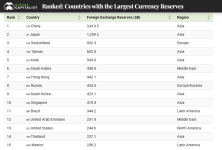
The table below shows the countries with the largest foreign exchange reserve holdings.
搜狗截图20260626154501.png
One clear pattern stands out in the rankings: Asia dominates.

Seven of the world’s 10 largest reserve holders are located in the region, together accounting for roughly two-thirds of global foreign exchange reserves. This concentration reflects decades of export-led growth, persistent trade surpluses, and a policy focus on maintaining large financial buffers.

Why Countries Build Massive Currency Reserves​

Foreign exchange reserves act as a country’s emergency fund. Central banks can use them to stabilize currencies during market turmoil, pay for essential imports, service foreign debt, or reassure investors during periods of capital flight.

The larger the reserve buffer, the greater a country’s ability to respond to external economic shocks without relying on foreign assistance.

The importance of reserve accumulation became especially clear after the 1997 Asian Financial Crisis. Many Asian economies experienced severe currency collapses and were forced to seek external assistance. In the years that followed, governments across the region adopted a strategy of building substantial reserve buffers as a form of economic self-insurance.

What Large Reserves Mean for the Global Economy​

Large reserve holdings can provide important benefits. Countries with substantial reserves are often better positioned to weather external shocks and maintain investor confidence during periods of market stress.
 
Taiwan and Hong kong both have surprisingly high foreign reserves, disproportionately large with reference to their size and population.
 
Its purpose to protect from currency manipulators like George Soros.

789th post... I'm so outta here. So long y'all!!!
 
China’s “shadow reserves” refer to an estimated $3 trillion in hidden, off-balance-sheet foreign exchange assets—predominantly US dollars—controlled by state commercial banks, policy lenders, and sovereign wealth funds. While China's official foreign exchange reserves remain steady around $3.2 trillion, these vast uncounted reserves serve as an emergency financial cushion and a hedge against Western sanctions. [1, 2, 3, 4, 5, 6]
Following the 2022 freezing of Russia's central bank reserves by Western nations, Beijing quietly accelerated the buildup of these hidden assets. Instead of holding everything on the balance sheet of the People's Bank of China (PBOC), the following mechanisms are utilized to park these funds: [1, 2]
  • State-Owned Commercial Banks: The majority of shadow reserves are held by institutions like the Bank of China and the Industrial and Commercial Bank of China (ICBC). These banks hold nearly $1 trillion in offshore foreign currency assets funded by state enterprises, off the central bank's official books. [1, 2]
  • Policy Banks & Investment Vehicles: Funds are regularly transferred to state policy banks or the State Administration of Foreign Exchange (SAFE) lending pools. Once these funds are deployed to back foreign infrastructure or commercial initiatives, they exit official central bank reserve tallies. [1]
  • Gold Accumulation: To complement paper assets, the PBOC and associated state entities continuously funnel excess capital into massive physical gold purchases. [1, 2]
China's large-scale manipulation of these assets allows the government to steer currency markets, stabilize the yuan, and project immense global economic influence without triggering the regulatory scrutiny that usually accompanies the disclosure of official state reserves. [1, 2, 3]
 
China has to switch its currency reserve that is mostly in US dollar assets into some other more secure investments. Holdings in US dollar is no longer safe for China.
 

Users who are viewing this thread

Pakistan Defence Latest

Latest Posts

Back
Top