
SilentWatch
Registered Member


Hi ISI, MI and Pakistan Navy PDF members,
below is an independent AI assisted ranking of cables, in case of BUM vs Sindoor round 2 - use the opportunity to cut indian economy to size -> if they call us 'bhikari' we should ensure they also become one -> If we are not doing naval battles in Round 2, at least Hangors can CUT some cables?
reach out to me via DMs if you want more AI assisted (I have some uncensored models as well that can help) or send me objectives you want an independent think for targeting a strike package for value.
other posts in the series:
---
OVERALL MAP:
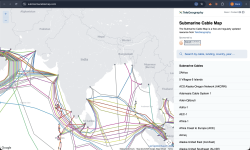
To rank these cable systems, I use three key capacity metrics, which are explained below:
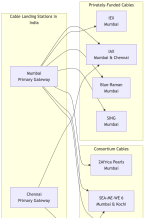
the next-generation privately-funded and consortium cables
These are built by groups of telecom companies from different countries sharing the enormous cost. They are open to any member operator for capacity purchase.
below is an independent AI assisted ranking of cables, in case of BUM vs Sindoor round 2 - use the opportunity to cut indian economy to size -> if they call us 'bhikari' we should ensure they also become one
-> If we are not doing naval battles in Round 2, at least Hangors can CUT some cables?reach out to me via DMs if you want more AI assisted (I have some uncensored models as well that can help) or send me objectives you want an independent think for targeting a strike package for value.
other posts in the series:

HI ISI, MI and Rocket Force PDF members
Below is a GLM 5.3 and Deepseek V4 AI assisted list of the top 100 data centres, taking them out in the next BUM vs Sindoor round 2 can chronically impact the financial data centres in the indian economy -> a few strikes and the clients will be too scared to host US, Canadian and EU financial data on Indian Servers. An important Economic damage value that extends by pushing down India's post war recover growth rate significantly and end a stategic value industry india as - Pakistan doesnt
reach out to me via DMs if you want more AI assisted (I...
Below is a GLM 5.3 and Deepseek V4 AI assisted list of the top 100 data centres, taking them out in the next BUM vs Sindoor round 2 can chronically impact the financial data centres in the indian economy -> a few strikes and the clients will be too scared to host US, Canadian and EU financial data on Indian Servers. An important Economic damage value that extends by pushing down India's post war recover growth rate significantly and end a stategic value industry india as - Pakistan doesnt
reach out to me via DMs if you want more AI assisted (I...
- SilentWatch
- Replies: 1
- Forum: Indian Defence Forum

Hi all
I have been playing with AI models for while, now pointing them on an independent thought on highest value ecomomic value. i.e. hitting the least number of coordinates for max economic damage for India chronically.
Hopping serving folk in intelligence is using AI to its maximum, I used Gemini Pro 3.6, GLM 5.3 and Deepseek for this analysis using public info.
Happy for any comments even in improving the analysis.
---
Spatial Assessment Methodology
The audit evaluates each node using a balanced dual-dimension scoring framework with an equal weighting system (50% per...
I have been playing with AI models for while, now pointing them on an independent thought on highest value ecomomic value. i.e. hitting the least number of coordinates for max economic damage for India chronically.
Hopping serving folk in intelligence is using AI to its maximum, I used Gemini Pro 3.6, GLM 5.3 and Deepseek for this analysis using public info.
Happy for any comments even in improving the analysis.
---
Spatial Assessment Methodology
The audit evaluates each node using a balanced dual-dimension scoring framework with an equal weighting system (50% per...
- SilentWatch
- Replies: 0
- Forum: Indian Defence Forum

---
OVERALL MAP:
 Metrics for Ranking Explained
To rank these cable systems, I use three key capacity metrics, which are explained below:| METRIC | DESCRIPTION | WHY IT MATTERS |
|---|---|---|
| ** Designed Capacity ** | The theoretical maximum bandwidth the cable can achieve with its current fiber pairs and latest transmission technology (e.g., 100Gbps per wavelength, 400Gbps per wavelength). | Represents the future-proofed potentialof the cable. A high designed capacity indicates the cable can handle significantly more traffic as demand grows and technology is upgraded. |
| Lit Capacity | The portion of the designed capacity that has been installed and is operational(i.e., "lit" with active lasers and transmission equipment). | Represents the current maximum potential of the cable. This is the capacity that the cable owner can sell to customers or use for their own traffic. |
| Activated Capacity | The portion of the lit capacity that is currently being used for traffic. | Indicates the current utilization and demand on the cable. A high activated capacity relative to lit capacity shows the cable is well-utilized. |
Ranking of Major Cable Systems by Designed Capacity
The following table ranks the cable systems based on their designed capacity. Note that data for some systems is not publicly disclosed, and capacities are constantly evolving. The ranking is based on the most recent available information.| RANK | CABLE SYSTEM | DESIGNED CAPACITY (TBPS) | KEY LANDING POINTS IN INDIA | STATUS & SIGNIFICANCE |
|---|---|---|---|---|
| 1 | MIST | >216 Tbps mordorintelligence+1 | Mumbai, Chennai, Tuticorin | Future Powerhouse. This is a next-generation cable with the highest publicly stated designed capacity connected to India. Its activation will be a major boost. |
| 2 | India-Asia Xpress (IAX) | Not Publicly Disclosed, but Expected to be Very High (Likely 100+ Tbps) | Mumbai, Chennai | Jio's Major Project. As a private cable backed by Reliance Jio, it is designed for massive future capacity to serve their domestic and international data needs. |
| 3 | India-Europe Xpress (IEX) | Not Publicly Disclosed, but Expected to be Very High (Likely 100+ Tbps) | Mumbai | Jio's Major Project. Similar to IAX, this is a key cable for Jio's global expansion, targeting European routes with high capacity. |
| 4 | 2Africa / EMIC-1 | Not Publicly Disclosed, but Part of the World's Largest Cable Project (Likely >100 Tbps per branch) | Mumbai, Chennai | Global Colossus. This is a massive, transformative project led by Facebook. The branch landing in India will have substantial capacity, part of its >500 Tbps total design. |
| 5 | SEA-ME-WE 6 | Not Publicly Disclosed, but Expected to be High (Likely >100 Tbps) | Mumbai, Chennai | Next-Gen Consortium Cable. This is the successor to the SEA-ME-WE 5 cable, using the latest technology. It will be a critical artery for Europe-Asia traffic. |
| 6 | SEA-ME-WE 5 | 24 Tbps (Upgradeable) | Mumbai, Chennai | Current Workhorse. This is one of the most important existing cables. While its designed capacity is lower than the newer systems, it is heavily utilized and has undergone upgrades. |
| 7 | Bay of Bengal Gateway (BBG) | 20 Tbps (Upgradeable) | Chennai, Porthcawl | Key Regional Link. A crucial cable for connectivity to Southeast Asia and the Middle East. Its capacity is being upgraded to meet demand. |
| 8 | AAG (Asia-America Gateway) | 20 Tbps (Upgradeable) | Mumbai | Primary US Route. A major cable for traffic to the United States. Like SEA-ME-WE 5, it is a critical but older system undergoing upgrades. |
| 9 | IMEWE (India-Middle East-Western Europe) | 3.84 Tbps (Initial, Upgradeable) | Mumbai, Chennai | Important Legacy Route. An older cable that was very significant when built. Its capacity is much lower than modern systems, but it still carries traffic. |
| 10 | EIG (Europe-India Gateway) | 3.84 Tbps (Initial, Upgradeable) | Mumbai, Chennai | Important Legacy Route. Similar to IMEWE, a key cable for Europe-India traffic, but its capacity is now dwarfed by newer systems. |
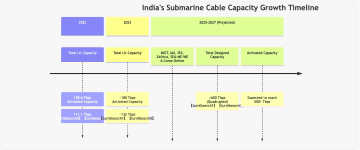
 Future Outlook: A Quadrupling of Capacity
the next-generation privately-funded and consortium cables
1. Privately-Funded Cables (e.g., Reliance Jio's Projects)
These are typically built by a single company (like a large tech or telecom firm) for their own use and to sell capacity to others.| CABLE SYSTEM | LANDING STATIONS IN INDIA | OPERATOR / OWNER | STATUS & SIGNIFICANCE |
|---|---|---|---|
| India-Asia Xpress (IAX) | Mumbai and Chennai submarinenetworks+2 | Reliance Jio Infocomm | Under Construction / Expected 2024-2025. This is Jio's flagship private cable project. It will connect India directly to Singapore, Malaysia, and Thailand, creating a high-capacity, low-latency link to the Asia-Pacific region. Having two diverse landing points on opposite coasts (west and east) enhances national resilience. |
| India-Europe Xpress (IEX) | Mumbai submarinenetworks+2 | Reliance Jio Infocomm | Under Construction / Expected 2024-2025. As the name suggests, IEX will link India to Europe(via landings in Oman, Djibouti, Saudi Arabia, Egypt, France, Italy, Greece). It will interconnect with IAX in Mumbai, creating a massive global ring submarinenetworks . The landing in Mumbai places it directly at the heart of India's financial and internet exchange point. |
| Blue-Raman | Mumbai(Expected) | Google & Telecom Italia Sparkle | Under Construction / Expected 2025-2026. This is a groundbreaking project that will create a new route from Europe to India avoiding the congested Suez Canal by going through Israel. This provides a critical alternative path, enhancing global network resilience. The Mumbai landing will connect this new route to India's core network. |
| SING (Singapore-India Gateway) | Mumbai(Expected) | Google (Likely Operator) | Planned / Under Development. While details are less public than others, this project aims to create a direct, high-capacity link between Mumbai and Singapore, another critical global hub. This would further boost capacity between these two major internet exchange points. |
 Consortium Cables (e.g., Multi-Operator Global Projects)
These are built by groups of telecom companies from different countries sharing the enormous cost. They are open to any member operator for capacity purchase.| CABLE SYSTEM | LANDING STATIONS IN INDIA | CONSORTIUM / KEY OPERATORS | STATUS & SIGNIFICANCE |
|---|---|---|---|
| 2Africa (Pearls Branch) | Mumbai(Expected) | Meta (Facebook), China Mobile, Orange, South Africa's MTN, etc. | Under Construction / Expected 2024. This is the world's largest submarine cable project. The "Pearls" branch specifically extends the cable to India and Pakistan. The Mumbai landing will bring unprecedented capacity from this global network, directly benefiting Indian consumers and businesses. |
| SEA-ME-WE 6 | Mumbai and Cochin (Kochi) linkedin+1 | Global Consortium (DoT-owned operators like BSNL, MTNL, and private players like Airtel, Tata Communications, etc.) | Under Construction / Expected 2026 en.wikipedia . This is the successor to the SEA-ME-WE 5 cable, which is a primary artery for traffic between Europe, the Middle East, and Asia. SEA-ME-WE 6 will have a massive designed capacity of 126 Tbps en.wikipedia . Having two landing points in India (west and south) provides crucial redundancy and improves connectivity to southern India. Airtel has landed the SEA-ME-WE-6 submarine cable in Chennai . |
| MIST (Myanmar/Malaysia-India-Singapore Transit) | Mumbai and Chennai | OMS Group (and others) | Under Construction / Expected 2025-2026. This cable will create a new high-capacity route connecting India to Myanmar, Thailand, Malaysia, and Singapore. Its design capacity of 216 Tbps submarinenetworks makes it one of the most powerful cables in the region, and dual landings in Mumbai and Chennai ensure robust connectivity across the country. |
Source:
GLM 5.3
GLM 5.3
Last edited:


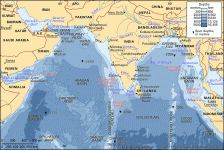
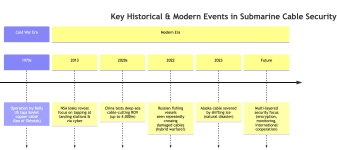
 1. Cutting a Cable at 2,500 Meters: Possible but Complex
 2. Tapping a Cable at 2,500 Meters: The Ultimate Challenge
 The Hangor-Class Submarine and AIP: A Potential Role?


