Remittances from Overseas Pakistanis - Updates

Remittances are not Pakistan’s problem. They are Pakistan’s signal. They tell us that families are remarkably resilient, that social networks extend across borders, and that the diaspora remains deeply connected. But they also tell us something more uncomfortable: too many households are surviving because the domestic economy is not delivering enough work, income, and opportunity.

At the macro level, remittances keep the economy afloat. At the micro level, they are increasingly a lifeline. The challenge for policymakers is to ensure that this lifeline becomes a bridge—from survival to productivity, from dependency to opportunity. Until that happens, Pakistan will continue to celebrate remittances as a blessing, while ignoring the distress they quietly reveal at home.
 

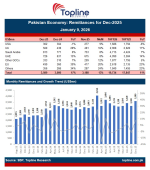
Pakistan receives $3.6bn in remittances in December 2025

  • During 1HFY26, remittances clock in at $19.7bn

Remittance inflow since Jan 2024​

Figures in USD Billion
The inflow of overseas workers’ remittances into Pakistan stood at $3.59 billion in December 2025, the State Bank of Pakistan (SBP) data showed on Friday.

Remittances increased by nearly 16.5% year-on-year (YoY), compared to $3.1 billion recorded in the same month last year. Monthly remittances were up by 13%, compared to $3.2 billion in November.

During the first six months of the fiscal year (1HFY26), remittance inflows stood at $19.7 billion, up from $17.8 billion in 1HFY25, a jump of 11%.

“Remittances growth momentum is continuing on the back of higher manpower exports in previous years, lower differential in formal and informal exchange market and continuation of remittances incentive package,” said Topline Securities, in a note.

“We maintain our FY26 remittances target of $41 billion, up 7.5% from the FY25 level of $38 billion,” it added.

Remittances play a significant role in supporting the country’s external account, stimulating Pakistan’s economic activity, and supplementing the disposable incomes of remittance-dependent households.

Meanwhile, the government promotes remittances through incentives and formal channels to sustain steady growth and ensure their role in economic stability.

Back in August, SBP noted that since 2009, the Pakistan Remittance Initiative (PRI) has been working to enhance home remittances through formal channels in Pakistan. As a result of active engagements with financial institutions (FIs), the number of FIs on the PRI network has increased from around 25 in 2009 to more than 50 in 2024. The FIs include conventional banks, Islamic banks, microfinance banks, and Exchange Companies (ECs).

Further, Electronic Money Institutions (EMIs) are also allowed to receive home remittances through banks. The number of international entities has increased from around 45 in 2009 to around 400 at present.

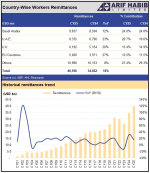
Breakdown of remittances

Overseas Pakistanis in Saudi Arabia remitted the largest amount in December 2025 as they sent $813 million during the month. The amount was up 6% on a yearly basis, and 8% above the $753 million sent by the expatriates in November.

Inflows from the United Arab Emirates (UAE) rose by 15% on a yearly basis, from $631 million to $726 million in December 2025.

Remittances from the United Kingdom (UK) amounted to $560 million during December 2025, up by 16% compared to $481 million in November 2025. YoY inflows from the UK were up by 28%.

Overseas Pakistanis in the US sent $302 million in December 2025, a YoY decrease of 1%, but up 9% on a monthly basis.

Meanwhile, remittances from European Union (EU) countries clocked in at $499 million in December, recording a significant increase of 39% on a yearly basis.
 

Remittances rise to $19.7b in H1​


December inflows jump 17% YoY to $3.6b, supporting external account

Usman Hanif
January 10, 2026


remittances photo reuters file


KARACHI: Pakistan's remittance inflows maintained strong upward momentum during the first half of FY26, providing continued support to the country's external account amid a declining export environment.

According to data issued by the State Bank of Pakistan (SBP), remittances sent by overseas Pakistanis rose 11% year-on-year (YoY) to $19.7 billion during the first half of fiscal year 2026 (1HFY26).

"In 1HFY26, remittances increased by 11% YoY to $19.7 billion," AHL data highlighted.

The growth was driven by a sharp increase in December inflows, which climbed 17% YoY to $3.6 billion, compared with $3.1 billion in December 2024. On a month-on-month (MoM) basis, remittances were up 13%.

Topline Securities corroborated the trend, noting that Pakistan received $3.6 billion in remittances in December 2025, marking a 17% YoY and 13% MoM increase. The brokerage highlighted that cumulative inflows during 1HFY26 stood at $19.7 billion, reflecting an 11% YoY rise.

Market analysts attributed the sustained growth in remittances to multiple structural and cyclical factors. These include higher manpower exports in preceding years, a narrowing differential between formal and informal exchange rates, and the continued implementation of the government's remittance incentive schemes, which encourage overseas Pakistanis to use official banking channels.

"Remittances growth momentum is continuing on the back of higher manpower exports in previous years, lower differential in formal and informal exchange market and continuation of remittances incentive package," Topline Securities noted in its commentary.
 
In 2025, a total of 762,499 Pakistanis proceeded abroad for employment, according to final statistics released by the Bureau of Emigration and Overseas Employment. This marks a notable increase from the 727,381 registered in 2024, driven primarily by demand in Gulf countries, with Saudi Arabia remaining the top destination.

The outflow, comprising mostly skilled and unskilled labourers, underscores Pakistan's ongoing reliance on overseas remittances amid domestic economic challenges, while also highlighting concerns over brain drain in professional sectors.
 
On the outlook, analysts remain cautiously optimistic. Brokerage houses maintained their full-year FY26 remittance target at $41 billion, representing a 7.5% increase from the FY25 level of $38 billion. If achieved, this would mark one of the highest annual remittance inflows in Pakistan's history and provide a crucial buffer for the balance of payments.

However, some economists warned against overreliance on remittances as a substitute for deeper structural reforms. Najam Ali, Chief Executive Officer of Next Capital, cautioned that while rising remittances can ease short-term external pressures, they may also reduce the urgency for policy action.

"Growing remittances may plug the current account gap, but they also enable economic complacency by postponing overdue and painful trade policy reforms," he said.

Pakistan has historically relied on remittances, since Zulfikar Ali Bhutto in the first half of the 1970s, to offset chronic trade deficits, particularly during periods of weak exports and limited foreign direct investment.

While the latest figures underscore the resilience of overseas inflows, analysts stressed that sustainable external stability will ultimately depend on export diversification, productivity gains, and long-delayed trade and industrial reforms.
 
Economist Nadeem Haque commented, "There is noise of narrative every 30 seconds; negotiations every hour, but reforms are missing since 1947."

Furthermore, the SBP, on Friday, injected Rs1.6 trillion through Reverse Repo Purchase and Shariah-compliant Mudarabah-based Open Market Operations (OMO) to maintain liquidity in the market.

The central bank conducted the Open Market Operation, Reverse Repo Purchase (Injection), for seven- and 14-day tenors on January 09, 2026, and injected Rs1,296.1 billion against nine bids, while the remaining Rs294 billion were injected through Shariah-compliant Mudarabah-based OMO.

Moreover, the rupee on Friday appreciated by three paisa against the US dollar in interbank trading and closed at Rs280.02 compared to the previous day's closing at Rs280.05.
 
In 2025, a total of 762,499 Pakistanis proceeded abroad for employment, according to final statistics released by the Bureau of Emigration and Overseas Employment. This marks a notable increase from the 727,381 registered in 2024, driven primarily by demand in Gulf countries, with Saudi Arabia remaining the top destination.

The outflow, comprising mostly skilled and unskilled labourers, underscores Pakistan's ongoing reliance on overseas remittances amid domestic economic challenges, while also highlighting concerns over brain drain in professional sectors.

There are only 3 countries that took in more than 50,000 workers last year.

Country​
2021​
2022​
2023​
2024​
2025​
Saudi Arabia​
155,777514,909426,951452,562530,256
Qatar​
37,98757,99955,11240,81868,376
U.A.E​
27,442128,477229,89464,13052,664
Bahrain​
12,97713,65313,34525,19837,726
Oman​
38,35082,38060,04681,5879,375
Iraq​
2,8192,3874,3076,6506,128
Türkiye​
1601518001,5575,288
U.K​
1,0342,92216,44913,6954,355
Malaysia​
1066,17520,9055,7903,609
Cyprus​
1,9612,9062,8921,1722,393
China​
6076731,7941,8862,230
Japan​
179001,1841,5182,210
Azerbaijan​
4321388442,161
U.S.A​
5518019091,0771,005
Jordan​
334349244308517
Spain​
4487863941,038464
Lebanon​
71219278344
Nigeria​
135201210242312
Somalia​
215217150194202
Hong Kong​
5275122134174
Libya​
862065867148
Tanzania​
42384355144
Iran​
7461148175137
Singapore​
21958785135
Cameroon​
0613209125
Zambia​
24285482120
Guinea​
2563965113
South Africa​
31435764103
Sweden​
71111778484
Algeria​
414307657
Angola​
2030354847
Sierra Leone​
13332631
Morocco​
1210102130
Switzerland​
138242917
Croatia​
34383814
Tunisia​
32723
Syria​
01630
Others​
4,3055,64511,40817,76617,718

Source: Bureau of Emigration & Overseas Employment
 
Brain Drain: Idealism vs. Realism:

While many view the emigration of both skilled and unskilled workers from Pakistan as a "Brain Drain," the unfortunate reality is that it is often the necessary utilization of an "unemployed brain" or this process utilizes human capital that would otherwise remain stagnant or unemployed. By exporting workers to other countries, these individuals can secure a better life . By working abroad, these individuals improve their standard of living and and support the national economy through remittances. In this sense, a domestic liability is converted into an international asset. It is an unfortunate situation, but a necessary economic reality.

I know it sounds ridiculous, for a country like Pakistan, to have exports, less than its remittances, but that’s the reality of our situation.
 
Last edited:

PM hails record remittances

Syed Irfan Raza
January 12, 2026

1768251908714.png

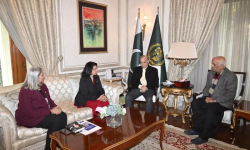
Samina Amjad Randhawa and Amjad Karim Randhawa, parents of the late Arfa Karim Randhawa, and Arfa Karim Foundation CEO Tabinda Islam call on Prime Minister Shehbaz Sharif in Islamabad on January 11. — PID

ISLAMABAD: Prime Minister Shehbaz Sharif has thanked overseas Pakistanis for sending record remittances in Dec 2025 which surpassed figures of the last year.

In a statement here on Sunday, the prime minister said patriotic Pakistanis living abroad remitted 3.6 billion dollars in Dec 2025, which reflects their strong commitment to the country’s economic stability.

He said remittances witnessed a 16.5 per cent increase compared to the same period last year.

The prime minister termed the rise in remittances a clear manifestation of overseas Pakistanis’ confidence in the government’s economic policies.

Rich tribute paid to late IT prodigy Arfa Karim

He appreciated their role in rejecting negative propaganda and contributing to national development through continued financial support.
 

PM hails record remittances

Syed Irfan Raza
January 12, 2026

View attachment 171851

Samina Amjad Randhawa and Amjad Karim Randhawa, parents of the late Arfa Karim Randhawa, and Arfa Karim Foundation CEO Tabinda Islam call on Prime Minister Shehbaz Sharif in Islamabad on January 11. — PID

ISLAMABAD: Prime Minister Shehbaz Sharif has thanked overseas Pakistanis for sending record remittances in Dec 2025 which surpassed figures of the last year.

In a statement here on Sunday, the prime minister said patriotic Pakistanis living abroad remitted 3.6 billion dollars in Dec 2025, which reflects their strong commitment to the country’s economic stability.

He said remittances witnessed a 16.5 per cent increase compared to the same period last year.

The prime minister termed the rise in remittances a clear manifestation of overseas Pakistanis’ confidence in the government’s economic policies.

Rich tribute paid to late IT prodigy Arfa Karim

He appreciated their role in rejecting negative propaganda and contributing to national development through continued financial support.
 

What are the long-term consequences of excessive dependence on remittances?

An economy that leans more on its diaspora than on its domestic productive capacity faces severe long-term vulnerabilities.

On diaspora dependency

Mohiuddin Aazim
January 12, 2026

For decades, workers’ remittances have served as a vital lifeline for Pakistan’s economy. During periods of balance-of-payment stresses, declining exports, and constrained external financing, inflows from overseas Pakistanis have repeatedly provided critical breathing space.

According to State Bank of Pakistan (SBP) data, remittances reached an unprecedented $38.3 billion in FY25, surging over 26 per cent from the previous year.

While this influx has bolstered foreign exchange reserves and sustained household consumption, it simultaneously revives a pressing and uncomfortable inquiry: what are the long-term consequences of excessive dependence on such transfers?

A comparison with merchandise exports starkly illustrates the scale of this reliance. SBP balance-of-payments data reveals a persistent pattern where remittances consistently rival or surpass export earnings — an unusual structural imbalance for a large developing economy.

In FY25, remittances at $38.3bn decisively outstripped exports, which grew modestly to approximately $32.3bn.

This trend, evident over several years, signals a growth model where foreign exchange earned abroad by individuals is supplanting income generated through productive, export-oriented activity.

Remittances effectively create a parallel welfare system that mitigates immediate hardship but also allows systemic governance failures to persist unchallenged
 
Remittances, while offering short-term stability, are no substitute for genuine economic productivity in the home country of a nation’s diaspora.

Such inflows predominantly fuel consumption rather than long-term investment, unless channelled by robust domestic institutions. In Pakistan’s context, abundant remittances have frequently coincided with anaemic industrial growth and stagnant export diversification.

Steady inflows of remittances can inadvertently reduce the urgency for policymakers to enact politically challenging reforms in taxation, energy, industrial policy, and export competitiveness, thereby perpetuating underlying weaknesses.
 
Further economic costs reside in the allocation of remittance income itself.

Household-level research, including studies in the Pakistan Social Sciences Review, indicates that most funds are directed towards daily consumption, housing, healthcare, and education.

While these expenditures undeniably improve welfare, relatively little is invested in entrepreneurship, productivity-enhancing assets, or technological upgrading.

This consumption-heavy allocation gradually erodes the economy’s capacity to generate broad-based employment and exportable surpluses, perpetuating dependency.

Moreover, remittance dependence distorts exchange-rate dynamics. Persistent dollar inflows, unaccompanied by commensurate export growth, can sustain an overvalued real exchange rate.

This undermines the international competitiveness of domestic producers. The economy thus risks a vicious cycle: weakened exports lead to a wider trade gap, which in turn necessitates ever-greater remittance inflows to finance the gap, further entrenching the structural imbalance.
 

Users who are viewing this thread

Pakistan Defence Latest

Latest Posts

Back
Top