Remittances from Overseas Pakistanis - Updates

Banks say shift in cost of remittances to burden them, dent profitability

  • SBP reports remittances cost at Rs76bn in FY26, projects cost to grow to Rs85-90bn in FY27
July 4, 2026

Reacting to a government decision to have shifted its cost of bringing workers’ remittances over to banks in the country, Pakistan Banks Association (PBA) said on Saturday the move had placed an additional financial burden on the financial institutions that would dent their profitability.

Banks in Pakistan have been directed to bear the cost of bringing the remittances with effect from July 1, 2026. Earlier, the government was giving a subsidy to banks to keep the transaction cost at zero for remittances senders and beneficiaries.

State Bank of Pakistan (SBP) reported on Friday the cost of attracting remittances from overseas Pakistanis into the country was recorded at Rs76 billion in the fiscal year ended June 30, 2026.

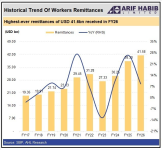
The country is projected to record over $41.5 billion workers remittances in the year (FY26), as the remittance numbers for June 2026 are in the finalisation stage at present.

SBP Governor Jameel Ahmad has estimated the cost of bringing the remittances would rise to Rs85-90 billion in the fiscal year 2026-27 (FY27), as the country anticipated the inflows of workers’ remittances growing to $44 billion in FY27.

Poor banks, how they will survive with bit less of profits?

 

Pakistan receives record $41.6 billion workers’ remittances in FY26​

Inflows rise 8.6% year-on-year as June remittances reach $3.5 billion, led by Saudi Arabia and United Arab Emirates

News Desk
News Desk

July 9, 2026
2 min read
Pakistan receives record $41.6 billion workers’ remittances in FY26

AAAAAAAA
Sans SerifSerifClassicModern
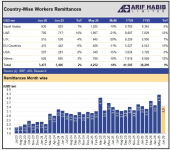
Pakistan received $41.6 billion in workers’ remittances during fiscal year 2025-26, up 8.6% from $38.3 billion in the previous fiscal year, according to data released by the State Bank of Pakistan (SBP) on Thursday.

In June 2026, workers’ remittances stood at $3.5 billion. The inflows increased 2.0% on a year-on-year basis but fell 18.3% compared with the previous month.

Saudi Arabia remained the largest source of remittances in June, with inflows of $829.6 million. The United Arab Emirates followed with $792.2 million, while remittances from the United Kingdom stood at $514.9 million.


Inflows from the United States were recorded at $296.8 million during the month.

The full-year increase in remittances provides support to Pakistan’s external account at a time when the country continues to manage import payments, debt obligations and foreign exchange reserve targets.

Read This: SBP phases out Sohni Dharti remittance programme, ends new rewards from July 1

Workers’ remittances are a key source of foreign exchange for Pakistan and help support household consumption, the current account and overall balance of payments.


The record annual remittances come as the SBP has started withdrawing two remittance-related incentive schemes.

The central bank has begun winding down the Sohni Dharti Remittance Programme, ending the award of new reward points on remittance transactions from July 1, 2026. Eligible remittances received through formal banking channels up to June 30, 2026, will still earn points under the existing mechanism, with banks submitting transaction details to 1LINK for crediting rewards.

Users will have until June 30, 2027, to redeem reward points accumulated by June 30, 2026. The programme will become non-functional from July 1, 2027.

The Sohni Dharti Remittance Programme was launched to encourage overseas Pakistanis to send money through SBP-regulated financial institutions instead of informal channels.


Separately, banks and other authorised institutions will no longer receive reimbursement from the SBP for processing eligible workers’ remittances after the central bank discontinued the Telegraphic Transfer Charges Incentive Scheme. The decision took effect on July 1, 2026.
 
For first time ever Pakistan remittances beat exports which will be around $40.5bn for FY2025-26.

1783581647391.png

1783581687728.png
 
Sure, they give you a good breather and support. But the fact is that the country's economy is in shambles.

Remittances from 1 billion in 2001 hwve grown to 42 billion (expected) in 2026, they have outperformed our exports.

The country's heavy reliance on the remittance should be cause of fidgety for our economic managers.
 
For a moment leave the political aspect aside and pay heed only as an economist.

Given the present situation even if you bring angles from heavens our economic woes won't go. Successive governments have tried their receips and have failed. I think we have reach at a point where it more about our national character and less about the policies.

Like, we are just not interested in paying our fair share of taxes at all. Our mindset has completely changed. Further the talk of the town is trading where we can hold our cash with ourselves and make quick profits. Instead of investment where you put up industries do either import substitution or launch new products crate employment. Moreover, we are no longer an ambitious business people. We just focus on traditional economies like Textile, Rice, Sugar and leather etc etc.

In order to change this situation empower private sector as much as fast. Pakistan's precipitation is the most biggest impediment, change it on warfooting. Be Transparent.

Your take, please?

agree the private sector usually takes charge and invests and grows business, provides opportunities for labor/skilled/unskilled manpower to be utilized.

However, for investment and business to flourish, the environment needs less rep tape and less punitive measures and other briberies to open and operate. If the cost of doing business is not worth it, then nobody will bother. The guy with money will flee elsewhere and setup shop where its economical, cheaper and where they can make profits. See how much of our industry has shifted to other places like Dhaka, or to China, or elsewhere.

Corruption and mismanagement and brutal thuggery by establishment(military) is at the core of our issues. We have the same old families, feudals ruling the country since forever. No change at all. This is the problem. No accountability or reforms to curb that.
the security and food bill of employing soooo many just for "protocols" and "security" of protecting useless bureaucrats, judges, politicians, etc are in billions these days, plus the costs of their high-value maintainence of the vehicles and the gas/petrol/diesel bills the govt has to foot. Eliminate that FIRST.

nobody will bother unless the system is changed totally
 
Sure, they give you a good breather and support. But the fact is that the country's economy is in shambles.

Remittances from 1 billion in 2001 hwve grown to 42 billion (expected) in 2026, they have outperformed our exports.

The country's heavy reliance on the remittance should be cause of fidgety for our economic managers.

it is actually critically alarming......the day the mideast starts telling our diaspora they're no longer needed, those remittances will dry up.
Pakistanis from Europe, North America etc cannot match or send that much as most of their incomes stays where they live........unlike the gulf workers who send most of it home(being permanent "temporary" status which means they cannot stay there permanently).
 
This is actually terrible news. Exports means jobs in Pakistan whereas remittances mean jobs abroad. This points to a stagnant economy, forcing people to go abroad for work.
For Pakistanis in Pakistan, exiting the country with a secured job is a painful and long process, and even then so many mishaps when FIA/immigration tries to stop them from leaving the country!
 
it is actually critically alarming......the day the mideast starts telling our diaspora they're no longer needed, those remittances will dry up.
Pakistanis from Europe, North America etc cannot match or send that much as most of their incomes stays where they live........unlike the gulf workers who send most of it home(being permanent "temporary" status which means they cannot stay there permanently).
Given what has happened recently in UAE, with people getting deported and their assets being frozen, it is quite likely that there has been frontloading of remittances to relative safety in Pakistan. That is a one-off jump and won't be sustained.
 
To view this content we will need your consent to set third party cookies.
For more detailed information, see our cookies page.
 
Given what has happened recently in UAE, with people getting deported and their assets being frozen, it is quite likely that there has been frontloading of remittances to relative safety in Pakistan. That is a one-off jump and won't be sustained.
I had read the UAE seized the earnings of the deported Pakistanis that were deposited in its banks. You meant the remaining Pakistanis in the UAE sent their savings home to avoid a similar fate ?
 
A study published by the Asian Development Bank (ADB) in 2024 found that Pakistani migrants tend to remit more when economic conditions are improving back home, and when there is a positive association between remittances and domestic economic activity.

The SBP last week abolished two incentive schemes paid to banks for increasing remittances, after the amount grew to a level that came under the International Monetary Fund’s (IMF) radar.

Banks expressed disappointment over the decision, but financial sector experts believe the move is unlikely to significantly affect the profitability of the banking sector.
 
I had read the UAE seized the earnings of the deported Pakistanis that were deposited in its banks. You meant the remaining Pakistanis in the UAE sent their savings home to avoid a similar fate ?
Yes, if I were in the UAE and had a Shia sounding name , I wouldn't keep any assets in the UAE system beyond the bare minimum needed for sustenance.
 

Users who are viewing this thread

Latest Posts

Back
Top