Remittances from Overseas Pakistanis - Updates

We pay tens of billions in dollars each year to IPPs, all of which go to overseas shell companies owned by the chor elites...Oil or any other legit imports is not the biggest driver of the deficit. Our chor military/mafia mobster alliance is the biggest driver of all economic malaise...

you nailed it......when everyone sees the Chors/Thugs/Mafia operate with impunity in the country (they are partners with establishment, judiciary, bureacrats,politicians, military).......then NOBODY is going to Invest.

Businessmen who have the capital to invest are not going to invest when they know its all chor mafias who run the country. When your local businessmen won't do that and will prefer the ME or EU or USA, then do not expect anyone else to do it.

Even the old telecom companies from overseas have left. No new player wants to come, heck even u cannot attact European airlines to service Pakistan due to many concerns/issues. SAFETY is # 1.
Look at the pathetic PIA privatization, so much time passed since the process was done/completed and still the state of the airline is at standstill. I had hoped for improvement but NOTHING seems to be happening. Nobody even responds to tenders anymore for equipment or spare parts. Thats how bad it looks.

Indicators are real when u see whats happening. The middle class has turned into poor class. People are stuggling to put food on table, have meds for sick family, even struggle for educating kids. Where is the Govt??

They keep getting IMF money every few months and depositing it into their personal accounts abroad........

no new hospitals, no end of corruption, no end of nepotism, no merit at all. CORRUPTION thug mafia still occupies the country.......from the presidency to the parliament, to judiciary to establishment and all.......Same faces hogging the country last 70 odd years and their chor tabbars.......

Only thing people from overseas buy is some fucking house or some fucking plot in some new housing society, that is not investment for economic prosperity.......even with that they're praying that its not a scam/fraud/ponzi scheme run by corrupt feudal mafias and thugs.....cuz if there is fraud, yeah good luck recovering even 1 rupee of your money........even police doesnt do shit as theyre all involved with policiticians and crimnal mafias (yes it happened to 2 family members of mine so its fucking real, and in Islamabad too of all places)

The piece of shit criminal thug status quo people (ALL of them together) have brought the country to a standstill. Even African poor countries are faring better as they realized their methods and set out to correct them. While we just can't get our shit together despite having nukes and military "power"
 
I'm glad to contribute when i send few hundred a year INTO my own Pakistani local bank account. ;)
I wanted to open a local bank account and well so that I can get a local debit card and avoid having to carry currency and all those conversions in my visits. However I was dissuaded from it by several people who said it requires excessive documentation , bothersome taxes and effort to maintain the account and prevent it from being frozen.

I then looked into the Roshan accounts and you can transfer foreign currency to it and its exempt from most of the bothersome attributes of local accounts, but you cannot use a Roshan account to transfer money to a local bank account ! Which makes its utility low.
 
I wanted to open a local bank account and well so that I can get a local debit card and avoid having to carry currency and all those conversions in my visits. However I was dissuaded from it by several people who said it requires excessive documentation , bothersome taxes and effort to maintain the account and prevent it from being frozen.

I then looked into the Roshan accounts and you can transfer foreign currency to it and its exempt from most of the bothersome attributes of local accounts, but you cannot use a Roshan account to transfer money to a local bank account ! Which makes its utility low.

You can transfer money from roshan account to any local account or withdraw cash from ATM.
 
$41.5 billion is a serious number for nation like Pakistan

it helps Supports the rupee, Helps pay for imports, Supports foreign-exchange reserves and Massively reduces the current-account deficit

it also Supports household spending and the domestic economy

and So $40bn+ of annual remittances is almost like Pakistan having another enormous export industry

Remittances / goods exports is one of the highest in the world
 
I wanted to open a local bank account and well so that I can get a local debit card and avoid having to carry currency and all those conversions in my visits. However I was dissuaded from it by several people who said it requires excessive documentation , bothersome taxes and effort to maintain the account and prevent it from being frozen.

I then looked into the Roshan accounts and you can transfer foreign currency to it and its exempt from most of the bothersome attributes of local accounts, but you cannot use a Roshan account to transfer money to a local bank account ! Which makes its utility low.

The RDA can send/transfer money to other local accounts, but LOCAL accounts can't transfer money into the RDA......RDA can only receive foreign remittances from abroad.
You can easily do/pay debit transactions, do local mobile top-ups, do an e-transfer to someone else, use ATM for cash withdrawals, and pay for stuff with debit taps.


Keep in mind, it takes few days to receive the money into the RDA after u initiate the transfer(mine used to take a week)........When i had my RDA in HBL, it was nice in the beginning but then HBL started charging me per remittance (like 2300Rs) each time i send money into my own account. Yeah that's when I closed it.

Not all banks may have those high charges but I found that having local rupee account locally helps, its cheaper with the charges but the debit card bit has its own nuance........like when the debit card expires, u have to pickup the new one at your bank branch where u opened the account, they won't/don't/never send it home or give it to your family/relative. So u need to be in Pakistan to receive your card/pickup at that time roughly.......its a problem for overseas Pakistanis as we need the debit card the most.

You'll need to go open a local account (in-person) or use those digital accounts like Sadapay/Nayapay, but not sure if they ship card to overseas). RDA is the other option but avoid some banks (like HBL) who overcharge for receiving remittance.

I would encourage you to open a local rupee account in one of the banks you like, next time in Pak. I was able to open a local account (without a job in Pak or any letter other than my NICOP/CNIC) in Allied Bank.......hope more banks allow u to open some account with just CNIC, or u show them your american job letter/pay stub when u open it locally........it will be better than the RDA.
 
Last edited:

Pakistan registers $3.6bn in remittances for July 2026

  • Remittances increased by 4.5% on a month-on-month basis
August 10, 2026
BR Web Desk

The inflow of overseas workers’ remittances into Pakistan stood at $3.631 billion in July 2026, the State Bank of Pakistan (SBP) data showed on Monday.

In terms of growth, remittances increased by 4.5% on a month-on-month basis and 13% on a year-on-year basis.


Overseas
 
Breakdown of remittances

Overseas Pakistanis in Saudi Arabia remitted the largest amount in July 2026, sending $914 million. The amount was up 11% compared to the $824 million sent by the expatriates in the same month last year. Moreover, the amount was up by 10% compared to $830 million in June 2026.

Inflows from the United Arab Emirates rose by 11% on a yearly basis, from $665 million in July 2025 to $737 million in July 2026. However, on a monthly basis, remittances declined by 7%, down from $792 million registered in June 2026.

Remittances from the UK amounted to $555 million in July 2026, up 23% from $450 million in the same month last year.

Overseas Pakistanis in the US sent $317 million in July, a 7% increase from $296 million in June.

Meanwhile, remittances from European Union (EU) countries clocked in at $462 million in July, recording an increase of 11% on a monthly basis from $415 million in June.
 
The north-south divide

This windfall, however, is creating a massive divide. Remittances concentrate overwhelmingly in Punjab, K-P and AJK.

Sindh and Balochistan receive a much smaller share, next to none.

The State Bank of Pakistan does not issue a detailed breakdown of remittance inflows. Without such data, economists must rely on proxy research methods.

Applied economist Dr Jazib Mumtaz of the Institute of Business Administration notes that roughly half of Pakistan's migrants originate from Punjab, about one-quarter from K-P, around 9% from Sindh and the rest from other regions. If remittances follow the same pattern, Punjab alone receives nearly half of all inflows while Sindh receives only a fraction.

Cultural and structural factors explain much of the imbalance. Punjab and K-P have developed long-standing migration networks over generations. Families already settled abroad help relatives secure jobs, accommodation and documentation.

Many communities in Sindh have historically relied more on agriculture and local employment, leaving weaker overseas networks. Aadil Nakhoda, assistant professor at IBA specialising in international trade, observes that the flows remain heavily concentrated in K-P and Punjab because of the nature of semi-skilled and unskilled labour migration. In AJK, the pattern is more mature, shaped by multi-generational links with the UK.

Punjab, K-P, AJK's well-established overseas networks

Outside of agriculture and major industrial centres like Faisalabad, Sialkot, Gujranwala, and Peshawar, job seekers in northern Pakistan typically have three options: take a government job, work abroad, or open a shop that relies on spending from families supported by overseas remittances. Even government employment now relies indirectly on these remitters.
This north south divide isn't surprising if you know how Sindhi society is. You don't need networks of people in Gulf or europe to move there like this article author is saying. You need money to pay for that journey, because cost of visa isn't just ticket price.

In interior Sindh 80% of farmers are landless, known as haris. They work on fields of waderas since no land reform was done like in India. This have made majority of Sindhis to live in perpetual poverty because if they had option to go abroad like even in Gulf then their families will stop working on wadera lands.

Hence the PPP model of giving some sindhis govt jobs as lollipop but even those are unsustainable.

Probably explain why there isn't any industrialisation in interior Sindh despite being near port and cheap land. A factory will pay Rs50k/month for unskilled labour. Landless haris will stop working on wadera lands.

Now you know why interior Sindh despite all the advantages have little to no industrialisation and hardly any contribution to Pakistan GDP. Why interior Sindh in all indicators is well behind even KPK and is more like Balochistan.
 

Remittance momentum carries into FY27

B Recorder
August 11, 2026

The upbeat momentum in home remittances continues in the new fiscal year despite the government withdrawing the rebate previously given to banks for attracting inflows into the formal sector.

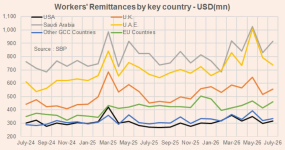
There is also no visible impact, in terms of inflows, from GCC countries due to the economic slowdown following the Iran-US war. The GCC’s share stood at 55 percent in July, versus 54 percent in the last fiscal year.


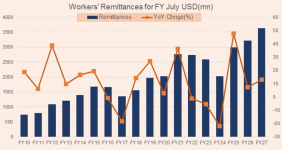
Inward flows stood at $3.6 billion, up 13 percent YoY and 4 percent MoM. At this run rate, allowing for the usual seasonal spikes and lows, FY27 inflows could reach somewhere between $43-45 billion. That is encouraging. Inflows from both Saudi Arabia and the UAE are growing at double-digit rates YoY, with no hiccups so far.

1786474937037.png

Another interesting element is the number of workers going to the UAE. In Jan-July 2026, around 50,000 workers left for the UAE on work visas, compared with 52,000 in the same period of 2025 and 64,000 in 2024.

This is significantly lower than the 230,000 recorded in 2023. The decline was already well underway, and the trend now appears to be stabilising at a much lower base.
 
There has been some decline in the number of workers going to Saudi Arabia. Meanwhile, the trend of highly qualified workers going abroad remains intact.

So far, there is no visible dent from any possible economic slowdown in the GCC, particularly in the UAE and within Dubai. Market participants speculate that people continue to send back money that had been taken out of the country over the past few years, while some goods exports may also be diverted through the UAE to evade taxation.

1786475115130.png

Only time will tell how sustainable these trends are. For now, however, things look fine. Medium-term risks to continued growth in remittances are rising, but in the short term, external account stability in FY27 may continue despite stagnating exports.

The question, however, is how sustainable it is for banks to provide incentives to attract inflows through the formal sector. In previous years, the government provided rebates to banks through the SBP for offering discounts to remittance senders, while additional flows were supported through marketing incentives. Last year, the marketing component was closed, and from July, there is no rebate either.
 
More importantly, one needs to question the economy’s growing reliance on home remittances. Remittances increased from around $4 billion in FY05 to $42 billion in FY26, while goods exports rose from $15 billion to $31 billion. The former grew tenfold, while the latter barely doubled. Imports, meanwhile, increased from $19 billion to $64 billion over the same period.

This trend is unlikely to continue indefinitely. As imports continue to grow, the burden of financing them cannot keep falling disproportionately on remittances. The economy needs stronger contributions from other elements of the external account, particularly goods and services exports.

The government needs to rethink the economic model if the country is to sustain growth, even at its current modest pace. However, no government in Pakistan appears to think that far ahead. Governments tend to fight to live from one day to the next, with the focus largely remaining on the ongoing fiscal year.

For now, at least, remittances have started FY27 on a strong note.
 

21,951 deportations expose Pakistan’s Gulf jobs dependence​


Economists warn remittances vulnerable to policy decisions abroad

Shazia Tasneem Farooqi
August 29, 2026

tribune


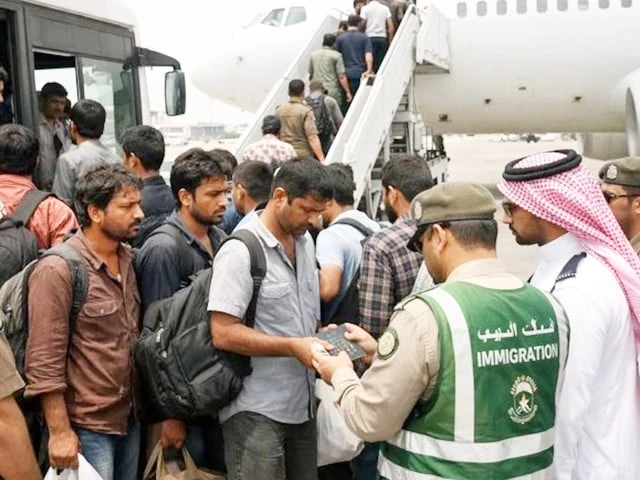
KARACHI: For Pakistani families, a job in the Gulf can mean the difference between financial security and economic hardship. But the sudden loss of that job can send a worker back to the same weak labour market that pushed him abroad in the first place – exposing a vulnerability that is increasingly visible as thousands of Pakistanis are deported from Gulf countries.

The recent deportations of 21,951 Pakistanis have also brought into focus a larger economic dependence that Pakistan relies heavily on overseas jobs to absorb its workforce and on the resulting remittances to support its external account.

The immediate financial impact of the latest deportations may be limited, but economists warn that the country’s dependence on labour markets and policy decisions beyond its control leaves millions of households exposed.

Pakistan relying on jobs it does not control

“The immediate UAE impact remained limited, with deported workers’ estimated annual transfers at about $42 million, or less than 0.1% of total remittances,” said Dr Abid Qaiyum Suleri, an economist at the Sustainable Development Policy Institute (SDPI).

He said remittances carry major advantages. They create no public debt, demand no profit repatriation and reach households directly. The weakness arises because Pakistan uses them to compensate for weak exports and low investment, while millions of workers remain subject to rules over which we have almost no influence.

“Remittances exceeded all export earnings in FY26, while Saudi Arabia and the UAE supplied nearly 45% of the total. The UAE deportations have not yet reduced national inflows materially. However, in a geopolitically fragile world, visa policies or other geopolitical decisions taken abroad can affect a Pakistani family’s income overnight,” Suleri said.

Remittances reached a record $41.6 billion in FY26. Goods exports earned $30.84 billion, while combined goods and services exports earned $40.88 billion.

Remittances also offset a trade deficit exceeding $35.5 billion. Without them, and holding other flows constant, the current-account deficit would have approached $41.7 billion.

At the macroeconomic level, Pakistan has become overdependent on jobs it does not control, he said, noting that remittances were 9.9% of GDP in 2025.
 

Users who are viewing this thread

Pakistan Defence Latest

Country Watch Latest

Latest Posts

Back
Top