Not sure where to post this, not part of the military but the ministry of interior. Nevertheless worth posting.
Breaking barriers: Saudi Arabia welcomes its first female camel patrolwoman
Clad in uniform, she made a striking appearance on camelback in the Founding Day parade
Last updated: February 24, 2024 | 18:02
Ramadan Al Sherbini, Correspondent
In a video interview the woman expressed her joy and pride in being the first Saudi female in the squad.X@fayez_malki
Cairo: At an official ceremony marking the kingdom's Founding Day, the first Saudi camel patrolwoman made her debut, highlighting the country's strong drive for women's empowerment.
The Interior Ministry has released a video showing the young woman as she rides a camel in a security patrol.
Clad in a military uniform, the woman participated in a parade staged by the ministry commemorating the Founding Day annually celebrated on February 22 in Saudi Arabia.
In a video interview with Saudi actor and TV host Fayez Al Malki, the woman, whose age was not given, expressed joy and pride in being the first Saudi female in the squad.
In 2019, the kingdom announced allowing women to serve in the army. In recent years, Saudi Arabia has vigorously pursued a drive to empower women from different walks of life as part of dramatic changes in the kingdom.
Women can sign up to join the Saudi Arabian Army, Royal Saudi Air Defense, Royal Saudi Navy, Royal Saudi Strategic Missile Force, and Armed Forces Medical Services.
They can also be recruited as soldiers, lance corporals, corporals, sergeants, and staff sergeants.
The Growing Role of Arab Women in Defense
By
Asian Military Review
-
January 17, 2024
 The role of women in the defense industry is changing across the Middle East, but particularly in Saudi Arabia, as successful programs, such as the World Defense Show’s International Women in Defense forum, have shown.
The defense sector remains a male dominated industry across the globe. It was reported last year that women represented just 23-25% of the workforce of the top five United States defense contractors.
However, there is hope for change. When it comes to female CEOs, the aerospace and defense industry is surpassing other industries in equality. According to Korn Ferry, women CEOs represent 19% of the leaders in aerospace and defense, compared to just 5% across all other sectors. Lockheed Martin, General Dynamics, Northrop Grumman and Boeing’s defense, space and security division, four of the five largest United States aerospace and defense firms, are all headed by women.
While this imbalance is also present in the Middle East, a traditionally more conservative region when it comes to gender roles, in recent years there has been a notable upturn in female participation and contribution. Arab women are increasingly breaking stereotypes by taking on roles traditionally reserved for men in the defense sector, with many now serving as pilots, engineers, peacekeepers, and in special forces units.
There have been notable achievements across the region recently: Jana Sader became Lebanon’s first female fixed-wing pilot; Sabaa Thnaibat, the first woman to fly the F-16 platform solo in the Jordanian Air Force; Sheikha Aisha bint Rashid Al Khalifa became Bahrain’s first female fighter pilot; Sara Sabry became the first Egyptian in space;
and Saudi Arabian Rayannah Barnawi became the first Arab woman astronaut. All showcase a growing openness to challenge established gender norms.
This challenging of stereotypes and breaking of barriers is demonstrating a change in dynamics and priorities across the Middle East, but has been especially noticeable in Saudi Arabia.
The role of Saudi Vision 2030
The change to allow women into the Saudi military came as part of the Kingdom’s Vision 2030, which seeks to reform almost every aspect of life and government, including supporting women’s entry into the workforce. The expansion of women’s roles in the military and the integration of women into the Armed Forces are crucial steps towards achieving these goals. In 2018, the Kingdom opened up opportunities for women to apply for a number of non-military security roles. Saudi women have also been a part of public security since 2019, in the General Directorate of Prisons, Criminal Evidence and Customs and the General Directorate of Narcotics.
The Saudi military chief of staff, Gen Fayyad Al Ruwaili and Director-General of the General Administration of Admission and Recruitment Maj Gen Imad Al Aidan, launched the first military section for women in the Saudi Arabian Armed Forces in January 2021. This allowed women to join the military as lance corporals, corporals, sergeants, and staff sergeants in the Royal Saudi Land Forces, the Royal Saudi Air Defense force, the Royal Saudi Navy, Strategic Missile Forces and Armed Forces Medical Services. Women can also rise through the ranks to a number of officer positions and senior ranks.
The establishment of the Armed Forces Women’s Cadre Training Centre in February 2022 and the subsequent graduation of hundreds of women was another important step in in preparing women for military roles. The first female recruits graduated from the Armed Forces Women’s Cadre Training Centre in September last year, the first time in the Kingdom’s history that women will begin service in front-line roles.
Continued Regional Progress
Further initiatives promoting gender equality and diversity have been implemented within defense institutions. Policies have been introduced to ensure equal opportunities for men and women in recruitment, training, and career progression. Arab countries have also been investing in mentorship programs and leadership development initiatives specifically tailored for women in the defense sector, fostering a supportive environment for their professional growth.
At the first World Defense Show in 2022, the International Women in Defense Program that took place on 8th March, International Women’s Day, was a resounding success. Led by HRH Ambassador Reema bint Bandar Al Saud, the event addressed the challenges and celebrated achievements in the industry, though a series of expert panels and discussions. The program returns for WDS 2024, with an expanded format and another impressive roll call of influential industry leaders, with Ambassador Reema once again at the helm.
Ambassador Reema said: “This is a moment to celebrate the contributions and achievements of women around the world from our past and present. Women have been serving, fighting, and contributing to the security and prosperity of their nations for over 100 years.
“International Women in Defense is a global campaign, creating resilience in an ever-changing world, and helping us to navigate the challenges we face within the sector, sharing personal experiences and celebrating the contributions of women who continue to serve their country. In this event, we converge to support national, regional and international efforts to accelerate women’s participation in the defense sector on a global scale, forging alliances and sharing best practice which are fundamental to retain the pace of change,” she added.
These acknowledgement of the advancements in the role of women in defense contribute greatly to changing global perceptions about the capabilities and contributions of women in traditionally male-dominated fields. In Saudi Arabia, it signifies a broader societal shift in attitudes towards gender roles, reflecting a commitment to inclusivity, diversity, and the recognition of the valuable contributions women can make in defense and security. The strides made in the Middle East, contribute to the global narrative of women increasingly playing pivotal roles in defense and security.
The role of women in the defense industry is changing across the Middle East, but particularly in Saudi Arabia.

www.asianmilitaryreview.com
Saudi Women in the Military Sector
View attachment 152121
View attachment 152122
View attachment 152123
View attachment 152124
Saudi Women in the military sector are those working in the military sector in the
Kingdom of Saudi Arabia across various entities, including the
Ministry of Defense,
Ministry of Interior,
Ministry of National Guard, and the Presidency of State Security.
Role of Saudi women in the Ministry of Defense
The Ministry of Defense has designated the Unified Admission and Recruitment Portal to enable women to apply for military positions at various ranks across its branches, including the
Royal Saudi Naval Forces,
Royal Saudi Air Force,
Royal Saudi Land Forces,
Royal Saudi Air Defense Forces, and Health Services. Additionally, the ministry has established a Training Center for Female Military Personnel in the Armed Forces, which offers training programs and curricula, providing an optimal learning environment for female personnel. Several training courses are conducted at the center, including the Basic Individual Course, Foundational Non-Commissioned Officer (NCO) Management Course, Advanced NCO Management Course, and Military Police Qualification Course.
In the health services sector of the Ministry of Defense, women have contributed to the advancement of the healthcare system, achieving leading global positions in the medical field. Female personnel of the ministry have been awarded medals in recognition of their contributions to Operation Decisive Storm and Operation Restoring Hope.
Role of Saudi women in the Ministry of Interior
Women in Public Security
Women have contributed to many security missions executed by the public security sector, including: serving pilgrims by being appointed as personnel in the Special Forces for the Security of the Two Holy Mosques. They have also been assigned to the General Department of Criminal Evidence and its branches, working in identity verification through fingerprint matching, criminal background checks, forensic photography, and conducting biomedical examinations related to DNA analysis. Additionally, they contribute to forensic laboratories by analyzing evidence collected from crime scenes, examining handwriting in counterfeiting and forgery cases, and performing administrative, financial, human resources, internal auditing, information technology, and systems tasks.
Women in Civil Defense
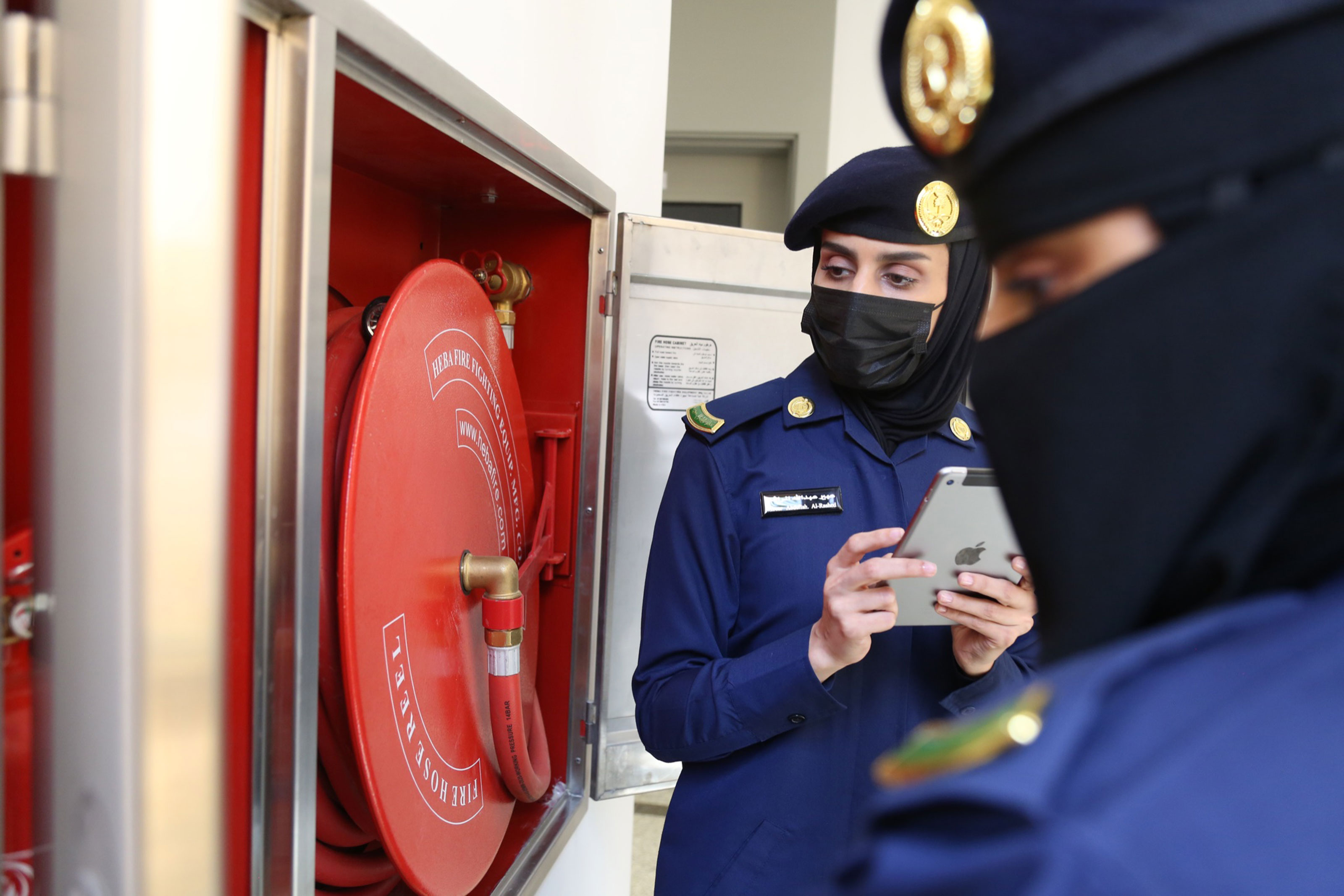
Women in Civil Defense work on developing implementation plans to increase women's participation in Civil Defense and support tasks. They conduct preventive inspections, assess safety conditions, and evaluate general preventive measures in facilities. Additionally, they contribute to the qualification and development of personnel in the sector and oversee various awareness and educational initiatives in schools and universities.
Women in the Border Guard
Women participate in various committees and awareness events related to beach, maritime, and medical safety. They work as inspectors in Border Guard sectors at border centers and serve in medical professions as doctors and specialists. Additionally, they take on administrative roles, including legal, information technology, financial, administrative, and public relations tasks.
Women at King Fahd Security College
Women contribute to designing and implementing training and development programs for female personnel in security sectors during qualification and on-the-job training. They also work on developing quality standards for training and qualification, maintaining security and discipline within the college, providing medical services for personnel and their families, and handling related administrative tasks. Additionally, they participate in recruitment committees for female personnel in the Ministry of Interior sectors, organized by the Women's Security Training Institute at the college, and prepare awareness and educational programs.
Women in the General Directorate of Prisons
Women supervise the management of women’s prisons and carry out duties related to guarding, transportation, protection, and surveillance. They also provide security training and academic counseling, work in administrative fields by developing plans and programs, contribute to rehabilitation and correctional programs, and conduct studies and research within specialized departments.
Women in the Drug Control Sector
Women support field teams in executing arrests, conducting searches, and transferring female detainees to the relevant authorities. They also contribute to preventive affairs by delivering lectures and seminars, participating in awareness exhibitions, and training and qualifying female personnel at the Drug Control Institute under the General Directorate of Training.
Women at the National Operations Center
Women at the National Operations Center perform administrative and technical tasks, as well as quality and development functions. They handle emergency security reports and inquiries through the 911 service number, monitor incoming field observations to operation rooms and relay them to the relevant authorities. Additionally, they participate in data analysis, indicator development, process improvement, and maintaining order, security, and safety within the facility.
Saudi Women in the military sector are those working in the military sector in the Kingdom of Saudi Arabia across various entities, including the Ministry of Defense, Ministry of Interior, Ministry of National Guard, and the Presidency of State Security.

saudipedia.com
View attachment 152125
I covered Saudi Arabian women in the military a bit on page 24 in this thread.