
Beijingwalker
VIP Member

Russia Refuses Japan's Demand to Remove Smashed Imperial Crest from New War Memorial
A fifteen-metre bronze Soviet soldier splitting a stone bearing Japan'simperial chrysanthemum has triggered a diplomatic row in Khabarovsk:Tokyo's consulate asked for the crest to be removed, Moscow refused,and Chinese social media applauded the refusal as a lesson in memorypolitics.
5 September 2026
A fifteen-metre bronze Soviet soldier, rifle in hand, cleaves a stone marker intwo. On the stone: a chrysanthemum crest — Japan's de facto nationalemblem — and the characters for "Great Empire of Japan." The monument,unveiled this week in Khabarovsk in the Russian Far East, commemorates theSoviet Union's August 1945 offensive that destroyed Japan's Kwantung Armyin Manchuria in little more than a week, the campaign that sealed Japan'ssurrender and, in Chinese historical memory, liberated the country's northeastfrom occupation.
Within a day of its unveiling it had become a diplomatic incident. The daybefore the ceremony, Japan's consulate-general in Khabarovsk asked Russiato remove the chrysanthemum crest: the imperial seal, depicted in a smashedstate, was an insult to national dignity. Moscow's answer came from NikolaiOvsienko, a presidential-administration official and deputy head of the RussianMilitary Historical Society: the monument would not be dismantled, and thecrest, as a symbol of militarist Japan, would stay. Locals, one Weibo postnoted, have already nicknamed the soldier "Ivan.
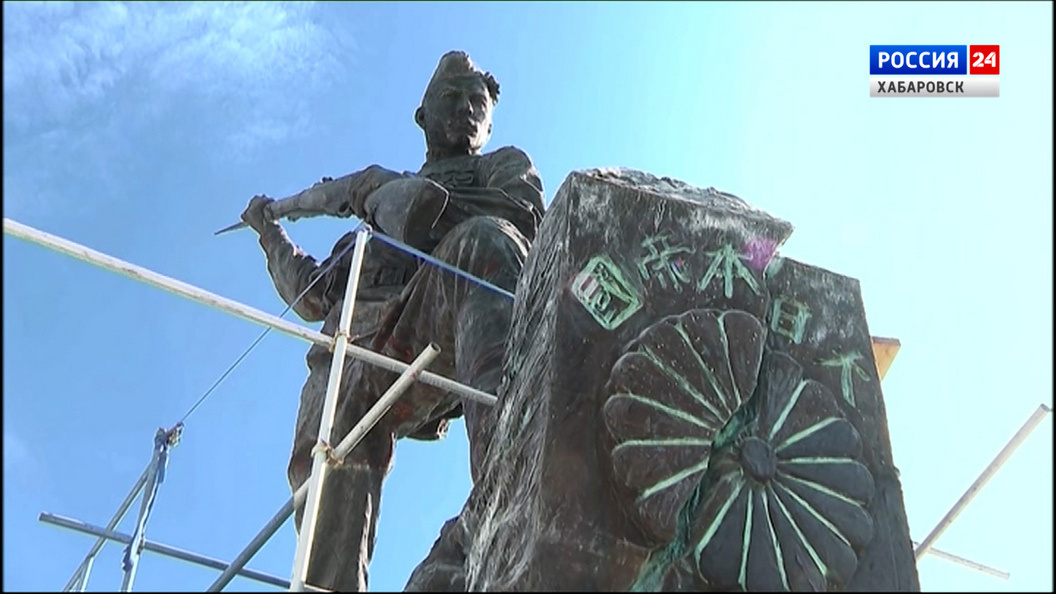
The soldier and the boundary stone with its chrysanthemum crest, still under scaffolding, in a framefrom a Russia 24 Khabarovsk broadcast.
On Weibo, where a post laying out the dispute drew more than 10,000 likes, therefusal landed as a long-awaited counterpunch. "Russia built a sculpture ofsmashing the Empire of Japan, and Japan is devastated," one widely readpost began, using the slang 破防 — to have one's psychological defensesbreached. The commenter's takeaway was pointed at home: "On this weshould learn from Russia. So many places in our country have 'peacemonuments' built by Japan, and Japan only ever asks one side for peace.
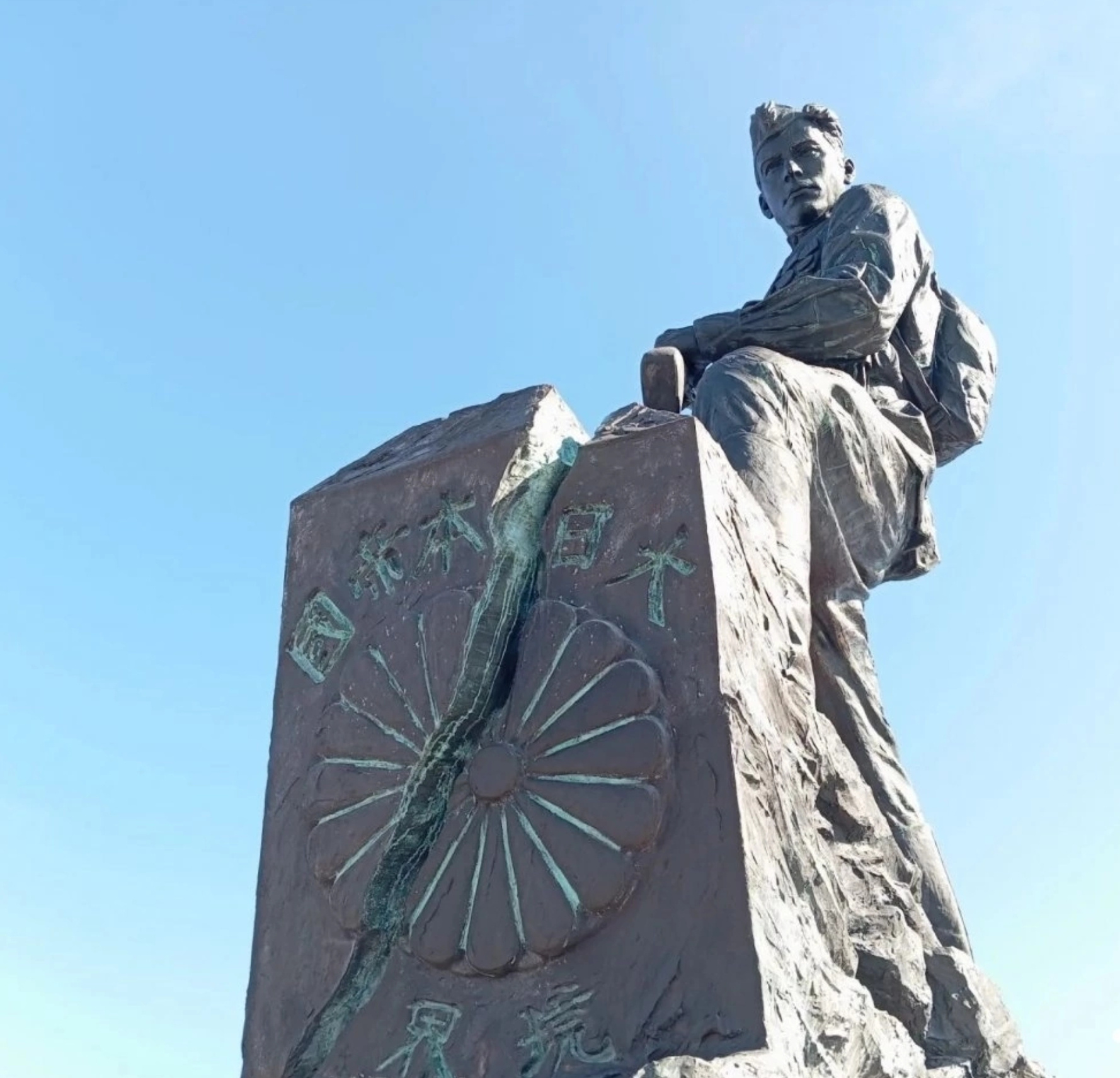
Detail of the boundary stone, carved with the imperial chrysanthemum and border inscriptions of the"State of Japan.
The monument's iconography is unusually specific. Its plinth carries a map ofOperation August Storm; pillars name the Soviet fronts that took part in theManchurian offensive, beside portraits of their commanders. The stone thesoldier splits is a boundary marker of the empire it names — the kind of objectthat once demarcated Manchukuo's frontier. None of this is accidental: theunveiling fell in the same week as September 3, the day both Russia and Chinamark as victory over Japan, which China observed this year with a delibrately quiet 81st anniversary a year after its military parade.
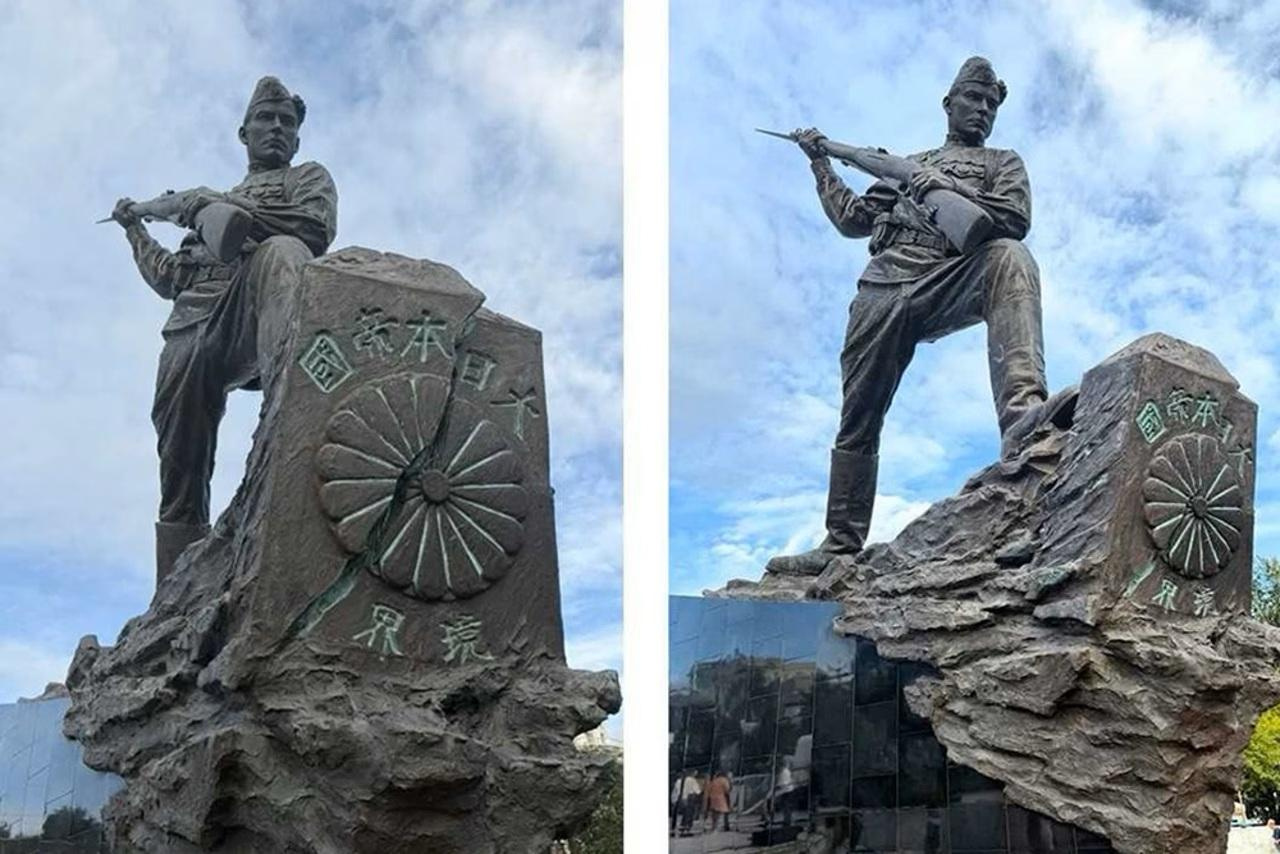
Two views of the finished monument, the soldier beside the stone carved with "Empire of Japan."
The row resonates because it touches a raw asymmetry in how the war isremembered across East Asia. Japan and Russia have never signed a peacetreaty ending the war — the Kuril Islands dispute has stood in the way since 1945 — and memorials on each side are statements, not ceremonies. ForJapan, the chrysanthemum is the state itself; for Russia, the point of themonument is precisely that the crest is broken. Between the two sits a Chinese public that read Moscow's refusal, with evident satisfaction, as a lesson in how to treat history's unresolved endings: the crest stays because the point of the monument is that it stays.
A fifteen-metre bronze Soviet soldier splitting a stone bearing Japan'simperial chrysanthemum has triggered a diplomatic row in Khabarovsk:Tokyo's consulate asked for the crest to be removed, Moscow refused,and Chinese social media applauded the refusal as a lesson in memorypolitics.
5 September 2026
A fifteen-metre bronze Soviet soldier, rifle in hand, cleaves a stone marker intwo. On the stone: a chrysanthemum crest — Japan's de facto nationalemblem — and the characters for "Great Empire of Japan." The monument,unveiled this week in Khabarovsk in the Russian Far East, commemorates theSoviet Union's August 1945 offensive that destroyed Japan's Kwantung Armyin Manchuria in little more than a week, the campaign that sealed Japan'ssurrender and, in Chinese historical memory, liberated the country's northeastfrom occupation.
Within a day of its unveiling it had become a diplomatic incident. The daybefore the ceremony, Japan's consulate-general in Khabarovsk asked Russiato remove the chrysanthemum crest: the imperial seal, depicted in a smashedstate, was an insult to national dignity. Moscow's answer came from NikolaiOvsienko, a presidential-administration official and deputy head of the RussianMilitary Historical Society: the monument would not be dismantled, and thecrest, as a symbol of militarist Japan, would stay. Locals, one Weibo postnoted, have already nicknamed the soldier "Ivan.
The soldier and the boundary stone with its chrysanthemum crest, still under scaffolding, in a framefrom a Russia 24 Khabarovsk broadcast.
On Weibo, where a post laying out the dispute drew more than 10,000 likes, therefusal landed as a long-awaited counterpunch. "Russia built a sculpture ofsmashing the Empire of Japan, and Japan is devastated," one widely readpost began, using the slang 破防 — to have one's psychological defensesbreached. The commenter's takeaway was pointed at home: "On this weshould learn from Russia. So many places in our country have 'peacemonuments' built by Japan, and Japan only ever asks one side for peace.
Detail of the boundary stone, carved with the imperial chrysanthemum and border inscriptions of the"State of Japan.
The monument's iconography is unusually specific. Its plinth carries a map ofOperation August Storm; pillars name the Soviet fronts that took part in theManchurian offensive, beside portraits of their commanders. The stone thesoldier splits is a boundary marker of the empire it names — the kind of objectthat once demarcated Manchukuo's frontier. None of this is accidental: theunveiling fell in the same week as September 3, the day both Russia and Chinamark as victory over Japan, which China observed this year with a delibrately quiet 81st anniversary a year after its military parade.
Two views of the finished monument, the soldier beside the stone carved with "Empire of Japan."
The row resonates because it touches a raw asymmetry in how the war isremembered across East Asia. Japan and Russia have never signed a peacetreaty ending the war — the Kuril Islands dispute has stood in the way since 1945 — and memorials on each side are statements, not ceremonies. ForJapan, the chrysanthemum is the state itself; for Russia, the point of themonument is precisely that the crest is broken. Between the two sits a Chinese public that read Moscow's refusal, with evident satisfaction, as a lesson in how to treat history's unresolved endings: the crest stays because the point of the monument is that it stays.


