HOW THE UKRAINE WAR HAS EXPOSED VULNERABILITIES WITHIN RUSSIA'S SU-25 FLEET
- Aviation Features
- How the Ukraine War has exposed vulnerabilities within Russia's Su-25 fleet
By
Alexander Mladenov 10th October 2023
FEATURE
The protracted war in Ukraine has exposed key vulnerabilities of the ageing Su-25 fleet, leading to significant combat attrition while the type’s operational effectiveness has been unimpressive. This leads to a conclusion that the end of the Frogfoot’s career in Russia is in sight. Alexander Mladenov explains why.
Known as the only Russian Aerospace Forces (RuAF) combat jet purposely designed back in the 1970s for the highly dynamic, dirty and dangerous close air support (CAS) role, performed at low- and ultra-low level over the battlefield the ugly yet sturdy Su-25
Frogfoot has built a reputation as a survivable and effective attack workhorse.
Su-25’s otherwise time-proven CAS abilities have been utilized to a very limited extent, as in the very beginning of the invasion of Ukraine the fleet suffered from extensive attrition when operating over enemy territory for prolonged periods. Russian MOD
It was utilised to fly high-intensity, short-range, low-level sorties over the preceding four decades, in tens of local wars and conflicts in the past. In most of the cases the
Frogfoot had performed pretty well, but the all-out war in Ukraine presented a completely different case in 2022 and 2023. The type has fared in a mediocre way while also suffering from significant losses and the survivors experiencing a lot of wear and tear. Furthermore, the excessive attrition, combined with the non-descript battlefield achievements, is set to threaten the Su-25’s medium-term future with the Russian air arm.
No doubt, the chief cause for the
Frogfoot’s lacklustre efficacy and the fast nearing to the end of its mass front-line service could be attributed to the deadly encounters with the latest-generation man-portable air defence systems (MANPADS) and short-range air defences (SHORAD) in Ukraine, despite the type’s extensive combat survivability design features and self-protection aids. As a result, the venerable Frogfoot can no longer be considered as being deadly accurate and survivable for employment in regular low-level CAS operations in high-intensity peer warfare.
As of December 31, 2022, the combined combat and non-combat attrition in the war zone (including the aircraft which suffered heavy damage) accounted for about 25 Su-25s. This represents some 20% of RuAF’s pre-war single-seat
Frogfoot fleet strength and no fewer than 30% of the serviceable aircraft at the beginning of war. The number of Su-25s downed by the Ukrainian air defences or suffering heavy damage but eventually returning to base or crashing in the combat zone (due to causes either related or non-related to combat damage) increased to 30-plus examples by September 1, 2023.
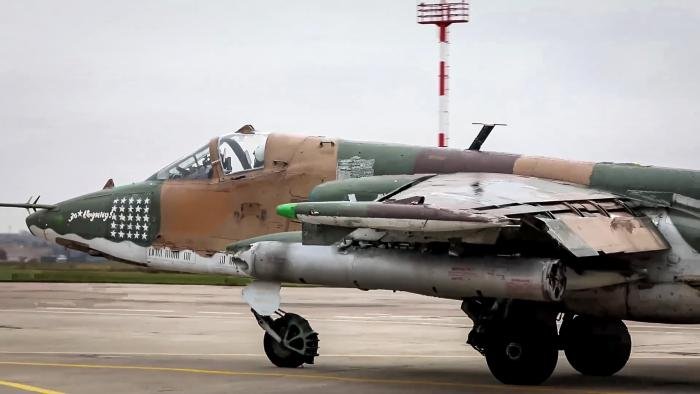
This is a Su-25SM3 belonging to the 368th ShAP from Budennovsk in Stavropol region. The aircraft is armed with two five-round B13L pods for 122mm rockets, lofted at a maximum range exceeding 5nm, but with a questionable accuracy. Russian MOD
Initial Combat Experience
The RuAF Su-25 fleet was called to action during the early hours of the February 24, 2022 invasion of Ukraine, supporting the rapid advance of Russian ground troops towards Ukrainian capital, Kyiv and other important urban centres such as Kharkiv, Kherson and Mykolaiv. The RuAF gathered all of its serviceable single-seat
Frogfoots, serving with ten frontline squadrons flying the type (a total of 70-plus airframes), to provide CAS coverage to all four axes of the ground troops’ advance.
The stiff resistance of the Ukrainian troops on most of the offensive axes has led to painful and growing losses, accounting for no fewer than ten aircraft reported lost or heavily damaged in three weeks of intense fighting, while showing generally low efficacy in the primary CAS role. Later, the combat attrition continued to mount at a steady rate, with an average of two losses per month until the year end.
From early April 2022 onwards, the RuAF Su-25 fleet began to be employed in combat in a much safer way, and the tactics used continued to be unchanged in 2023. In its ‘new’ risk-averse fire support role, the gradually melting
Frogfoot fleet could be referred to as a mere extension to the Russian Land Forces’ otherwise seriously depleted long-range artillery and multiple launch rocket systems (MLRS) inventory. Featuring more flexibility but packing much less firepower and lethality due to the light warloads and much worse accuracy.
The main tactics in this ‘new’ role called for engaging area targets exclusively by indirect fires, launching rockets at long and supposedly safe distances as the aircrews were instructed to avoid as much as possible entering into enemy-controlled airspace. This weapons delivery method has, however, proved to be very low effective one, especially when taking into consideration the use of old-fashioned unguided rockets; as a result, a significant proportion of the Su-25’s intense combat missions could be considered as an outright waste of otherwise scarce and hard-to-replenish resources.
All official video clips and still images released by the Russian MoD include aircraft with blurred serials but in general the units can be easily recognized. This is a Su-25SM3 from the 368th ShAP, an attack regiment home-based at Budennovsk but operating out of Millerovo. Russian MOD
Dangerous and Dirty Business
A serious proportion of the traditional CAS sorties, flown in an intense rate in the first weeks of the Russian invasion of Ukraine, were dedicated to supporting the airborne troops that seized Hostomel Airport near Kyiv. The large-scale heliborne assault was followed by giant mechanized columns which invaded Ukraine from Belorussian territory and eventually managed to get to Kyiv’s northern and northwestern suburbs such as Hostomel, Bucha and Irpen, albeit with serious losses. The Russian troops have, however, proved unable to enter the capital due to the well-organised defence.
The Su-25 fleet supporting this most important axis of invasion in February-March 2022 operated out of Luninets airfield in Belorussia. Numbered no fewer than 32 aircraft, this air group included a mixture of upgraded Su-25SMs and non-upgraded examples, with all of these Frogfoots provided from two front-line regiments assigned to the Eastern Military District (EMD) – the 266th and 18th ShAPs. The former operates non-upgraded aircraft, and the latter is equipped with upgraded Su-25SMs.
The low-flying Frogfoots operated mainly in pairs and sometimes in four-ship flights, armed with 550lb (250kg) free-fall bombs and 20-round 80mm rocket packs, while also carrying four 800-lit additional fuel tanks, badly needed to extend range and time over target area, situated at about 170nm from their base. In addition to daylight operations, the Luninets-based Su-25s were called upon for occasional night strikes against ammunition depots and concentrations of military equipment employing free-fall bombs.
Flying non-upgraded Su-25s, the 266th ShAP took the heaviest beating in the initial days of invasion, losing its commanders. The regimental CO, Lt Col Ruslan Rudnev, was reported killed in action on the very first day of invasion. His aircraft was shot down near Hostomel. Images of the wreckage have never been shown in the public, while the pilot’s funeral was reported on March 1.
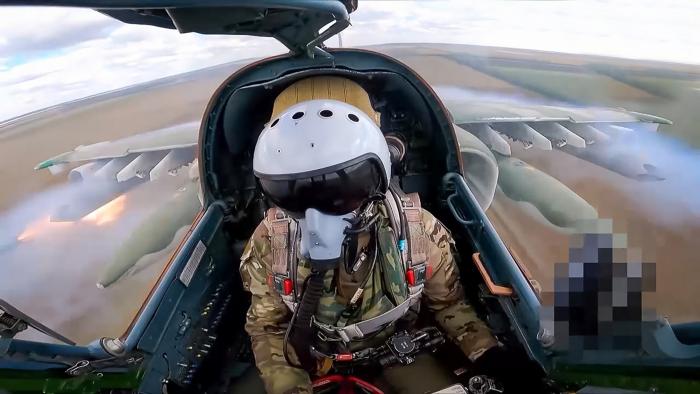
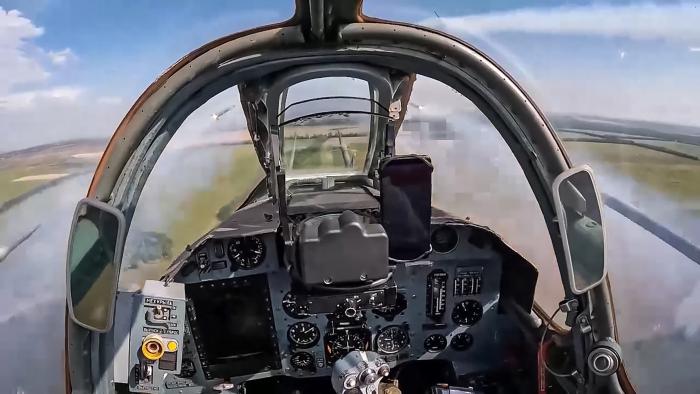
In early April 2022, Russian Frogfoot pilots began flying a single type of mission in the war, engaging ground targets in indirect attacks with 122mm rockets unleashed from pitching-up flight at ultra-low level, in an effort to maximize range and stay outside the lethal envelope of Ukrainian MANPADS on the forward edge of battle area. Russian MOD
His deputy, Lt Col Oleg Chervov, was killed in action on March 7, flying serial Yellow 28/RF-90969, with the wreckage found in the Bucha area near Hostomel. In total, the 266th ShAP reported two pilots killed in action, two aircraft lost and one suffering from heavy damage due to a MANPADS hit (most likely beyond repair) in the battle for Kyiv. In turn, the 18th ShAP has also suffered from serious combat losses including five Su-25SMs and three pilots.
The Russian troops advancing into the Donetsk and Lugansk (commonly known as Donbas) and Zaporozhyia regions received air support from the Su-25SM/SM3 fleets belonging to the 368th and the 960th ShAPs assigned to the Southern Military District (SMD). These upgraded Frogfoots were stationed at the forward operating airfields at Taganrog-Tsentralny (16 examples seen on August 13, 2022, according to satellite images) and Millerovo (eight aircraft in February, increasing to 36 examples as seen on satellite images as of August 14, 2022). Primorsko-Akhtarsk, the home base of the 960th ShAP on the Sea of Azov coast, was also utilized for combat operations, with 12 examples spotted there on August 9, 2022.
In turn, the Russian troops in the Kherson region, next to the Black Sea coast, advancing towards Kherson and Mykolaiv, and operating in the southern part of the Zaporozhyia region, were supported by the Su-25SMs of the attack squadron of the 37th SAP, a composite aviation regiment, stationed at Gvardeyskoye in Crimea, operating out of their permanent base or from forward airfields in Crimea. Six Frogfoots were spotted on satellite images of the base in August 2022, but some of these are believed to have been in unserviceable condition.
During the second stage of the Russian invasion, following the full withdrawal from Ukraine of the troops operating on the Kyiv axis in late March 2022, the 266th and 18th ShAPs promptly redeployed their surviving Frogfoots from Luninets to Buturlinovka airfield in Russia’s Voronezh region. They received the tasking to service the front line areas in the northeastern regions of Ukraine, around the big cities of Kharkiv, Chernihiv and Izyum. As of April 12, there were 30 Su-25s stationed there, seen on satellite images. The Frogfoots from the EMD were also reinforced by a handful of Su-25SMs drawn from the attack squadron of the 999th Air Base at Kant in Kyrgyzstan (assigned to the Central Military District), used as attrition replacements, with one of its aircraft reported shot down by MANPADS in September 2022.

The heavy damage to a Su-25 rear fuselage has been caused by a near detonation of a MANPADS warhead. The hit was taken on March 7, 2022 and this non-upgraded Frogfoot, serial Yellow 32/RF-90065, operated by the 266th ShAP, eventually managed to fly back to its forward operating base at Luninets in Belorussia. Russian MOD
Millerovo also hosted a detachment of Su-25s and Su-24Ms, originally belonging to the RuAF but handed over to the Wagner Group. Its air detachment began flying the initial combat sorties in March or April 2022, tasked with supporting the push against the cities of Popasna, Soledar and Bakhmut in Donbas.
New Safe-Firing Tactics
After the painful losses suffered in the initial weeks of war while carrying out their dynamic, dangerous, and dirty business to support the troops on the ground, from early April 2022, the Russians switched to using the diminishing Su-25 fleet in a much more risk-averse manner. The new combat employment method, however, lacked any accuracy, flexibility, or mass destruction effects. It called for indirect attack by unleashing 122mm S-13 rockets and occasionally S-8 80mm and S-24 240mm rockets in shallow climb, to maximize range and therefore avoid entering within the reach of Ukraine’s MANPADS and AAA.
This ‘conservative’ combat employment method, also known as lofted rocket release, called for the aircraft approaching a pre-set launch point at ultra-low level (80 to 160ft) and high speed, conducted in two or four-ship formations. Immediately after weapons release, at 10 to 15 degrees pitch up angle, pilots initiate a sharp U-turn while returning to safe ultra-low altitude and pumping flares in an effort to fool the guidance of heat-seeking surface-to-air missiles that may be unleashed from positions at the forward edge of the battlefield.
The warload in these indirect attack missions includes, as a rule, only two B13L five-round packs with up to ten 122mm S-13 rockets or two S-24 240mm rockets on single-round launch rails – fairly unimpressive configurations, with very low or no lethality at all considering the wide dispersion of the hits, leading to no or very small real gains. There is also a small proportion of missions flown with two B8M1 20-round packs for 80mm S-8-series of rockets unleashed in a single salvo.
A non-upgraded Su-25, Yellow 22, of the 266th ShAP rests at Luninets airfield in Belorussia in March 2022, sporting a long-range external stores configuration. Used for providing CAS to the troops on the ground around Kyiv, it consists of four drop tanks and four FAB-250M-62 high-explosive bombs. Russian MOD