Russia-Ukraine War - News, Discussions & Updates

Status
Not open for further replies.
The American-made Abrams tank used by Ukrainian soldiers was destroyed in one hit by the Russian T-72B3 tank.

-Russian Ministry of Defense

To view this content we will need your consent to set third party cookies.
For more detailed information, see our cookies page.


In addition to tank shells, and to increase firepower and range, the latest versions of Russian tanks, including the T-72B3, were designed to fire laser-guided missiles with a range of up to 4-5 km.

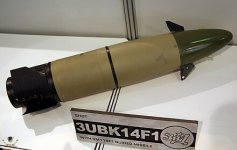
9K120 Svir, 9K119 Refleks, 9K119M Refleks-M (NATO reporting name AT-11 Sniper) are laser beam anti-tank guided missile systems, both designed to be fired from 125 mm tank barrels as well as anti-tank guns (2A45, 2A46 and 2A46M).

1709766549224.jpeg
 
Last edited:

Massive Drone Attack | Young Men Fleeing Ukraine | The Assault Of Terny. Military Summary 2024.03.06​


To view this content we will need your consent to set third party cookies.
For more detailed information, see our cookies page.


The Bloom | Zelensky Got Iskander Warning | Escalation In The Black Sea. Military Summary 2024.03.06​


To view this content we will need your consent to set third party cookies.
For more detailed information, see our cookies page.
 
To view this content we will need your consent to set third party cookies.
For more detailed information, see our cookies page.


Sent to the Moon
 
To view this content we will need your consent to set third party cookies.
For more detailed information, see our cookies page.


Sent to the Moon


To view this content we will need your consent to set third party cookies.
For more detailed information, see our cookies page.
 
Here is the video of the third Abram kill A single shot from "much-maligned" T72 B sent Abrams into a sea of flame

Russia appears to have validated its "empty tin cans" claim about American Abrams tanks. According to the Russian Defence Ministry, another Abrams tank has been destroyed. The duel between Russian T-72B3 and U.S.-supplied armour occurred near Avdiivka. The U.S.-sent armour "was knocked out" by the crew of the Russian T-72B3 in "one shot." Watch this report for more.

To view this content we will need your consent to set third party cookies.
For more detailed information, see our cookies page.
 
Here is the video of the third Abram kill A single shot from "much-maligned" T72 B sent Abrams into a sea of flame

Russia appears to have validated its "empty tin cans" claim about American Abrams tanks. According to the Russian Defence Ministry, another Abrams tank has been destroyed. The duel between Russian T-72B3 and U.S.-supplied armour occurred near Avdiivka. The U.S.-sent armour "was knocked out" by the crew of the Russian T-72B3 in "one shot." Watch this report for more.

To view this content we will need your consent to set third party cookies.
For more detailed information, see our cookies page.

Not that easy. even if, the tank will survive, the crew will survive.

To view this content we will need your consent to set third party cookies.
For more detailed information, see our cookies page.


To view this content we will need your consent to set third party cookies.
For more detailed information, see our cookies page.
 
Not that easy. even if, the tank will survive, the crew will survive.

To view this content we will need your consent to set third party cookies.
For more detailed information, see our cookies page.


To view this content we will need your consent to set third party cookies.
For more detailed information, see our cookies page.

I don't think the crew will survive a direct hit by a HEAT shell like that They are dead for sure!
 
I don't think the crew will survive a direct hit by a HEAT shell like that They are dead for sure!
Depends on where the hit. If the shell hits and destroys the crew compartment then certainly nobody will survive. If just other parts of the tank then the big chance the crew will not die.
 

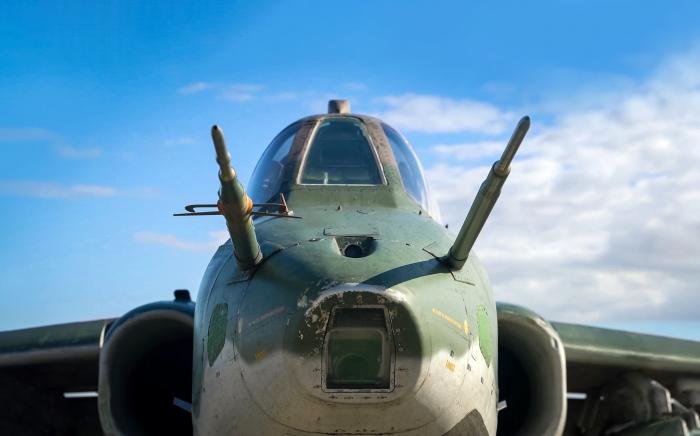
HOW THE UKRAINE WAR HAS EXPOSED VULNERABILITIES WITHIN RUSSIA'S SU-25 FLEET​

  1. Aviation Features
  2. How the Ukraine War has exposed vulnerabilities within Russia's Su-25 fleet


By Alexander Mladenov 10th October 2023
FEATURE

The protracted war in Ukraine has exposed key vulnerabilities of the ageing Su-25 fleet, leading to significant combat attrition while the type’s operational effectiveness has been unimpressive. This leads to a conclusion that the end of the Frogfoot’s career in Russia is in sight. Alexander Mladenov explains why.
Known as the only Russian Aerospace Forces (RuAF) combat jet purposely designed back in the 1970s for the highly dynamic, dirty and dangerous close air support (CAS) role, performed at low- and ultra-low level over the battlefield the ugly yet sturdy Su-25 Frogfoot has built a reputation as a survivable and effective attack workhorse.
Su-25’s otherwise time-proven CAS abilities have been utilized to a very limited extent, as in the very beginning of the invasion of Ukraine the fleet suffered from extensive attrition when operating over enemy territory for prolonged periods.
Su-25’s otherwise time-proven CAS abilities have been utilized to a very limited extent, as in the very beginning of the invasion of Ukraine the fleet suffered from extensive attrition when operating over enemy territory for prolonged periods. Russian MOD
It was utilised to fly high-intensity, short-range, low-level sorties over the preceding four decades, in tens of local wars and conflicts in the past. In most of the cases the Frogfoot had performed pretty well, but the all-out war in Ukraine presented a completely different case in 2022 and 2023. The type has fared in a mediocre way while also suffering from significant losses and the survivors experiencing a lot of wear and tear. Furthermore, the excessive attrition, combined with the non-descript battlefield achievements, is set to threaten the Su-25’s medium-term future with the Russian air arm.
No doubt, the chief cause for the Frogfoot’s lacklustre efficacy and the fast nearing to the end of its mass front-line service could be attributed to the deadly encounters with the latest-generation man-portable air defence systems (MANPADS) and short-range air defences (SHORAD) in Ukraine, despite the type’s extensive combat survivability design features and self-protection aids. As a result, the venerable Frogfoot can no longer be considered as being deadly accurate and survivable for employment in regular low-level CAS operations in high-intensity peer warfare.
As of December 31, 2022, the combined combat and non-combat attrition in the war zone (including the aircraft which suffered heavy damage) accounted for about 25 Su-25s. This represents some 20% of RuAF’s pre-war single-seat Frogfoot fleet strength and no fewer than 30% of the serviceable aircraft at the beginning of war. The number of Su-25s downed by the Ukrainian air defences or suffering heavy damage but eventually returning to base or crashing in the combat zone (due to causes either related or non-related to combat damage) increased to 30-plus examples by September 1, 2023.
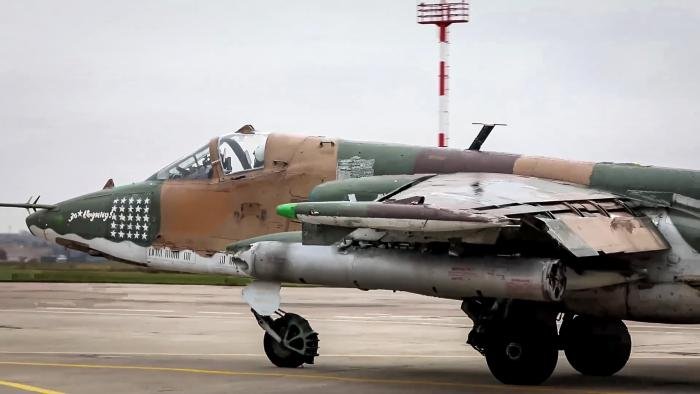
This is a Su-25SM3 belonging to the 368th ShAP from Budennovsk in Stavropol region. The aircraft is armed with two five-round B13L pods for 122mm rockets, lofted at a maximum range exceeding 5nm, but with a questionable accuracy.
This is a Su-25SM3 belonging to the 368th ShAP from Budennovsk in Stavropol region. The aircraft is armed with two five-round B13L pods for 122mm rockets, lofted at a maximum range exceeding 5nm, but with a questionable accuracy. Russian MOD

Initial Combat Experience

The RuAF Su-25 fleet was called to action during the early hours of the February 24, 2022 invasion of Ukraine, supporting the rapid advance of Russian ground troops towards Ukrainian capital, Kyiv and other important urban centres such as Kharkiv, Kherson and Mykolaiv. The RuAF gathered all of its serviceable single-seat Frogfoots, serving with ten frontline squadrons flying the type (a total of 70-plus airframes), to provide CAS coverage to all four axes of the ground troops’ advance.
The stiff resistance of the Ukrainian troops on most of the offensive axes has led to painful and growing losses, accounting for no fewer than ten aircraft reported lost or heavily damaged in three weeks of intense fighting, while showing generally low efficacy in the primary CAS role. Later, the combat attrition continued to mount at a steady rate, with an average of two losses per month until the year end.
From early April 2022 onwards, the RuAF Su-25 fleet began to be employed in combat in a much safer way, and the tactics used continued to be unchanged in 2023. In its ‘new’ risk-averse fire support role, the gradually melting Frogfoot fleet could be referred to as a mere extension to the Russian Land Forces’ otherwise seriously depleted long-range artillery and multiple launch rocket systems (MLRS) inventory. Featuring more flexibility but packing much less firepower and lethality due to the light warloads and much worse accuracy.
The main tactics in this ‘new’ role called for engaging area targets exclusively by indirect fires, launching rockets at long and supposedly safe distances as the aircrews were instructed to avoid as much as possible entering into enemy-controlled airspace. This weapons delivery method has, however, proved to be very low effective one, especially when taking into consideration the use of old-fashioned unguided rockets; as a result, a significant proportion of the Su-25’s intense combat missions could be considered as an outright waste of otherwise scarce and hard-to-replenish resources.
All official video clips and still images released by the Russian MoD include aircraft with blurred serials but in general the units can be easily recognized. This is a Su-25SM3 from the 368th ShAP, an attack regiment home-based at Budennovsk but operating out of Millerovo.
All official video clips and still images released by the Russian MoD include aircraft with blurred serials but in general the units can be easily recognized. This is a Su-25SM3 from the 368th ShAP, an attack regiment home-based at Budennovsk but operating out of Millerovo. Russian MOD

Dangerous and Dirty Business

A serious proportion of the traditional CAS sorties, flown in an intense rate in the first weeks of the Russian invasion of Ukraine, were dedicated to supporting the airborne troops that seized Hostomel Airport near Kyiv. The large-scale heliborne assault was followed by giant mechanized columns which invaded Ukraine from Belorussian territory and eventually managed to get to Kyiv’s northern and northwestern suburbs such as Hostomel, Bucha and Irpen, albeit with serious losses. The Russian troops have, however, proved unable to enter the capital due to the well-organised defence.
The Su-25 fleet supporting this most important axis of invasion in February-March 2022 operated out of Luninets airfield in Belorussia. Numbered no fewer than 32 aircraft, this air group included a mixture of upgraded Su-25SMs and non-upgraded examples, with all of these Frogfoots provided from two front-line regiments assigned to the Eastern Military District (EMD) – the 266th and 18th ShAPs. The former operates non-upgraded aircraft, and the latter is equipped with upgraded Su-25SMs.
The low-flying Frogfoots operated mainly in pairs and sometimes in four-ship flights, armed with 550lb (250kg) free-fall bombs and 20-round 80mm rocket packs, while also carrying four 800-lit additional fuel tanks, badly needed to extend range and time over target area, situated at about 170nm from their base. In addition to daylight operations, the Luninets-based Su-25s were called upon for occasional night strikes against ammunition depots and concentrations of military equipment employing free-fall bombs.
Flying non-upgraded Su-25s, the 266th ShAP took the heaviest beating in the initial days of invasion, losing its commanders. The regimental CO, Lt Col Ruslan Rudnev, was reported killed in action on the very first day of invasion. His aircraft was shot down near Hostomel. Images of the wreckage have never been shown in the public, while the pilot’s funeral was reported on March 1.
In early April 2022, Russian Frogfoot pilots began flying a single type of mission in the war, engaging ground targets in indirect attacks with 122mm rockets unleashed from pitching-up flight at ultra-low level, in an effort to maximize range and stay outside the lethal envelope of Ukrainian MANPADS on the forward edge of battle area.
In early April 2022, Russian Frogfoot pilots began flying a single type of mission in the war, engaging ground targets in indirect attacks with 122mm rockets unleashed from pitching-up flight at ultra-low level, in an effort to maximize range and stay outside the lethal envelope of Ukrainian MANPADS on the forward edge of battle area. Russian MOD
His deputy, Lt Col Oleg Chervov, was killed in action on March 7, flying serial Yellow 28/RF-90969, with the wreckage found in the Bucha area near Hostomel. In total, the 266th ShAP reported two pilots killed in action, two aircraft lost and one suffering from heavy damage due to a MANPADS hit (most likely beyond repair) in the battle for Kyiv. In turn, the 18th ShAP has also suffered from serious combat losses including five Su-25SMs and three pilots.
The Russian troops advancing into the Donetsk and Lugansk (commonly known as Donbas) and Zaporozhyia regions received air support from the Su-25SM/SM3 fleets belonging to the 368th and the 960th ShAPs assigned to the Southern Military District (SMD). These upgraded Frogfoots were stationed at the forward operating airfields at Taganrog-Tsentralny (16 examples seen on August 13, 2022, according to satellite images) and Millerovo (eight aircraft in February, increasing to 36 examples as seen on satellite images as of August 14, 2022). Primorsko-Akhtarsk, the home base of the 960th ShAP on the Sea of Azov coast, was also utilized for combat operations, with 12 examples spotted there on August 9, 2022.
In turn, the Russian troops in the Kherson region, next to the Black Sea coast, advancing towards Kherson and Mykolaiv, and operating in the southern part of the Zaporozhyia region, were supported by the Su-25SMs of the attack squadron of the 37th SAP, a composite aviation regiment, stationed at Gvardeyskoye in Crimea, operating out of their permanent base or from forward airfields in Crimea. Six Frogfoots were spotted on satellite images of the base in August 2022, but some of these are believed to have been in unserviceable condition.
During the second stage of the Russian invasion, following the full withdrawal from Ukraine of the troops operating on the Kyiv axis in late March 2022, the 266th and 18th ShAPs promptly redeployed their surviving Frogfoots from Luninets to Buturlinovka airfield in Russia’s Voronezh region. They received the tasking to service the front line areas in the northeastern regions of Ukraine, around the big cities of Kharkiv, Chernihiv and Izyum. As of April 12, there were 30 Su-25s stationed there, seen on satellite images. The Frogfoots from the EMD were also reinforced by a handful of Su-25SMs drawn from the attack squadron of the 999th Air Base at Kant in Kyrgyzstan (assigned to the Central Military District), used as attrition replacements, with one of its aircraft reported shot down by MANPADS in September 2022.
The heavy damage to a Su-25 rear fuselage has been caused by a near detonation of a MANPADS warhead. The hit was taken on March 7, 2022 and this non-upgraded Frogfoot, serial Yellow 32/RF-90065, operated by the 266th ShAP, eventually managed to fly back to its forward operating base at Luninets in Belorussia.
The heavy damage to a Su-25 rear fuselage has been caused by a near detonation of a MANPADS warhead. The hit was taken on March 7, 2022 and this non-upgraded Frogfoot, serial Yellow 32/RF-90065, operated by the 266th ShAP, eventually managed to fly back to its forward operating base at Luninets in Belorussia. Russian MOD
Millerovo also hosted a detachment of Su-25s and Su-24Ms, originally belonging to the RuAF but handed over to the Wagner Group. Its air detachment began flying the initial combat sorties in March or April 2022, tasked with supporting the push against the cities of Popasna, Soledar and Bakhmut in Donbas.

New Safe-Firing Tactics

After the painful losses suffered in the initial weeks of war while carrying out their dynamic, dangerous, and dirty business to support the troops on the ground, from early April 2022, the Russians switched to using the diminishing Su-25 fleet in a much more risk-averse manner. The new combat employment method, however, lacked any accuracy, flexibility, or mass destruction effects. It called for indirect attack by unleashing 122mm S-13 rockets and occasionally S-8 80mm and S-24 240mm rockets in shallow climb, to maximize range and therefore avoid entering within the reach of Ukraine’s MANPADS and AAA.
This ‘conservative’ combat employment method, also known as lofted rocket release, called for the aircraft approaching a pre-set launch point at ultra-low level (80 to 160ft) and high speed, conducted in two or four-ship formations. Immediately after weapons release, at 10 to 15 degrees pitch up angle, pilots initiate a sharp U-turn while returning to safe ultra-low altitude and pumping flares in an effort to fool the guidance of heat-seeking surface-to-air missiles that may be unleashed from positions at the forward edge of the battlefield.
The warload in these indirect attack missions includes, as a rule, only two B13L five-round packs with up to ten 122mm S-13 rockets or two S-24 240mm rockets on single-round launch rails – fairly unimpressive configurations, with very low or no lethality at all considering the wide dispersion of the hits, leading to no or very small real gains. There is also a small proportion of missions flown with two B8M1 20-round packs for 80mm S-8-series of rockets unleashed in a single salvo.
A non-upgraded Su-25, Yellow 22, of the 266th ShAP rests at Luninets airfield in Belorussia in March 2022, sporting a long-range external stores configuration. Used for providing CAS to the troops on the ground around Kyiv, it consists of four drop tanks and four FAB-250M-62 high-explosive bombs.
A non-upgraded Su-25, Yellow 22, of the 266th ShAP rests at Luninets airfield in Belorussia in March 2022, sporting a long-range external stores configuration. Used for providing CAS to the troops on the ground around Kyiv, it consists of four drop tanks and four FAB-250M-62 high-explosive bombs. Russian MOD
 
This prevailing method of low-risk weapons delivery offers very poor accuracy as there is no visual aiming and release is undertaken at maximum range. The method of lofted rocket launch could be effective, at least in theory, only when servicing large-size targets, employing a significant number of aircraft and rockets to achieve area saturation.
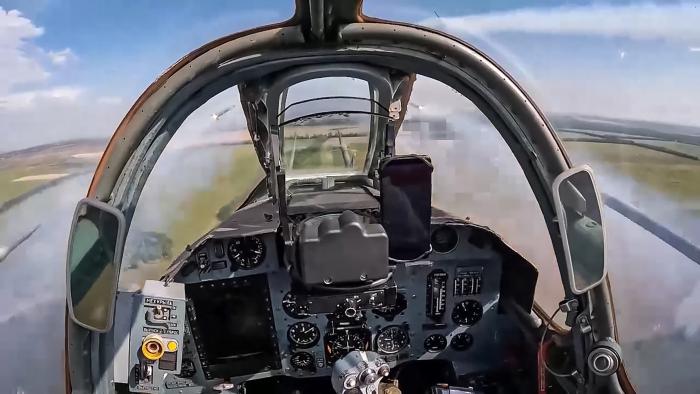
Pilots of non-upgraded Su-25 navigated using paper maps and hand-held GPS receivers in an effort to get to the pre-calculated rocket launch point while keeping the recommended speed and heading. The upgraded SM and SM3, in turn, offer computer-aided aiming for somewhat improved accuracy for these unguided lofted rocket attacks, with navigation and weapons release cues to the pilot displayed on the Head-Un Display (HUD). The mission computer of both upgraded Frogfoot versions runs software that factor the rocket ballistics while also considering aircraft speed, wind speed and direction in order to compute the launch point position, range to target, altitude and climb angle needed for accurate delivery.
According to Su-25 pilots, the main target set on the battlefield consisted of hardened defensive positions as well as concentrations of troops and military vehicles, and other heavy military equipment. There were, indeed, rare occasions of high-risk combat flying for pounding targets in direct attacks in Donbas region, in CAS situations, using S-25-series of 250mm rockets from shallow dive offering the best accuracy.
It is noteworthy that the RuAF Frogfoot fleet has proved unreachable by Ukraine’s radar-guided SAM systems due to the very nature of the strikes, undertaken in risk-avoidance manner at ultra-low altitude, at up to 300ft, and without crossing the forward line of own troops.
Ugly and sturdy, but hauling unusually light warloads, the RuAF Su-25 fleet had an unimpressive performance in the war in Ukraine, with little or no gains and suffering from serious losses.
Ugly and sturdy, but hauling unusually light warloads, the RuAF Su-25 fleet had an unimpressive performance in the war in Ukraine, with little or no gains and suffering from serious losses. Russian MOD

Russia’s Melting Frogfoot Fleet

Prior to the launch of the ill-fated invasion of Ukraine, the Russian Aerospace Force (RuAF) fielded an active fleet of no fewer than 130-plus single-seat Su-25/BM/SM/SM3s (including 105 to 110 upgraded examples to the SM and SM3 standards), of which between 70 and 80 were maintained in serviceable condition, available for immediate rushing into combat on February 24, 2022. The fleet also included 25 to 30 Su-25UB two-seaters, all of these in the non-upgraded configuration.
These battle-proven but rapidly ageing armoured attack aircraft equip four front-line attack regiments (fielding two component squadrons with regular numerical strength of 12 single-seaters and four to six two-seaters each), in addition to two more attack squadrons incorporated into the structure of a composite aviation regiment and an air base outside Russia. A handful of Frogfoots were also in operation with one instructor-research squadron for combat training and conversion training duties at Lipetsk plus four more two-seaters assigned to a composite training squadron. In addition, it is believed that the Russian air arm still has about two dozen of single-seat Frogfoots in long-term storage or undergoing upgrades, overhauls and life extensions at three depot-maintenance facilities situated in Kubinka, Yevpatoria and Vozdvizhenka (these could be used as attrition replacement in the foreseeable future).
The vast majority of the Su-25/BM/SMs in active service with the RuAF are late production models built between 1986 and 1991 to the so-called 9th and 10th Series configuration, provided with enhanced combat survivability features. The older 8th Series non-upgraded Frogfoots are still in operation with the 266th ShAP. The Su-25’s airframe service life limit is currently set at 2,500 hours while time between overhauls is set at 800 to 1,000 hours and 15 to 16 years, whichever is reached first.
A pair of Su-25SM3s, each laden with S-13 122mm rockets in two B13L packs, is seen here ready for take-off for another combat mission at Millerovo in Rostov on Don region bordering with Donbas.
A pair of Su-25SM3s, each laden with S-13 122mm rockets in two B13L packs, is seen here ready for take-off for another combat mission at Millerovo in Rostov on Don region bordering with Donbas. Russian MOD
The fleet annual utilization rate was relatively low in the past, but since 2010, as the RuAF has gone to an intense training regime and began participating in combat operations in Syria, the figure increased to between 130 and 150 hours, translating into 200 to 250 sorties per airframe. The wartime utilization is much higher, causing, in turn, seriously increased wear and tear, and much faster consumption of the service life.
The faithful yet ugly Frogfoot still has some pretty good life-extension reserves, at least in theory, according to its design authority, the Sukhoi Attack Aircraft company. The type could be good for a service life extension to 4,000 flight hours and 40 years; a follow-on extension could see the Su-25’s service life reaching up to 5,000 flight hours and 50 years. This option, however, would depend on the fleet’s eventual size and its actual technical condition in terms of structural integrity issues and corrosion damage following the end of the fatiguing, exhausting, controversial and very protracted invasion of Ukraine.

Wagner Group Operations

The Su-25 was operated from March or April 2022 to June 2023 by the air arm of the notorious Wagner Group PMC, which has gained a lot of significance and got its own sectors of advancement in war-torn Donbas. Enjoying a generous support of the Russian government at the times, Wagner Group PMC’s combat jet fleet consisted of about a dozen ex- RuAF Su-24Ms and Su-25s (non-upgraded aircraft, with most of these directly taken out of mothballs while others were transferred from front-line units such as the 266th ShAP). Operating out of Millerovo, these strike jets were flown by contractor pilots, tasked to pound targets in nearby Donbas to supporting the push of the PMC’s assault group in the highly contested Popasna, Soledar and Bakhmut areas.
The Wagner Group’s air assets are said to have been flown in combat in an effective though high-risk manner, calling for unguided weapons release from close distances at low and ultra-low altitude, in an effort to score as much as accurate hits. This specific combat employment method of direct attack had led to serious losses, with at least five Su-25s and one Su-24M reported gunned down in combat in CAS sorties, while an undisclosed number of aircraft took heavy damage but eventually managed to return to base.
Maj Gen (ret’d) Kantamat Botashev, head of the Wagner Group’s own air arm, was killed in his 35th combat sortie near Popasna on May 22, when a MANPADS hit his non-upgraded Su-25. This is a scene from his funeral ceremony in a small village near the city of Karachaevsk in the southwestern part of Russia.
Maj Gen (ret’d) Kantamat Botashev, head of the Wagner Group’s own air arm, was killed in his 35th combat sortie near Popasna on May 22, when a MANPADS hit his non-upgraded Su-25. This is a scene from his funeral ceremony in a small village near the city of Karachaevsk in the southwestern part of Russia. via Telegram
The first Su-25 belonging to the Wagner Group PMC was reported gunned down on May 12, 2022, near Popasna, taking a MANPADS hit. The pilot, 63-year-old Nikolay Markov, failed to eject and was killed in the crash. He was a retired colonel from the Belorussian Air Force with a lot of experience and expertise from the time he flew as a mercenary pilot in Africa.
The most prominent loss of the Wagner Group PMC was the next Su-25 gunned down while flown by its air arm Commanding Officer, Major General (Retired) Kantamat Botashov. The 63 years-old pilot is said to have logged no fewer than 35 high-risk combat sorties, the first of which was flown on April 18. His Frogfoot was shot down on May 22, 2022, reportedly by a FIM-92 Stinger MANPADS, near Popasna in Lugansk region in his third attack pass to deliver weapons in a shallow dive. The mission was dedicated to supporting ground troops encircled by the Ukrainians. Botashov’s Frogfoot took a MANPADS hit at ultra-low level, with the pilot having no time to eject. It was hinted that Nikolay Markov was a wingman of Botashov in the high-risk combat mission flown on May 12, when the Markov’s aircraft was shot down.
The third Wagner Group Su-25 was lost in combat on June 18, 2022, near the city of Svitlodarsk, not far away from Bakhmut. The aircraft took a hit from an Igla MANPADS, fired by an air defence team of the 72nd Mechanized Brigade of the Ukrainian Land Forces. The mercenary pilot, Andrey Fedorchukov, was lucky this time to eject safely. However, he was immediately captured by the Ukrainian troops and underwent a detailed interrogation in the following days. The captured pilot revealed that the Wagner Group’s air arm is based at Millerovo, and he flew one to two CAS missions a day, with the tasking provided by Russian MoD officers. Fedoruchkov also said that his monthly base salary accounted to RUB 205,000 (equating to about USD 3,200 at the time of shooting down) plus additional bonuses for effective combat work.
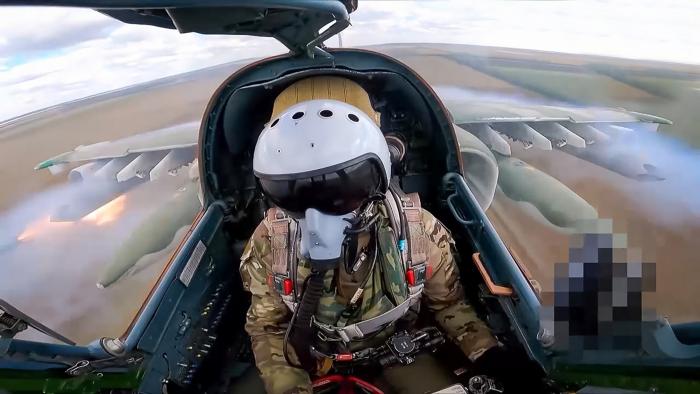
S-13 122mm rockets seen having just been launched from a B-13L pod while in gentle climb. This is a typical risk-averse indirect attack profile commonly used by the RuAF Frogfoot community in the invasion of Ukraine.
S-13 122mm rockets seen having just been launched from a B-13L pod while in gentle climb. This is a typical risk-averse indirect attack profile commonly used by the RuAF Frogfoot community in the invasion of Ukraine. Russian MOD
The accurate navigation of his non-upgraded Su-25 when flying combat missions became possible thanks to the use of a hand-held Garmin GPS receiver, used together with a smartphone loaded with the popular Russian-made ProNebo flight/navigation/weapons release software application. It is also known that many RuAF pilots also use the highly effective ProNebo software on a daily basis for mission planning on the ground and in flight for navigation and weapons release purposes.
The fourth Wagner Group PMC Su-25 was declared lost on June 21, 2022, in Russia’s Rostov region. Serialled Yellow 23/RF-90858, this specific aircraft was previously assigned to the 266th ShAP. It is still unknown if the aircraft was damaged in a combat sortie, or it had just suffered from a major technical malfunction that led to the fatal crash as the pilot, Major (Retired) Vladimir Krot, was reported killed following an unsuccessful ejection.
The fifth and the last known so far Wagner Group PMC Frogfoot loss occurred on March 15, 2023. It was a Su-25 shot down by the Ukrainian forces in the combat zone near Bakhmit, supporting the push of the ground assault teams of the notorious private military contractor, with the pilot ejecting safely and promptly recovered by the own troops.

CAS Business in Crisis?

The full-blown and rather bloody war in Ukraine has clearly demonstrated that the classic CAS on demand by the ground troops with direct attacks, the bread and butter for the Frogfoot community in the past, is now almost non-existent. This is especially true for the follow-on stages of war, from late March 2022 onwards. In addition, Su-25 pilots have also proved inadequately trained in the beginning, falling easy victims to ground fire when hitting MANPADS density never seen by them before on the battlefield.
The Su-25SM3’s integrated self-protection suite consists of missile approach warners, enhanced countermeasures dispensers (downwards- and upwards-firing 26mm and 50mm cartridges) and sophisticated radar jammer pods. The pair of missile warners covering the rear hemisphere is optimized to issue warnings on approaching surface-to-air and air-to-air missiles.
The Su-25SM3’s integrated self-protection suite consists of missile approach warners, enhanced countermeasures dispensers (downwards- and upwards-firing 26mm and 50mm cartridges) and sophisticated radar jammer pods. The pair of missile warners covering the rear hemisphere is optimized to issue warnings on approaching surface-to-air and air-to-air missiles. Russian MOD
Based on the above, it could be speculated that the only way the Su-25 would be able to operate in an effective manner in peer warfare – called upon to perform CAS in high-density MANPADS environment – is when employing guided bombs and missiles with stand-off ranges, combined with a much-enhanced self-protection suite. Such guided munitions, however, are in short supply in the RuAF, and the Frogfoot fleet is not in the list of recipients. There are also no chances for introducing further enhancements to the type’s self-protection aids.
Operating at night could be a good option, at least in theory, to reduce combat losses but the meaningful night operating capability is available to the Su-25SM3 version only and this has been used on rare occasions in the war. However, the Russian military currently lacks any other survivable combat jet type with more or less effective attack capability to deal with dangerous CAS missions. This means the melting Frogfoot fleet will continue serving in this role in the war in Ukraine, albeit with much-compromised efficacy (due to the risk-averse tactics) and suffering from further combat attrition.
It could be eventually predicted with a pretty good degree of certainty that the days of the Frogfoot in mass service with the RuAF are numbered. The war will be over soon or later, but the heavily beaten Su-25 fleet, after suffering from so many losses, and being in a worn-out state, is not likely to recover anywhere close to the pre-war numerical strength, due to the lack of enough aircraft held in reserve and deemed suitable for return to service following general overhaul and upgrade.
Most likely, the proportion of the Frogfoot fleet, considered still good for use, will be consolidated after the war into no more than two front-line attack regiments, each consisting of two squadrons. One of these regiments will be stationed in the SMD and the other in the EMD, in addition to the attack squadron assigned to the 999th Air Base at Kant in Kyrgyzstan.
The Frogfoot is commonly regarded as a tough machine but its design can no longer be considered as being survivable when taking hits by increased-lethality warheads of modern-day MANPADS.
The Frogfoot is commonly regarded as a tough machine but its design can no longer be considered as being survivable when taking hits by increased-lethality warheads of modern-day MANPADS. Russian MOD
 
The remaining two front-line attack regiments, currently equipped with the type, as well as the sole attack squadron of the 37th SAP, could be expected to trade in, during the foreseeable future, their worn out Frogfoots for Su-34s and Su-34Ms. The Fullback is the strike aircraft of preference to the RuAF, with on-going production contracts and upgrade program, while new production orders are expected to follow in the second half of the 2020s.
It can be also predicted that it is highly unlikely for the Russian air arm to proceed forward with ordering newly built Su-25s, in the form of two-seaters with new mission avionics, which could be built, at least in theory, at the production line in the Ulan-Ude Aviation Plant in Siberia.
It is unlikely the RuSAF and MoD will pump serious money in the development and production of an attack derivative of the Yak-130 jet trainer too, to be used as the Su-25 replacement in the low-level attack role. There were multiple offers in the late 2000s and the early 2010s, made by Irkut, the Yak-130’s manufacturer, to develop a dedicated attack version for the RuAF. Dubbed Yak-131, it was conceived to feature amour protection and some other built-in combat survivability enhancements, combined with up-rated engines. It seems that such a design would remain on paper only and the Russian air arm’s attack branch is set to disappear with the coming decline of the Su-25 fleet, as the last examples are expected to continue soldiering on in the front line role until the late 2020s.

Topics​

Read more about
Thumbnail

Originally published in AirForces Monthly Magazine​

 
To view this content we will need your consent to set third party cookies.
For more detailed information, see our cookies page.


To view this content we will need your consent to set third party cookies.
For more detailed information, see our cookies page.


To view this content we will need your consent to set third party cookies.
For more detailed information, see our cookies page.


To view this content we will need your consent to set third party cookies.
For more detailed information, see our cookies page.


To view this content we will need your consent to set third party cookies.
For more detailed information, see our cookies page.
 
I would like to see the IDF hit by this mine

To view this content we will need your consent to set third party cookies.
For more detailed information, see our cookies page.
 
To view this content we will need your consent to set third party cookies.
For more detailed information, see our cookies page.
 
Status
Not open for further replies.

Users who are viewing this thread

Country Watch Latest

Back
Top