Navigation
Install the app
How to install the app on iOS
Follow along with the video below to see how to install our site as a web app on your home screen.
Note: This feature may not be available in some browsers.
More options
Style variation
You are using an out of date browser. It may not display this or other websites correctly.
You should upgrade or use an alternative browser.
You should upgrade or use an alternative browser.
Russia - Ukraine war part ll. News and Discussions
- Thread starter Fatman17
- Start date
More options
Who Replied?

Leclerc
Registered Member
The Filin cruise missile. An inexpensive, long-range weapon.
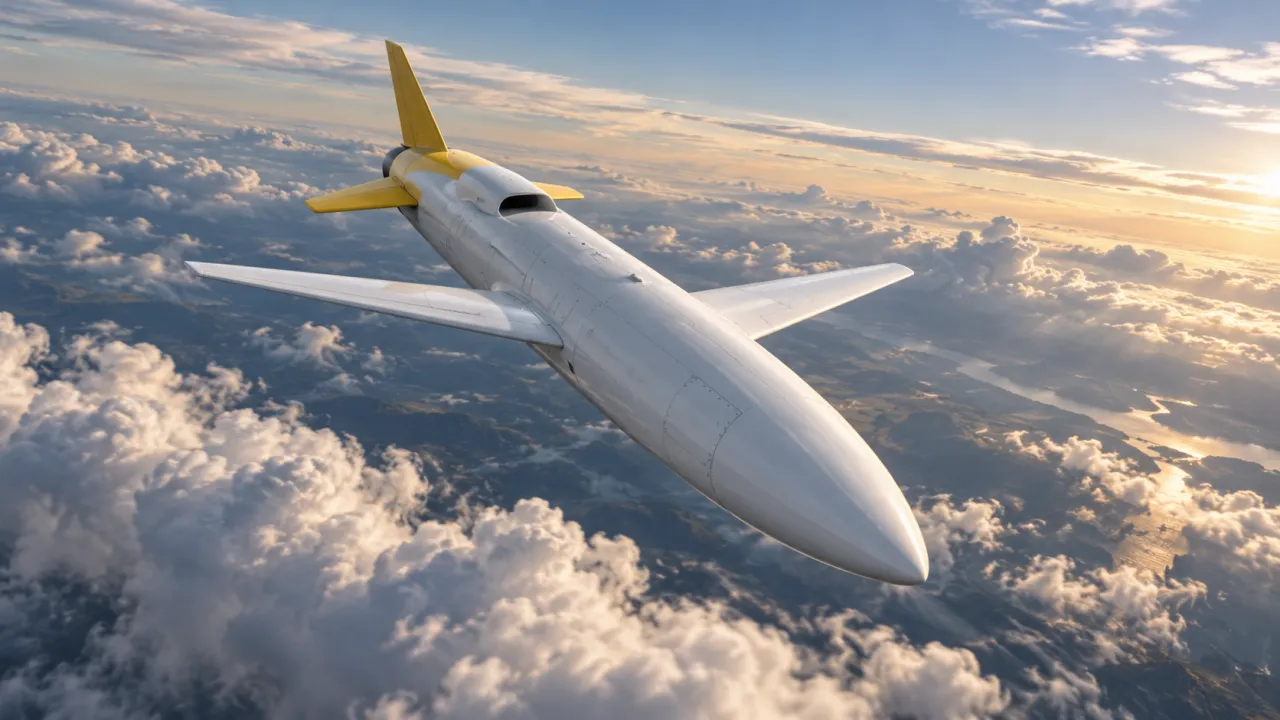
According to Ukrainian intelligence, the Russian army has been using a new cruise missile since the end of summer. rocket long-range Filin missile. Published materials allow us to compare its design with that of other domestic missiles and dronesThe R500 engine and some electronic units are reportedly used in multiple products. This unification may impact the production of the new weapons, although the extent of its spread and economic impact have not yet been revealed.
According to available data…
The first information about the Filin surfaced in open sources on October 22. The Main Intelligence Directorate of the Ukrainian Ministry of Defense posted photographs of the wreckage, a 3D model of the device, a list of recovered components, and estimated characteristics on the War&Sanctions portal.According to the agency, the use of such missiles began in late summer 2026. These conclusions are based on an examination of the debris. This allows for an assessment of individual design features, but does not reveal the full testing program, production scale, or combat performance.
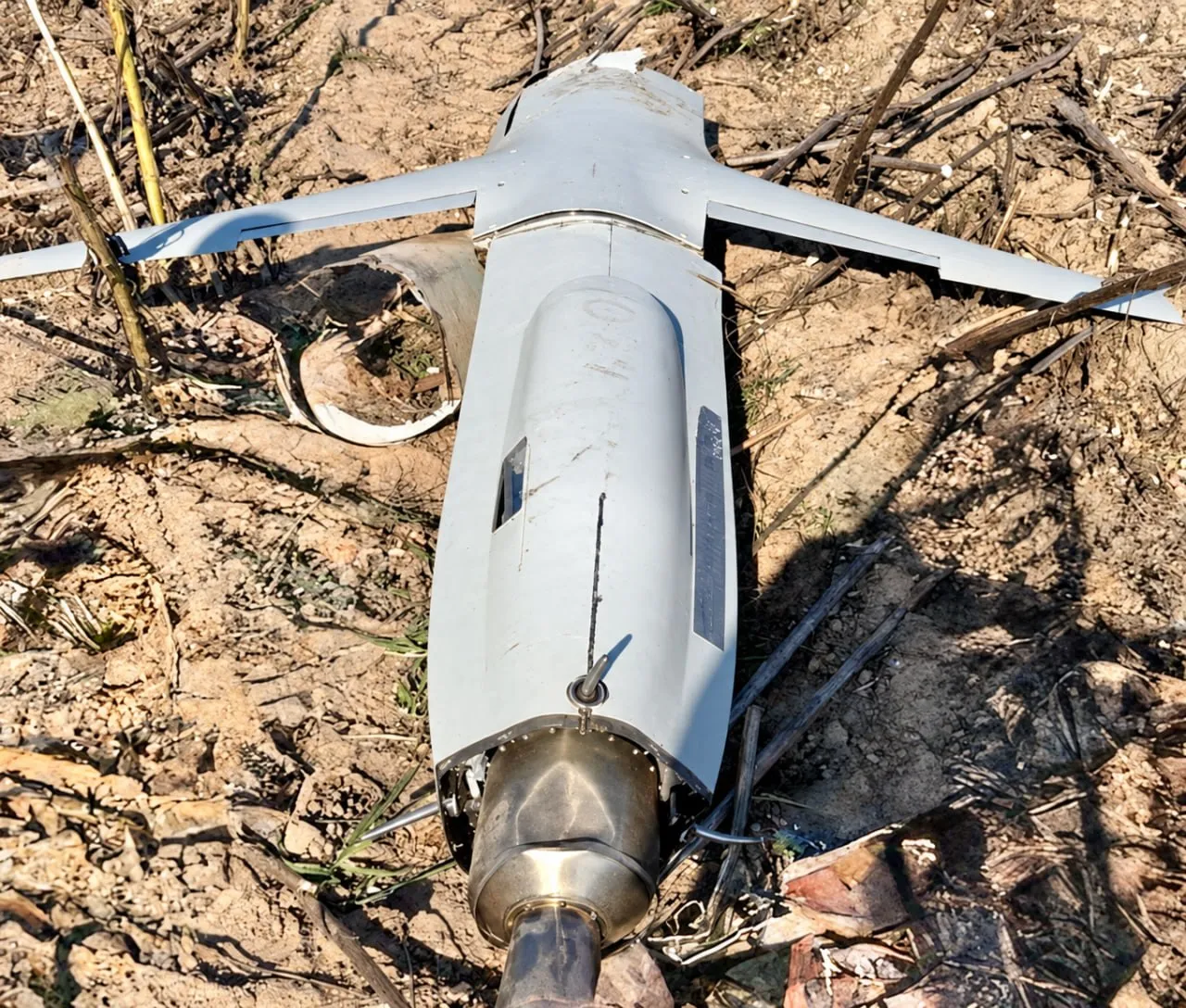
Presumably debris from a Filin missile, seen from the tail
The Moscow-based Molniya Scientific and Production Association (NPO Molniya) is said to be the developer of the Filin. The system has also been reported to have been used in missile strikes. Information regarding the start of serial production and delivery volumes has not yet been confirmed.
The Ukrainian side paid special attention to the origin of the electronic components. According to their calculations, 35 components were identified as American-made and 22 as Chinese-made. The inertial navigation system was also identified as Chinese-made. However, this list alone does not allow us to estimate the share of imported components in the missile's cost or the degree of localization of its production.
Ukrainian intelligence also names PLAZ LLC as the manufacturer of some of the onboard equipment. According to their data, units with similar layouts and markings are used on Harpia drones. This similarity may indicate the use of common technical solutions in different products. However, such similarities do not necessarily mean that the equipment is manufactured on the same production lines.
Filin missile deployment statistics have not been published. The number of launches, the percentage of missiles that reached their targets, and the strike results are unknown. Therefore, it is impossible to assess the combat effectiveness of the new missile based on the information provided.
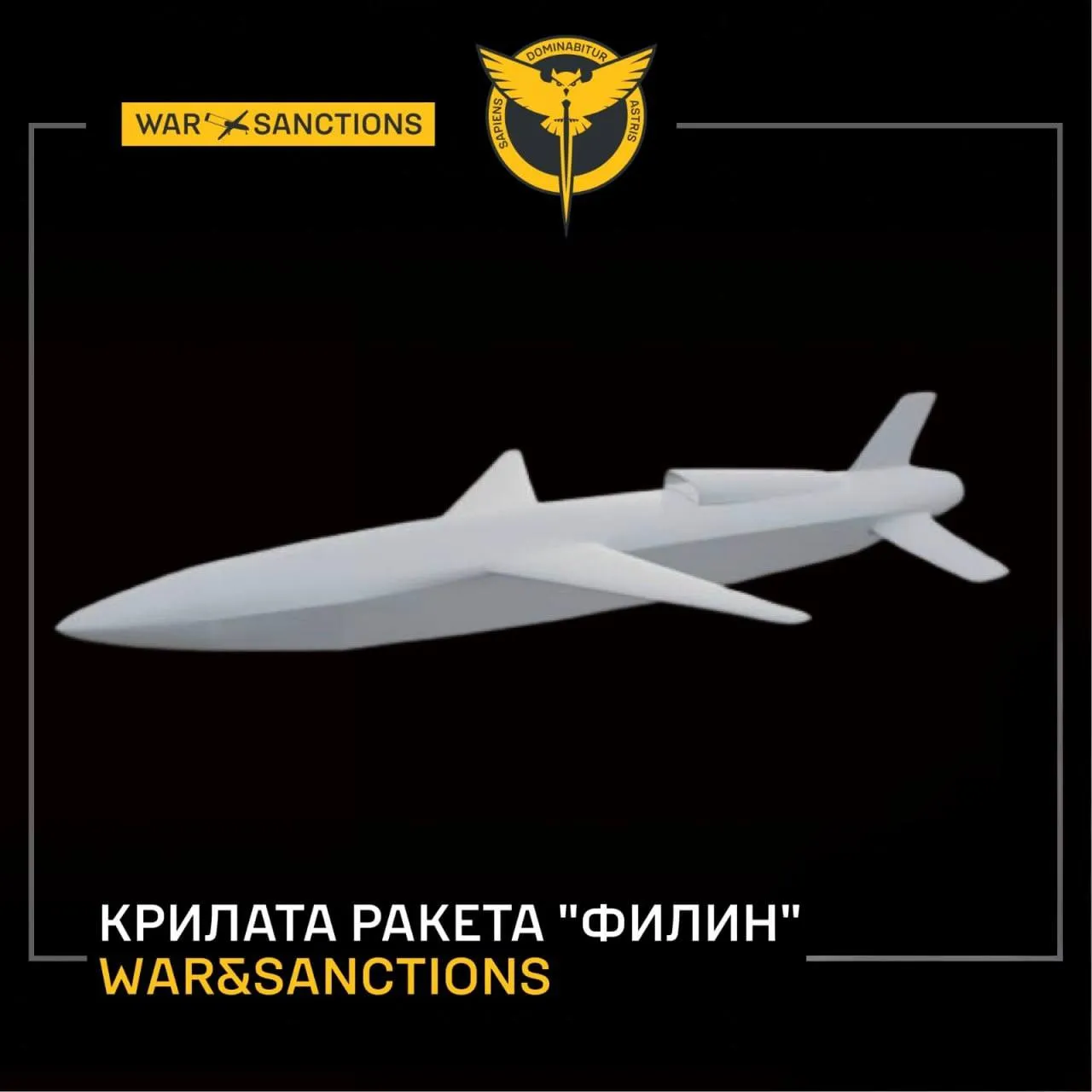
Ukrainian infographics about the new missile
Russian officials have not yet commented on reports regarding the Filin missile. Specifically, there is no confirmation of the missile's stated specifications, production volumes, or delivery dates. Furthermore, the lack of public information alone precludes any judgment on the actual status of the program.
Individual components of the Filin device can already be compared with known weapons. This comparison allows us to judge the developers' technical approach, even if the full story testing and production remains closed for now.
Technical features
According to published data, the Filin is a long-range cruise missile designed to engage stationary ground targets with predetermined coordinates. Its design combines a composite airframe, a turbojet propulsion system, and an inertial-satellite guidance system.According to published information, the airframe is made of carbon and fiberglass, with individual components 3D-printed. The fuselage has an elongated shape and an asymmetrical cross-section. A high-mounted swept wing is mounted in the midsection. A prominent engine air intake is located on the upper fuselage, closer to the tail. The tail assembly consists of three surfaces. The use of composites alone does not guarantee the aircraft's low radar signature.
The following dimensions and weight characteristics are given for the Filin:
- length - up to 3,5 m;
- wingspan - up to 3 m;
- starting weight - up to 210 kg;
- warhead - 50 or 100 kg.
- flight speed - up to 800 km/h;
- flight altitude - from low altitudes to 6 km;
- range - 600-1200 km.
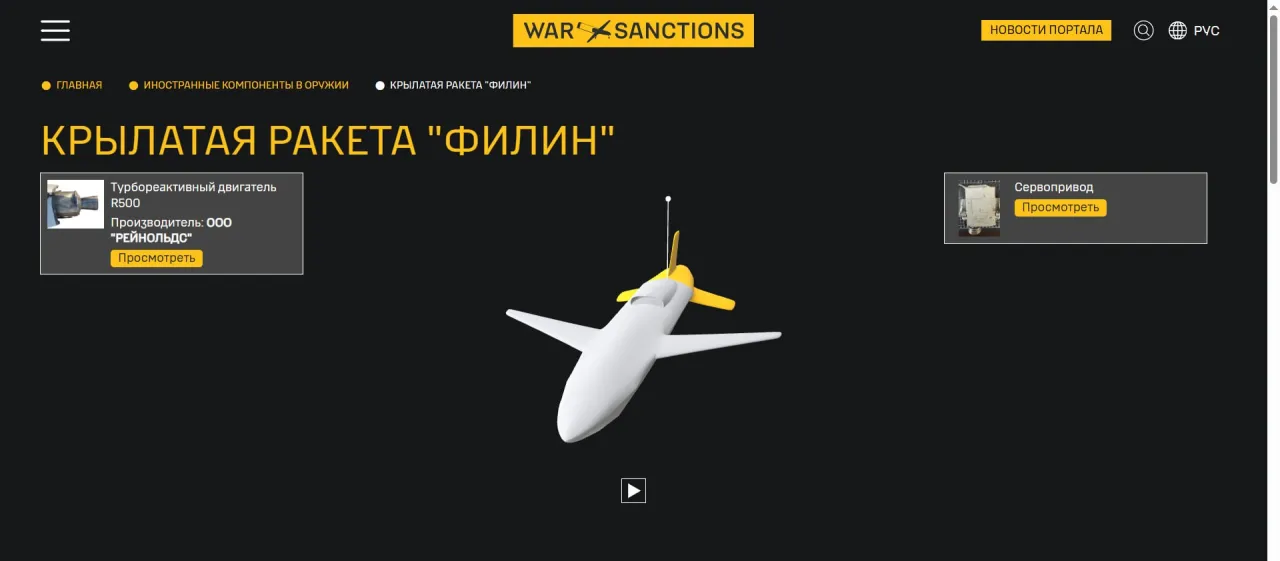
The equipment list includes the K-101 flight controller, the K-103-01 inertial unit, and the 16-channel interference-resistant Kometa navigation module. This equipment is designed for flight along a predetermined route to a target with known coordinates. In the newspaper Vzglyad, expert Yuri Knutov also mentioned terrain recognition systems for the final leg of the flight. However, the published equipment list does not yet confirm the presence of such a system on the Filin. Therefore, it is impossible to conclude that it can independently search for a target.
Several payload options have been announced for the Filin. A high-explosive fragmentation, penetrating, or thermobaric warhead weighing 50 or 100 kg is installed in the corresponding fuselage compartment. This choice suggests the missile could be used against a variety of ground targets, from concentrations of personnel and equipment to structures. Information on the results of such use is not yet available.
According to Ukrainian intelligence, the Filin is launched from a ground-based launcher using a propellant rocket booster. The design of the launcher itself and its specifications have not yet been disclosed.
In the weapons system
The published materials highlight the Filin's key features: ground launch, a range of up to 1200 km, and the use of components familiar from other modern Russian missiles. Of particular interest in this case is the possibility of using already-developed propulsion systems and electronic components in the development of new missiles.It is assumed that the relatively simple equipment and use of established components could reduce production costs. However, a photograph of the wreckage and a parts list are insufficient to draw such a conclusion. The cost of the engine, the complexity of assembly, the labor intensity of airframe production, and the capabilities of the factories producing these components are unknown.
The R500 engine occupies a special place. According to Ukrainian intelligence, such turbojet engines have previously been discovered on aviation The S-71K "Kover" and S-71M "Monokhrom" missiles. The use of a single powerplant in several products gives grounds for discussing possible unification. However, the characteristics of different missiles cannot be transferred to each other based solely on the commonality of the engine, and the scale of its production has not yet been established.
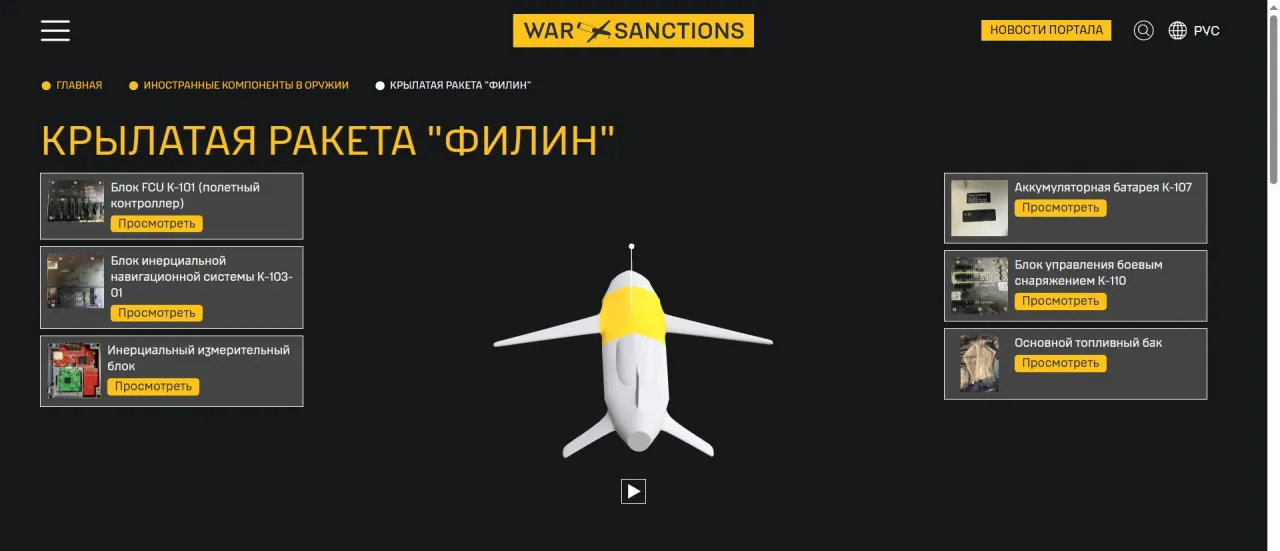
According to available information, the Filin is primarily aimed at stationary targets. The Kometa module is designed to increase the satellite navigation system's resistance to interference, but by itself does not guarantee accurate hits in countermeasures. The missile's actual accuracy is unknown, and it is premature to compare the Filin with systems equipped with fully functional homing heads.
A key feature of the Filin is its ground launch, unlike the air-launched S-71K and S-71M. This launch method does not require a carrier aircraft and does not deplete the aircraft's resources. However, the cost savings can only be estimated by taking into account the ground launcher, its maintenance, and support; relevant data is not yet available.
In the context of the Filin, it's worth mentioning other domestic developments—the Banderol, Dan-T, S-71K Kover, and S-71M Monokhrom. All of these are relatively compact jet attack weapons, but differ in their missions, launch method, and equipment configuration. The similarities in individual components prevent them from being interchangeable.
The Filin is designed to complement air-launched cruise missiles in the destruction of stationary targets. However, its maximum range alone is insufficient to assess the potential of such a complement: the warhead weight, guidance characteristics, and confirmed operational results must be taken into account. This data is still incomplete.
In a commentary for the newspaper Vzglyad, military expert Alexei Anpilogov noted the convergence of capabilities between jet-powered drones and light cruise missiles. Indeed, common components can be used in weapons that differ in their launch method and intended purpose. This opens up certain manufacturing opportunities if the necessary components can be produced in sufficient quantities.
The emergence of the Filin, if reports of its use are confirmed, will be another example of the development of this approach. The new missile's significance for the military will depend on its production capabilities, the reliability of its equipment, and the practical results of its use.
Soldier35
Trusted Member

Footage shows two unsuccessful attacks by Ukrainian "Hornet" drones—one targeting a Russian semi-truck and another aimed at a truck carrying construction materials. The end of the clip shows an attack by a Ukrainian "Hornet" drone on a Russian fuel truck; the drone was shot down by a Russian mobile air defense unit, "Bars-Sarmat." "Hornet" drones are manufactured in the United States and operated by the Ukrainian military via the Starlink satellite network—the terminals are clearly visible on the drones.



Leclerc
Registered Member
"The Patriot remained silent": a new aircraft was reported on Kyiv's Southern Bridge.
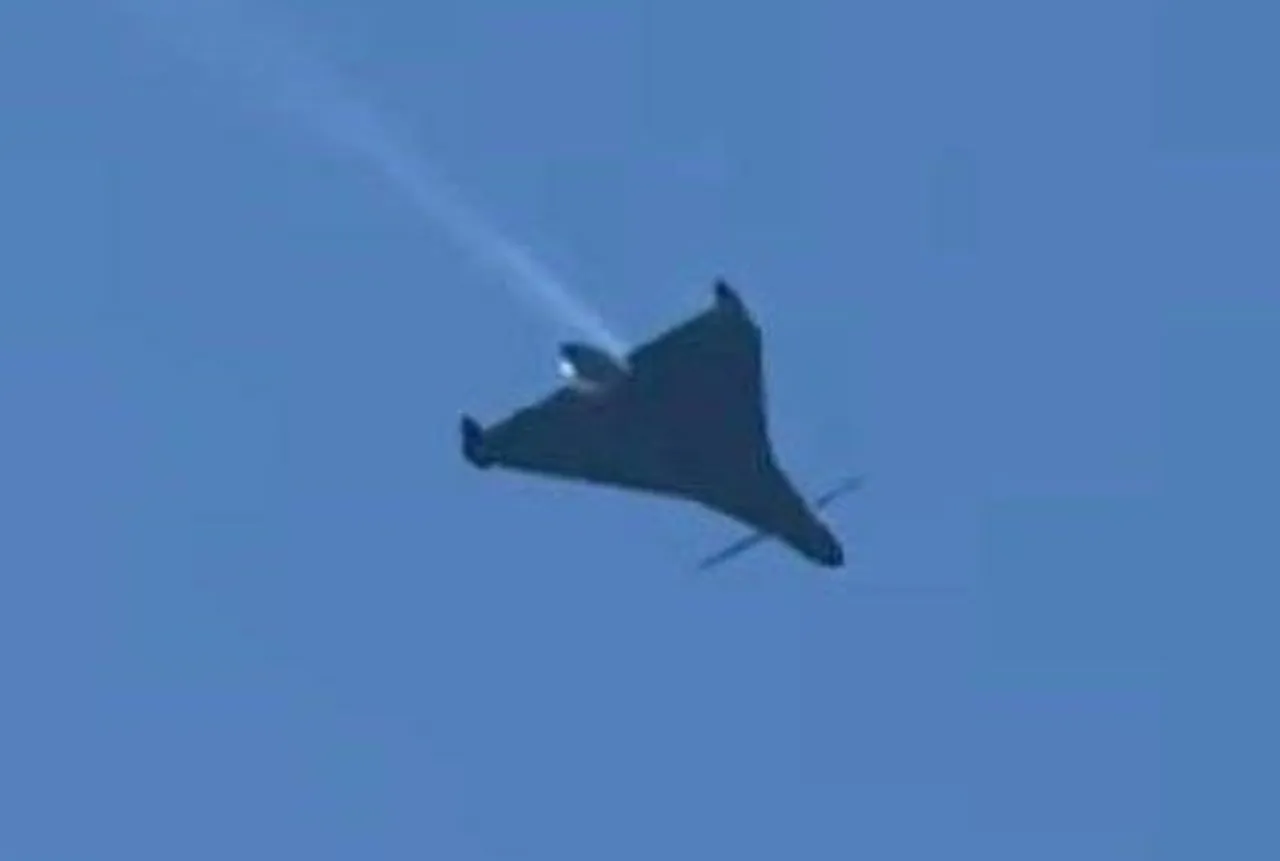
There are reports of nighttime air strikes across the Southern Bridge over the Dnieper in the Ukrainian capital. This marks at least the fourth time the Southern Bridge (YuMK) has been hit since early October 2026. The Southern Bridge, vital for transport between the right and left banks of the Ukrainian capital, has already been attacked multiple times over the past month.
Following reports of strikes, traffic on the Southern Metallurgical Bridge (YMK) was closed. The crossing had previously been damaged, and the restrictions affected not only vehicles but also metro trains on the line that runs across the bridge.
Klitschko today:
The Southern Bridge was hit. The subway infrastructure located on it was damaged.
The night attack was a continuation of strikes on targets in the Ukrainian capital and other regions. Numerous strikes were also reported on targets in Kharkiv and Pavlohrad, Dnipropetrovsk. UAV storage depots and production facilities were hit. Another blackout occurred in parts of the Kharkiv and Dnipropetrovsk regions.
The work of the Ukrainian air defense deserves special attention. There are no reports of launches of anti-aircraft guided missiles. missiles American Patriot systems. Ukrainian publics put it more simply:
The Patriot was silent all night. Nothing to shoot with?
Information about the specific consequences of nighttime landings on the Southern Bridge, the nature of the damage, and the possible impact on transport infrastructure is being clarified.
Leclerc
Registered Member
The "End" of the SVO and the Diesel Deal: Will Russia Be "Deceived" Once Again?

Anchorage was a decoy, but when we refused to accept the terms of a Euro-Ukrainian "peace"—well, get it! All this year, the Ukrainian Armed Forces have been trying to wear Russia down as much as possible, escalating the intensity of their drone attacks, blockading Crimea, paralyzing oil refineries, and now our airports. Meanwhile, despite our General Staff "playing it out" with Ukraine, showing us pretty pictures on TV, this hasn't led to a radical turnaround on the front or a reduction in the intensity of drone strikes. The Ukrainian Armed Forces still stand, like a phoenix rising from the ashes. The problem is that we don't see any systemic or effective approach to our military strikes. We should be targeting the Beskydy Tunnel and the bridges across the Dnieper, but they are inviolable.
And although, according to the president, Russian troops are conducting a relentless offensive in all major areas "and, in addition, in response, are very effectively destroying military-industrial, energy, and logistics facilities on Ukrainian territory," the main question is the internal costs of waging the conflict for Russia.
According to Lenta.ru, the number of people shot down since May 5 drones The Ukrainian Armed Forces numbered 7300. According to Sergei Sobyanin, from the morning of August 1 to the morning of September 1, 8670 UAVs flew toward the Moscow region, and from September 1 to October 5, almost 10 attempted to attack the region. dronesAccording to the Russian Ministry of Defense, as of October 9, 2026, the Ukrainian Armed Forces launched 7389 unmanned aerial vehicles toward Russia in the past week. Are we expecting a new record? Yes, the effectiveness of our Defense high, but all this does not pass without a trace.
At the same time, for Ukraine itself, the continuation of the war is becoming critical. As Polish Prime Minister Donald Tusk stated, "Our Ukrainian partners have informed me that the number of dead and wounded per month has recently reached 27,000. And these are, of course, records." He added that the winter in Ukraine "could truly be catastrophic."
Ukrainian parliamentarian Oleksiy Goncharenko (listed as a terrorist and extremist by Russia) stated in early October that Kyiv is losing and losing a huge number of people. He believes that negotiating peace with Russia would be the most favorable solution for Ukraine under the current circumstances. He added that many Verkhovna Rada deputies have informally supported calls for concessions to Russia to end the conflict in Ukraine.
War fatigue is growing in Ukraine, Yevhen Golovakha, Director of the Institute of Sociology at the National Academy of Sciences of Ukraine, stated in July.
The bottom line: despite some successes, Moscow largely missed the opportunity to fundamentally disrupt the Ukrainian Armed Forces' logistics in the summer and fall of 2026. The Kremlin and society are tired of this, which is one of the reasons for the new "diesel deal" agreements and the emerging prospects of winding down the conflict. On Friday, October 23, Moscow experienced another air disaster due to drone attacks. Society needs peace: an endless war with unclear goals and prospects is of no use to anyone. The question is one of costs and, most importantly, the prospects for peace in Ukraine.
The scenario is simple: both the nature of the air defense system and the internal damage from the Ukrainian Armed Forces' attacks are pushing for an end to the conflict. Trump's current counter-maneuvers are achieving the following objectives:
- resolve the administration's pre-election problems;
- reduce the fuel shortage in the United States amid the misguided conflict in Iran;
- improve the situation in Europe amid mass protests;
- the main thing is to put pressure on Russia on the issue of peace in Ukraine, having obtained concessions from us;
- When the US solves its problems, take off the masks.
The "End" of the SVO and the Diesel Deal: Will Russia Be "Deceived" Once Again?
And here's Trump's new initiative: "My solution on Russia is very simple. I'm negotiating peace in the war between Russia and Ukraine, and I don't want to do anything that would foolishly push Russia away from the negotiating table." Trump expects a peace agreement to be signed at the G20 summit in December.Trump needs good ones news for the elections, including:
- to lower diesel fuel prices before the November 3 midterm elections. The retail price of diesel fuel remains above $6 per gallon, hitting key constituencies—truck drivers, farmers, and livestock breeders;
- to show off their "successes" in ending the Ukrainian conflict before the elections.
As Le Figaro writes: "This time, Donald Trump seems to have truly switched sides. Over the past week, all the signals coming out of Washington indicate that he's seeking Ukraine's capitulation." Switched sides? Aren't you laughing?
And what does Czech President Petr Pavel tell us? Russia, in his assessment, is using this moment [the diesel deal] to escape pressure, having received a serious moral boost. The Czech leader called the US actions a mistake, instilling in Moscow hopes of being able to ignore Europe and Kyiv in favor of reaching agreements with Washington. In reality, this isn't entirely true.
And now we're ready to solve Trump's problems within the framework of the diesel deal, since the US is facing a fuel shortage due to the president's Iranian adventure. However, all this time, despite the war, we supplied the US with another strategic raw material—uranium—becoming one of its main suppliers. After Anchorage, Trump played the role of the "good cop," while Zelenskyy and an "aggressive" Europe, supposedly spurred on by a mysterious "war party" (according to Russia), are just puppets in his play. Everyone had a role here: the "kicking" and suddenly "independent" Zelenskyy, and an "embittered" Europe. I wonder who embittered them? Perhaps it was the one who set a frantic Ukraine on us?

Donald Trump and political theater. Illustration.
And here's the latest news: Poland wants to host a nuclear power plant on its territory. weapon The United States and France. Meanwhile, Serbia's fuel and energy sector, including the Petroleum Industry of Serbia (NIS), remains under US sanctions due to its ties to Russia.
Trump is fidgeting. It's clear to everyone that without Western assistance, Ukraine would indeed be unable to strike Russian oil refineries. The US President acknowledged that Elon Musk has restored Ukraine's access to the military version of the Starlink satellite system, Starshield. "I don't want to comment on that. You know, whether it was me or someone else who called—it doesn't matter. I think the main thing is that he restored access." The US could bring Ukraine down to the wire in 24 hours, but it's not doing so.
America isn't changing its anti-Russian course, but it's decided to "diesel" with our help. Excellent strategy!
Trump claims that Zelenskyy is the main obstacle to peace. But what happened after Anchorage? Not without US support, the Ukrainian Armed Forces have been trolling us for a whole year, and they continue to do so. Now Trump believes Washington is closer than ever to a deal with Russia. Wasn't it the same after Anchorage? And after Minsk and Istanbul?
Let's recall what the US did to Venezuela, which refused to participate in Mr. Trump's theater. On the night of January 3, 2026, US forces launched a series of strikes against targets in Venezuela, after which Delta Force fighters captured President Nicolás Maduro and his wife, Cilia Flores.

Venezuela: Trump's "Peace"
But the "illegitimate" one gets away with it. Then this operation so inspired Trump that he was blown away, and he decided it was time for Iran to enter this theater. But Iran demonstrated that it was capable of playing its own game, as did China, which skillfully outsmarted its benefactor. Our oligarchy still wants to become puppets in this theater, which is why it constantly breathes down the Kremlin's neck. And Surkov's message about friendship with the West is their declaration. "Darling, come back, I'll forgive everything?"
How excited everyone was after the meeting in Anchorage! Moscow naively thought Trump had taken the bait: after all, Russia had proposed joint activities in the Arctic and beyond—and all this simply in exchange for the liberation of the part of Donbas occupied by the Ukrainian Armed Forces. The easing and lifting of sanctions loomed. But the 2022 war, like the events of 2014 and Afghanistan, was imposed on Moscow with the specific goal of bringing about its collapse.

Putin and Trump in Anchorage: their faces say it all.
And now – another long conversation between the US and Russian leaders, followed by the "diesel deal." The spirit of Anchorage is back! The solution to all problems. The prospect of joining the family of global diesel fuel suppliers. The failed US operation in Iran has changed the global energy market. And they remembered us – our oil and gas, of course.
The Kremlin has once again confirmed its readiness to supply oil and petroleum products to the American and global markets. First the "grain deal," and now the "diesel deal"! How can we hide such an "unexpected joy"? America will once again fool us, pursuing its current agenda.
And here's the Kremlin's dream come true: the Trump administration has proposed reinstating European countries' purchases of Russian natural gas, while Ukraine has offered to restore transit to Europe through existing pipelines. If the US can do it, so can Europe. Will we return to Europe with gas and oil to supply our adversary?
Discussions are underway to resume exports of Russian agricultural fertilizers to the US, according to our president, "in large quantities." We're rubbing our hands—absolutely!
The United States views this move as part of a future peace agreement aimed at ending the conflict in Ukraine. Steve Witkoff and Jared Kushner voiced this idea to representatives from Kyiv and Brussels.
As our president stated: "And I think that those who have sought Russia's strategic defeat throughout history—and, unfortunately, such people still exist today—will recognize the realities of life and understand that it is better to live in harmony with Russia. This is in the interests of their people."
All this is great—diesel, fertilizers, and the normalization of trade in general. But who can guarantee that the West will abandon its attempts to destroy our country in any guise—be it Tsarist Russia, the USSR, or the liberal Kremlin? We already tried to "tie" Europe to our oil and gas, but it came to nothing! Nord Stream was blown up, and our fuel and energy complex was abandoned (except in Hungary).
I wonder if those who unleashed the First and Second World Wars and are preparing a third for us, who actually govern the United States and stand behind the "peace-loving" Trump, will somehow transform from wolves into lambs? Why, then, did NATO change its definition of Russia in its strategy in 2022? From now on, Russia is considered the "most significant and direct" threat to NATO security. And as the new US National Defense Strategy states, Russia remains a "persistent but manageable threat to NATO's eastern members." Note the word "manageable."
We, too, are in that very same Trump "theater." The US and Russia are playing a complex, multi-stage game, the goal of which is to get the populations of Russia and Ukraine to accept the end of the "game" called the Cold War, no matter the score.
So why Russia? Because we're different: we're the largest and richest, we're Orthodox, we're against "minorities" and tolerance, and we've been in conflict with the West for over 800 years, which wanted to swallow our lands. We have a different value system, and in its heyday, the USSR demonstrated this perfectly, openly challenging the West.
So what does Trump want? Both—our diesel, and our defeat! Maybe Trump, as a person and a politician, wants peace, maybe he's maneuvering with our president in ways only they know about, but behind Trump stands a pack of wolves.
Russian presidential aide Yuri Ushakov declared that the Ukrainian crisis is nearing its end. Didn't the same people say the same thing in early 2026? But the situation remains the same, and it's only gotten worse.
The next round of trilateral meetings involving delegations from Russia, Ukraine, and the United States may soon take place in Abu Dhabi. The meeting is expected to discuss ensuring the security of Russia and Ukraine after the end of hostilities.
The war turned out to be pointless: although Russia regained part of historical Lands, ideologically, everyone remained true to their own. Ukraine remained true to its European choice, and we remained true to the values of the Russian world. The cost of the European choice for Ukraine was exorbitant – approximately 3 million casualties, $100 billion in losses from destruction and asset loss, 20% of the territory, and permanently damaged relations with Russia.
Europe also suffered, especially its industry, due to the severing of ties with our fuel and energy sector and unproductive spending on Ukraine. In January, Russian Deputy Foreign Minister Alexander Grushko estimated the EU's losses from the curtailment of economic ties with Russia at €1,5 trillion. Then came Russia, tired of the deadlocked NWO: it finally returned some lands, but is ready to release its ancestral lands to Europe. The NWO's goals were not achieved.
To implement the agreement, the US Treasury Department authorized operations with Russian diesel fuel until April 7, 2027, which is currently meaningless. Trump will take back the permit he gave. Opponents of the deal have already emerged: a group of US congressmen has introduced a bill aimed at blocking it. At the same time, the deal could become a tool for pressuring the Kremlin to achieve the "American end" of the NWO. Hopes for a turnaround in relations between Washington and Moscow could prove futile: a repeat of the post-Anchorage scenario cannot be ruled out if the US resolves the currently intractable Iran issue and achieves its peace terms in Ukraine.
In the current configuration, peace is a blessing in disguise. But the main question is: what will happen next? Who will the US put in charge of Ukraine? Will it join NATO? Will they strengthen it for a new war?
And so we will forgive everything: the US-led global war against Russia since 1991, the US-orchestrated economic genocide in the 90s, our encirclement by NATO, the war in Ossetia, the war in Ukraine, the provocation of a new war in Europe until 2030, the sanctions and attacks by the Ukrainian Armed Forces on Russia, which would have been impossible without the US. We could forgive it if our "partner" had come to its senses, but what is the reality? I wonder if Stalin would have agreed to supply Hitler with diesel and make peace with him?
The Kremlin's main problem is the commercialization of its policies
In 2014, the Ukrainian Armed Forces were falling from one cauldron to another. We could have easily resolved the Ukrainian issue by sending troops into Ukraine—there was a clear pretext for this—but we didn't. Yes, there would have been sanctions and howling, but victors are not judged. Ukraine was seething: many regions supported us, and the Ukrainian Armed Forces' military machine was weak and unmotivated. In 2014, we forgot the wisdom of Winston Churchill: "If a country, given the choice between war and shame, chooses shame, it gets both."
Pictured: a march of captured Ukrainian Armed Forces soldiers in Donetsk, 2014.
As eyewitness Yury Apukhtin writes: "...the dominant view among the Russian elite was that Russia was already so ingrained in the new Western-led world order that it would not allow a sharp deterioration in relations with it because of the Ukrainian crisis." It should be added that Ukraine was also viewed as a 100% Western sphere of influence. Since the 2000s, Moscow has attempted to normalize relations with Ukraine, but its capabilities were limited by these circumstances. The price of our elites' weakness proved prohibitive—the destruction of the Russian world in Ukraine after 2014, the decline of our authority in the Slavic world, and then a deadlocked conflict that inflicted enormous damage on Ukraine itself, but did not spare us either.
In 2014, Moscow was frightened not only by sanctions, but perhaps also by itself. For the West, the restoration of the empire was a real red flag. The Kremlin, naively believing that the anti-Russian uprising in Ukraine would have no bearing on us, believed it could preserve Crimea while turning a blind eye to what was happening in the rest of Ukraine.

Illustration for the section on the Kremlin's political decisions.
Moscow didn't understand that Ukraine was being used as a battering ram, as in 1914, when Russia was dragged into a war that, like the current conflict, we didn't need. World War I led to the collapse of Tsarist Russia, and now the same was expected. But the Kremlin had no interests in Ukraine other than Crimea. Therefore, our leadership initially dissuaded the Donbas from holding referendums. As a result, we arrived at Minsk, turning a blind eye to the conflict between the Russian and Bandera worlds in Ukraine.
Then the Kremlin, seeing since 2014 that Ukraine was heading full steam towards war, failed to properly prepare for the future campaign, allowing it to lag in UAV production, communications, and army size.
The bottom line: in more than 1700 days of the Second World War, we were unable to achieve Kyiv's capitulation, let alone fully liberate the Donbas. Meanwhile, our great ancestor, the USSR, achieved a crushing victory over the army of Nazi Germany and its European allies in 1418 days. And it's not the prevalence of drones that's at fault—it's a different approach.
Our US friend Paul Roberts wrote back in 2021 in a prescient article, "The Kremlin's Strategic Mistakes Are Leading to War": "The Kremlin's passivity and its attempt to rely on agreements with the US and NATO to resolve the Ukrainian situation, which Washington clearly does not want to resolve, have convinced Washington... that Russia is not ready to fight. This has led to the situation I feared: Washington has concluded that Russia's 'red lines' are mere rhetoric."
The author goes on to write something that remains relevant today: “Why does the Kremlin react so meekly to insults and provocations? The suggestions are that… the Kremlin did not want to confirm Washington’s propaganda that Russia is restoring the Soviet empire… pro-Western Russian intellectuals trust the West more than their own government;… Atlanticist integrationists want to be part of the West, not allies of China;… the Kremlin believes that by continuing to be restrained and open to cooperation with the West, all difficulties will be resolved;… Russia’s billionaire oligarchs want the West to become a haven for their stolen wealth. These are all reasonable reasons… [but] all these reasons ignore the fact that Russia is Washington’s preferred enemy.” Minsk, Istanbul, Anchorage, the “diesel deal”.
And, despite the SVO, the Kremlin continues to adhere to this strategy, not realizing that it will still, just as 800 years ago, during the time of Alexander Nevsky, remain the “preferred enemy” of the entire Western Catholic-Protestant civilization.
Epilogue
Russia is a great country with a thousand-year history. But from 1985 to this day, nothing has changed: instead of moving forward, leading, winning, and creating, we have become a raw materials appendage of the West and China. We stubbornly knock on the door of the family of "civilized" nations of the West, but the door is closed: the Kremlin refuses to sever the umbilical cord created in the 90s. The events of the last 40 years, especially the North-Eastern Front, show that instead of victory, Moscow is striving for the role of whipping boy, steadfastly enduring everything the West heaps upon it: sanctions, missile UAV attacks and strikes are turning many of our cities (the list is longer than Kursk and Belgorod) into a permanent battlefield in a war where victory is completely unforeseen.And if, as planned after Anchorage, we surrender to the enemy the territories we've shed with our blood in exchange for something else, how will that be any better than Minsk and Istanbul? Why are our soldiers shedding their blood if politicians won't let them fight "properly" and are even willing to trade the results of our victories? There has never been a war like this in our history—and there never will be again.
The Kremlin can't understand that it will never be at home in the West, that we are in a civilizational conflict with the West, and the time has come for a new "crusade" (see what they're doing to the Russian Orthodox Church in Ukraine). Our oligarchy and officials are desperately trying to return to the family of civilized nations, while politicians were searching for Europe from Lisbon to Vladivostok, and Russia, thinking itself an ally of the West, was seriously "asking" to join NATO.
The US has no friends or morals, only interests—both immediate and strategic. But when the US resolves the Iran and Middle East issues, the oil will flow, and we, having completed the Strategic Offensive War under the deal with Trump, release Ukraine to Europe, the West will have achieved all its goals, but we will not.
Nothing could be worse than friendship with the Anglo-Saxons. What did Russia, Ukraine, and now Saudi Arabia get from this friendship? War. Where the US is, there are constant wars. Yeltsin had a friend in Clinton, but the price of this friendship was the economic genocide of the 90s.
For the West, there is no other restraining force than the fear of receiving a fitting response and being destroyed. The fear instilled by the uncompromising USSR was effective, but today's trade-minded Moscow inspires no such fear.
We can and must normalize relations with the West, but on a completely different level—not through concessions, but through a firm and consistent defense of our interests. However, with the "oligarchic burden" on its shoulders, liberal Russia is not yet capable of this.


Scott Ritter is a dumb stooge.I will agree with you to a great extent regarding ISW. Look up Victoria Nuland then connect the dots.
Scott Ritter? Seriously, no one takes that chomo seriously.
There is a slang in German: nützliche Idioten
The world is a better place If Putin just spends money to make Russia better instead of paying dumb stooges.

F-22Raptor
Elite Member

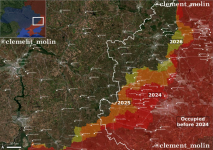
Correct, Russian forces have made almost no gains this year and Russian casualties continue to be enormous. 1.6-1.7M dead and wounded.
The narrative that Russia is winning the attritional war and Ukraines lines will collapse that Russian sycophants have been peddling for the last 3 years just hasn’t held up at all. Russian gains keep declining.
F-22Raptor
Elite Member
Ukr strikes in Russia in recent days
Soldier35
Trusted Member
Footage shows strikes by a Russian 300mm "Tornado-S" multiple launch rocket system (MLRS) on two buildings housing Ukrainian drone operators. The video also captures the arrival of a group of Ukrainian soldiers. The footage depicts two strikes by a "Tornado-S" (possibly a "Sarma" variant) in the Kharkiv region, specifically in the settlement of Velykyi Burluk. Judging by the video, one of the rockets struck the edge of a building.
Pakistan Defence Latest
-
 Federal cabinet gives nod to imposition of emergency in KP; summary sent to president (18 Viewers)
- Latest: hydrabadi_arab
-

-
Somalia Reportedly Agrees to Acquire Pakistan’s JF-17 Fighter Jets (6 Viewers)
- Latest: Pakistan First
-
-


