RescueRanger
Meme Lord

- Thread starter
- #16
When Disaster Strikes
Introduction
Disaster risk reduction and management have become key concepts in present-day development practices across the world. Globally and regionally, we are experiencing a constant increase in socioeconomic losses due to disasters.
Geological, ecological and climatic changes are persistently mounting disaster threats for the world community in general and developing nations in particular. With Little or no warning, disasters and emergencies can happen. The local government’s ability to respond to these incidents can be quickly overwhelmed.
What is Disaster?
A disaster happens when a hazard impacts upon a vulnerable population and causes damage, casualties and disruption. An earthquake in an uninhabited desert cannot be considered a disaster, no matter how strong the intensity may be.
What is a Hazard?
A dangerous phenomenon, substance, human activity or condition that may cause loss of life, injury or other health impacts, property damage, loss of livelihoods and services, social and economic disruption, or environmental damage.
Classification of Hazards
Hazards are classified into the following major categories:
1.Natural hazards i.e: earthquakes
2.Hydro-metrological hazards
3.Geological hazards
4.Human induced or socio-nature hazards
5.Technological hazards
6.Biological hazards
2. Natural hazards: Natural process or phenomenon that may cause loss of life, injury or other health impacts, property damage, loss of livelihoods and services, social and economic disruption, or environmental damage. Natural hazards are a sub-set of all hazards. The term is used to describe actual hazard events as well as the latent hazard conditions that may give rise to future events. Natural hazard events can be characterized by their magnitude or intensity, speed of onset, duration and areas of extent.
For example, earthquakes have short duration and usually affect a relatively small region, whereas, droughts are slow to develop and often affect larger regions. In some cases, one hazard may be triggered by another hazard, such as the flood caused by a hurricane or the tsunami that is created by an earthquake.
2.Hydro-metrological hazards: Hydro-meteorological hazards include tropical cyclones (also known as typhoons and hurricanes), thunderstorms, hailstorms, tornados, blizzards, and avalanches, floods including flash floods, heat waves and cold spells. Hydro-meteorological conditions can also be contributing factor in other hazards such as landslides, wild fires, locust plagues, epidemics, dispersal of toxic substances and volcanic eruption.
3.Geological hazards: Geological process or phenomenon that may cause loss of life, injury or other health impacts, property damage, loss of livelihoods and services, social and economic disruption, or environmental damage, such as, earthquake, volcanic eruption, land movement, rock fall, glacial surge, etc.
4.Human induced or socio-natural hazards: The phenomenon of increased occurrence of certain geo-physical and hydro-meteorological hazardous events, such as landslides, floods, land subsidence and drought that arise from the interaction of natural hazards with over exploited or degraded land and environmental resources.
This term is used to describe the circumstances where human activity is increasing the occurrence of certain hazards beyond their natural probabilities. Socio-natural hazards can be reduced and avoided through wise management of land and environmental resources.
5.Technological hazards: A hazard originating from technological or industrial conditions, including scientific accidents, dangerous procedures, infrastructure failures or specific human activities that may cause loss of life, injury, illness or other health impacts, property damage, loss of livelihoods and services, social and economic disruption, or environmental damage.
Examples of technological hazards include industrial pollution, nuclear radiation, toxic waste, dam failure, transport accident, factory explosion and chemical spill. Technological hazards may also arise directly as a result of the impacts of a natural hazard.
6.Biological hazard: Process or phenomenon of organic origin which is conveyed by biological vectors, including exposure to pathogenic microorganisms, toxins and bioactive substances that may cause loss of life, injury, illness or other health impacts, property damage, loss of livelihoods and services, social and economic disruption, or environmental damage. Examples of biological hazards include outbreaks of epidemic disease, plant or animal contagion, insect plagues and infestations.
What do we mean my Vulnerability?
The characteristics and circumstances of a community, system or asset that make it susceptible to the damaging effects of a hazard. Anderson and Woodrow (1990) categorized vulnerabilities into three areas:
1.Physical and material vulnerability: For example, poor people who have few physical and material resources usually suffer more from disasters than rich people. People who are poor often live on marginal lands, they don’t have any savings or insurance and they are in poor health. These factors make them more vulnerable to disasters which means that they have harder time surviving and recovering from a calamity than people who are better off economically.
2.Social and organizational vulnerability: People who have been marginalized in social, economic or political terms are vulnerable to suffer more from disasters whereas groups, which are well organized and have higher commitment towards their members, suffer comparatively less during disasters.
Weakness in social and organizational areas may also cause disasters. For example, deep divisions can lead to conflict and war. Conflict over resources due to poverty can also lead to violence. A second area of vulnerability then is the social and organizational aspect of a community.
3.Attitudinal and motivational vulnerability: People who have low confidence in their ability to affect change or who have “lost heart” and feel defeated by events they cannot control are harder hit by disasters than those who have a sense of their ability to bring the change they desire. Thus, the third area of vulnerability is the attitudinal and motivational aspect.
What is capacity?
The combination of all the strengths, attributes and resources available within a community, society or organization that can be used to achieve agreed goals.
What is Disaster Risk?
Disaster risk is the chance of likelihood of suffering harm and loss as a result of a hazardous event. It closely depends upon the exposure of something to a hazard. This can be expressed as:
Risk = Chance (C) x Loss (L)
The output of risk analysis is usually an estimation of the risk scenarios.
Table: History of Disasters in Pakistan: 1935 to 2015
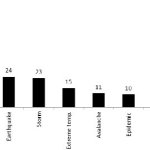
Source: National Disaster Management Authority – Pakistan
What is Disaster risk reduction?
Disaster risk reduction is the concept and practice of reducing disaster risks through systematic efforts to analyze and manage the causal factors of disasters through reduced exposure to hazards, lessened vulnerability of people and property, wise management of land and the environment and improved preparedness for adverse events.
What is Disaster Management?
Disaster management is a collective term encompassing all aspects of planning for and responding to disasters, including both pre and post disaster activities. It refers to the management of both the risks and the consequences of disasters.
Preparedness – activities prior to a disaster. Examples: Preparedness plans, emergency exercises, disaster preparedness training and warning systems.
Response – activities during a disaster. Examples: Public warning systems, emergency operations, search and rescue.
Recovery – activities following a disaster. Examples: Temporary housing, claims processing and grants, long-term medical care and counselling.
Mitigation – activities that reduce the effects of disasters. Examples: Building codes and zoning, vulnerability analysis and public education.
What is mitigation?
The efforts for lessening or limitation of the adverse impacts of hazards and related disasters in pre, during and post disaster scenarios.
What is Disaster Preparedness?
The knowledge and capacities developed by governments, professional response and recovery organizations, communities and individuals to effectively anticipate, respond to, and recover from, the impacts of likely, imminent or current hazard events or conditions.
What is Resilience?
The ability of a system, community or society exposed to hazards to resist, absorb, accommodate to and recover from the effects of a hazard in a timely and efficient manner, through the preservation and restoration of its essential basic structures and functions.
Resilience means the ability to “resile from” or “spring back from” a shock. The resilience of a community, with respect to potential hazard events, is determined by the degree to which the community has the necessary resources and is capable of organizing itself both prior to and during times of need.
Why community based disaster preparedness is important:
The flash flooding in September 2014 have again exposed the chink in Pakistan’s Disaster Management system, historically the country has seen devastating floods as recent as 2010 and 2011 which wreaked havoc leading to 1,985 deaths, an estimated 800,000 people homeless and over US$ 10.9bn in post disaster reconstruction and rehabilitation costs.[1]
A briefing paper published by the think tank German Watch, lists Pakistan as among the top ten countries that are the most vulnerable to climate change effects, in addition to natural hazards such as earthquakes; man-made hazards such as fire are a leading cause of loss of life and property with an estimated 16,500 deaths, 164,000 injuries and insurance claims estimated at around Rs.400 Billion.[2]
Whilst the government emergency service and disaster management apparatus has improved leaps and bounds since the catastrophic events of 2005, the approach towards community based disaster risk reduction continues to be reactive at best.[3]
Interventions from humanitarian agencies and non-governmental organizations to strengthen disaster resilience have in many cases duplicated efforts.
These well-meaning efforts are a welcome breath of fresh air considering Pakistan is prone to a wide variety of natural and manmade hazards, the general approach has always been to initiate programs through what is referred to as an implementation partner, this approach has sound logic and merit as it offers transparency, accountability and most importantly sustainability.
It can be argued however that this system is self-limiting based on the funds and remit of the program and the reach of the implementation partner.
What happens when the funds dry out? Or the program comes to an end? And then comes the reality that whenever a disaster or emergency occurs, more often than not; it is the ordinary members of that community or the bystanders that are the first on scene.
However as we have all too often witnessed, so many precious lives are lost at road traffic accidents because someone didn’t know basic first aid, or people die due to inadequate fire safety or personal safety education at home or in the workplace.
Therefore now more than ever community based disaster risk reduction and safety education is vital, Rescue 1122 CADRE program[4] is a step in the right direction, however as the Latin phrase goes: non omnia possumus omnes “We all can’t do everything” it is important for ordinary citizens to think “Disaster Preparedness”.
Over the years, Pakistanis have developed a strong sense of security culture, we wouldn’t walk down a dark alley alone at night, or leave our car unlocked with the keys inside in the forecourt of a petrol station; we take these countermeasures to protect our valuable assets, yet why do we neglect our most valuable assets, our lives and the lives of our loved ones?
In his book “Facing the Humanitarian Challenge: Towards a Culture of Prevention” the Nobel Peace Prize winner Kofi Annan stated “More effective prevention strategies would not only save tens of billions of dollars, but save tens of thousands of lives.” And this opinion is backed by a UNDP publication which reported that $1 spent on disaster prevention can save $7 spent on disaster relief.[5]

Because affected civilians will be the “first responders”, the process of organizing local residents must take place before, during, and after such catastrophic events occur. When a disaster strikes experts state that members of the community may be without help for anywhere up to 72 hours or even longer.[6] Hence, community based response is the first entity on scene that can save lives of those around them and survive a disaster.
Community preparedness doesn’t have to be complex, it can be as simple as a family getting together and making an emergency plan; which will let you know what to do and where to go for help if there’s a warning issued or a hazard observed.
You can learn first aid, how to extinguish a fire and create an emergency kit in case you need to evacuate your home.
References:
United Nations OCHA: http://www.unocha.org/
Sven Harmeling, Global Climate Risk Index 2012: http://germanwatch.org/klima/cri.pdf
Ikram Junaidi, Sep 12, 2014 Disaster Management ‘not a priority’: http://www.dawn.com/news/1131474
A step forward: Rescue 1122 volunteers to be trained on disaster management:http://tribune.com.pk/story/769971/...unteers-to-be-trained-on-disaster-management/
UNDP: Act Now, Save Later: http://www.undp.org/content/undp/en/home/ourwork/get_involved/ActNow/
http://www.masc.sc/programs/solutio...Culture-of-preparedness-The-72-hour-rule.aspx
Useful websites:
www.ndma.gov.pk
www.Rescue.gov.pk
www.Dpart.org
www.Unisdr.org