Another relevant topic is that of desertification and the reversal of it.
United for Land: Saudi Arabia's Local Heroes Combat Desertification
14 June 2024
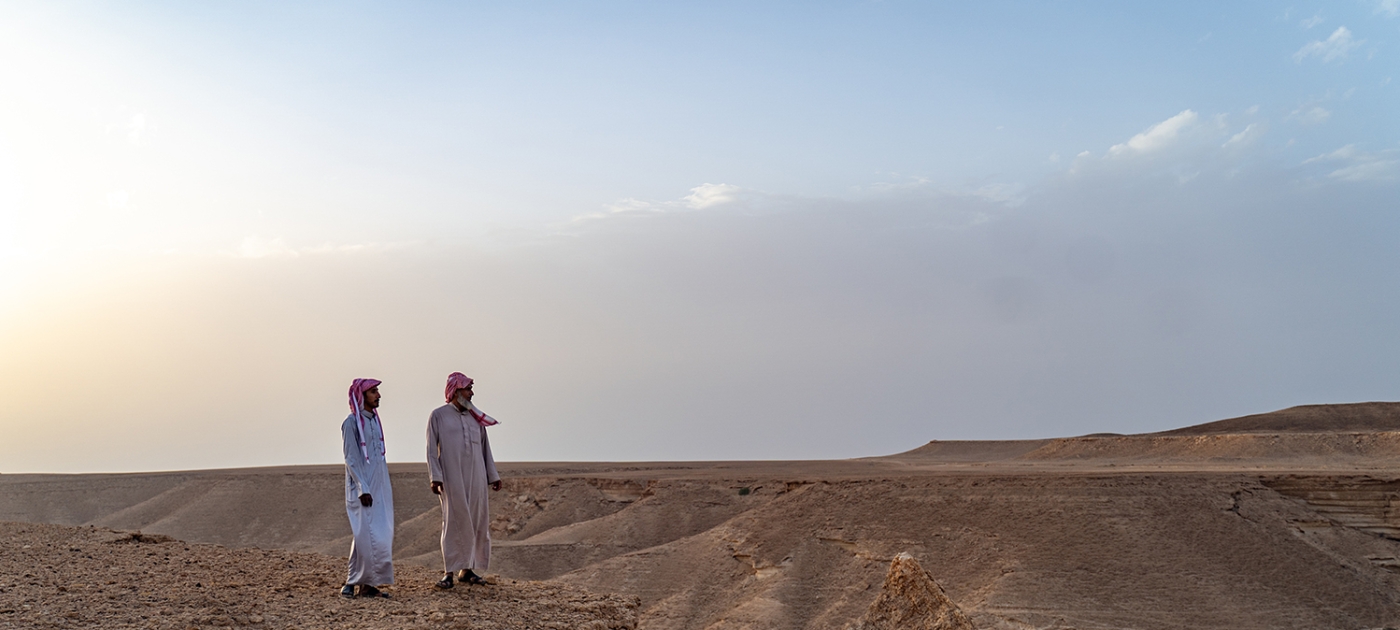
Caption: Local community leaders in Saudi Arabia are helping drive the country's ambitious agenda on sustainable land management and biodiversity conservation.
Photo: © UNEP/ Duncan Moore
In Saudi Arabia, land stewardship is an indispensable part of economy and identity. Over the years, rapid development and overgrazing, combined with rising temperatures have threatened soil quality and biodiversity, and exacerbated water scarcity.
Combating desertification has fast become a pressing concern for the country. With the aim of restoring 200 million hectares of degraded land at home and abroad, Saudi Arabia has extended safeguards for 18 per cent of its land, up from 4 per cent earlier, and has steadily increased the number of national parks.
In December this year, the country is all set to host the 16th Conference of Parties for the UN Convention to Combat Desertification in Riyadh. This conference will convene global leaders to address the urgent need to halt and reverse land degradation, with a goal to restore 1.5 billion hectares of degraded land, globally, by 2030.
Under the leadership of UN Resident Coordinator Mohamed El Zarkani, UN entities are joining hands to bolster the Kingdom’s initiatives to promote land restoration and climate resilient practices. Collaborations among diverse stakeholders and the United Nations Environment Programme (UNEP), the Food and Agriculture Organization (FAO), and the United Nations Convention to Combat Desertification (UNCCD) are ensuring that there is a united commitment to sustainable land management.
“I applaud Saudi Arabia's regional and global leadership on land restoration and drought resilience," said the Resident Coordinator. "We witnessed this leadership in initiatives such as the Saudi Green Initiative, Middle East Green Initiative, and G20 Global Land Initiative - all Saudi driven efforts built on international cooperation and partnership and culminating towards key global commitments to protect and restore lands. Hosting COP16 in Riyadh this year will be another key milestone in Saudi Arabia’s inspiring journey to combat desertification. Collaboration between the Saudi government, local communities, and UN Agencies, Funds, and Programmes, is a central feature to drive the land agenda forward while exemplifying the power of partnerships."
A few weeks ago, Saudi Arabia hosted World Environment Day, focusing on land restoration, desertification, and drought resilience. UNEP Executive Director Inger Andersen emphasized: “Land degradation, desertification and drought are not only arid nation problems. They are global problems,” underscoring the necessity of collective action.
The government, represented by the Ministry of Environment, Water, and Agriculture, is working closely with community leaders to implement nature-based solutions that combat desertification and drought, restoring the land.
Saudi Arabia's Local Heroes in Land Restoration
Abdullah Ibrahim Alissa: Reviving Thadiq National Park
Abdullah Ibrahim Alissa stands on a rocky outcrop in Thadiq National Park, a sprawling expanse of arid land north of Riyadh. As the park’s manager, Alissa has overseen the transformation of this area from desert to a thriving nature spot. Beneath him, steep terraces lined with carefully cultivated shrubs and small trees flourish, a testament to the successful afforestation projects he has spearheaded.
"I grew up in this area, and since childhood, I have seen it deteriorate and become a desert," Alissa shares. Through dedicated efforts under the Saudi Green Initiative, involving planting 250,000 trees and 1 million shrubs, the park has steadily been rejuvenated. Alissa’s work highlights the significant impact of community-driven restoration efforts and showcases the potential for reversing desertification through local action. Focusing on nature-based solutions to restore degraded land, the park has continued to grow trees in nurseries, planting mostly native species. Initiatives like these are marking the
UN Decade on Ecosystem Restoration. Read more about Alissa’s story and Saudi Arabia’s trajectory to regreening
here.
Sidr Al-Jawf Community: Resilience and Innovation in Al-Adhraa National Park
“Our strong bond with the land weaves us together, creating timeless connections that breathe life into our past, present, and future,” says a member of the Sidr Al-Jawf Community.
Situated near desert terrain, Al-Adhraa national park has a deep connection with the community influencing both recreational activities and the villagers' sense of identity. Observing the gradual decline of vegetation due to desertification, the community undertook a rehabilitation project in 2017. Despite initial setbacks due to insufficient support and technical knowledge, the group persisted.
“We never gave up! Drawing lessons from past setbacks, we formed a volunteer environmental team and set up the 'Al-Adhraa National Park' in a new location closer to the village,” shared a community member from Sidr Al-Jawf. Inspired by their resilience, FAO and Saudi Arabia’s National Center for Vegetation Development and Combating Desertification (NCVC) collaborated to support the larger Al-Adhraa community.
Caption: Revitalizing Al-Adhraa national park for future generations.
Photo: © FAO Saudi Arabia
The FAO and NCVC provided expertise, technical guidance, and a distance training course, significantly improving the skill and knowledge of community members and the efficiency of work in the park. “
The community's significant increase in awareness led them to officially register the “Sidr Al-Jawf Association” as the “Sidr Wild Trees Association” with the status of a National Center for the Non-Profit Sector. A study trip to China to learn similar practices, organized by FAO and NCVC, has further motivated the community.
Naif Ahmed Alhanwsh: Guardianship of Saudi Biodiversity
It was Naif Ahmed Alhanwsh’s childhood dream to become a veterinarian. However, he never imagined he would play a pivotal role in safeguarding Saudi Arabia’s biodiversity. Now the veterinarian and director of the King Khalid Centre for Wildlife Research, located around 70 kilometers north of Riyadh, Alhanwsh is at the forefront of breeding, rearing, and releasing endangered native species.
“It is an indescribable feeling to release animals into their natural habitat. It is so beautiful,” says Alhanwsh. The King Khalid Centre, established on what was a royal farm in 1987, is home to some of the most iconic wild animals in the Arabian Peninsula, including large-hooved mammals like the oryx. Alhanwsh's efforts are part of an ambitious national plan to rewild Saudi Arabia and prevent further land degradation, demonstrating how individual dedication can contribute to broader environmental goals. Learn more about his story
here.
Similar UN initiatives are helping promote innovative and resilient agricultural practices, ecotourism and more, empowering local farmers, cooperatives and communities.
Towards a Sustainable Future
As the world gathers under the banner of “United for Land,” marking the
World Day to Combat Drought and Desertification on June 17th, Saudi Arabia’s local heroes and collaborative efforts serve as powerful examples of what can be achieved through dedication, collaboration, and community engagement. The road to restoring our planet’s lands is challenging, but these initiatives demonstrate the journey is worthwhile.
As we look towards COP16, this spirit of unity and resilience will be crucial in securing a sustainable legacy for future generations.
For more information about the UN's work in Saudi Arabia, visit saudiarabia.un.org
06 May 2024
Story Nature Action
Saudi Arabia strives to regreen deserts to tackle drought and land degradation
Photo by UNEP/Duncan Moore
Abdullah Ibrahim Alissa is standing on a rocky outcrop in Thadiq National Park, a sprawling expanse of arid land north of Riyadh, capital of the Kingdom of Saudi Arabia.
Beneath Alissa, the park’s manager, are steep terraces lined with carefully cultivated shrubs and small trees, a flourish of greenery that has turned this place from a desert to a desired nature spot.
“I grew up in this area, and since childhood I have seen it deteriorate and become desertified,” Alissa says. “[But] through afforestation projects, protection and care, the area has completely changed.”
Rehabilitating this 600-square kilometre-park, known for its sweeping valleys, involved planting 250,000 trees and 1 million shrubs. Crews also constructed terraced dams to catch the area’s sparse rainwater.
Restoring Thadiq National Park is part of Saudi Arabia’s wider plan to regreen huge swathes of desert at home and abroad. The push is designed to tackle drought, desertification, and land degradation, which are threatening countries across West Asia and North Africa.
Three-quarters of the arable land in the region is already degraded, and 60 per cent of the population is already experiencing
water scarcity, a number set to increase by 2050.
"Land is a fundamental pillar of life, and together with the ocean and the climate, is vital for sustaining life on this Earth,” says Osama Ibrahim Faqeeha, Saudi Arabia's Deputy Minister of Environment.
On 5 June, Saudi Arabia will host
World Environment Day 2024, an annual celebration of the planet which this year focuses on desertification, land degradation and drought resilience.
More than
2 billion hectares of the world’s land is degraded,
affecting half the global population, and
threatening countless species.
Faced with more
severe and prolonged droughts,
sandstorms and
rising temperatures, finding ways to stop dry land from becoming desert,
fresh water sources from evaporating, and
fertile soil from turning to dust, is now crucial, say experts.
Saudi Arabia, where rapid development and an increase in cattle grazing has led to land degradation, has made countering desertification a priority.
Launched in March 2021, the
Saudi Green Initiative aims to turn 30 percent of Saudi Arabia’s land into nature reserves, plant 10 billion trees and restore 40 million hectares of degraded land.
“The country's goal is to plant 400 million trees by 2030,” says Khaled Alabdulkader, the CEO of Saudi Arabia’s
National Center for Vegetation Cover Development and Combating Desertification.
Saplings growing in a tree nursery at Thadiq National Park in central Saudi Arabia, where desert regreening efforts have involved planting 250,000 trees. Photo by UNEP/Duncan Moore
“The Saudi Green Initiative demonstrates the immense potential of cultural capital and traditional wisdom for managing the natural environment,” says Susan Gardner, the Director of the Ecosystems Division at the United Nations Environment Programme (UNEP). “Such approaches, grounded in tradition and tailored to the local context, are vitally important in a region that faces multiple stressors leading to land degradation and desertification.”
Thadiq National Park manager Abdullah Ibrahim Alissa surveys saplings at a tree nursery in a desert area of central Saudi Arabia that is being regreened to combat land degradation, desertification and drought. Photo by UNEP/Duncan Moore
Through the
Middle East Green Initiative, Saudi Arabia is leading efforts to plant an additional 40 billion trees across the region with the aim of reducing soil erosion, protecting biodiversity, and mitigating the impacts of climate change. The combined 50 billion trees target represents five per cent of the global afforestation target, and the equivalent of restoring 200 million hectares of degraded land.
Saudi Arabia has also partnered with the Group of 20 nations and United Nations Convention to Combat Desertification (UNCCD) to launch the
G20 Global Land Initiative, which aims to cut degradation by 50 per cent by 2040. As well, Saudi Arabia will host the 16th Conference of Parties for the UNCCD, widely seen as a pivotal moment in the global effort to end land degradation.
Globally, countries have pledged to restore
one billion hectares of land – an area larger than China, under the
UN Decade on Ecosystem Restoration. But if current trends persist,
1.5 billion hectares would need restoring to meet 2030 land degradation neutrality goals.
“Land protection and restoration activities deliver positive biodiversity outcomes as well as multiple benefits for people, including water and food security, public health and wellbeing, climate mitigation and adaptation,” says UNEP’s Gardner.
Community members and conservationists have planted more than a million shrubs in Thadiq National Park to restore degraded land and tackle drought and desertification. Photo by UNEP/Duncan Moore
Back in Thadiq National Park, Alissa and other conservationists have been buoyed by the return of birds to the area, which had seen an exodus of animals as desertification intensified.
Some 100 walled water terraces, extending like steps to the bottom of valleys, capture rainwater to sustain shrubs and saplings through sweltering summers. They also stop heavy winter rains from washing productive soils away.
“We inherited water terraces from our ancestors about 400 years ago,” says Alissa. “We used this technique in the park, and it is doing an excellent job at increasing the surface water.”
Thadiq National Park manager Abdullah Ibrahim Alissa and other community conservationists in central Saudi Arabia are proud of the afforestation work that has turned this desert area into a desired nature spot. Photo by UNEP/Duncan Moore
Focusing on
nature-based solutions to restore
degraded land, the park has continued to grow trees in nurseries, planting mostly native species.
“I hope we can double our work and results, increasing afforestation and replicating the achievement in other locations,” Alissa says.
World Environment Day on 5 June is the biggest international day for the environment. Led by the United Nations Environment Programme (UNEP) and held annually since 1973, the event has grown to be the largest global platform for environmental outreach, with millions of people from across the world engaging to protect the planet. World Environment Day in 2024 focuses on land restoration, desertification and drought resilience.
Saudi Arabia pledges to plant tens of billions of trees in the country and wider region to combat drought, desertification, and land degradation.

www.unep.org
https://www.unep.org/topics/sustain...-sustainable-development-goals-matter/goal-11








 The largest asset management company in the world
 The ideal opportunity for the investment that I saw in my career