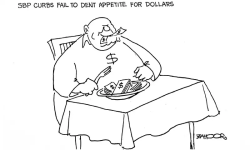
SBP - Banking Sector / Federal Board of Revenue

Pakistan receives $2bn from Saudi Arabia: State Bank

News Desk
April 16, 2026

The State Bank of Pakistan (SBP) confirmed on Thursday that Pakistan has received $2 billion from the Kingdom of Saudi Arabia.

The central bank said the funds were received “in the value date of 15April2026”.

The development comes amid Prime Minister Shehbaz Sharif’s visit to Saudi Arabia to push diplomatic efforts to promote peace in the Middle East.

A day earlier, the kingdom pledged an additional $3bn in deposits for Pakistan and extended its existing $5bn facility for a further three years.

Finance Minister Muhammad Aurangzeb said that the existing $5bn Saudi deposit would no longer be subject to the previous annual rollover arrangement and would instead be extended for a longer term.

Pakistan will reportedly return a $3.5bn loan to the UAE this month, putting pressure on its reserves and risking breaches of its International Monetary Fund (IMF) programme targets.

The development comes at a sensitive time for the country’s external account position, which is already under strain from rising global oil prices and economic spillovers linked to tensions in the Middle East.
 
Pakistan’s foreign exchange reserves stood at $16.4bn as of March 27, sufficient to cover close to three months of imports. However, the repayment requirement from the UAE has added fresh pressure on the country’s external buffers.

In March, Islamabad failed to secure an agreement with the UAE to roll over the $3.5bn facility, marking the first such failure in seven years and raising concerns about near-term financing gaps.

Pakistan’s foreign exchange position, though under pressure, remains part of a broader stabilisation effort under IMF-supported reforms.

Analysts say external financing risks remain a key vulnerability, particularly amid volatile energy prices and constrained global capital markets.
 

Pakistan returns $2 billion more to UAE​


Pakistan repaid $2bn UAE debt via Saudi loan, totalling $2.5bn returned to Abu Dhabi this week

Shahbaz Rana
April 18, 2026

the finance ministry officials said that pakistan would pay the remaining 1 billion uae debt on coming thursday photo pixabay


The finance ministry officials said that Pakistan would pay the remaining $1 billion UAE debt on coming Thursday. PHOTO: PIXABAY

ISLAMABAD: Pakistan on Saturday repaid a $2 billion debt to the United Arab Emirates after seven years, further reducing its dependence on the Gulf nation whose support allowed Islamabad to sail through two economic crises of 2018 and 2023.

Pakistan returned the $2b UAE debt by taking a new debt from Saudi Arabia, bringing the total repayments to Abu Dhabi this week to $2.5b, according to government officials.

The finance ministry had not factored in these repayments till the end of last month and had assured the International Monetary Fund (IMF) that its external financing requirements were fully met on the back of rollovers by China, Saudi Arabia and the UAE.

The Pakistan Tehreek-e-Insaf government took the $2b loan in 2018 to sustain foreign exchange reserves that were on a downward trajectory due to delays in reaching a deal with the IMF. Another $450m UAE loan that Islamabad paid early this week was taken in 1996-97 for a year, which Pakistan returned after 30 years.
 
To view this content we will need your consent to set third party cookies.
For more detailed information, see our cookies page.
 
To view this content we will need your consent to set third party cookies.
For more detailed information, see our cookies page.
 
To view this content we will need your consent to set third party cookies.
For more detailed information, see our cookies page.
 
“This completes the repayment of total deposits of $3.45 billion to UAE,” said the SBP in a post on X.

A senior official said earlier this month that Pakistan had decided to return $3.5 billion in debt to the UAE before the end of this month.

The official described the move as a cost the country was willing to bear to uphold “national dignity”, even as it is set to significantly draw down foreign exchange reserves.

These funds were part of external financing support extended by the UAE in 2019 to help stabilise Pakistan’s balance of payments.

In March, Islamabad failed to secure an agreement with the UAE to roll over the $3.5bn facility, marking the first such failure in seven years and raising concerns about near-term financing gaps.

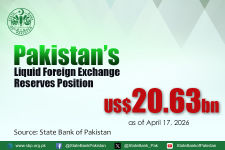
In a separate post on X, a day earlier, the SBP said foreign reserves held by the country stood at $20.63bn as of April 17.
 

Central bank increases policy rate by 100 bps to 11.5pc

News Desk Reuters
April 27, 2026

The State Bank of Pakistan (SBP) on Monday raised its key policy rate to 11.5 per cent.

In its meeting today, the Monetary Policy Committee (MPC) “decided to raise the policy rate by 100 basis points to 11.50pc” with effect from Tuesday, the SBP said in a statement.

It added that a detailed monetary policy statement will be released later.
 
To view this content we will need your consent to set third party cookies.
For more detailed information, see our cookies page.
 
The hike is the first in almost three years, as rising oil prices from the US-Israel war on Iran threatened to push inflation higher in the import-dependent nation.

The decision was in line with market expectations that the interest rate was bound to see a rise in today’s announcement.

While there was consensus among most researchers, bankers and other stakeholders that the interest rate would rise, opinions had been divided over the size of the hike.

A higher interest rate will yield more money for exporters and remitters but create serious problems for importers. It will also increase the debt burden of the government, which borrows heavily from banks and corporates to accumulate liquidity needed to run the government.

“The risks in the Gulf war are unseen and so uncertain that nobody can claim that the economy of Pakistan and other countries like it would remain in the same shape as it is now,” a financial expert earlier told Dawn.

He added that inflation could entirely change the economy, with greater uncertainty, in the form of a sharp decline in manufacturing and a further increase in existing poverty.

The Pakistan Stock Exchange (PSX) mostly traded in the red ahead of the MPC announcement, closing with a decline of 1,174.69 points compared to the previous session.

The SBP has cut rates by a cumulative 1,150bps since June 2024, from a record high of 22pc.
 

Users who are viewing this thread

Back
Top