SBP - Banking Sector / Federal Board of Revenue

Pakistan's GDP growth for FY26 to remain above govt estimate, says SBP chief

  • Workers' remittances estimated to hit above $41.5bn
July 3, 2026
Salman Siddiqui
B Recorder

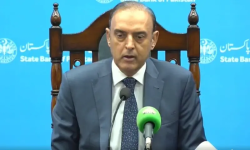
State Bank of Pakistan (SBP) Governor Jameel Ahmad on Friday projected that the country’s economic growth will be higher than the government’s provisional growth number at 3.7% for FY26.

Speaking at a press conference, Ahmad said that the country’s GDP growth is expected to be around 3.75-4.75% in FY26.

“Earlier, we expected GDP growth of over 4%, but due to the ongoing Middle East crisis, the growth is expected to be lower than that,” he said.
 
During FY 2026, Pakistan’s foreign exchange reserves, held by the central bank, surged to $18.4 billion, up from $13 billion registered FY 2025.

“The FX has increased despite a debt repayment of $8 billion in June alone,” he said.
 

Aurangzeb says digital tax reforms a must to boost revenue

July 4, 2026
B Recorder

FAISALABAD: A fully digitalised taxation system is imperative to eliminate leakages in addition to enhancing collection without creating any hassle to the taxpayers, said Federal Minister for Finance and Revenue Senator Muhammad Aurangzeb.

Addressing the business community here at Faisalabad Chamber of Commerce & Industry (FCCI) on Friday, he said that this is not a post-budget conference but actually the beginning of preparations for the budget for FY 2027-2028.

He said that the finance division is responsible for budget preparation while the Federal Board of Revenue (FBR) would look after the matters of tax administration and tax collection only.

Underlining the importance of the private sector, he said that it has to lead the economy to put Pakistan on a growth trajectory.

About financing, the minster said that the interest rate has been trimmed from 22 percent to 11.5 percent. “It could be further brought down if the Iran conflict is resolved immediately,” he opined.
 

FBR excludes agri income from tax expenditure purview

July 4, 2026
Sohail Sarfraz
B Recorder

ISLAMABAD: The Federal Board of Revenue (FBR) has excluded agricultural income, which falls outside the scope of federal income taxation, from the purview of annual tax expenditure (cost of tax exemptions).

According to the FBR’s new report on tax expenditure-2026, the cost of tax exemptions has not been calculated on the agricultural income. The revenue loss on account of agricultural income is not part of the FBR’s tax expenditure.

The report said that certain concessions and exemptions are treated as structural elements of the tax base or are granted in compliance with international obligations. Such provisions are not regarded as deviations from the benchmark tax system and are therefore excluded from the estimation of tax expenditures in this report.
 

ADB keeps Pakistan's growth outlook unchanged at 3.7pc for current fiscal year

Khaleeq Kiani
July 9, 2026

1783594456253.png


A farmer uses a tractor to plough a field on the outskirts of Lahore on July 8, 2026. — AFP

ISLAMABAD: The Asian Development Bank (ADB) on Thursday left its forecast for Pakistan’s economic growth unchanged at 3.7 per cent and projected inflation at 8.3pc for the current fiscal year, slightly higher than the government’s estimate.

In its Asian Development Outlook (ADO) July 2026, the Manila-based lender, however, lowered its growth forecast for developing Asia and the Pacific to 4.9pc for 2026 from 5.5pc in 2025, marking a 0.2-percentage-point reduction from its April projections.
 

Central bank keeps policy rate unchanged at 11.5pc

News Desk
July 27, 2026

1785151388013.png

SBP Governor Jameel Ahmed addresses a press conference. — DawnNewsTV

The State Bank of Pakistan’s (SBP) Monetary Policy Committee (MPC) on Monday kept the interest rate unchanged at 11.5 per cent.

The decision was announced by SBP Governor Jameel Ahmed during a press conference.

At the outset of the press conference, the governor said, “MPC has decided to keep the policy rate unchanged at 11.5pc”.

“There were several reasons for this, but I would like to explain some background: every time we hold committee meetings in January and July, we also issue projections for the next six months and what would be the level of economic growth, inflation outlook and situation of the external account; I will share that assessment as well.”

The governor explained that in the first half of the previous year, inflation was declining; however, “the fallout from the Middle East crisis impacted our domestic situation”.
 

KSA rolled over $5 billion for three years, SBP governor says​


Due to rollover, Pakistan’s gross external financing requirements have come down to $21.5 billion for the fiscal year

Shahbaz Rana
July 29, 2026

state bank of pakistan governor jameel ahmad photo via x


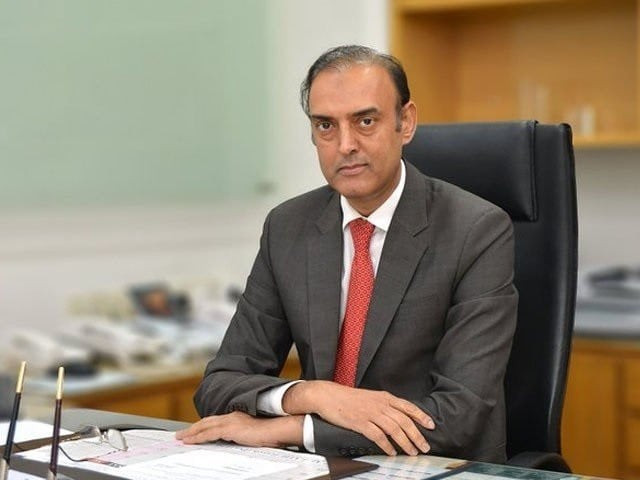
State Bank of Pakistan Governor Jameel Ahmad—PHOTO Via X

Pakistan’s external sector pressure subsided after Saudi Arabia rolled over a $5 billion debt for three years, coupled with $9b in foreign currency purchases from the local market in the last fiscal year, State Bank of Pakistan Governor Jameel Ahmad said on Wednesday.

The "three-to-five-year" rollovers of the short-term debts, which Pakistan had taken many years ago for one year, are part of the government’s new strategy to delay repayments and get breathing space before kick-starting the economy.

Due to the rollover of $5b cash deposits by Saudi Arabia till December 2028, Pakistan’s gross external financing requirements have come down to $21.5b for this fiscal year, the governor said while talking to The Express Tribune here in the Parliament House.

Pakistan has taken a total of $8b in cash deposits from Saudi Arabia, including $3b obtained in April this year. Out of this, the $5b deposits were rolled over every year before the kingdom granted some breathing space by giving up to a three-year extension.
 
In April this year, Finance Minister Muhammad Aurangzeb said that the kingdom had extended a $5b deposit for a longer period, but he did not share further details about its next maturity.

In addition, Saudi Arabia had given $3b for three months, which also matured this month but was further rolled over. The central bank governor did not comment on whether the remaining $3b has been rolled over for three months or for a longer period.

Ahmad said that the interest costs on foreign debts have also reduced by nearly half a billion dollars, which also contributed to lowering the overall gross financing requirements for this fiscal year.

The external gross financing requirements are the sums needed to meet the external obligations. Pakistan has remained heavily dependent on foreign creditors for meeting its external financing needs for debt repayments and funding the current account deficit.

Exports and foreign direct investment could not improve despite multi-front efforts, and in a latest push, the federal government approved Rs98b in subsidies for exporters for this fiscal year alone.
 
For the next fiscal year, the International Monetary Fund has projected $30b in external financing requirements.

But the governor said that the IMF’s projections for the next fiscal year were on the higher side, as the government was making efforts, and their success would bring down the overall external financing requirements even below this year’s level of $21.5b.

The government has reportedly reached out to Saudi Arabia and the United States for additional financing on a longer term to lessen the immediate heavy repayment requirements.
 

PM directs FBR to roll out digital production monitoring in five more sectors by December

  • Individuals and businesses involved in informal economic activities and tax evasion should be identified, says PM
Prime Minister Shehbaz Sharif directed the federal tax collecting authority on Wednesday that a system for digital monitoring of production in the textile, beverages, steel, poultry, edible oil and ghee, and tyres sectors should be made operational by December.

“A weekly review meeting on FBR reforms was held under the chairmanship of Prime Minister Muhammad Shehbaz Sharif, in which a detailed review of progress on increasing revenues and institutional reforms was presented,” the Prime Minister’s Office (PMO) said in a statement.

During the meeting, the PM directed that a comprehensive and scientific methodology be developed and presented for estimating tax potential in various sectors. In collaboration with the power sector, individuals and businesses involved in informal economic activities and tax evasion should be identified, and legal action taken against them.

“For the first time in Pakistan’s history, the alignment between data from the sugar production sector and the FBR is clear evidence that the tracking system installed by the FBR is operational and demonstrating improved performance,” he said.

“Individuals and businesses that comply with all regulations within the tax system and facilitate tax collection are a valuable asset to the country and nation and are worthy of appreciation.”

Moreover, the PM said that the government had provided as many facilities as possible to the export and domestic sectors concerning taxes and will continue to do so in the future.

He directed FBR Chairman and senior officers to be present in Karachi during the first week of every month so that the issues of the business community can be heard and resolved promptly.

Moreover, the premier was briefed by the FBR on the installation of the tracking system for the production sector, reforms implemented regarding the workforce in the FBR, and efforts to enhance operational efficiency.

The meeting was informed that the tracking system is fully operational in the sugar, cement, tobacco, tiles, and fertiliser sectors, while implementation in an additional 5 sectors, with a tax potential of more than Rs700 billion, is in its final stages.

“The meeting was further informed that work is underway in collaboration with the sectors to develop and implement the tracking system in 9 production sectors, which will enable the realisation of a tax potential of Rs560 billion.”


The PM directed that the implementation of the tracking system for collecting indirect taxes in the production sector be ensured by the end of this year, added the statement

While briefing on reforms regarding the workforce, the meeting was informed that officers were being trained at the country’s prestigious universities at the time of their recruitment, ensuring adherence to principles of merit and good performance.

The training modules are aligned with international standards and the requirements of Pakistan’s tax system, it was informed.

The meeting was further informed that a system has been introduced in the FBR to recognise officers and officials with better performance and to penalise those with poor performance.

On appointments and transfers in the FBR, the PM said this should be made solely “based on merit”.
 

Users who are viewing this thread

Latest Posts

Back
Top