Pioneer
Registered Member

Declaration on right to hold independence referendums expected to be signed in Cardiff Monday, days after Trump endorsed Irish reunification in visit to Dublin

(L-R) First Minister of Northern Ireland Michelle O'Neill; First Minister of Scotland John Swinney; First Minister of Wales Rhun ap Iorwerth. (AP Photo/Peter Morrison, Andy Buchanan/AFP, Mark Naftalin/AFP) (L-R) First Minister of Northern Ireland Michelle O'Neill; First Minister of Scotland John Swinney; First Minister of Wales Rhun ap Iorwerth. (AP Photo/Peter Morrison, Andy Buchanan/AFP, Mark Naftalin/AFP)
The leaders of Scotland, Wales and Northern Ireland are expected to meet on Monday in the Welsh capital of Cardiff to sign a declaration aimed at achieving independence from England and dissolving the United Kingdom of Great Britain and Northern Ireland, the UK’s Telegraph newspaper reported Sunday, a day after US President Donald Trump announced his support for Irish reunification.
According to The Telegraph, the declaration will assert the right of the three countries — which, along with England, make up the UK — to hold independence referendums and, should their populations vote in favor, split off from England.
The declaration signed by Scotland’s John Swinney, Wales’s Rhun ap Iorwerth and Northern Ireland’s Michelle O’Neill will cover four key areas, according to the report: economy, energy, Europe, and international cooperation and self-determination.
It will state that Scotland and Wales wish to enter the European Union as new members, and that Northern Ireland will enter the EU by way of unifying with the Republic of Ireland, which is already a member.
Wales, according to the report, will use the agreement as a way to pressure Prime Minister Andy Burnham to hand over additional powers to the devolved Welsh government, particularly relating to tax and spending.
The reported move comes after Wales elected pro-independence party Plaid Cymru in its 2026 parliamentary election, pushing out the Welsh Labour Party for the first time since the establishment of the devolved Welsh government in 1999.
This means that, for the first time, Scotland, Wales and Northern Ireland are simultaneously governed, fully or in part, by pro-independence parties — Scotland by the Scottish National Party (SNP) and Northern Ireland by a power-sharing government comprised of loyalist DUP and Irish republican party Sinn Féin.
The expected meeting in Cardiff on Monday will come two days after Trump surprised officials in Dublin and annoyed pro-British politicians in Northern Ireland and London by enthusiastically backing Irish unity during a visit to Dublin on Saturday, saying he would “love” to see it happen sooner rather than later.
It will state that Scotland and Wales wish to enter the European Union as new members, and that Northern Ireland will enter the EU by way of unifying with the Republic of Ireland, which is already a member.
Wales, according to the report, will use the agreement as a way to pressure Prime Minister Andy Burnham to hand over additional powers to the devolved Welsh government, particularly relating to tax and spending.
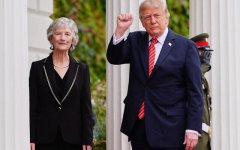
Ireland’s President Catherine Connolly, left, hosts US President Donald Trump ahead of a meeting at Áras an Uachtaráin in Dublin, September 12, 2026. (AP Photo/Julia Demaree Nikhinson)
“You have Northern Ireland and you have Ireland and it would seem to me that one of the ‘naturals’ of all time is to put them together,” Trump told reporters during a visit to a golf tournament at one of his resorts, doubling down on his initial comments.
“You asked about Scotland. That one I won’t talk about yet. I’ll save that for another day,” he added.
Scotland, where the Trump family also owns a golf resort, voted against independence from the rest of Britain in 2014. British Prime Minister Andy Burnham has ruled out another vote, as well as a referendum on Northern Ireland leaving the UK.
Trump made his comments about Irish unity after a meeting with Micheál Martin, the country’s Taoiseach, or prime minister. In his first comments since Trump’s remarks, the Irish premier said the response from some unionist politicians was “an overreaction.”
“It shouldn’t be a surprise. He takes a different sort of perspective on things,” Martin told reporters on Sunday after meeting Trump again for lunch at the golf course.
Martin said the pair discussed Northern Ireland and its relationship with the Republic of Ireland and that he also went through with the president how the British-run region achieved peace after decades of violence, a period known as The Troubles.
Ireland, long dominated by its bigger neighbor Britain, became a self-governing Catholic-majority country a century ago. Northern Ireland was split between two main communities: nationalists, most of them Catholic, who desired union with the rest of Ireland, and largely Protestant unionists, who wanted to stay British. Tensions eventually exploded in the Troubles involving paramilitary groups on both sides and British troops.
A 1998 peace accord that the United States was instrumental in negotiating largely ended the violence, but left Northern Ireland’s ultimate status unresolved. That agreement allows for a vote on unification if it appears likely a majority of people would vote for it. Burnham said Wednesday that the UK would only consider allowing a referendum “when public opinion has changed to the point where the call has to be considered.”
Burnham’s office referred back to that comment when asked about Trump’s statement.
Martin, in a separate interview with the BBC, likewise acknowledged that the moment for a referendum had likely not yet arrived.
“I support unity. I don’t see it happening now. I’ve been very clear about that,” Martin told BBC News in a separate interview.
“The chances are if [a vote] was held next week, it would find great difficulty in getting through.”
(L-R) First Minister of Northern Ireland Michelle O'Neill; First Minister of Scotland John Swinney; First Minister of Wales Rhun ap Iorwerth. (AP Photo/Peter Morrison, Andy Buchanan/AFP, Mark Naftalin/AFP) (L-R) First Minister of Northern Ireland Michelle O'Neill; First Minister of Scotland John Swinney; First Minister of Wales Rhun ap Iorwerth. (AP Photo/Peter Morrison, Andy Buchanan/AFP, Mark Naftalin/AFP)
The leaders of Scotland, Wales and Northern Ireland are expected to meet on Monday in the Welsh capital of Cardiff to sign a declaration aimed at achieving independence from England and dissolving the United Kingdom of Great Britain and Northern Ireland, the UK’s Telegraph newspaper reported Sunday, a day after US President Donald Trump announced his support for Irish reunification.
According to The Telegraph, the declaration will assert the right of the three countries — which, along with England, make up the UK — to hold independence referendums and, should their populations vote in favor, split off from England.
The declaration signed by Scotland’s John Swinney, Wales’s Rhun ap Iorwerth and Northern Ireland’s Michelle O’Neill will cover four key areas, according to the report: economy, energy, Europe, and international cooperation and self-determination.
It will state that Scotland and Wales wish to enter the European Union as new members, and that Northern Ireland will enter the EU by way of unifying with the Republic of Ireland, which is already a member.
Wales, according to the report, will use the agreement as a way to pressure Prime Minister Andy Burnham to hand over additional powers to the devolved Welsh government, particularly relating to tax and spending.
The reported move comes after Wales elected pro-independence party Plaid Cymru in its 2026 parliamentary election, pushing out the Welsh Labour Party for the first time since the establishment of the devolved Welsh government in 1999.
This means that, for the first time, Scotland, Wales and Northern Ireland are simultaneously governed, fully or in part, by pro-independence parties — Scotland by the Scottish National Party (SNP) and Northern Ireland by a power-sharing government comprised of loyalist DUP and Irish republican party Sinn Féin.
The expected meeting in Cardiff on Monday will come two days after Trump surprised officials in Dublin and annoyed pro-British politicians in Northern Ireland and London by enthusiastically backing Irish unity during a visit to Dublin on Saturday, saying he would “love” to see it happen sooner rather than later.
It will state that Scotland and Wales wish to enter the European Union as new members, and that Northern Ireland will enter the EU by way of unifying with the Republic of Ireland, which is already a member.
Wales, according to the report, will use the agreement as a way to pressure Prime Minister Andy Burnham to hand over additional powers to the devolved Welsh government, particularly relating to tax and spending.
Ireland’s President Catherine Connolly, left, hosts US President Donald Trump ahead of a meeting at Áras an Uachtaráin in Dublin, September 12, 2026. (AP Photo/Julia Demaree Nikhinson)
“You have Northern Ireland and you have Ireland and it would seem to me that one of the ‘naturals’ of all time is to put them together,” Trump told reporters during a visit to a golf tournament at one of his resorts, doubling down on his initial comments.
“You asked about Scotland. That one I won’t talk about yet. I’ll save that for another day,” he added.
Scotland, where the Trump family also owns a golf resort, voted against independence from the rest of Britain in 2014. British Prime Minister Andy Burnham has ruled out another vote, as well as a referendum on Northern Ireland leaving the UK.
Trump made his comments about Irish unity after a meeting with Micheál Martin, the country’s Taoiseach, or prime minister. In his first comments since Trump’s remarks, the Irish premier said the response from some unionist politicians was “an overreaction.”
“It shouldn’t be a surprise. He takes a different sort of perspective on things,” Martin told reporters on Sunday after meeting Trump again for lunch at the golf course.
Martin said the pair discussed Northern Ireland and its relationship with the Republic of Ireland and that he also went through with the president how the British-run region achieved peace after decades of violence, a period known as The Troubles.
Ireland, long dominated by its bigger neighbor Britain, became a self-governing Catholic-majority country a century ago. Northern Ireland was split between two main communities: nationalists, most of them Catholic, who desired union with the rest of Ireland, and largely Protestant unionists, who wanted to stay British. Tensions eventually exploded in the Troubles involving paramilitary groups on both sides and British troops.
A 1998 peace accord that the United States was instrumental in negotiating largely ended the violence, but left Northern Ireland’s ultimate status unresolved. That agreement allows for a vote on unification if it appears likely a majority of people would vote for it. Burnham said Wednesday that the UK would only consider allowing a referendum “when public opinion has changed to the point where the call has to be considered.”
Burnham’s office referred back to that comment when asked about Trump’s statement.
Martin, in a separate interview with the BBC, likewise acknowledged that the moment for a referendum had likely not yet arrived.
“I support unity. I don’t see it happening now. I’ve been very clear about that,” Martin told BBC News in a separate interview.
“The chances are if [a vote] was held next week, it would find great difficulty in getting through.”


